
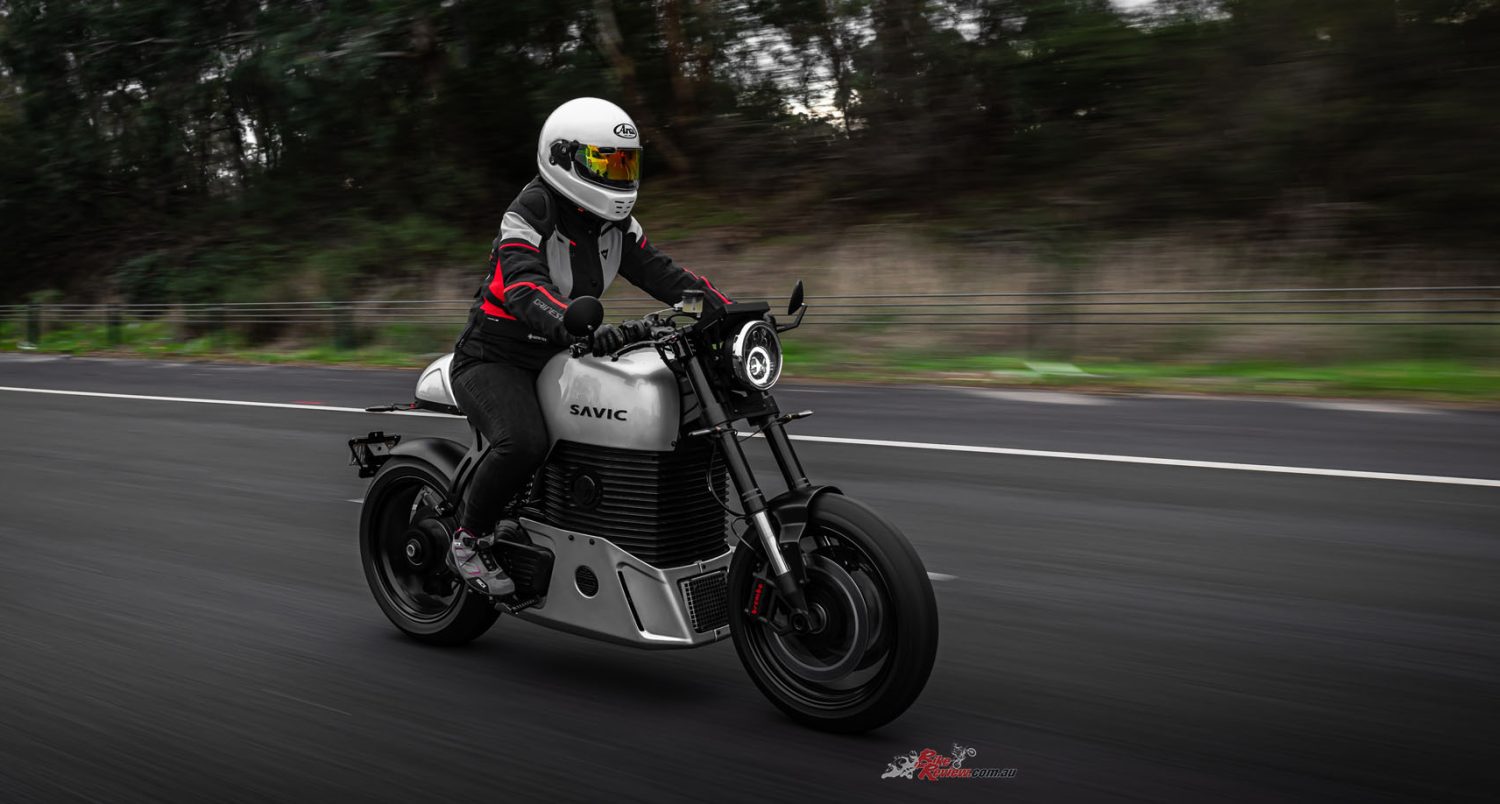

The Savic C-Series Alpha proves that Australian manufacturing isn’t finished yet, with an electric café racer that’s fast, refined and finally reaching customers. Photos: Sarah Hatton
Australia’s first locally built full sized electric roadbike, the Savic C-Series Alpha, delivers brutal torque, clever tech and a surprisingly high finish, all from a small Melbourne workshop. We spent a day out on the road in Melbourne, putting it to the test…
“What began in 2014 as a young engineer’s after-hours obsession has turned into the Savic C-Series Alpha”…
Australia hasn’t seen a locally built road-going motorcycle in decades, but in a small workshop in Melbourne’s inner west, one has been slowly taking shape. What began in 2014 as a young engineer’s after-hours obsession has turned into the Savic C-Series Alpha, a fully electric nakedbike now rolling into the hands of early customers.
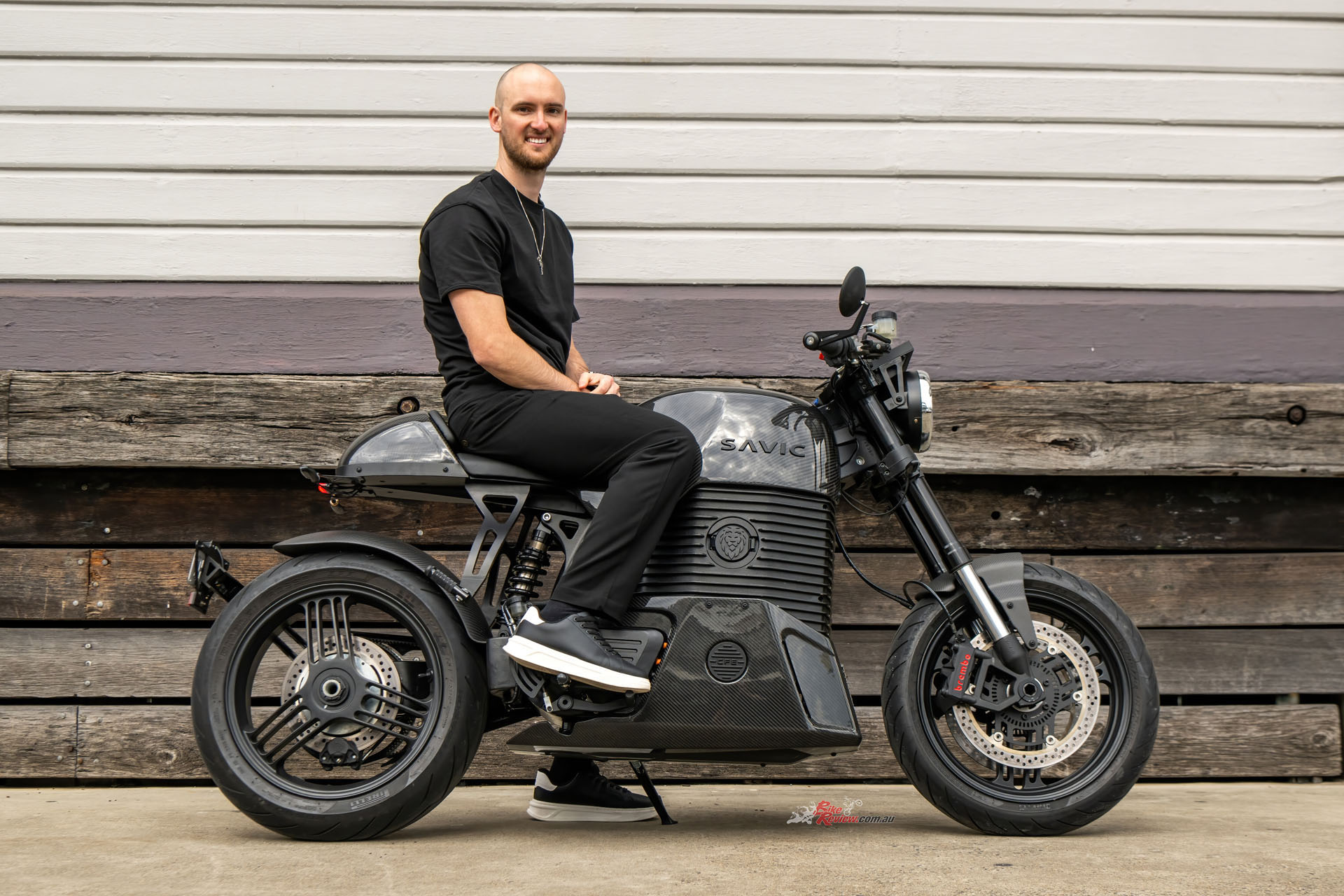
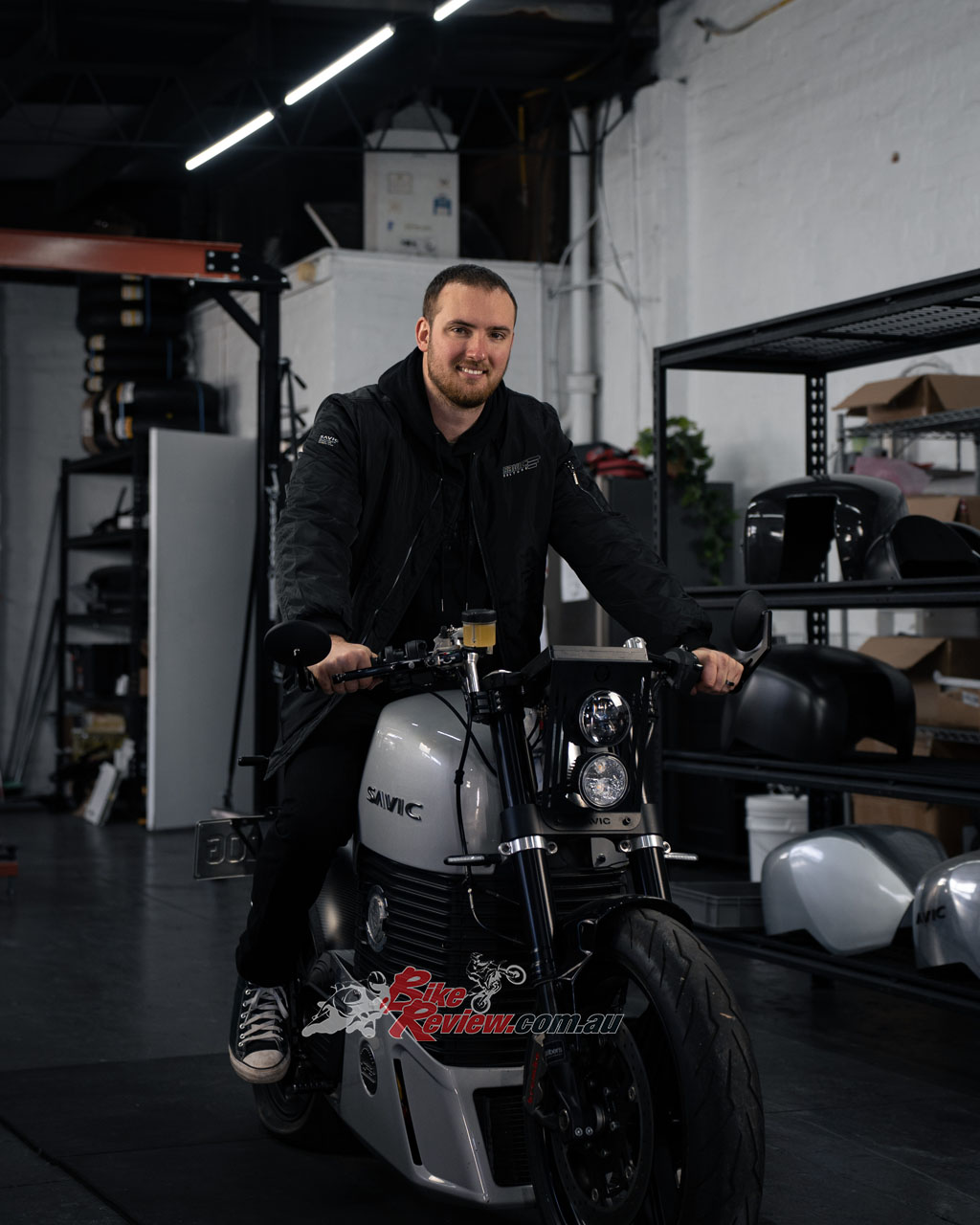
That engineer is Perth-born Dennis Savic and his persistence has been the defining ingredient. He was just 14 when he first dreamed of building his own motorcycle and over the past decade he’s sold his car, raised capital, built a brand and worked through multiple prototypes to get to the point where he’s finally delivering on his long-held promises.
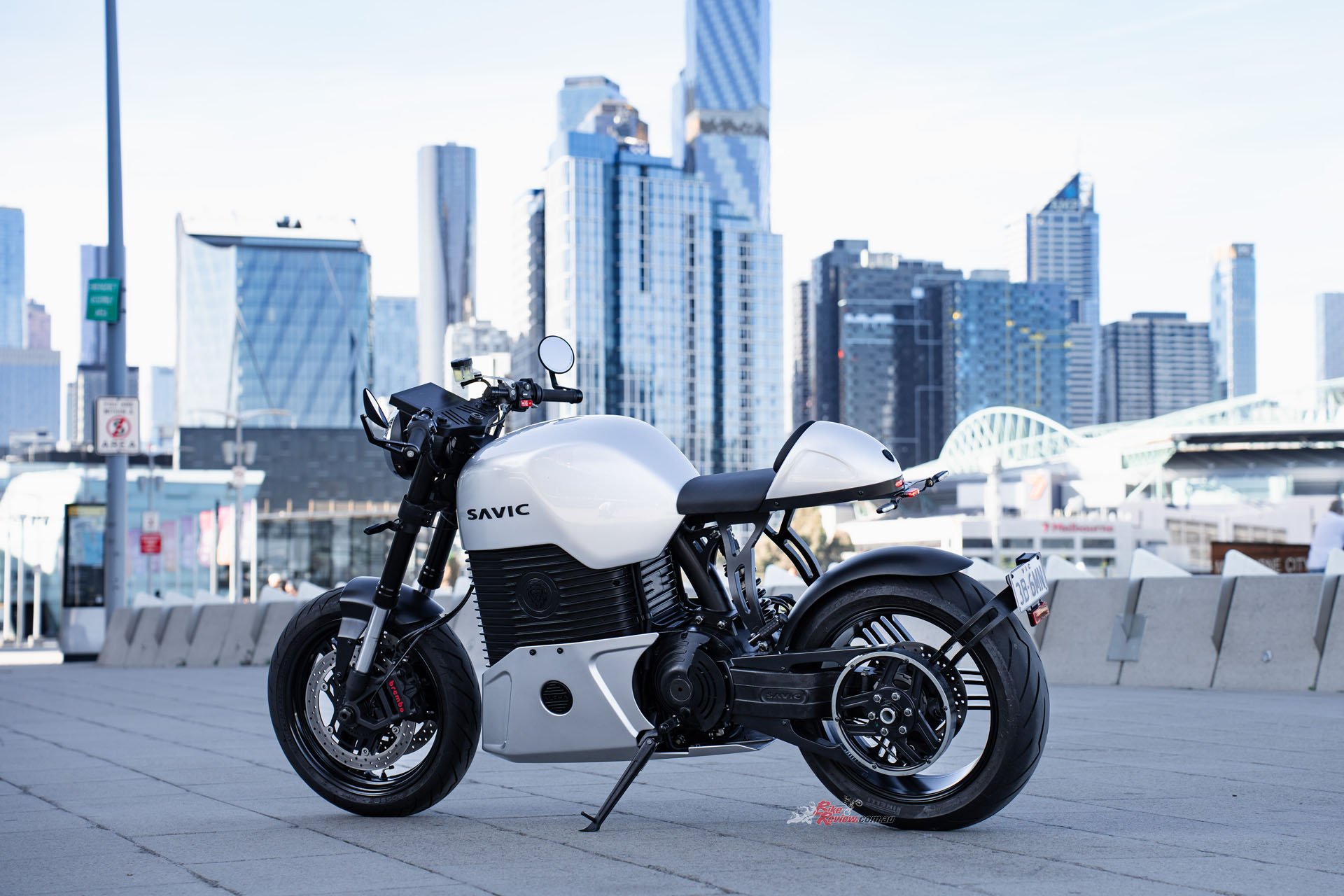
The Savic proves that emission-free doesn’t mean lack of fun.
Officially the bike has seven years of development behind it, but the truth is he’s been refining the idea for more than ten. Each prototype edged closer, each round of fundraising kept the dream alive and now the production Alpha boasts some impressive stats: 60kW [80.4hp] peak power, more than 200Nm [147.5ft-lb] of torque, 0-100km/h in 3.5 seconds and, importantly, a claimed combined range of 200km.
“The production Alpha boasts some impressive stats: 60kW [80.4hp] peak power, more than 200Nm [147.5ft-lb] of torque, 0-100km/h in 3.5 seconds”
And that’s not just impressive on paper. Because after a drizzly day carving through Melbourne traffic, sweeping along Yarra Boulevard and stretching its legs on the highway, the Alpha comes across as a fully resolved production motorcycle, one that demonstrates Australian manufacturing still has a place in the modern motorcycling story.
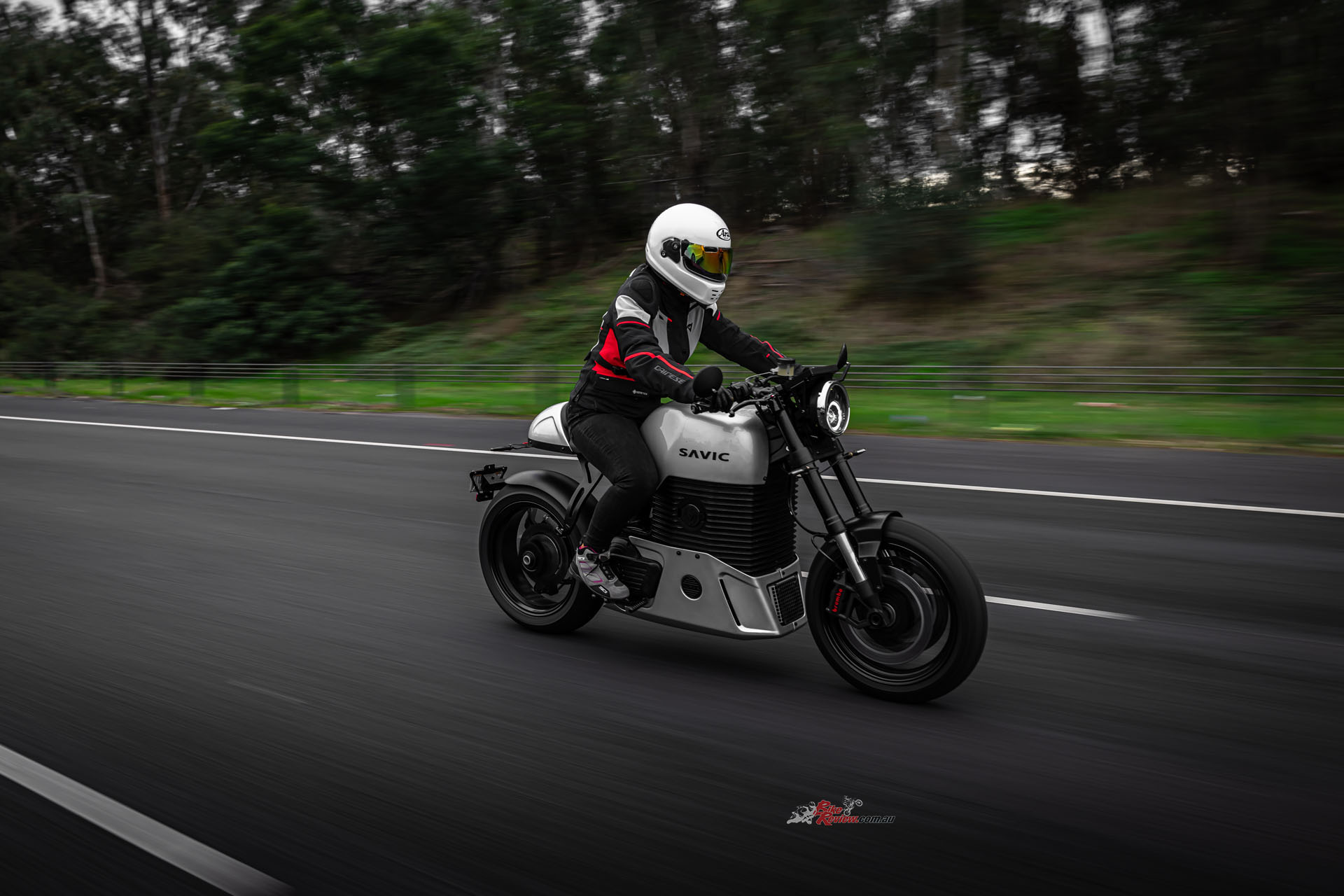
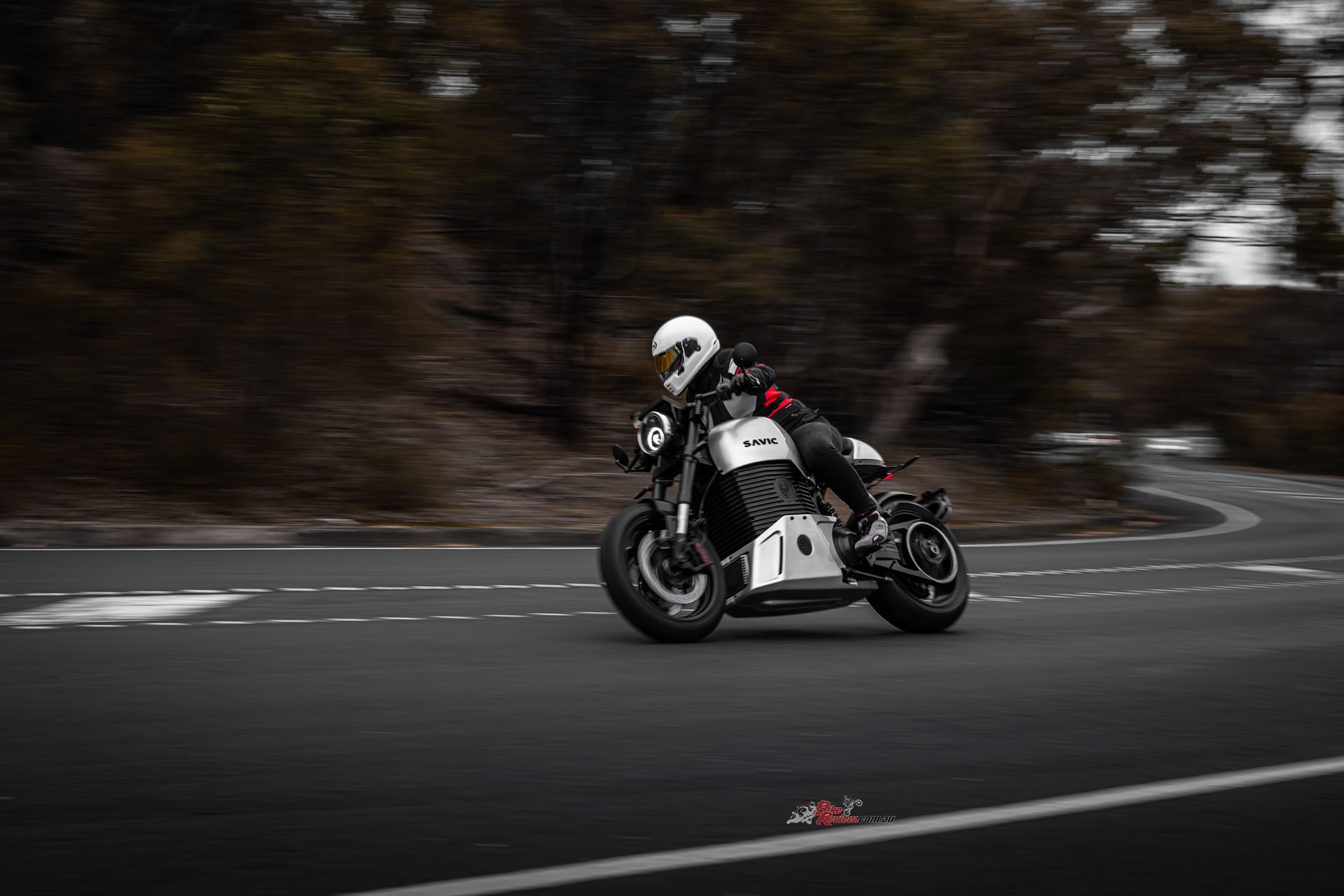
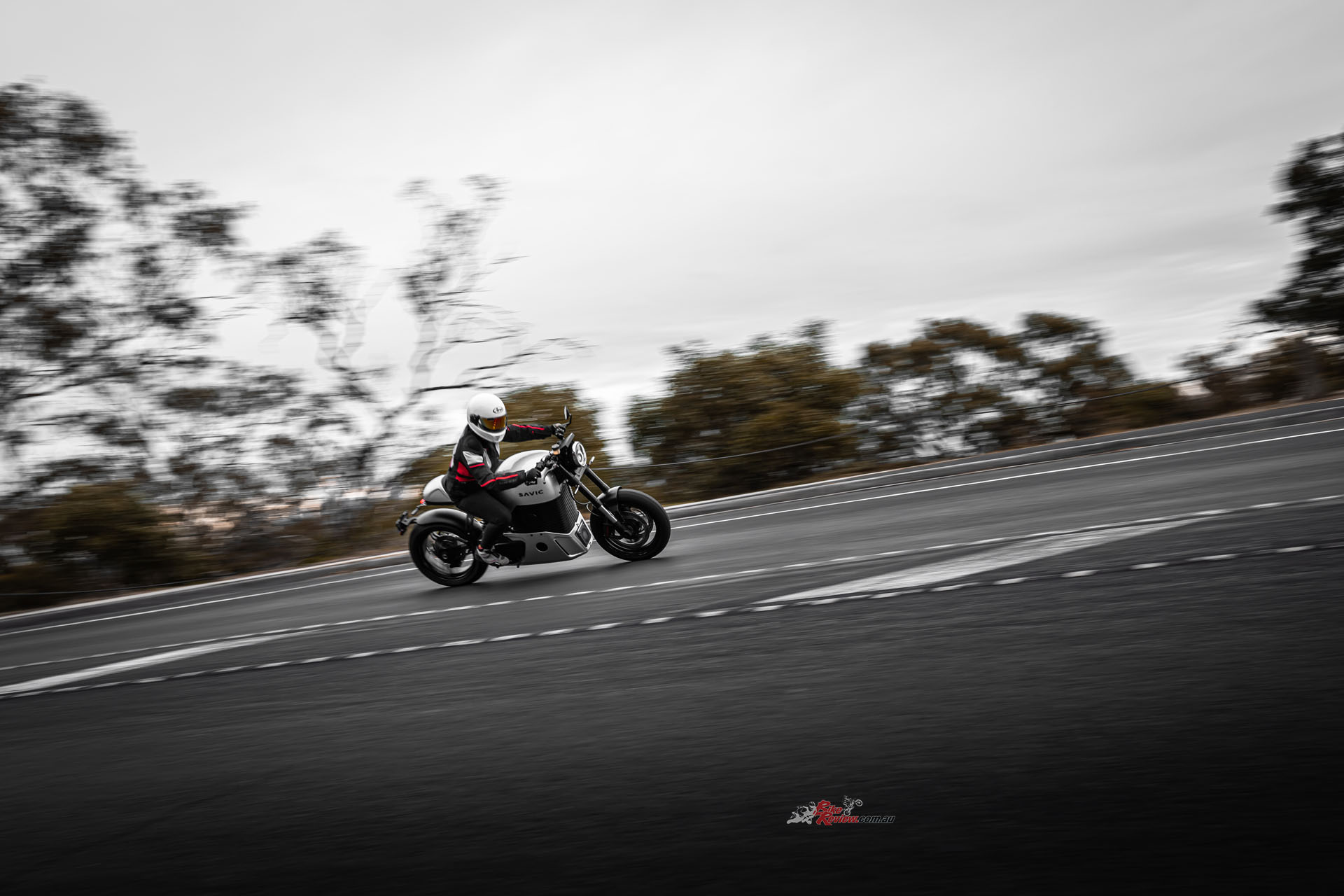
Ergonomics are neutral but you very much sit atop the Alpha, rather than within it. Sport mode is where the full 200Nm hits and the bike is brutally quick off the line…
The first surprise with the C-Series Alpha is the acceleration. Twist the Domino throttle and the response is smooth, but it doesn’t take long to realise how much shove is waiting underneath. Sport mode is where the full 200Nm hits and the bike is brutally quick off the line, it’s acceleration that makes you take a sharp inhale the first time you experience it. Fun? You bet.
Normal mode doesn’t feel like a step down so much as a different flavour of fast. The torque is still immediate, still strong, still seriously quick, but it comes in with a slightly smoother edge that makes it easier to use around town. Savic has built in four preset modes – Rain, Eco, Normal and Sport – plus three custom profiles where you can tune torque and regenerative braking.
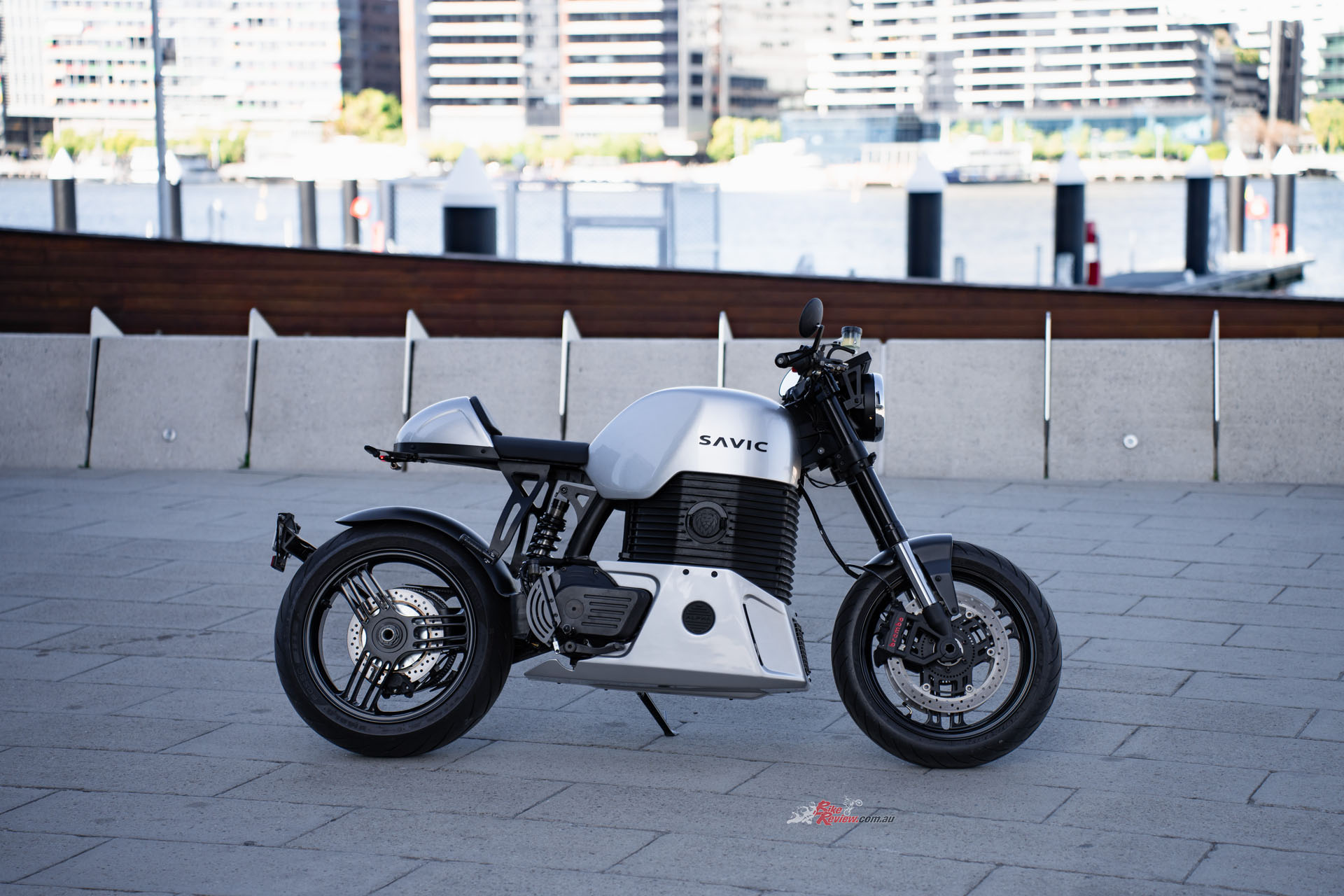
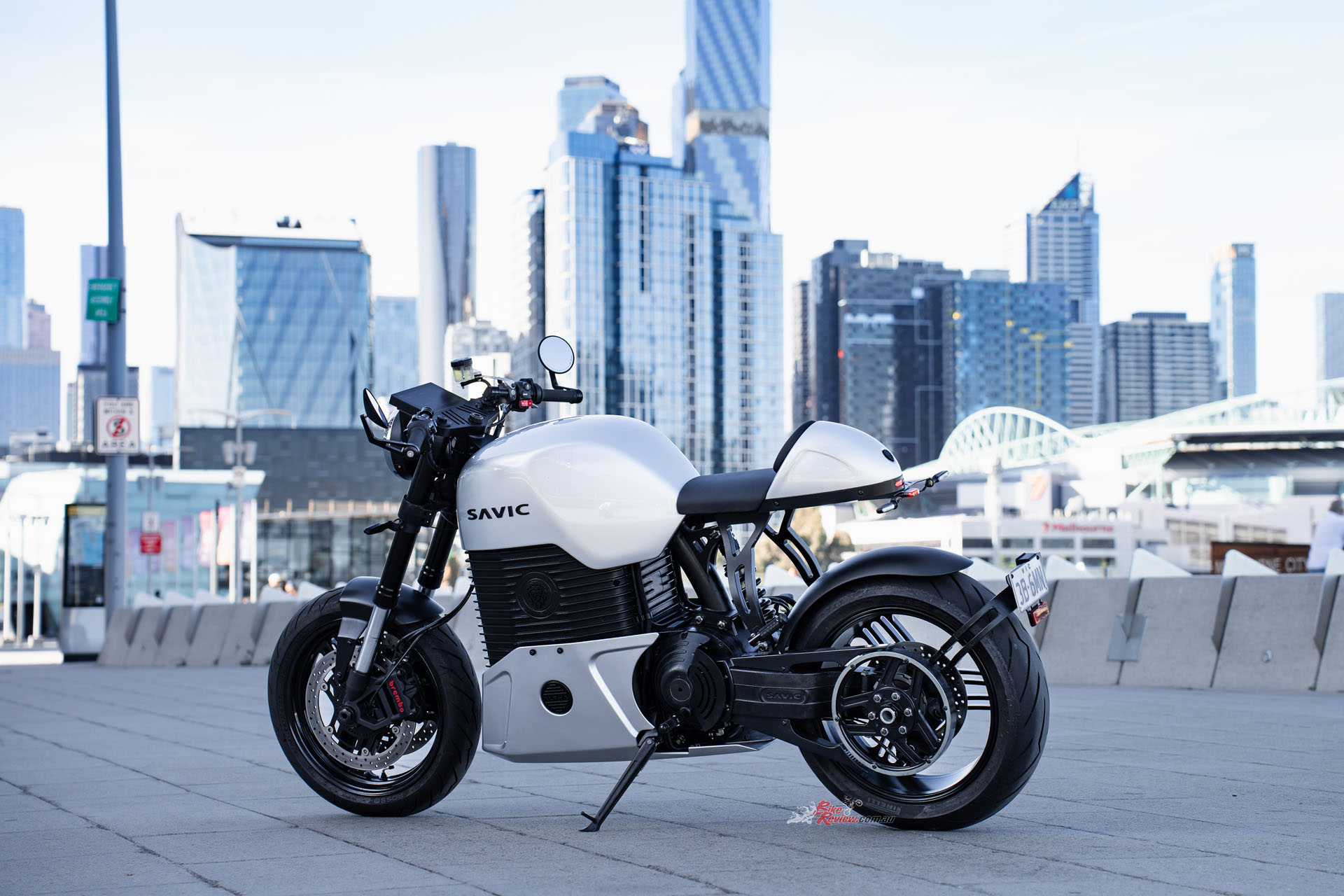
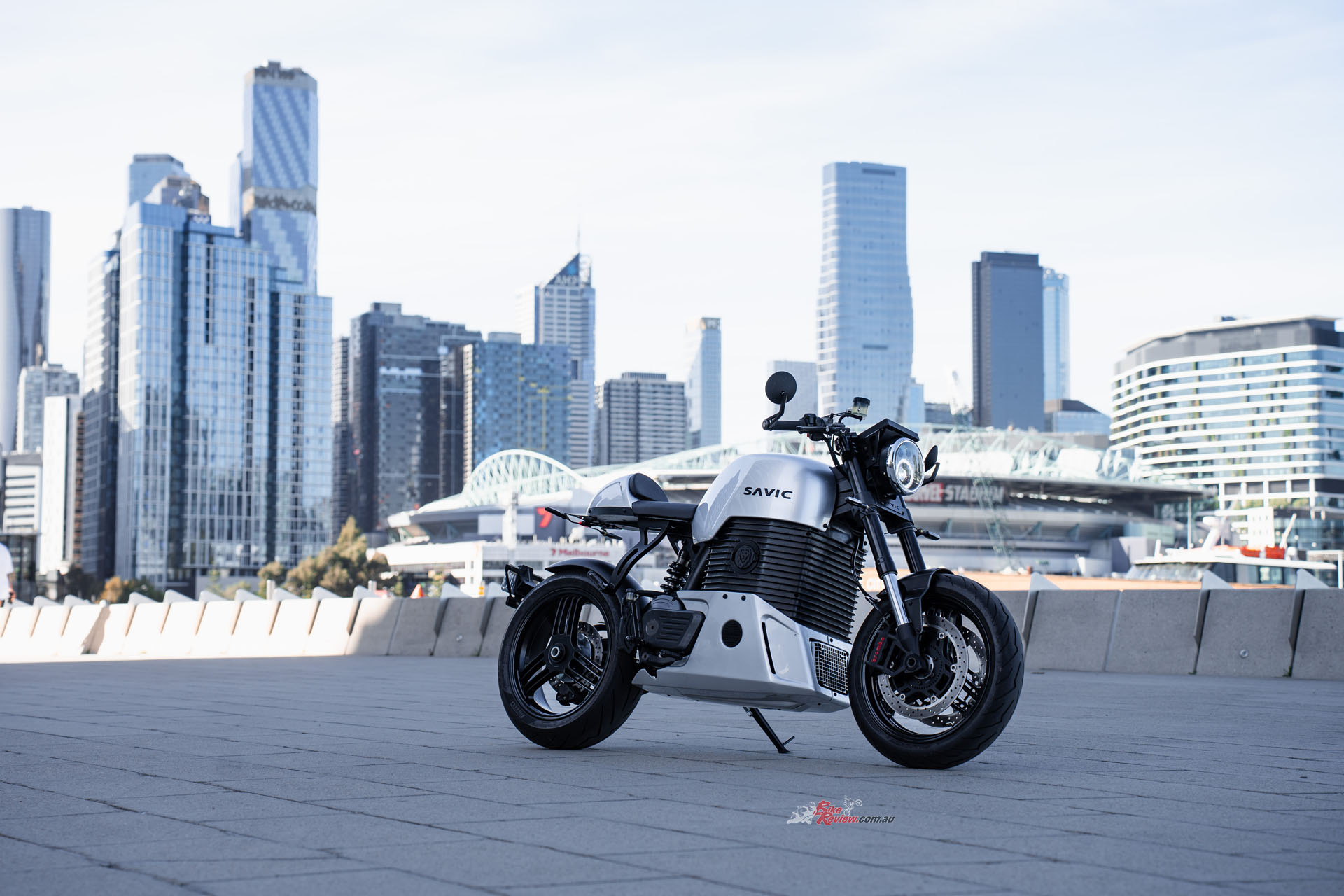
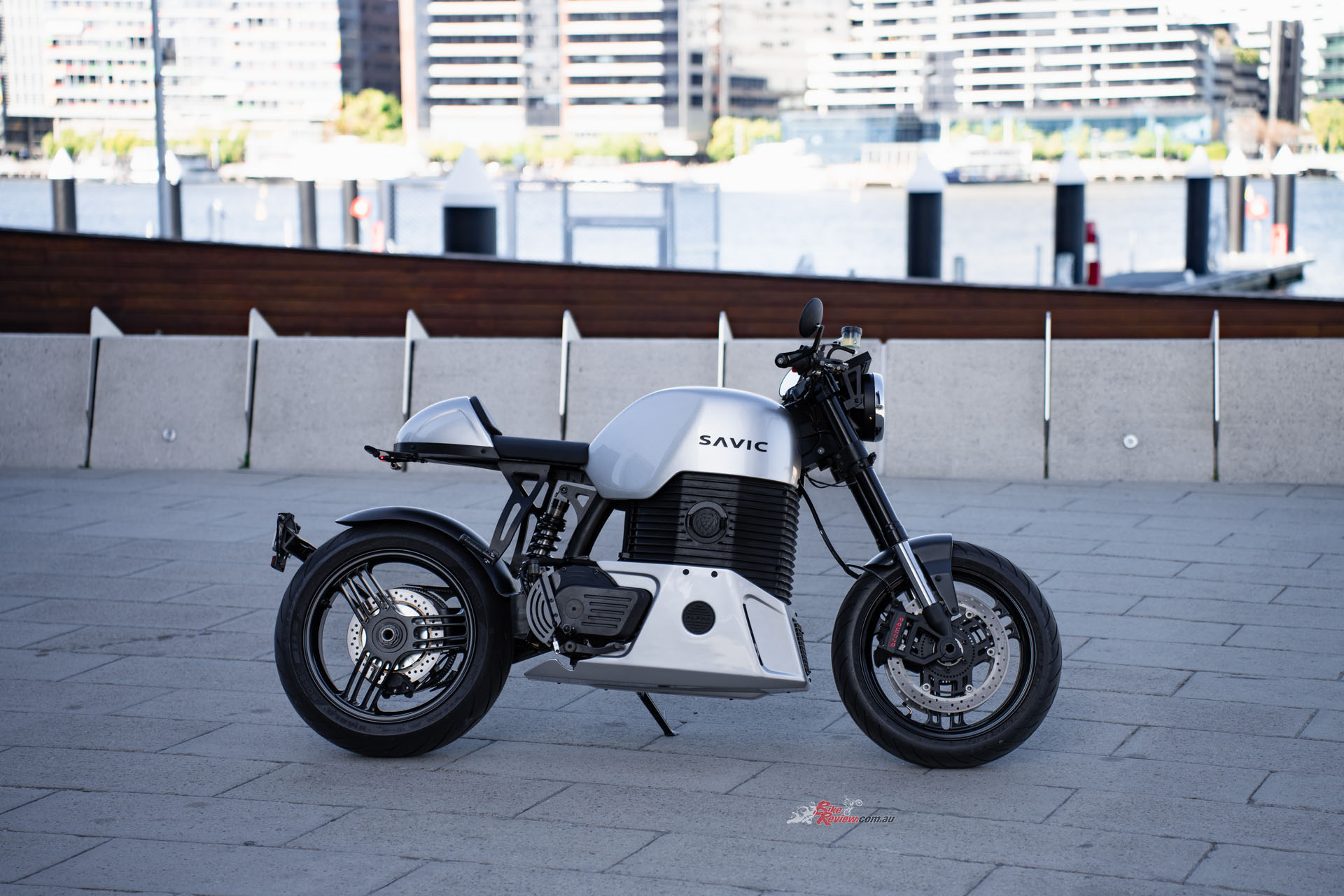
The conventional 1440mm wheelbase and 17-inch wheels make for a familiar feel.
On my bike only three modes appeared on the dash, a reminder that you can dive into the settings and choose which of the seven are active and easily selectable. Eco mode carries the strongest regenerative braking, although there was way less engine braking than I expected. Later, when I enquired, Savic explained that was deliberate, to avoid the uncomfortable and potentially dangerous sensation of a heavy bike decelerating sharply if you happen to roll off the throttle mid-corner. The result is a consistency between power delivery and deceleration that makes the pairing feel familiar.
“Savic has built in four preset modes – Rain, Eco, Normal and Sport – plus three custom profiles where you can tune torque and regenerative braking”
The weight is hard to ignore. At 280kg it feels cumbersome at low speeds and in tight manoeuvres, but the more time I spent on it the clearer it became which forces to work with and which to let the bike manage on its own. A push-button reverse helps take the sting out of parking and moving it around, making the bulk less intimidating than it first seems. On flowing roads the mass becomes part of its character, carrying momentum through bends in a way that feels planted rather than clumsy.
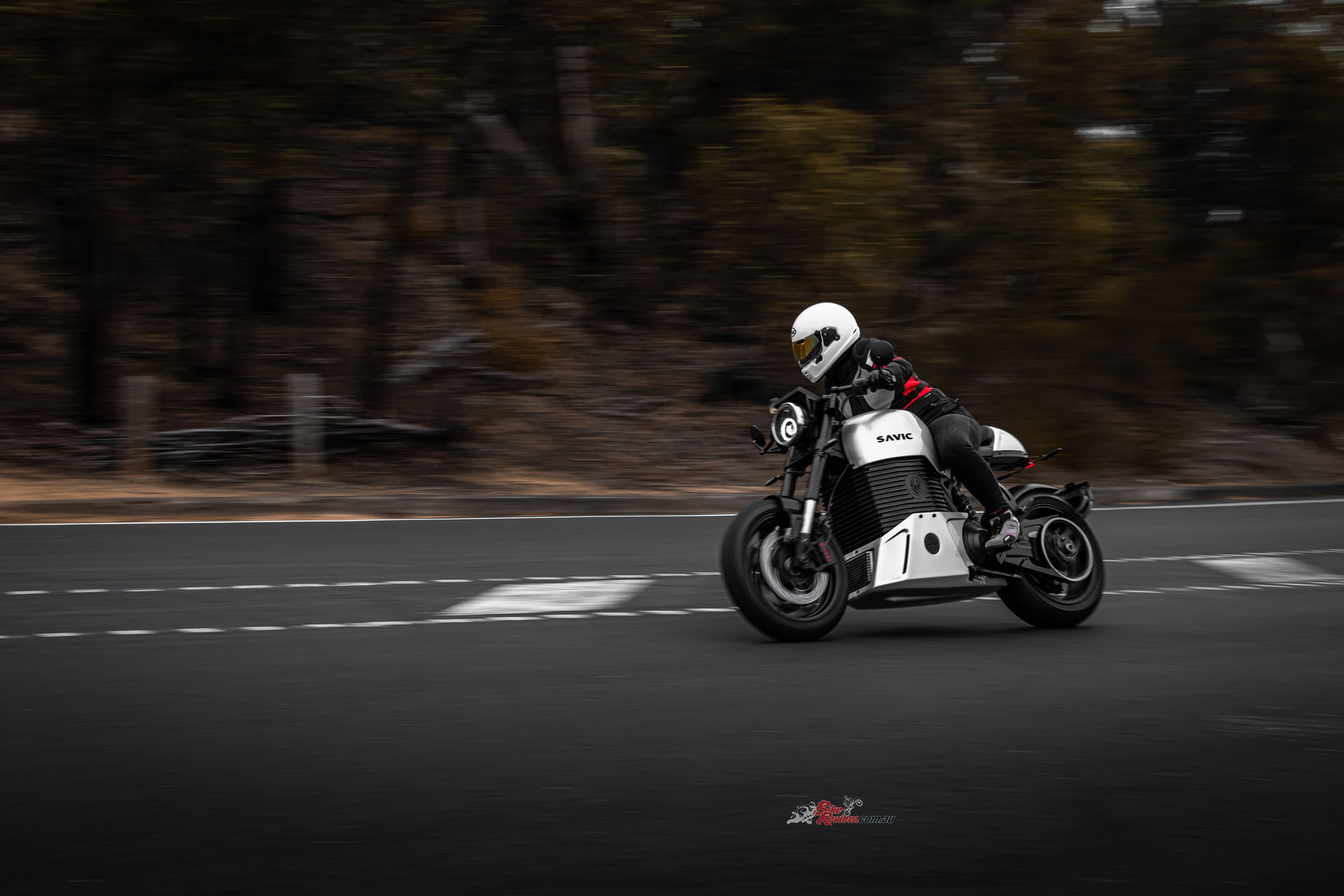
Meet Australia’s most powerful homegrown electric two-wheeler, the Savic C-Series Alpha.
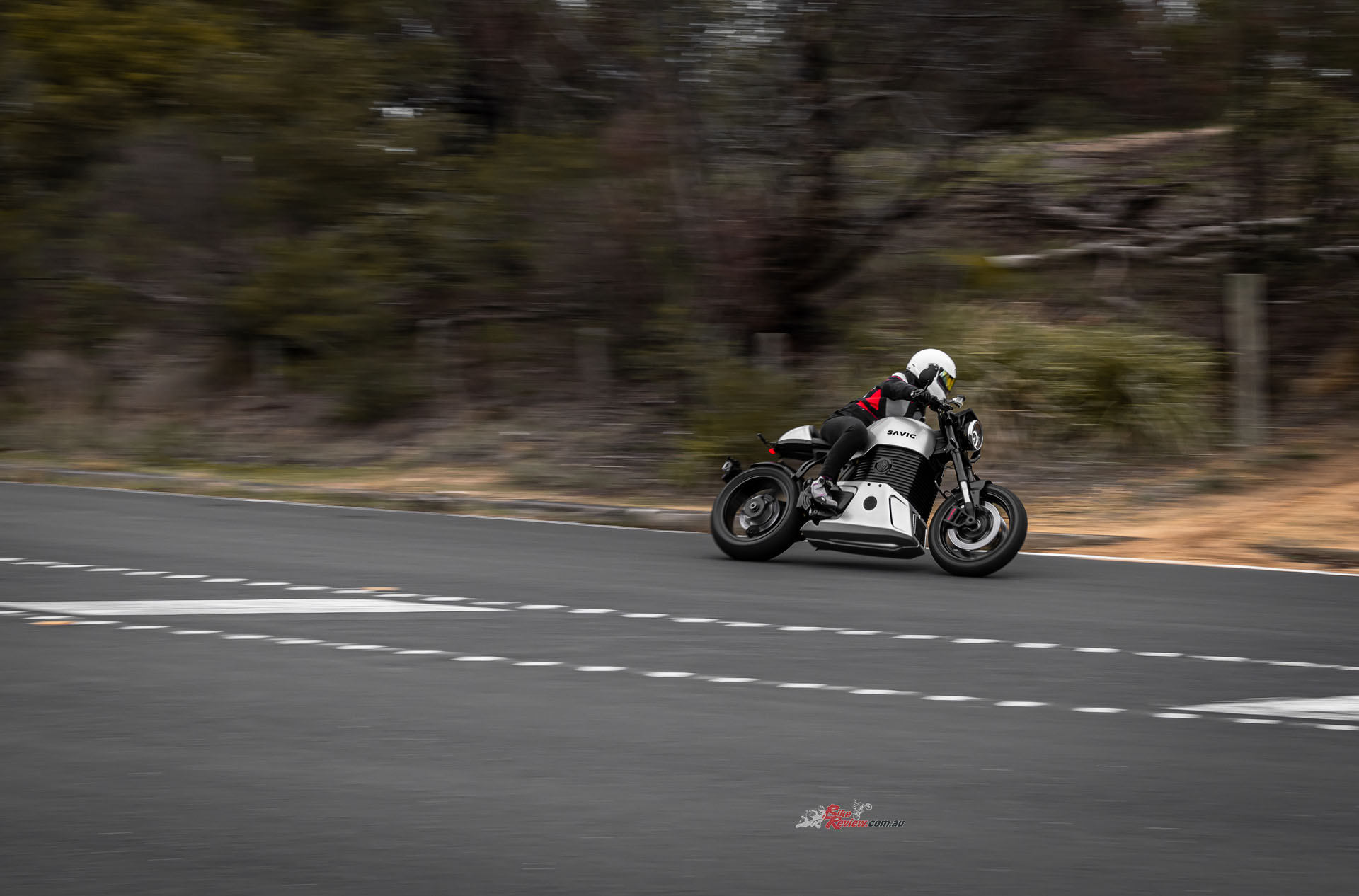
While it’s far from a light, it’s not an agile bike that encourages you to flick from side to side, but through longer, more open corners the Alpha settles into its stride. The weight that feels cumbersome in tight spots starts to work in its favour. Stop fighting against that bulk and it rewards you with a ride that’s calm, intuitive and better suited to everyday roads than you might expect.
Savic claims a real-world range of 200km, and that lined up with the mix of city, boulevard and highway riding on test. Plenty of petrol bikes wouldn’t do much better in the same conditions and that fact alone makes the Alpha a compelling argument for EVs in this segment.
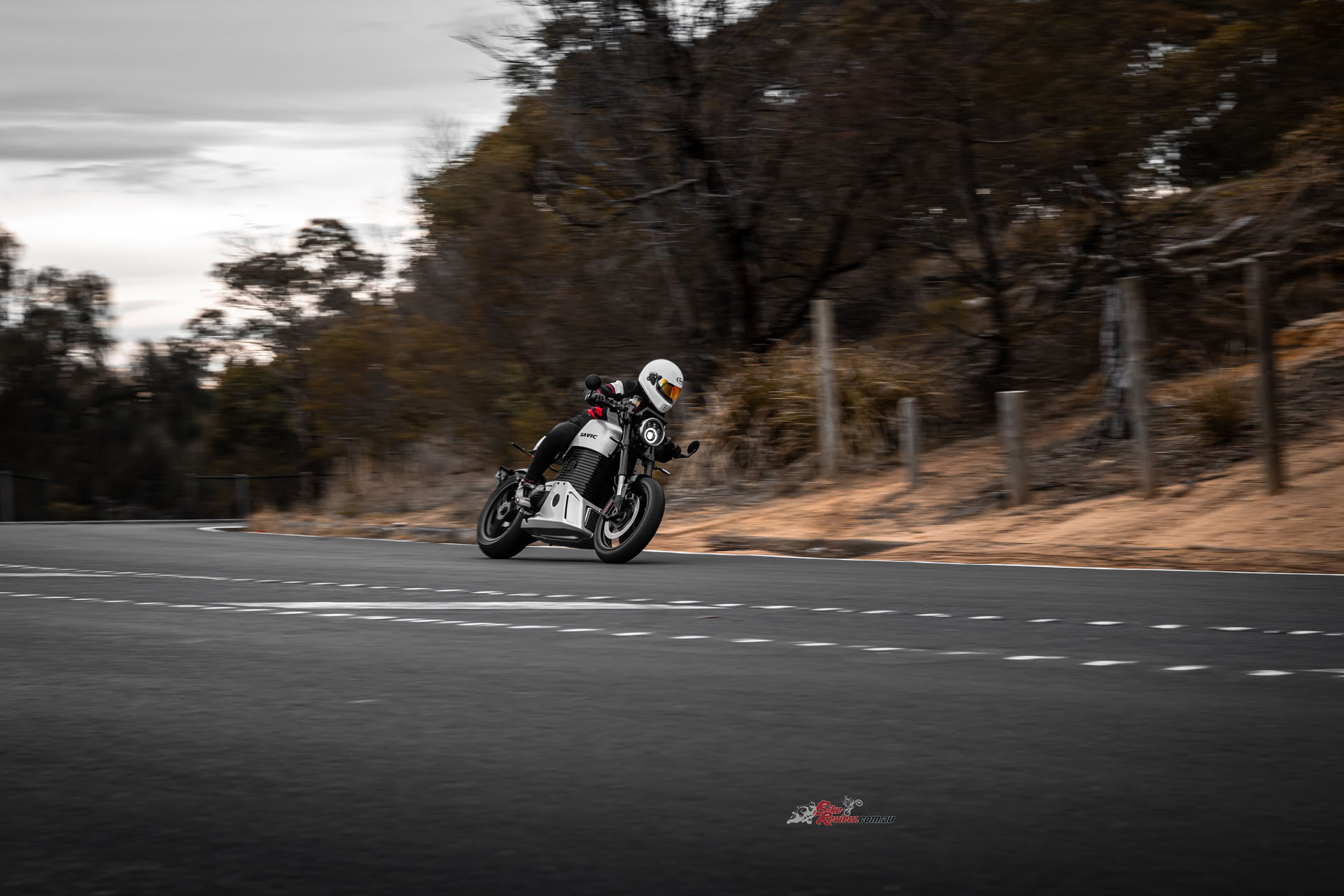
“Savic claims a real-world range of 200km, and that lined up with the mix of city, boulevard and highway riding on test”…
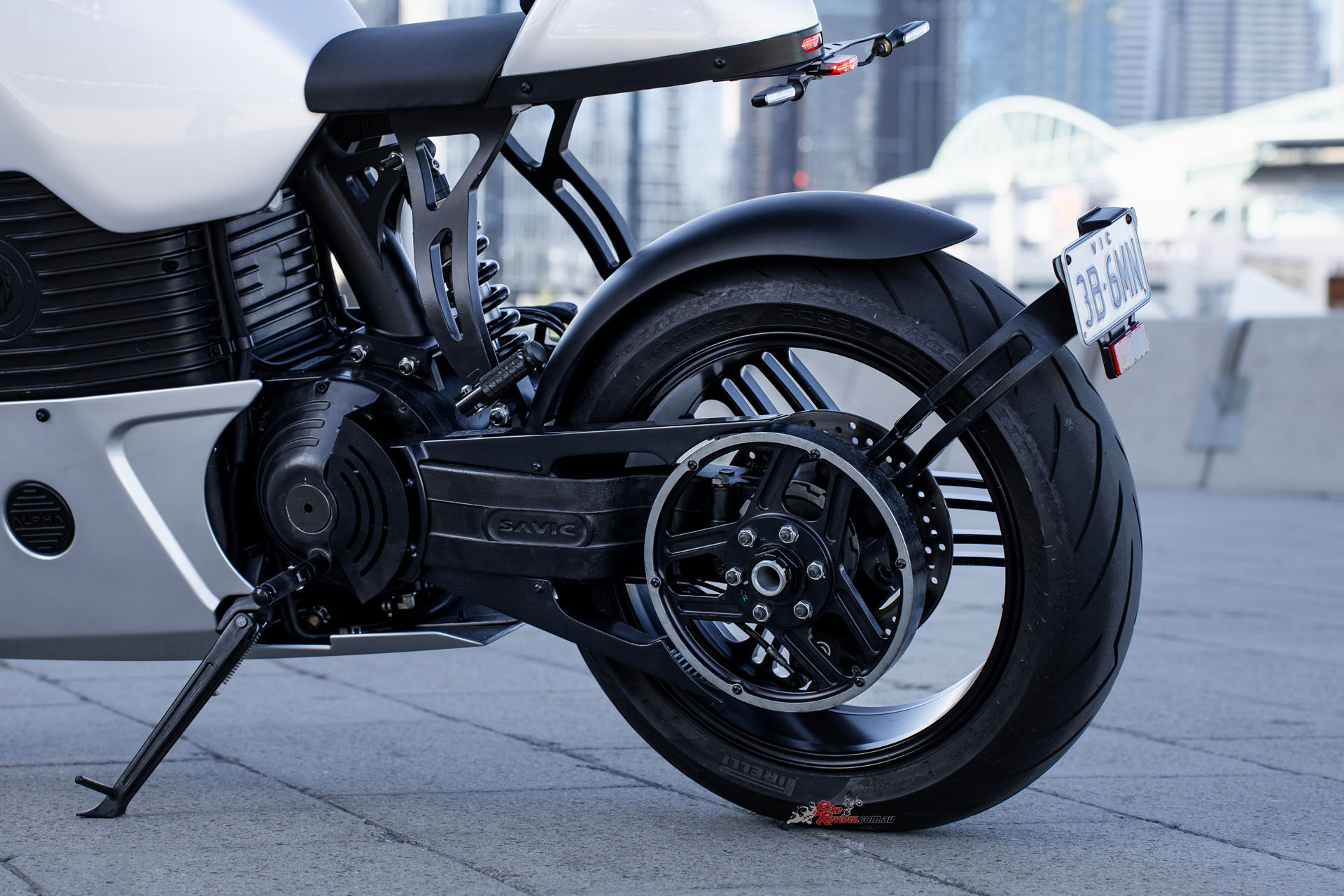
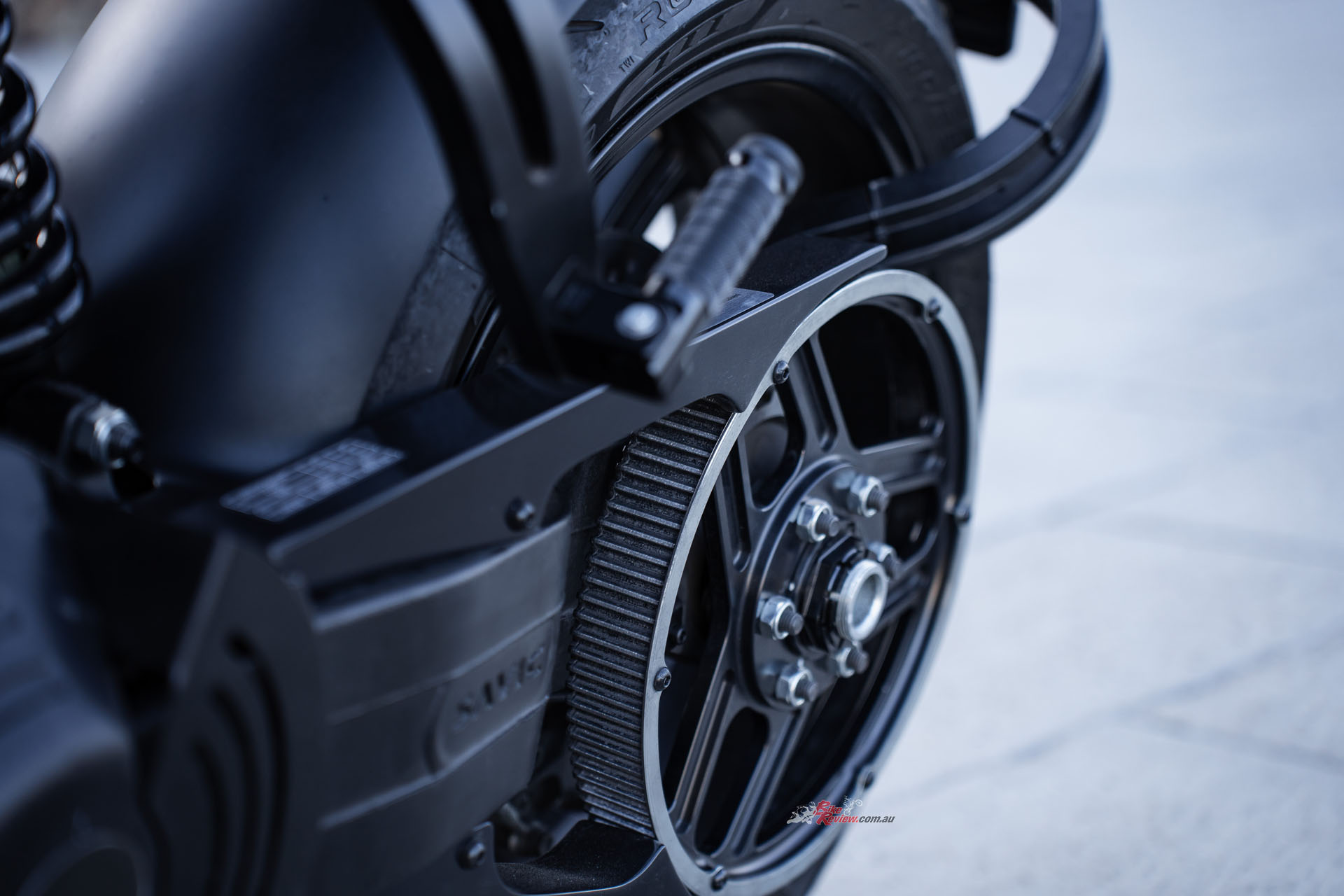
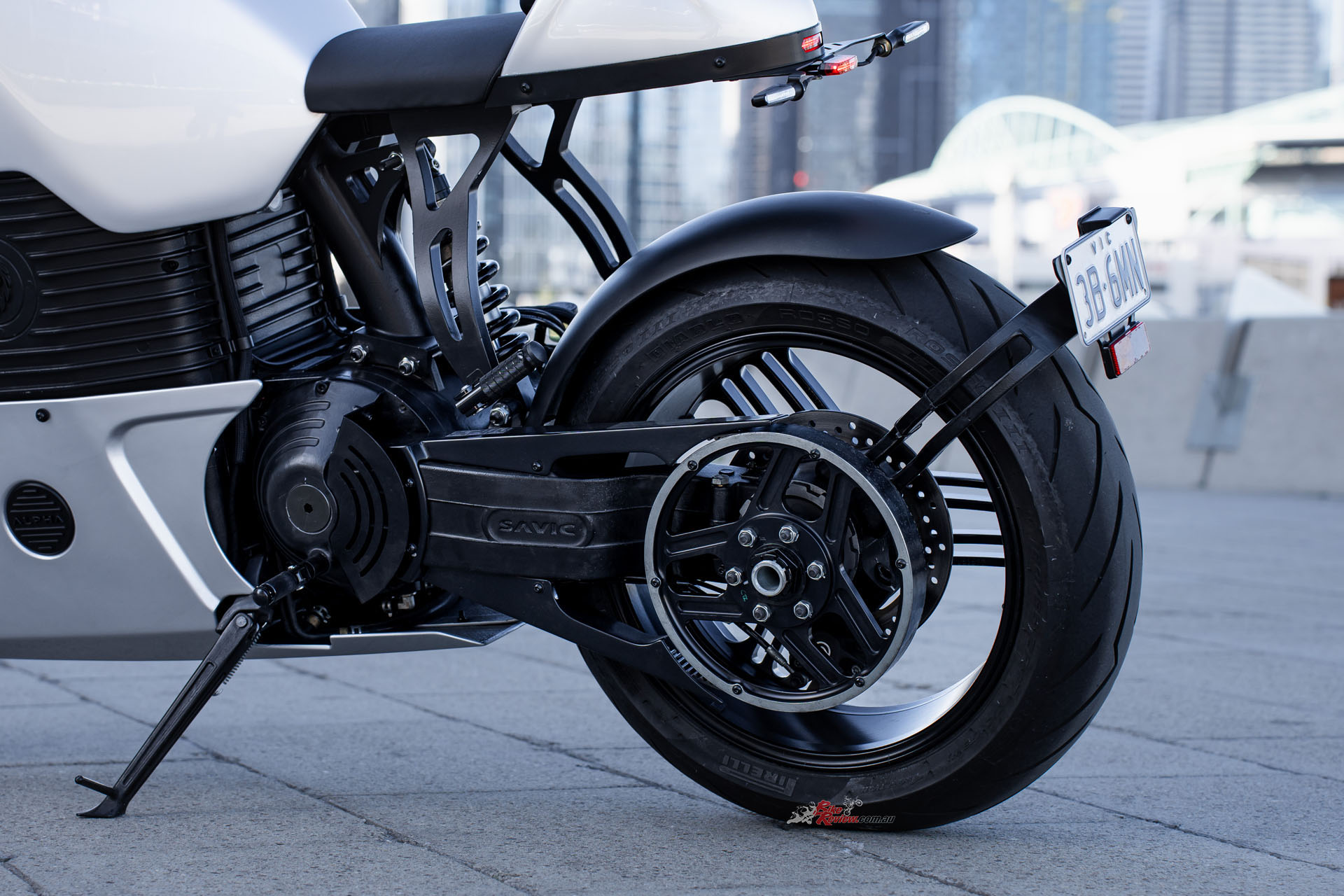
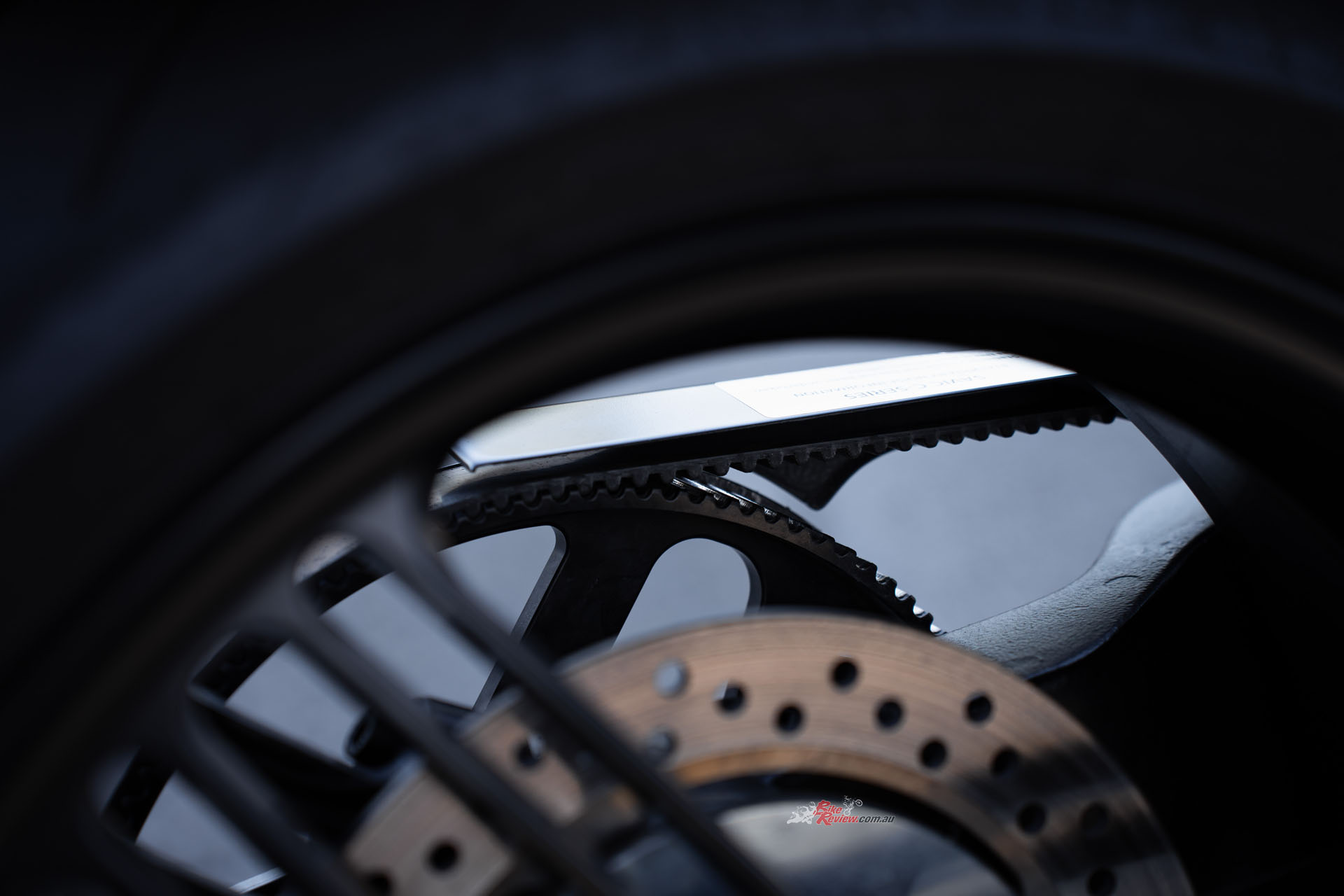
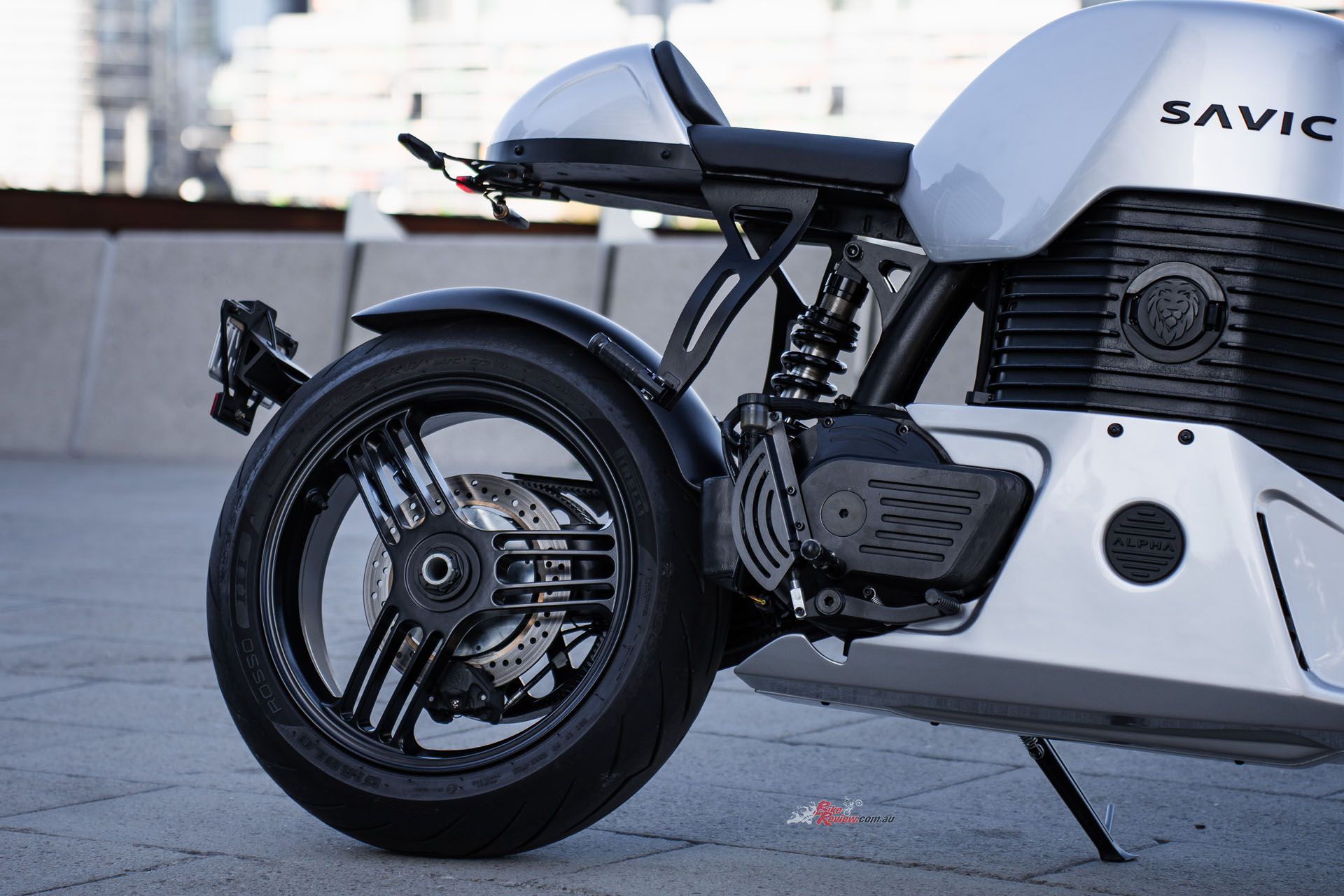
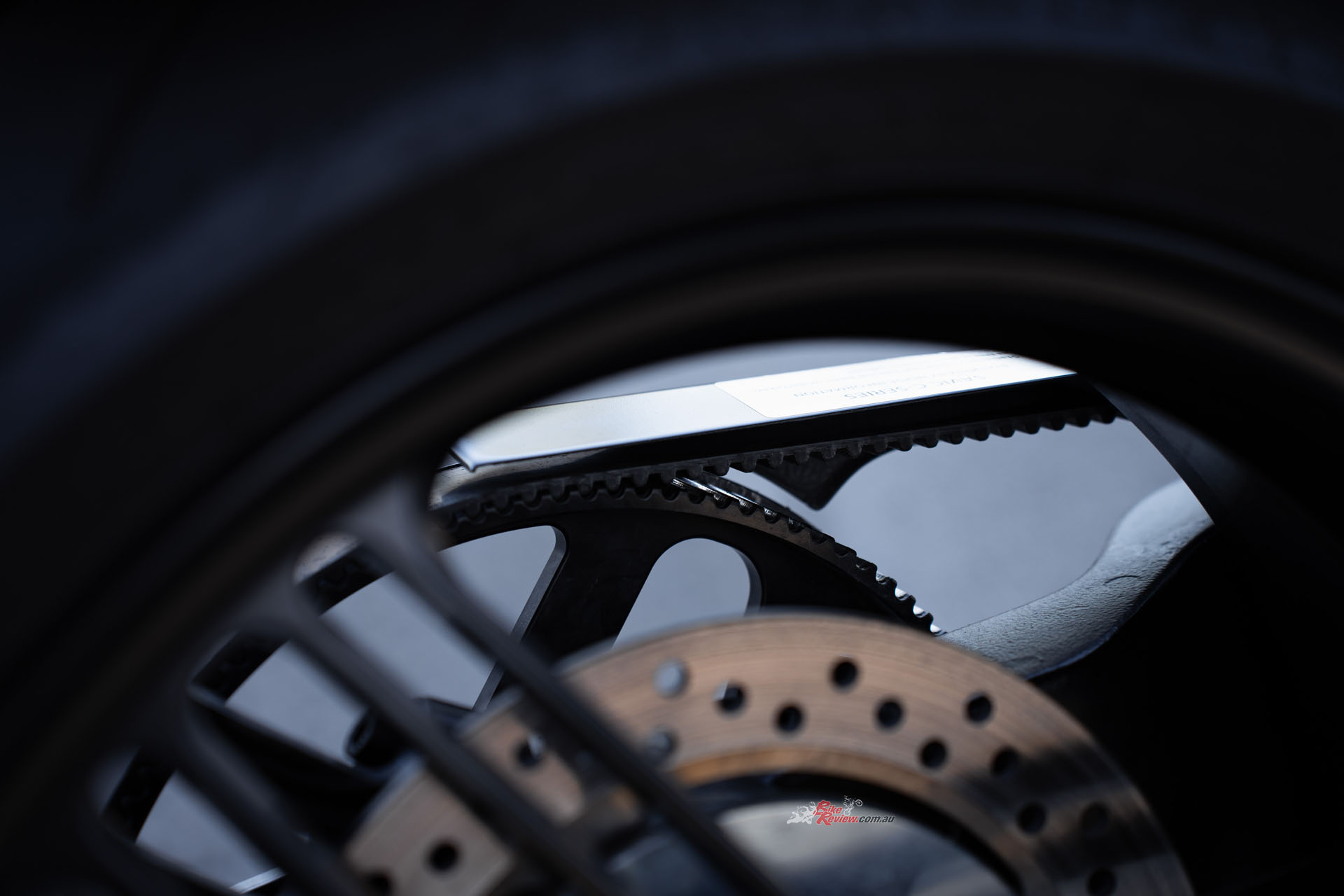
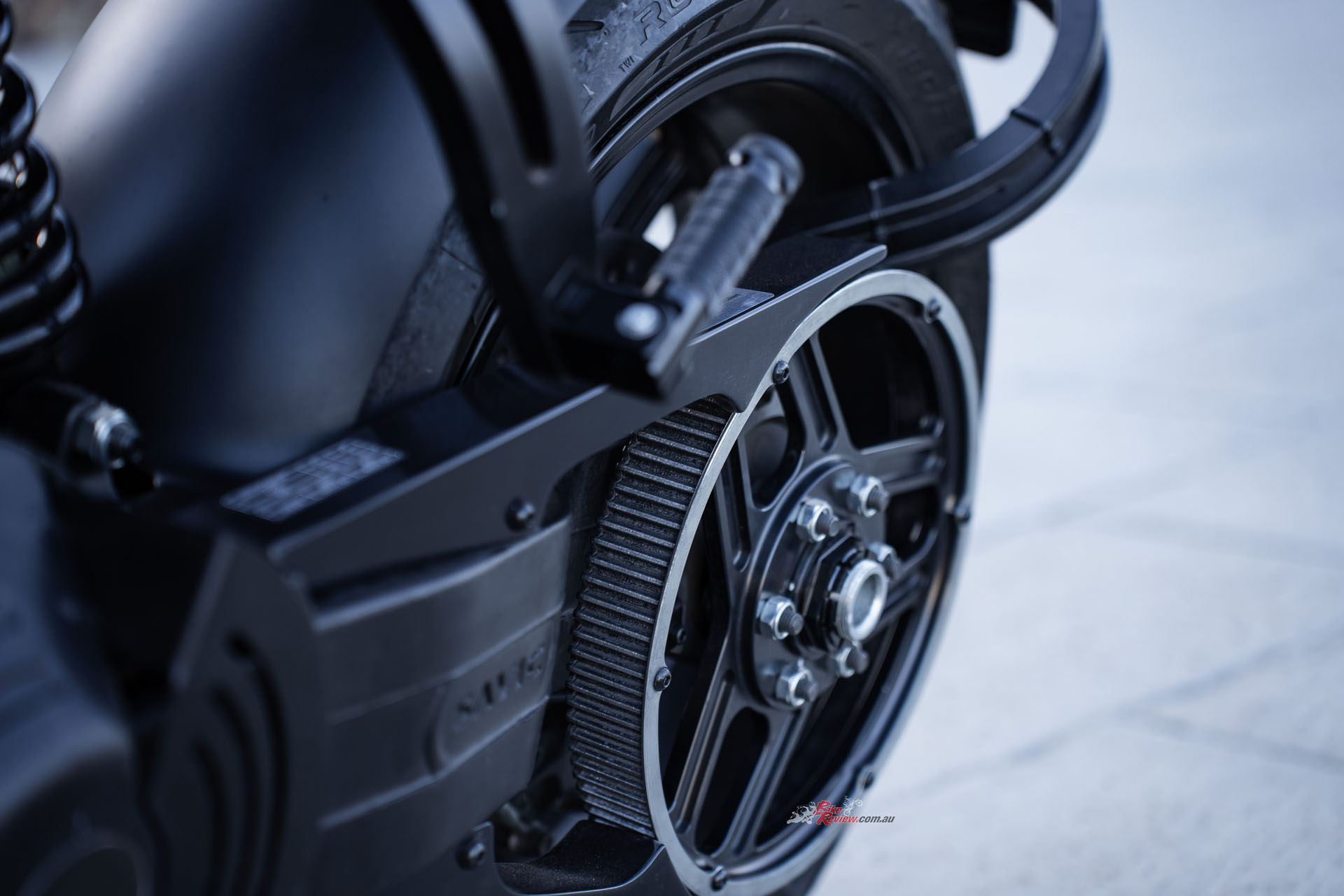
For a bike with such a big battery and motor, the chassis has been really well executed and accounts for that feeling of rock-solid stability. The cast-aluminium exoskeleton forms the chassis and incorporates the battery pack as a stressed element, and the swingarm is a single-sided design that gives the Savic a high-end premium look. Power is delivered through a carbon belt drive, which adds the familiar EV whine without any of the mess of a chain.
“Stop fighting against that bulk and it rewards you with a ride that’s calm, intuitive and better suited to everyday roads than you might expect”
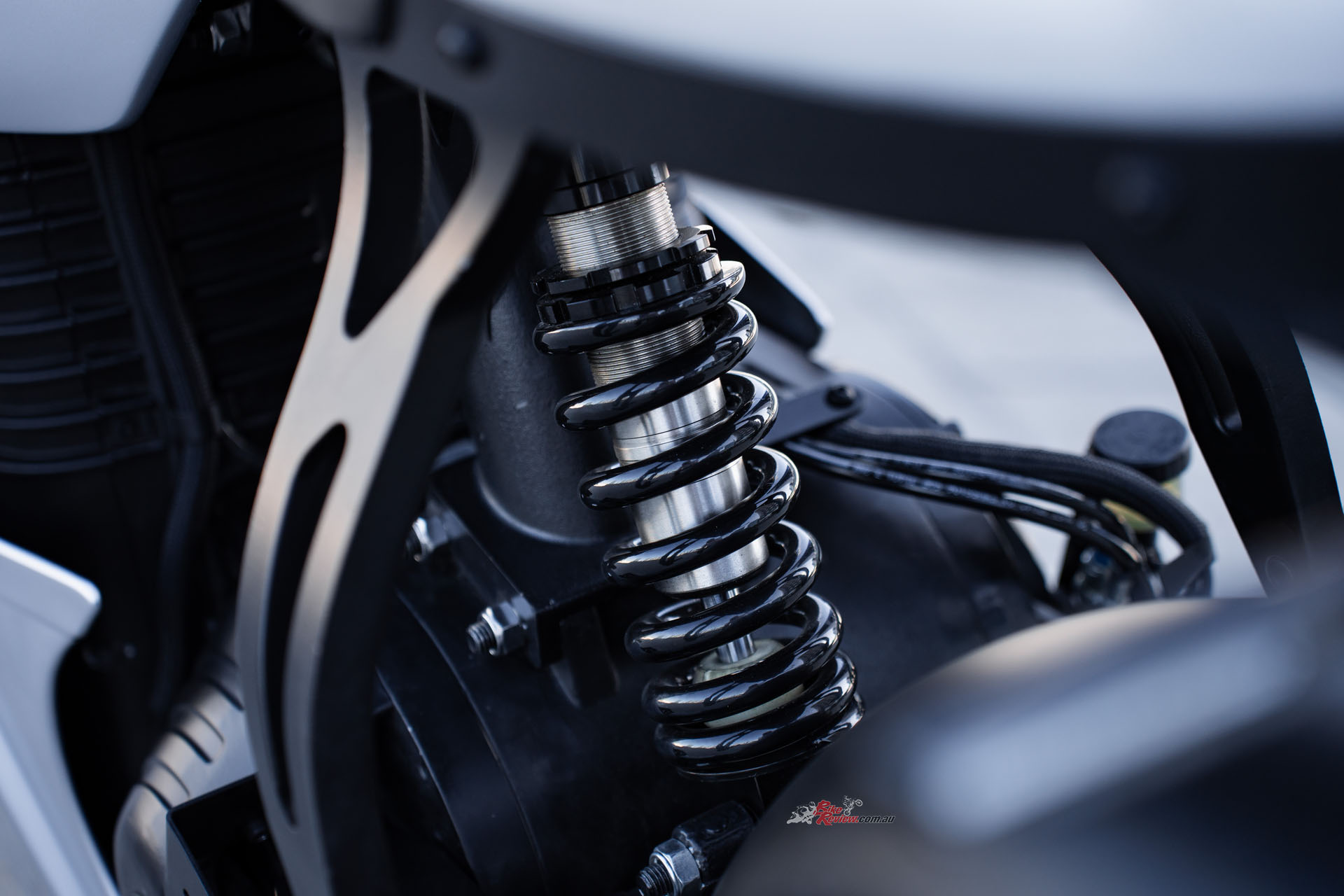
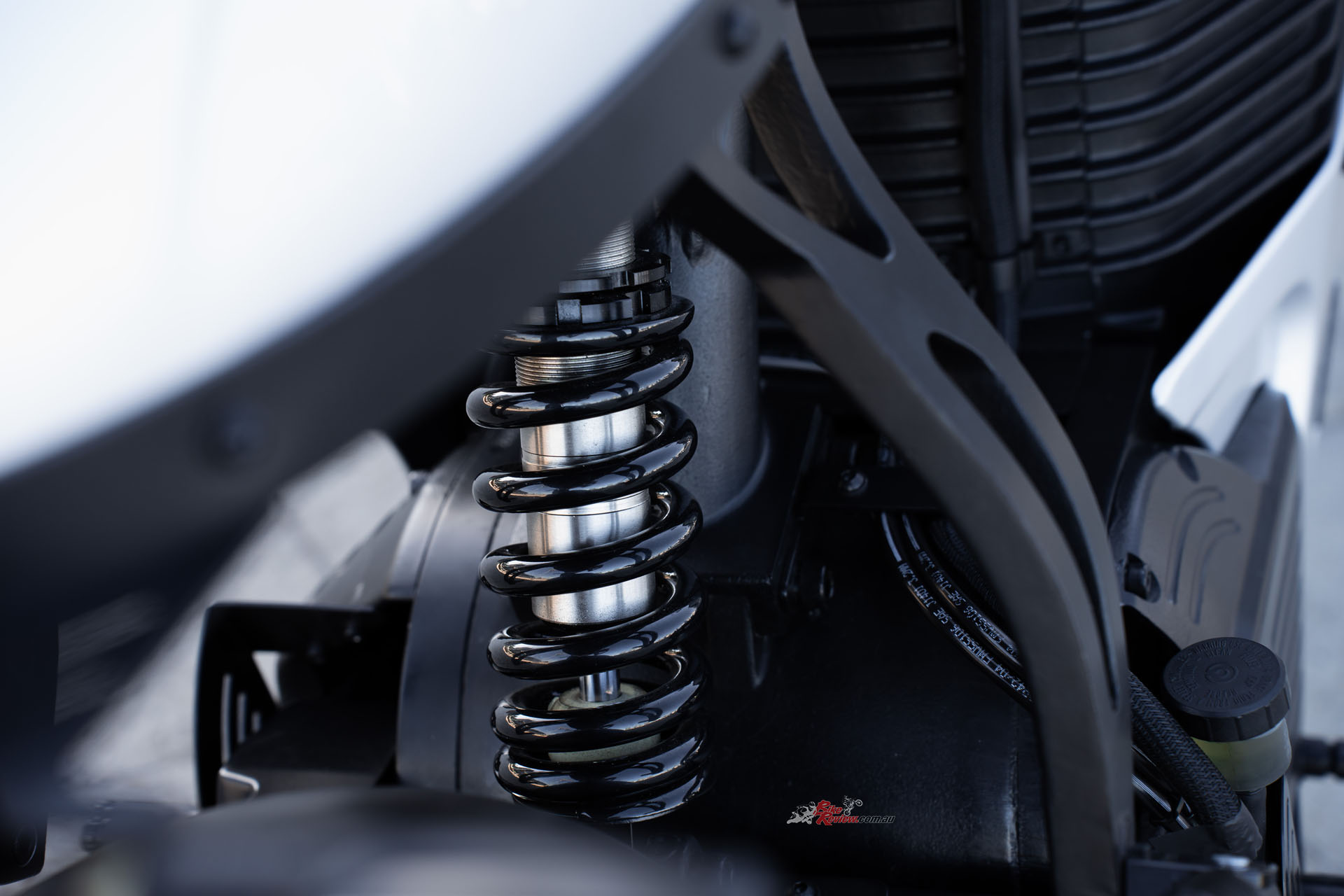
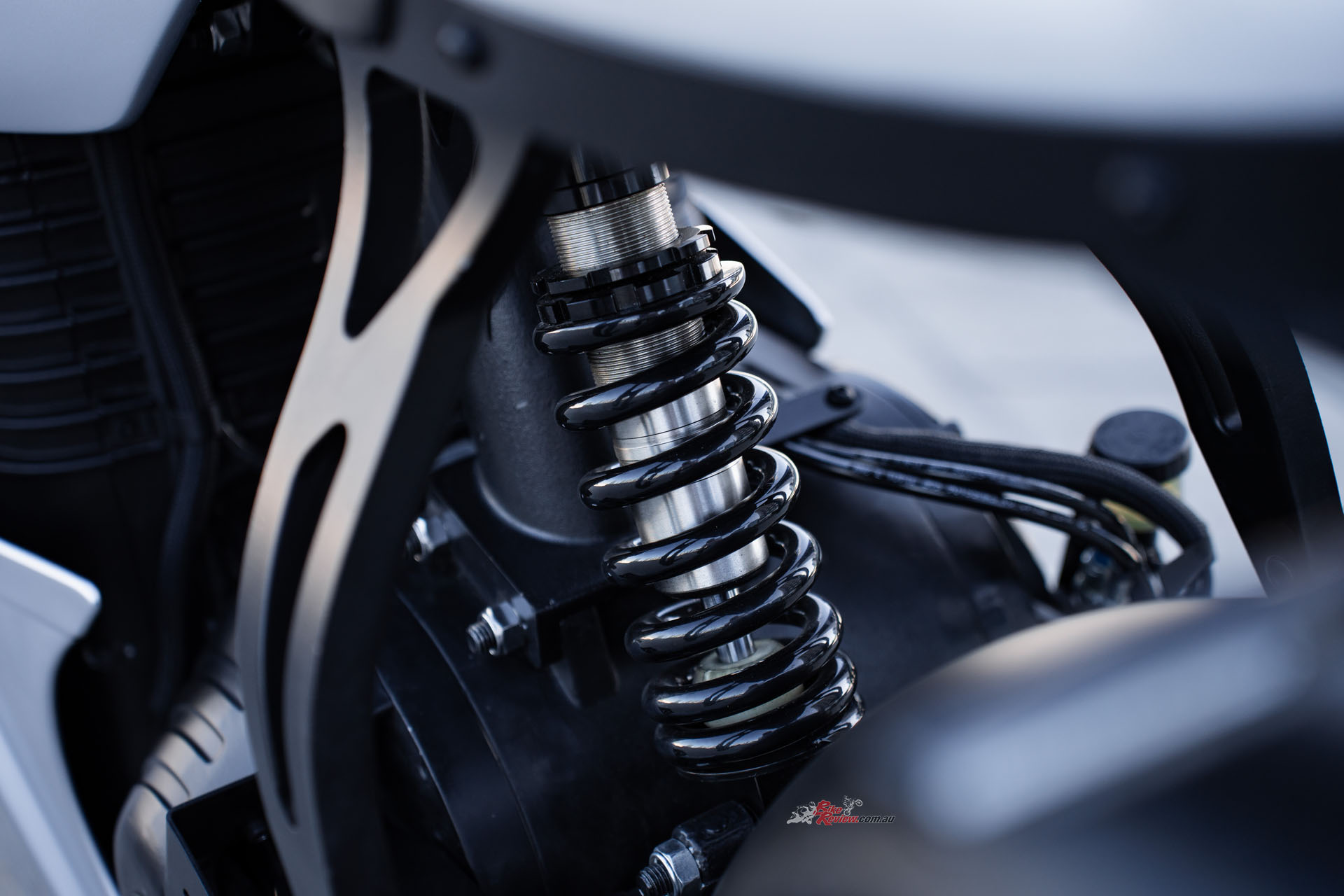
Suspension is Savic-branded, developed with Australian road racer Jed Metcher, and on paper it’s fairly basic – non-adjustable forks up front and preload-only on the rear. In practice, however, I couldn’t fault it for the riding I did. It coped well with the stop-start of city streets, the fast sweepers on Yarra Boulevard and highway work, offering enough compliance without feeling vague. The weight inevitably plays a role here too, but the bike just feels really well composed.
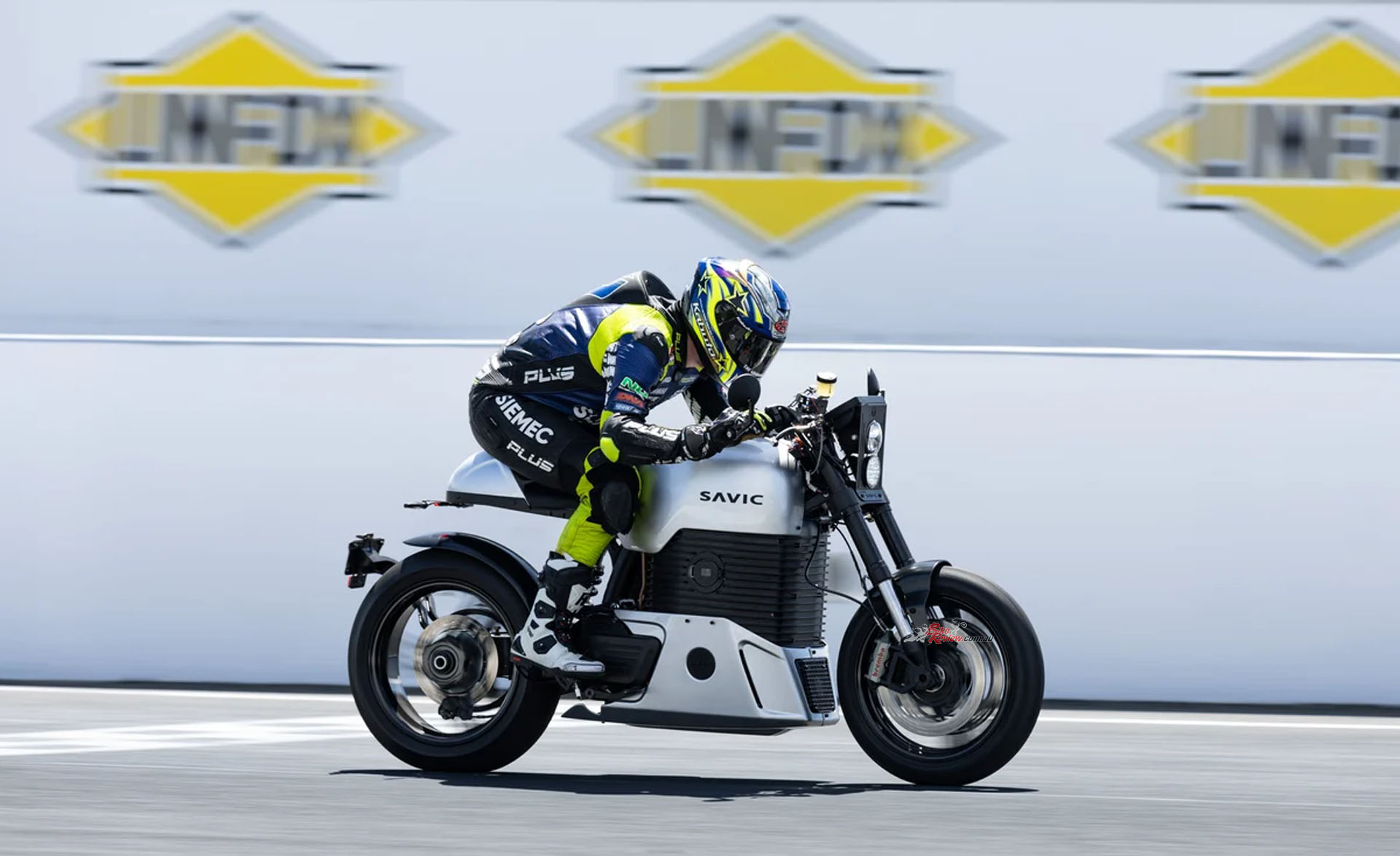
Jed Metcher crosses the stripe on Phillip Island’s Gardner Straight during testing of the Savic.
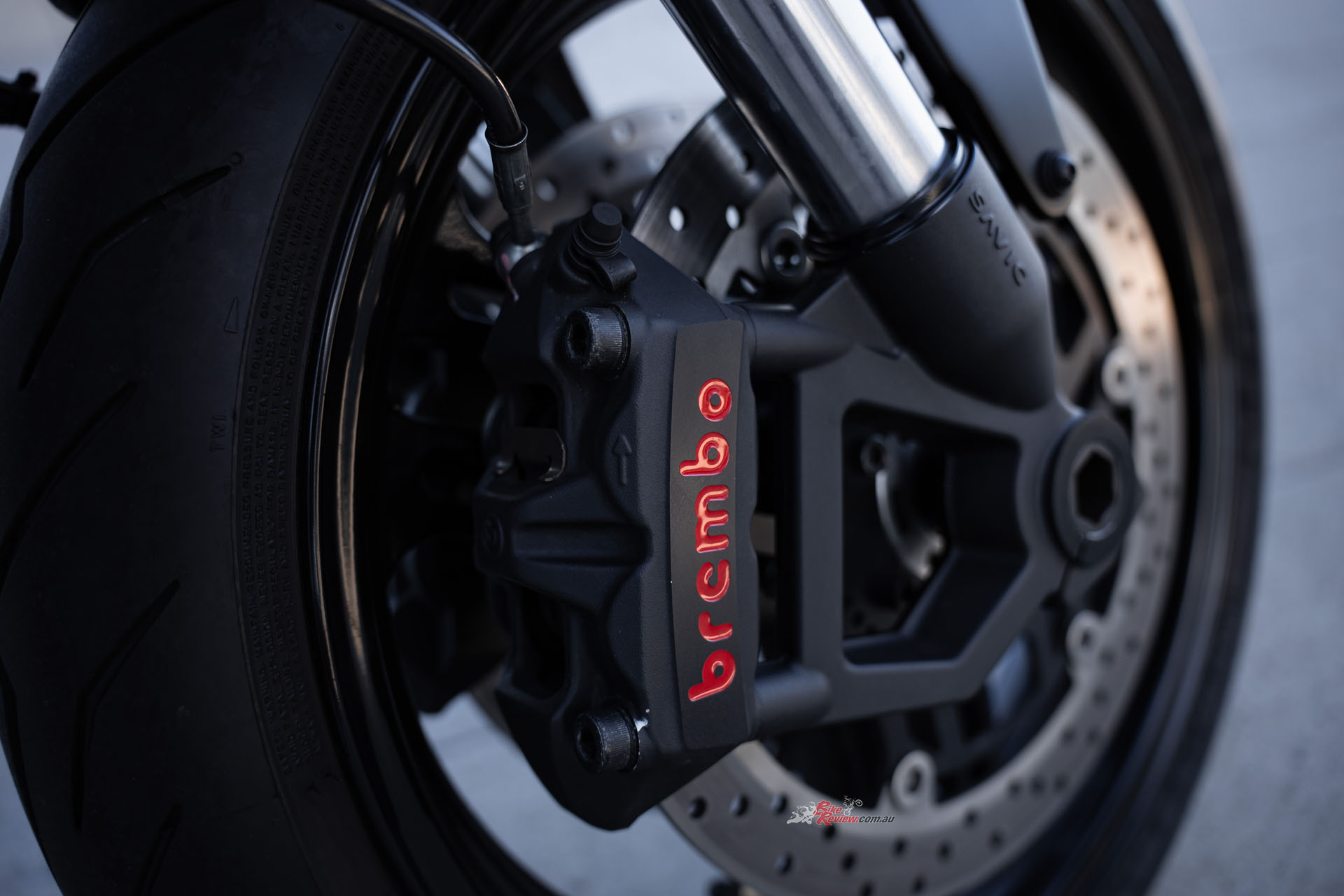
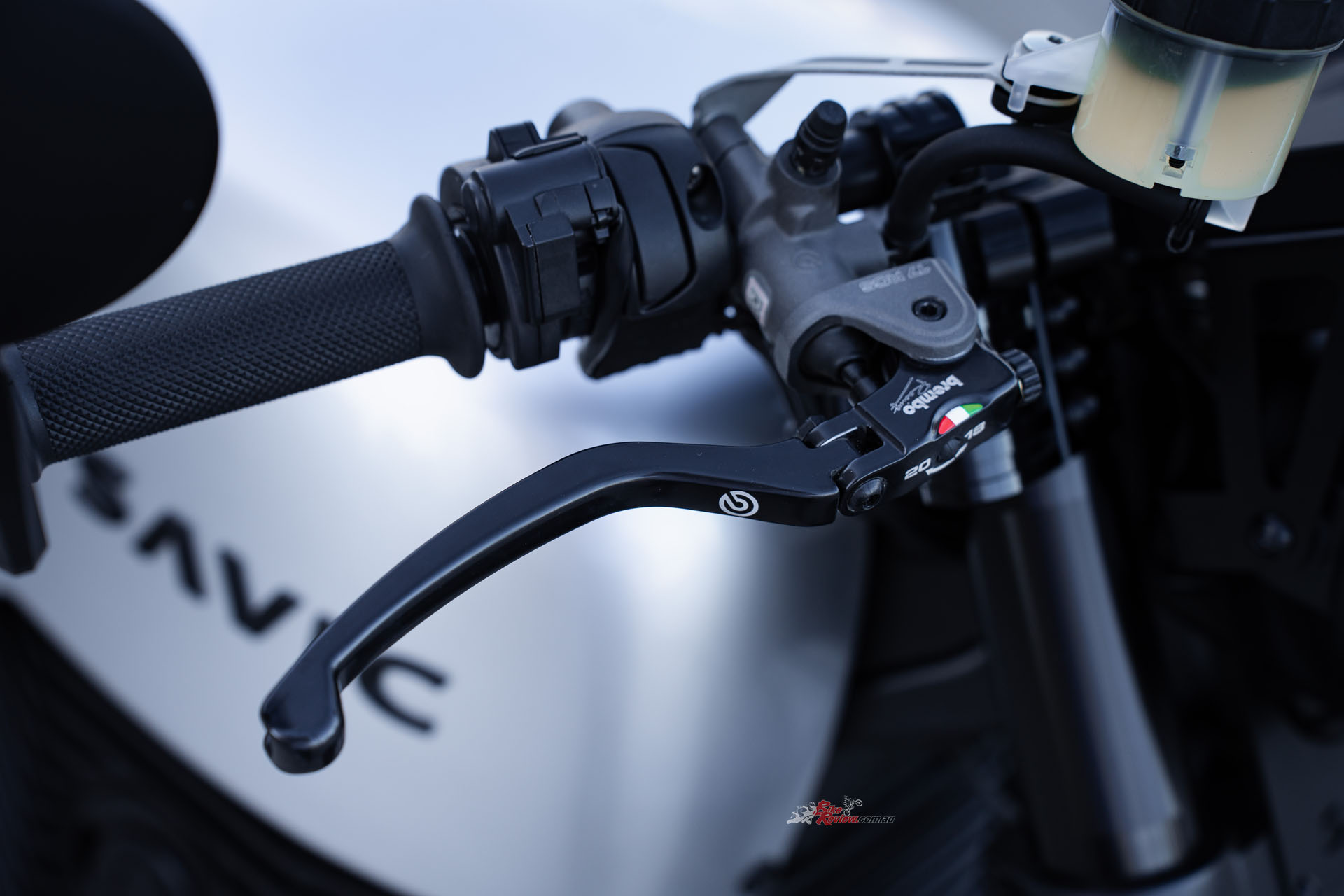
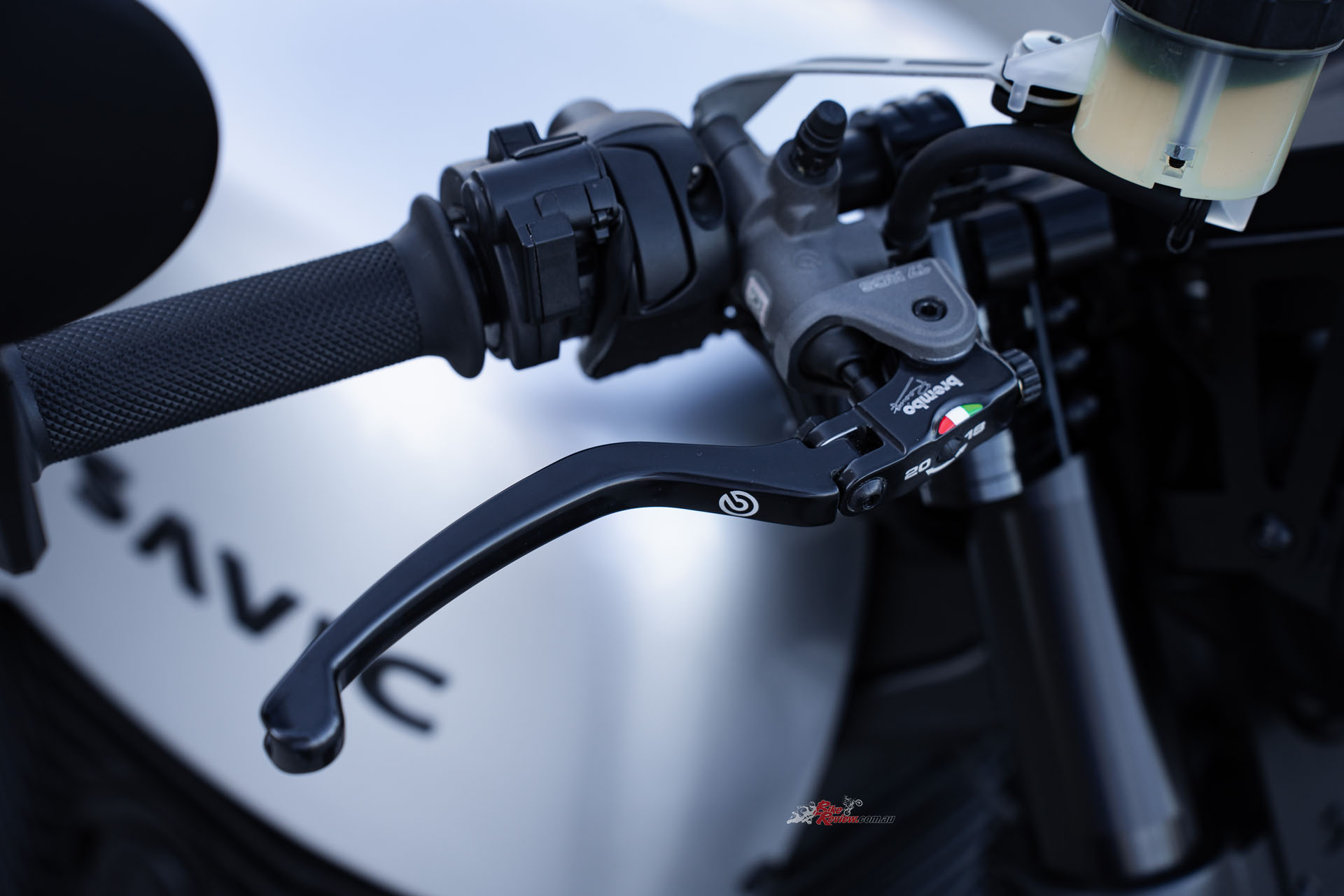
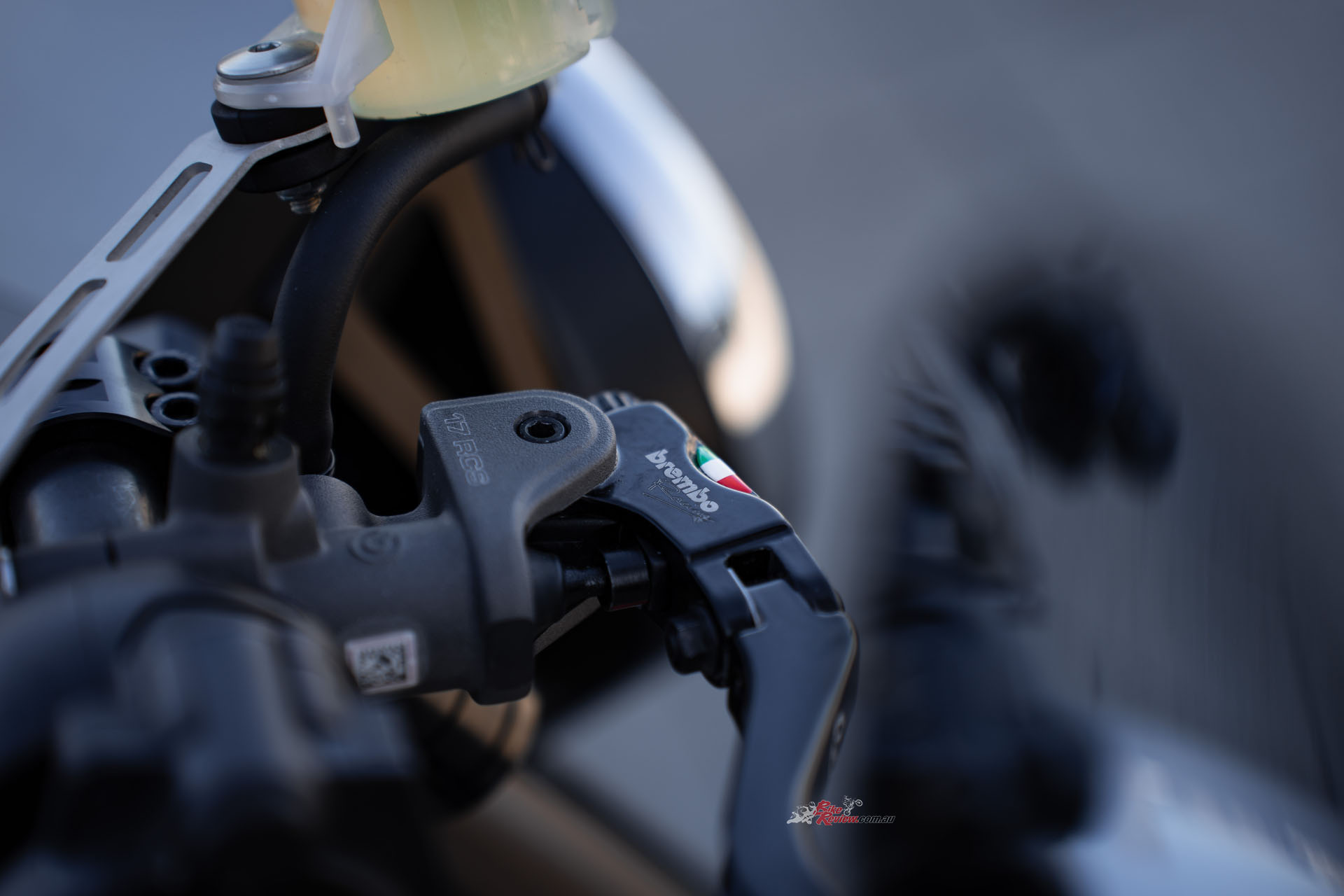
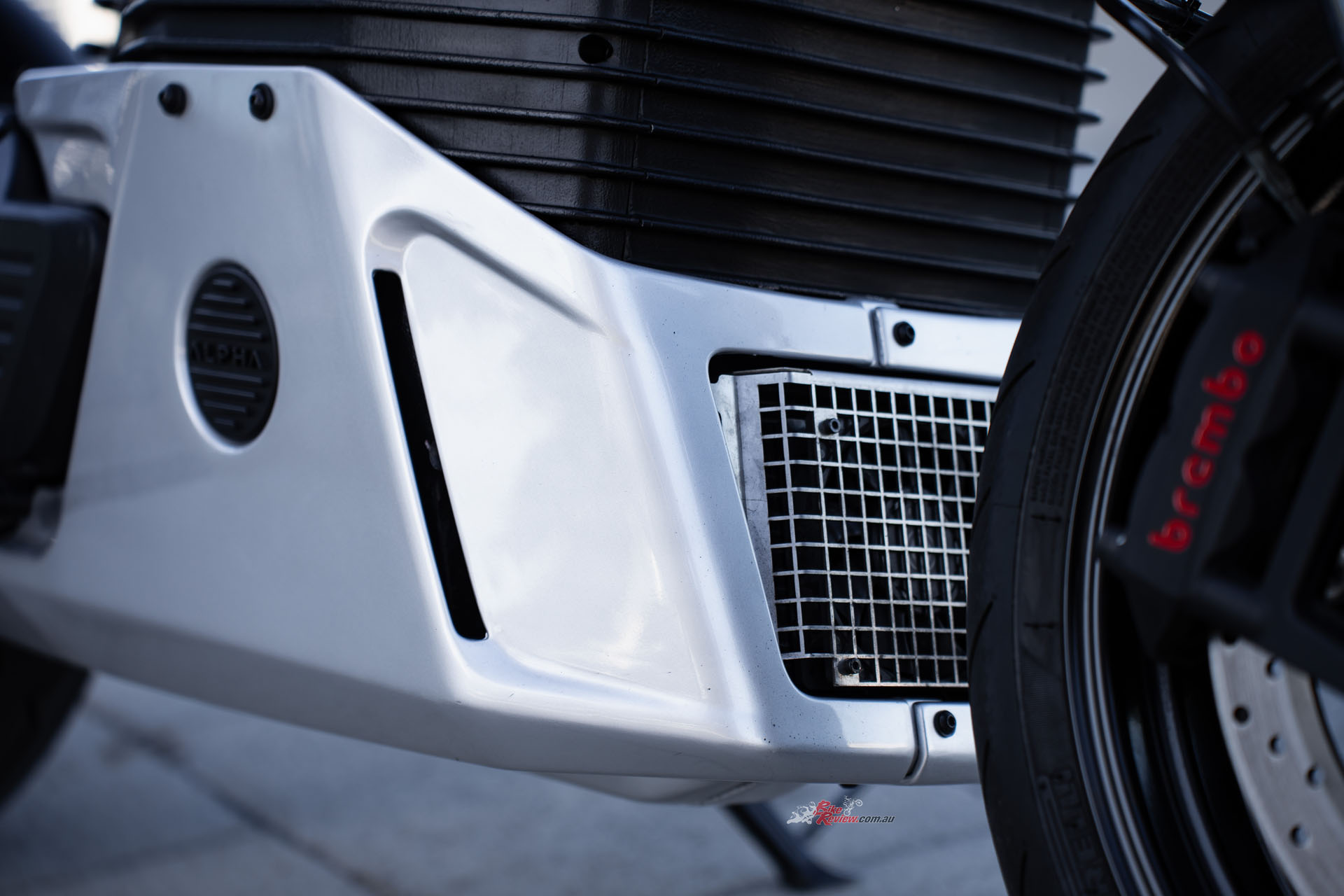
Braking is handled by Brembo, with twin M4 calipers up front and a Bosch-developed ABS system. The front anchors are excellent – strong, predictable and more than up to the job of slowing 280 kilos of velocity in a timely manner. The rear, though, was disappointing. On my test bike it offered little feedback and even less bite, and with over 600 kilometres already on the odo, it wasn’t a case of bedding in. Fortunately the front does most of the heavy lifting, but it’s a weak spot up the back.
The riding position feels familiar enough for a naked café racer, but a few quirks stand out. It has a claimed seat height of 780mm, which makes 280kg feel nice and manageable at a standstill, and that’s complemented by a narrow waist helped with reach. Comfort was another matter. After about an hour the hard seat became pretty uncomfortable, more noticeable than the wide ‘tank’ edges that pressed into my thighs. Given the seat height is already low, I feel like a little more padding wouldn’t go astray.
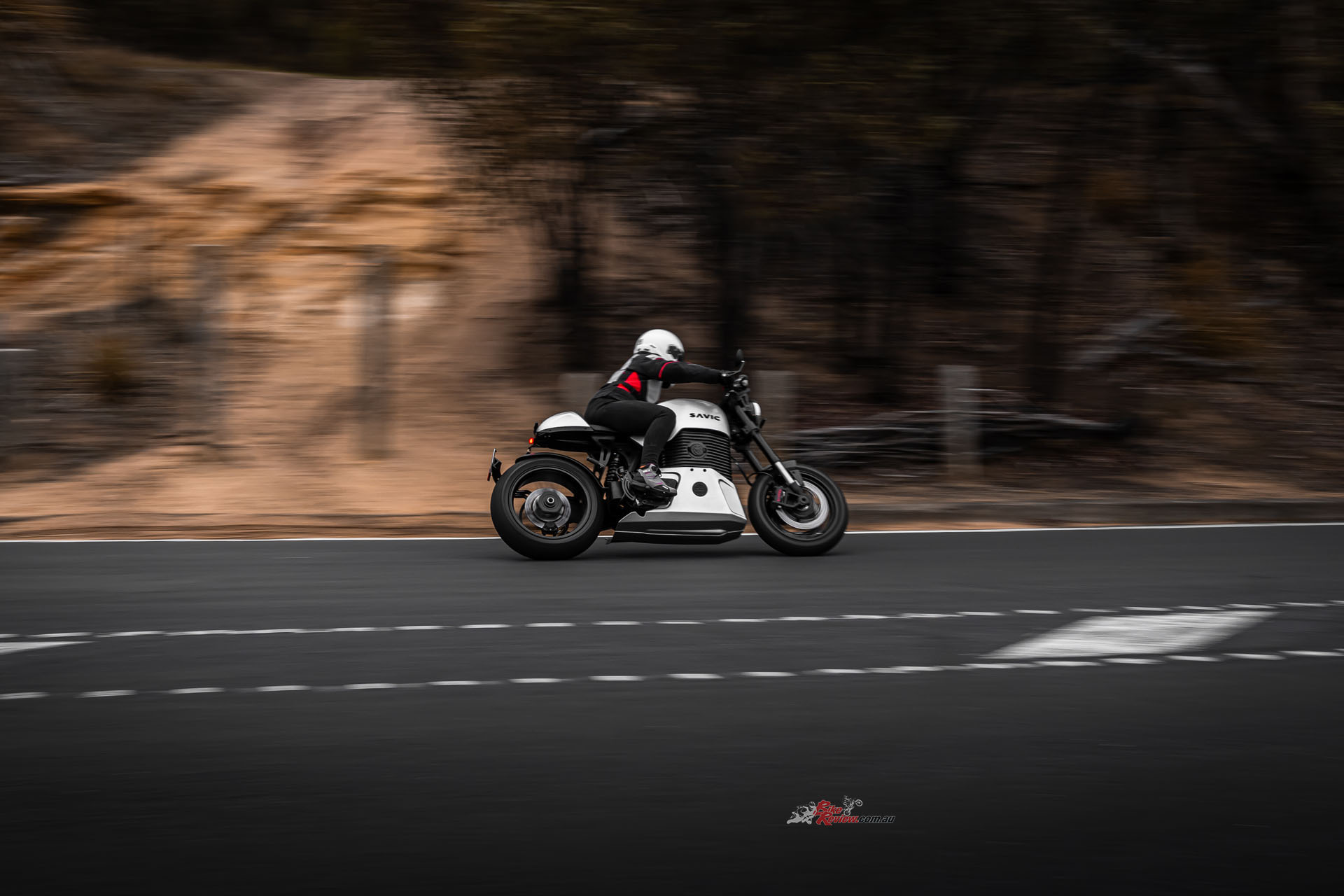
The Savic holds a line beautifully … once you realise you don’t have to wrestle all of that weight.
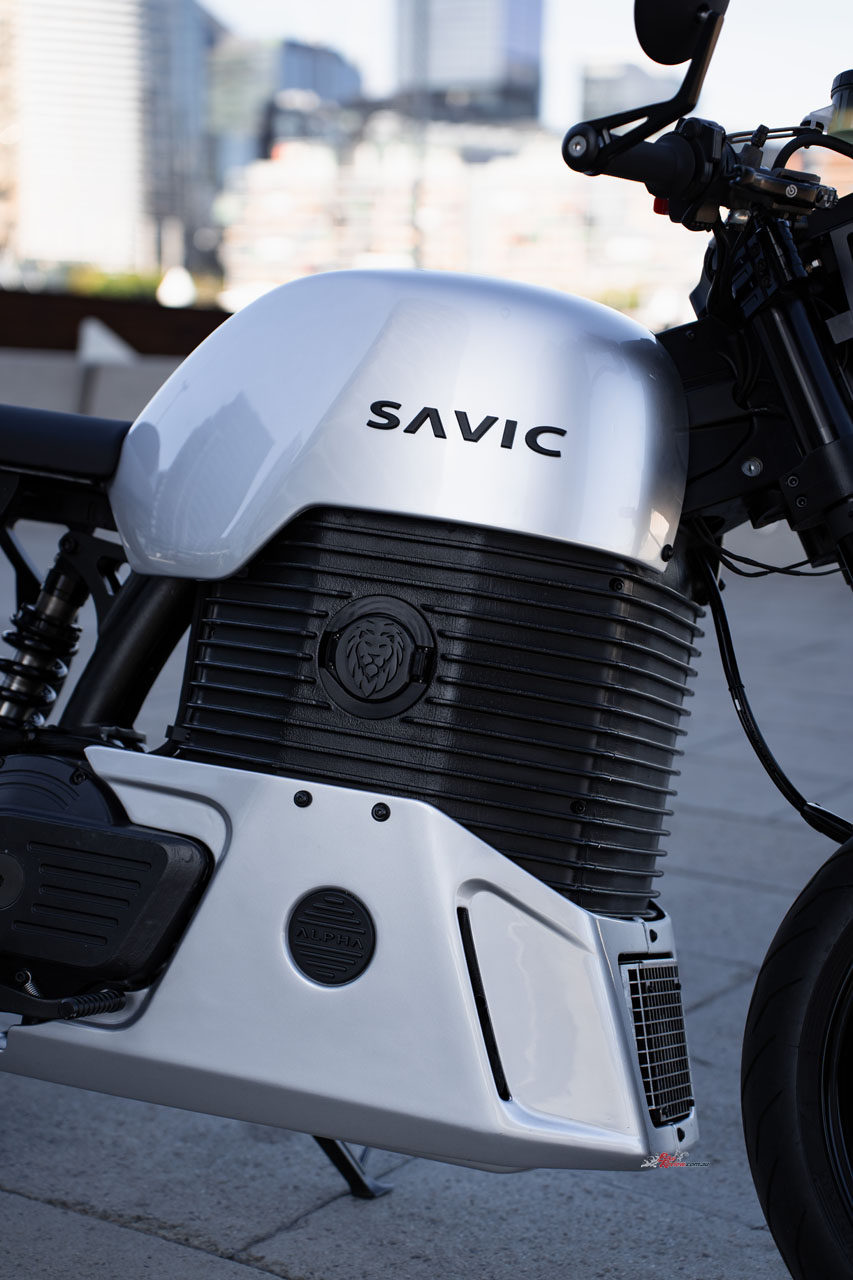
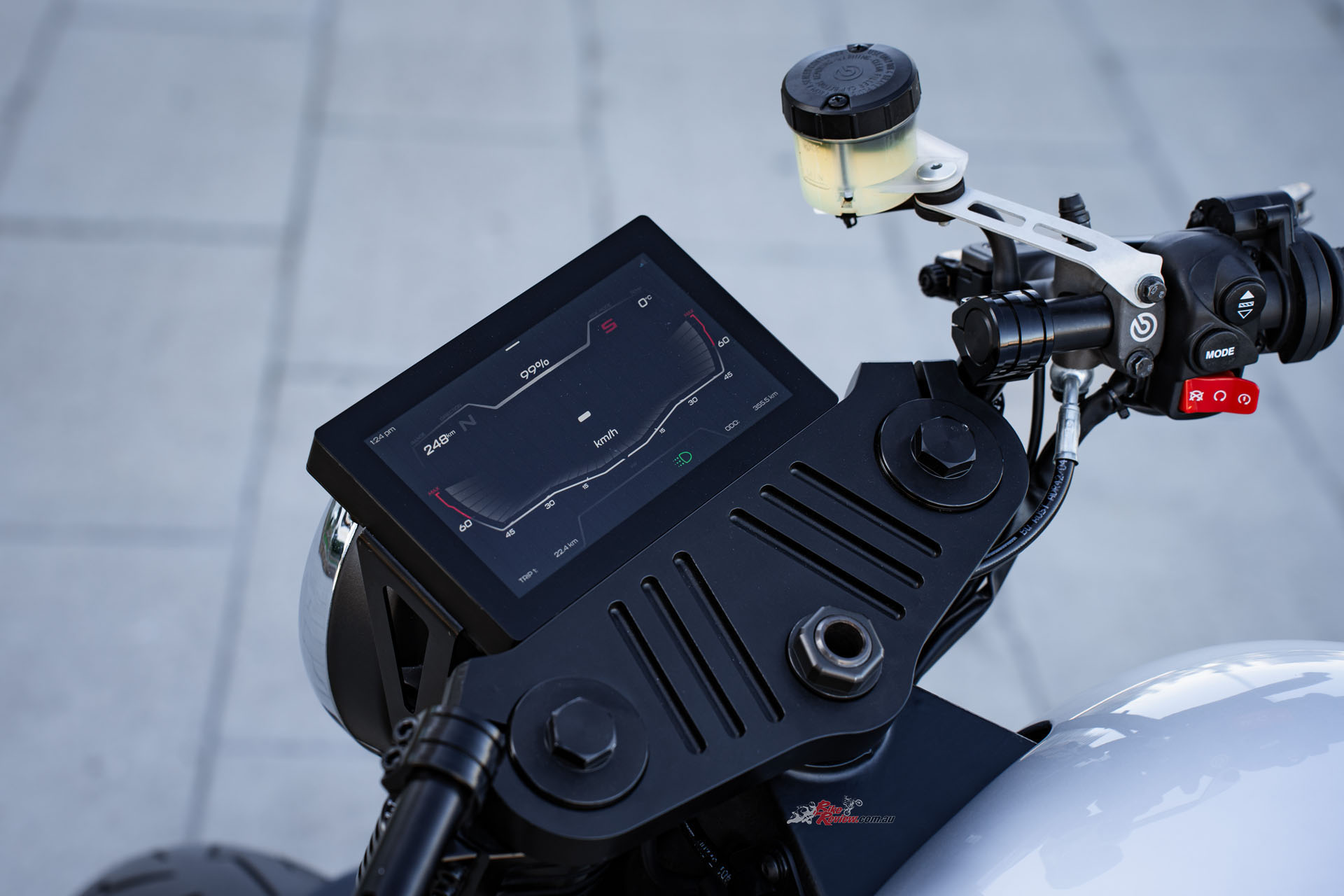
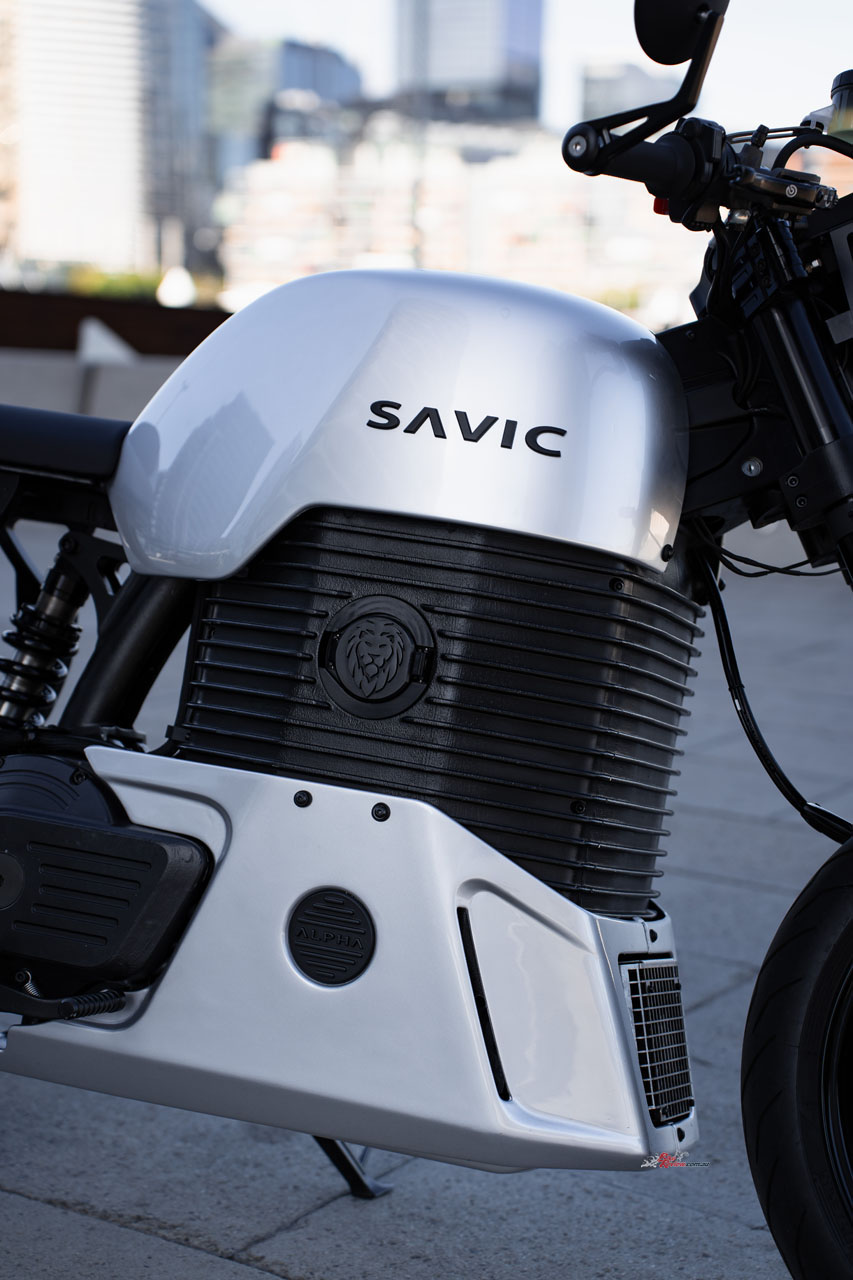
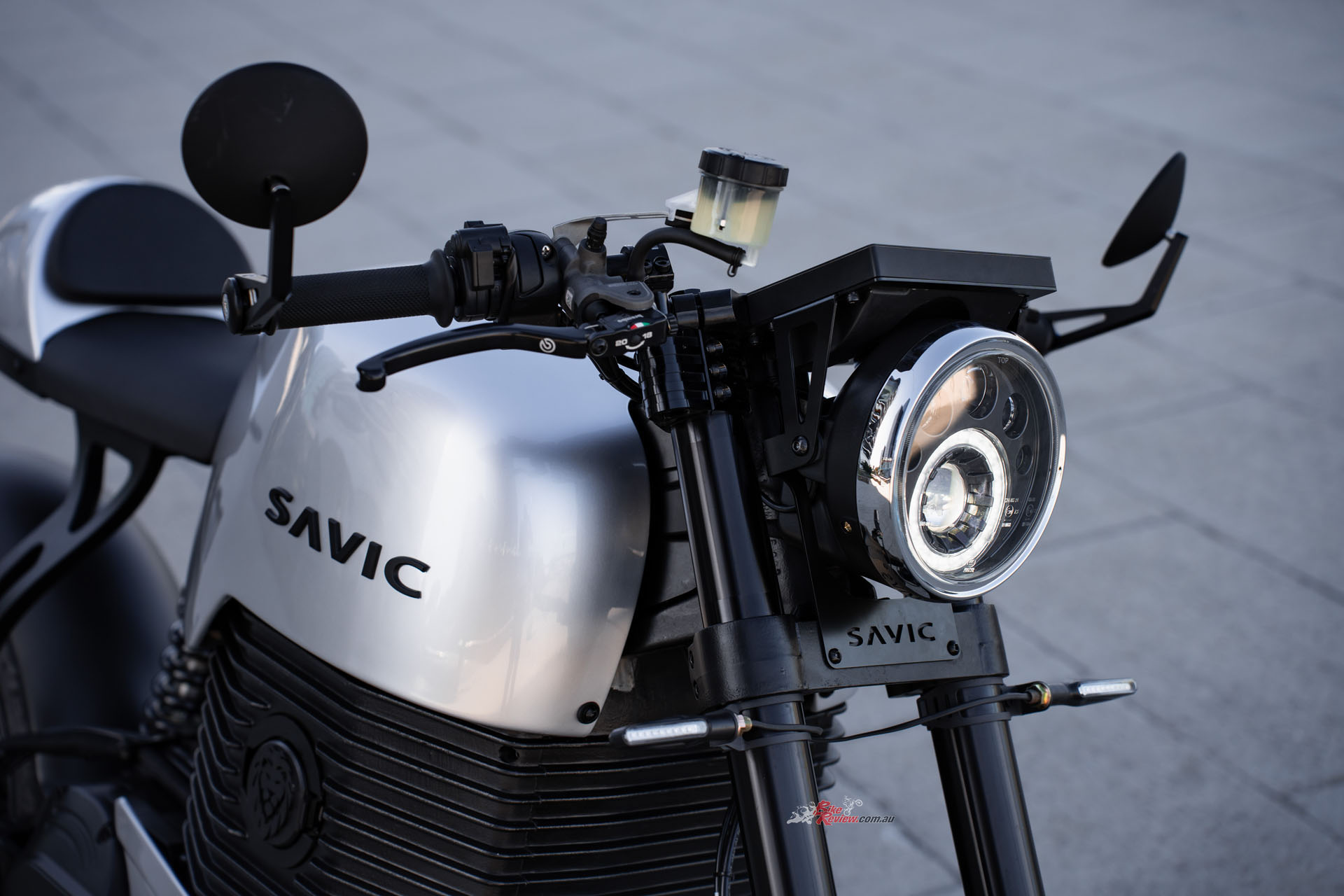
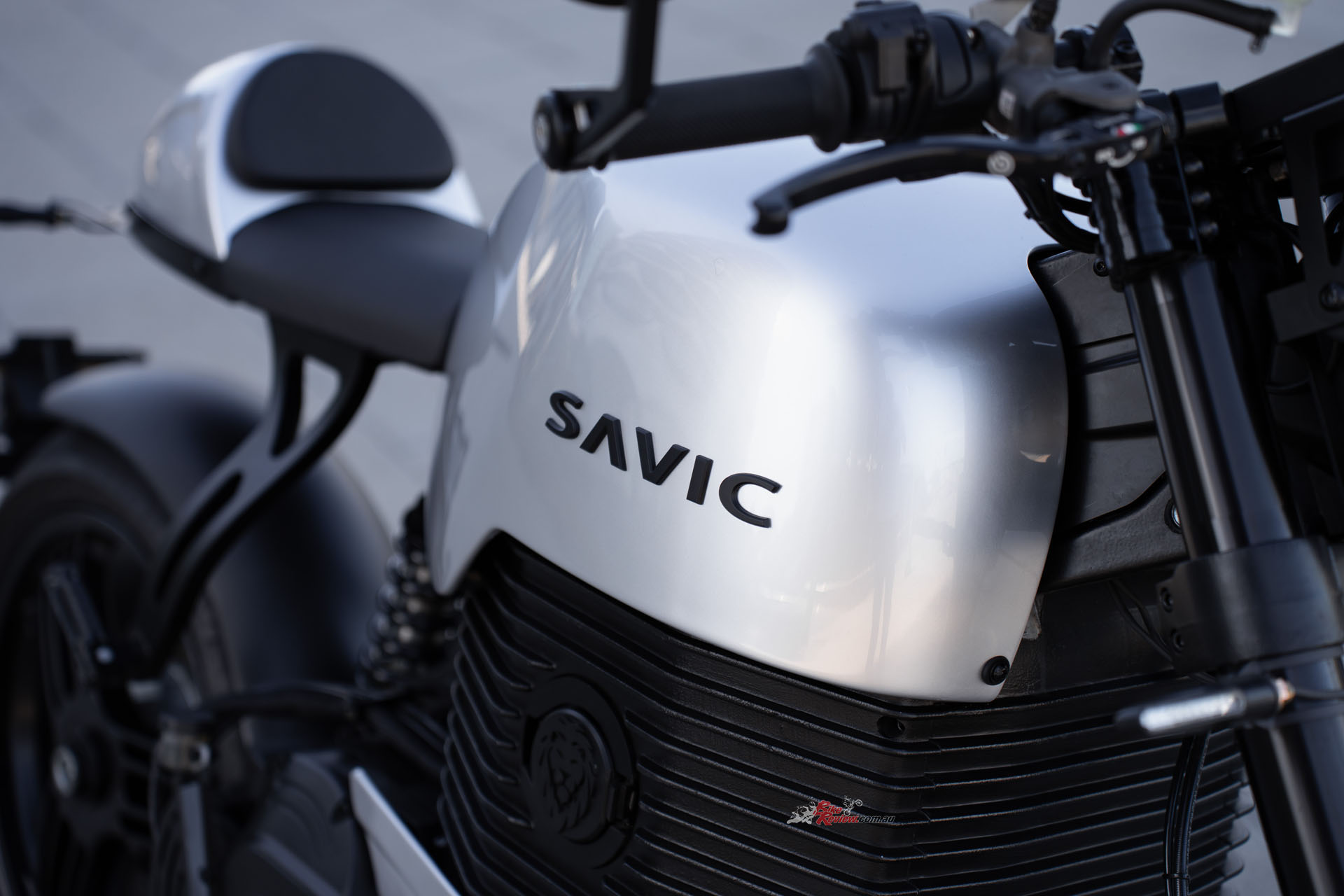
The tank itself – really the battery housing – dominates the ergonomics. It gives the bike its muscular stance but adds to the feeling of bulk between your knees. Up front, the cockpit is stripped back. A seven-inch touchscreen manages the bike’s settings and ride information, giving the Alpha a modern focal point without clutter. As well as seven riding modes, the Alpha layers on plenty of tech.
Check out our other Electric bike review here…
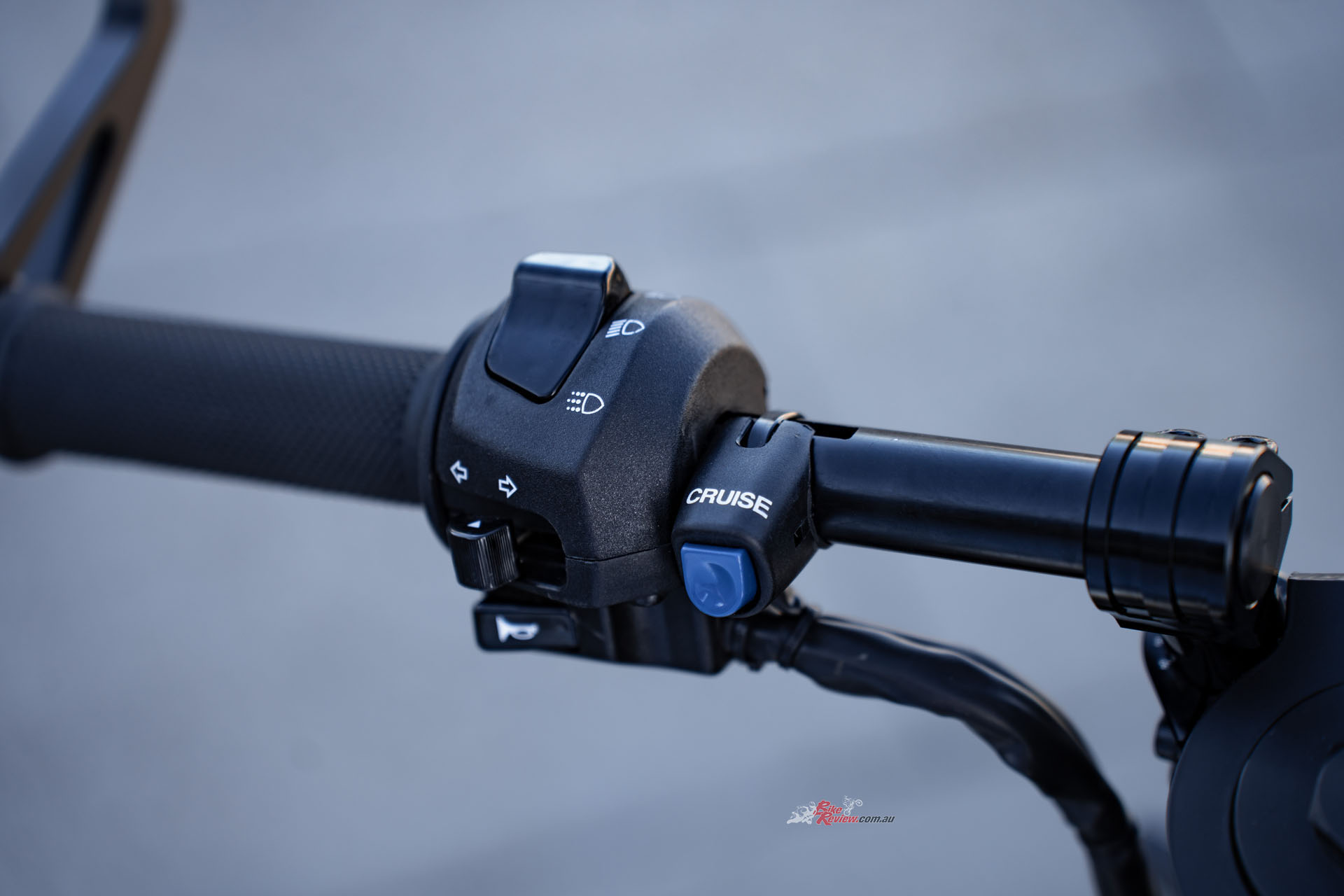
Cruise control comes standard, along with regenerative braking that can be tuned to suit each mode. A mobile app unlocks the bike without a key and doubles as the hub for diagnostics and firmware updates, made possible by the cloud-based IoT system built into every bike. There’s no traction control fitted yet, but Savic is working with Bosch on a system that will be added in future updates.
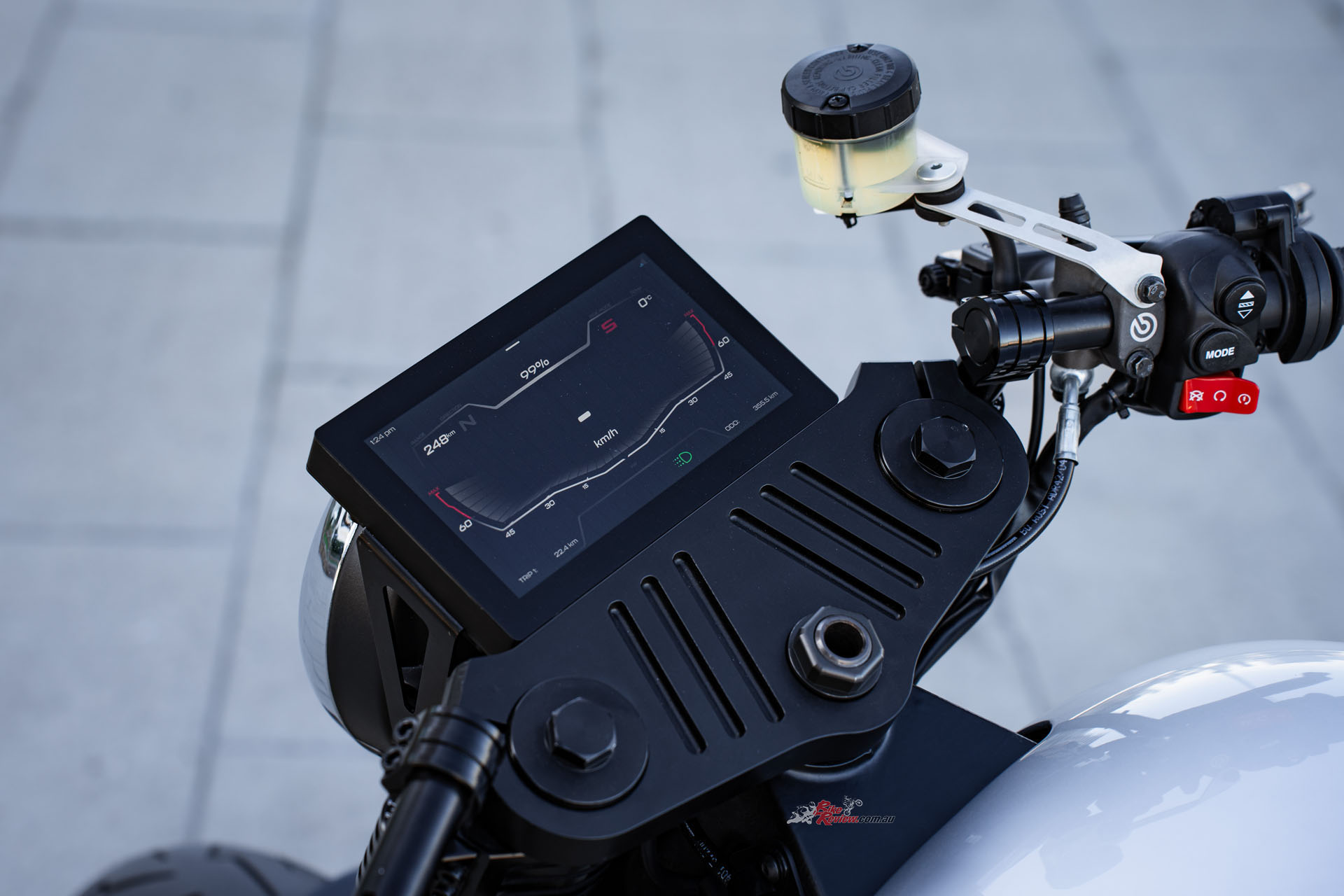
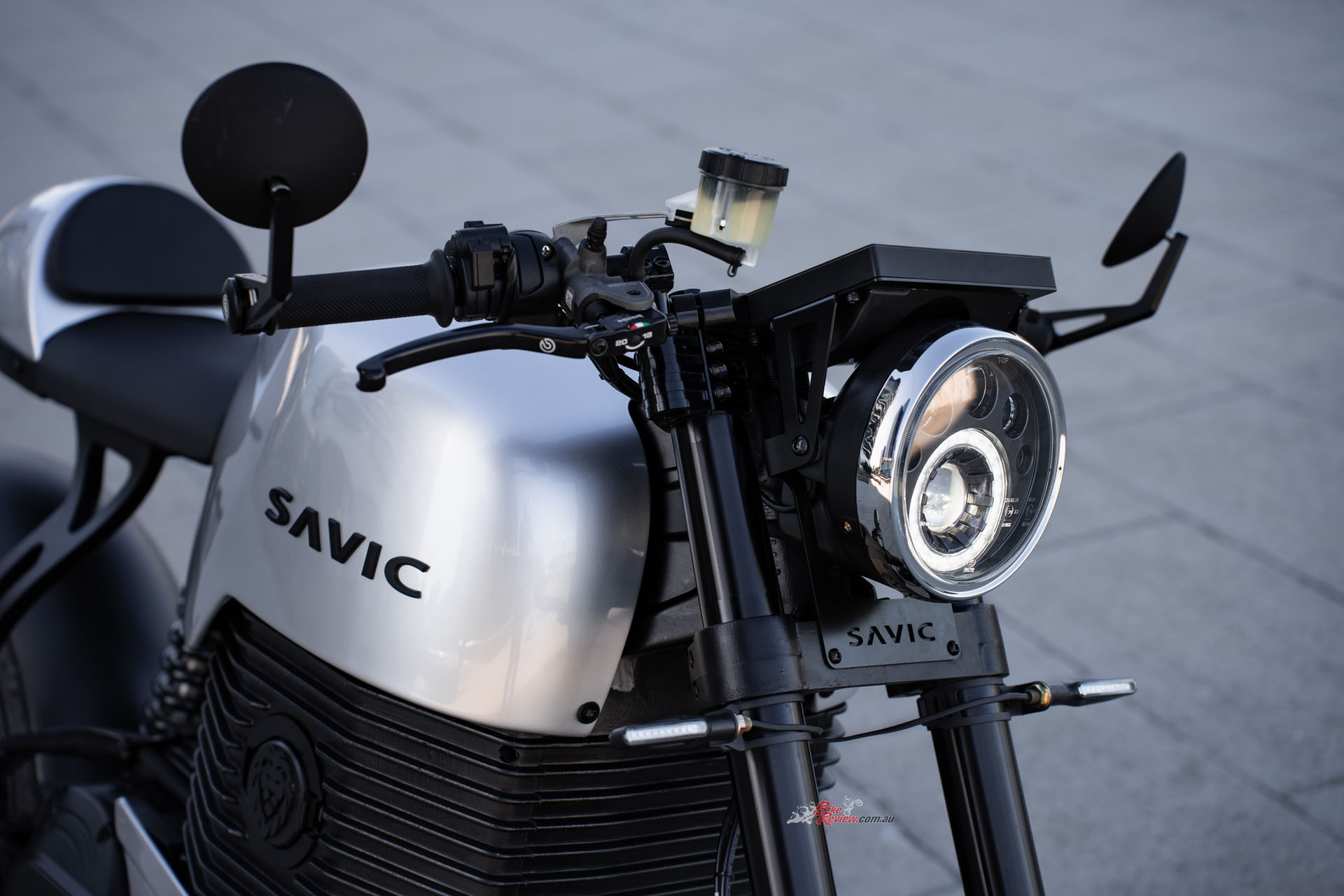
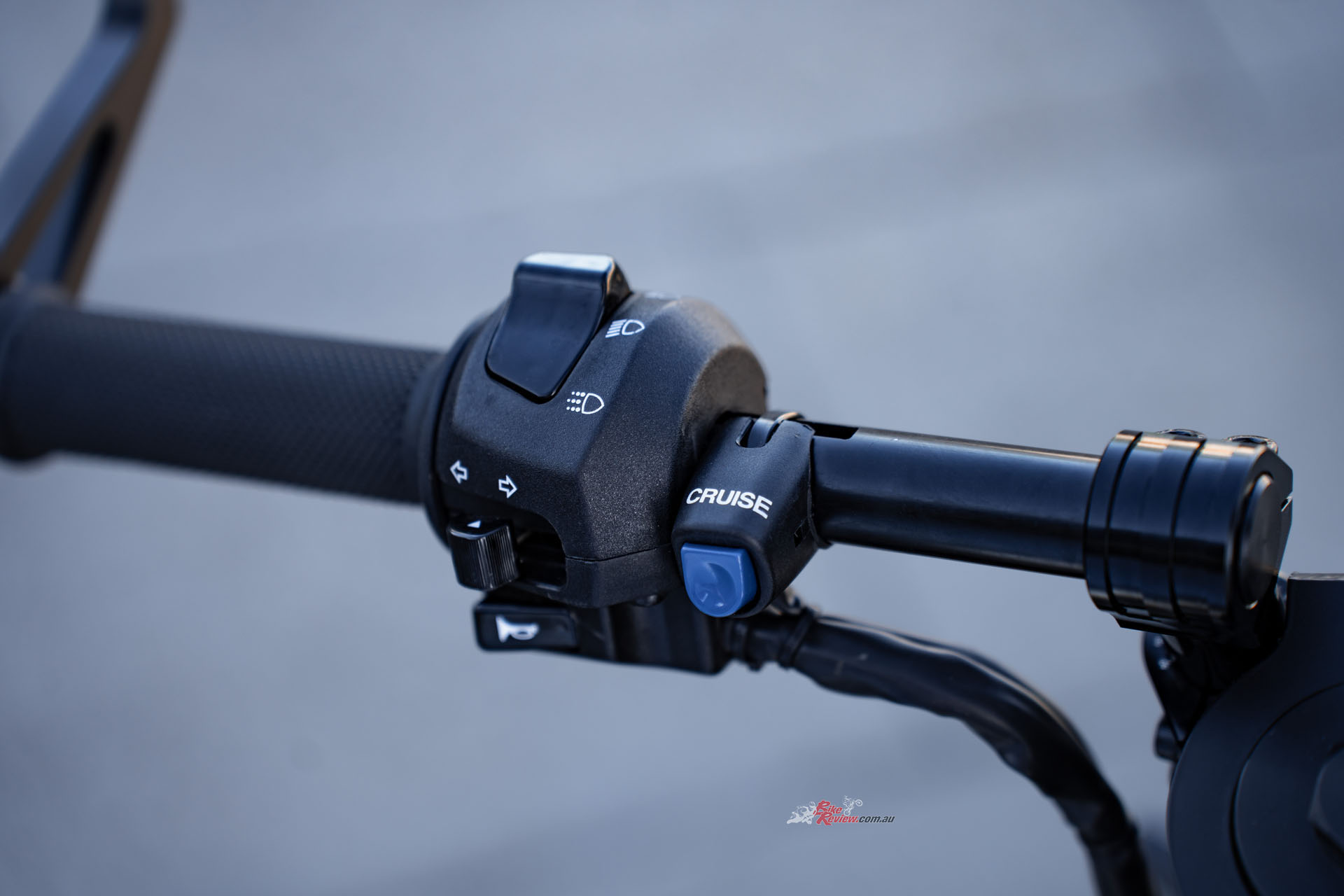
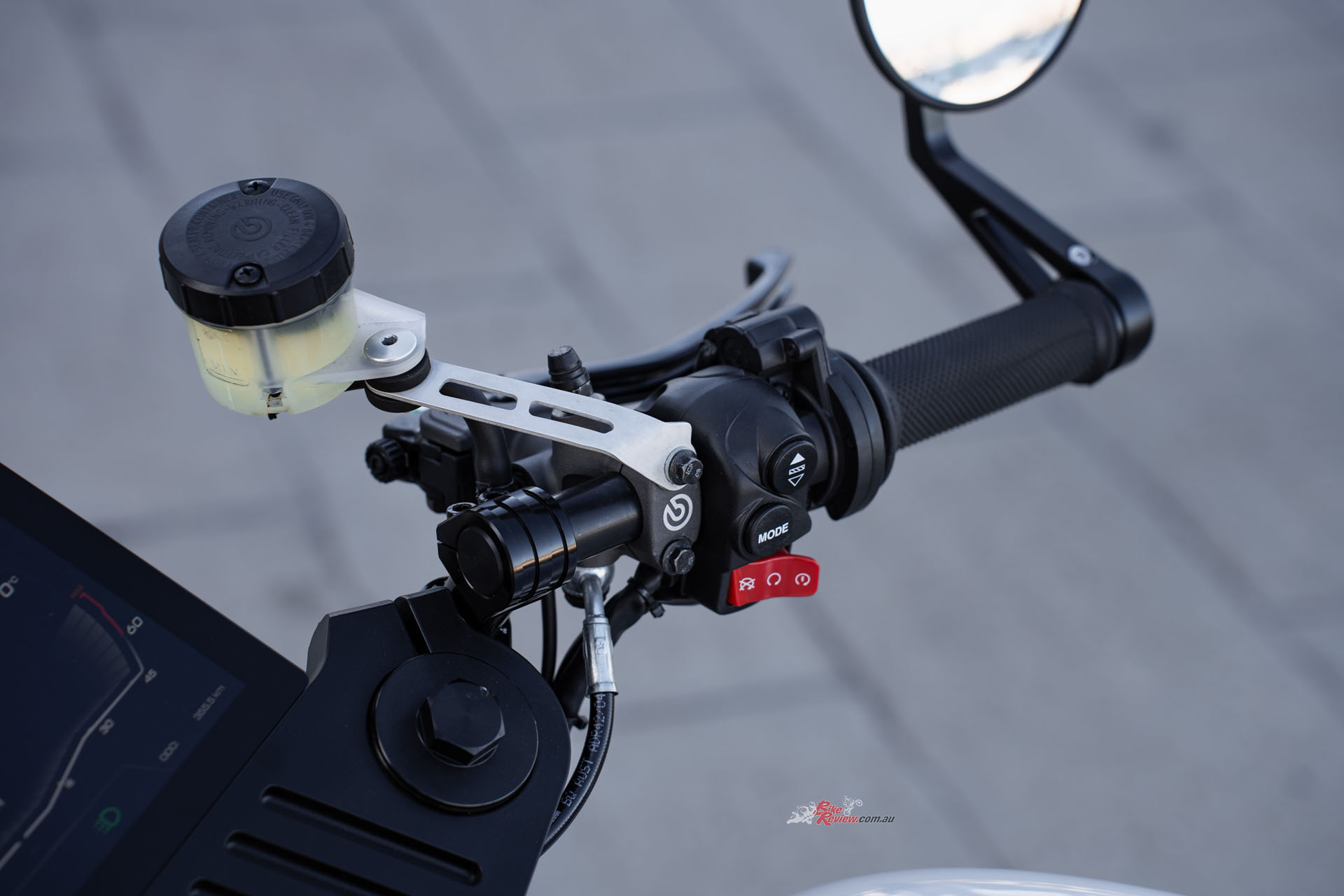
Not every detail feels finished. The stacked twin-lamp headlight looks really plain compared to the optional heritage circular unit. The cruise control switch is bright blue and literally cable-tied to the bar – functional, sure, but it doesn’t live up to what you’d expect from a $30k machine.
Even the handlebars themselves had me second-guessing. Because the left-hand side is relatively bare compared to the right, with its brake lever, master-cylinder and throttle gear, I couldn’t work out if I could actually feel the weight difference or if it was just my eyes playing tricks on me.
“Standard colours are metallic silver or black, with carbon-fibre available for an extra three grand”
Personalisation is one area Savic has thought through. Standard colours are metallic silver or black, with carbon-fibre available for an extra three grand, and customers have already commissioned bespoke shades like pistachio or British Racing Green. Seats can be trimmed in black or brown, and the heritage headlight gives the bike a more traditional face if the futuristic look isn’t to taste.
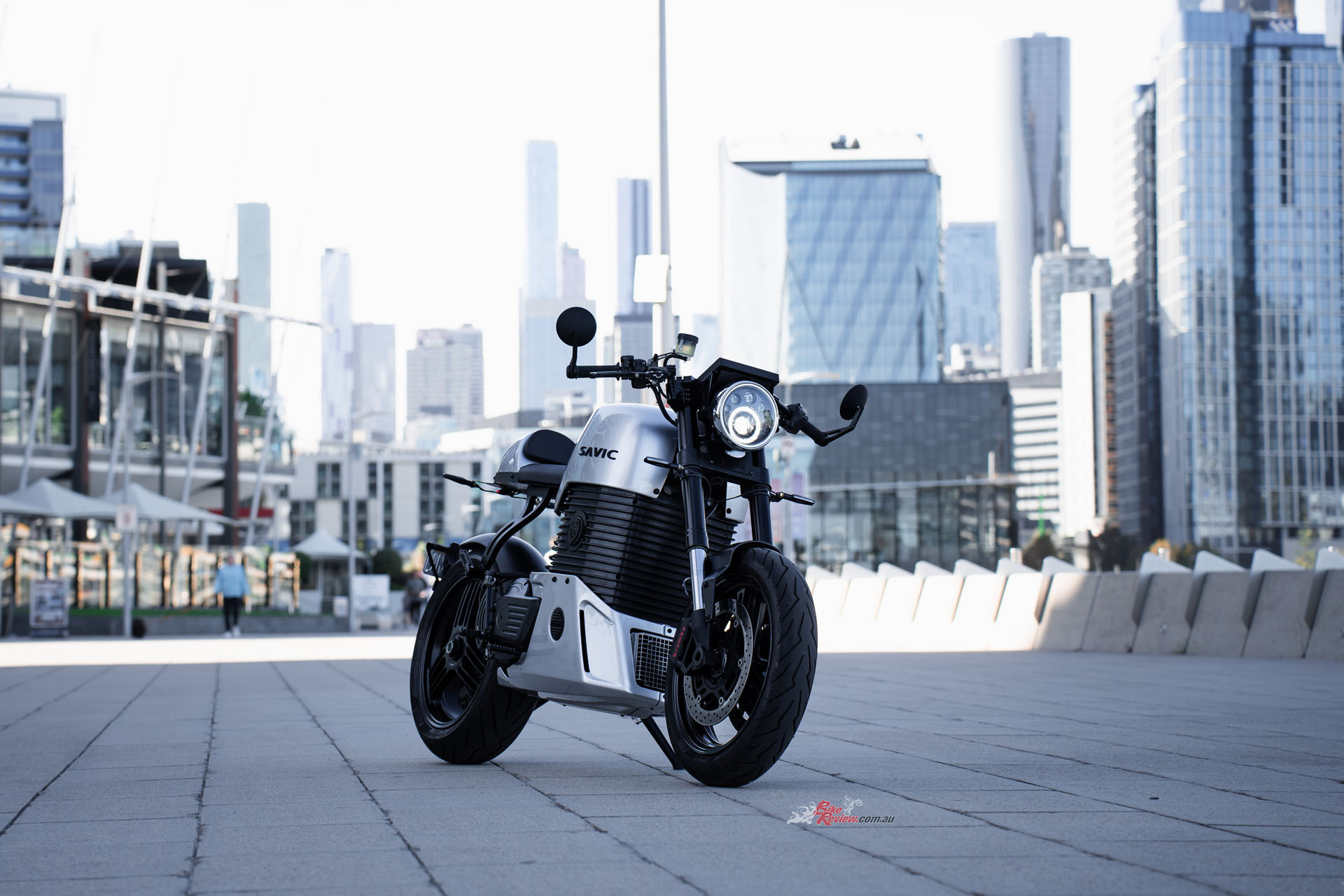
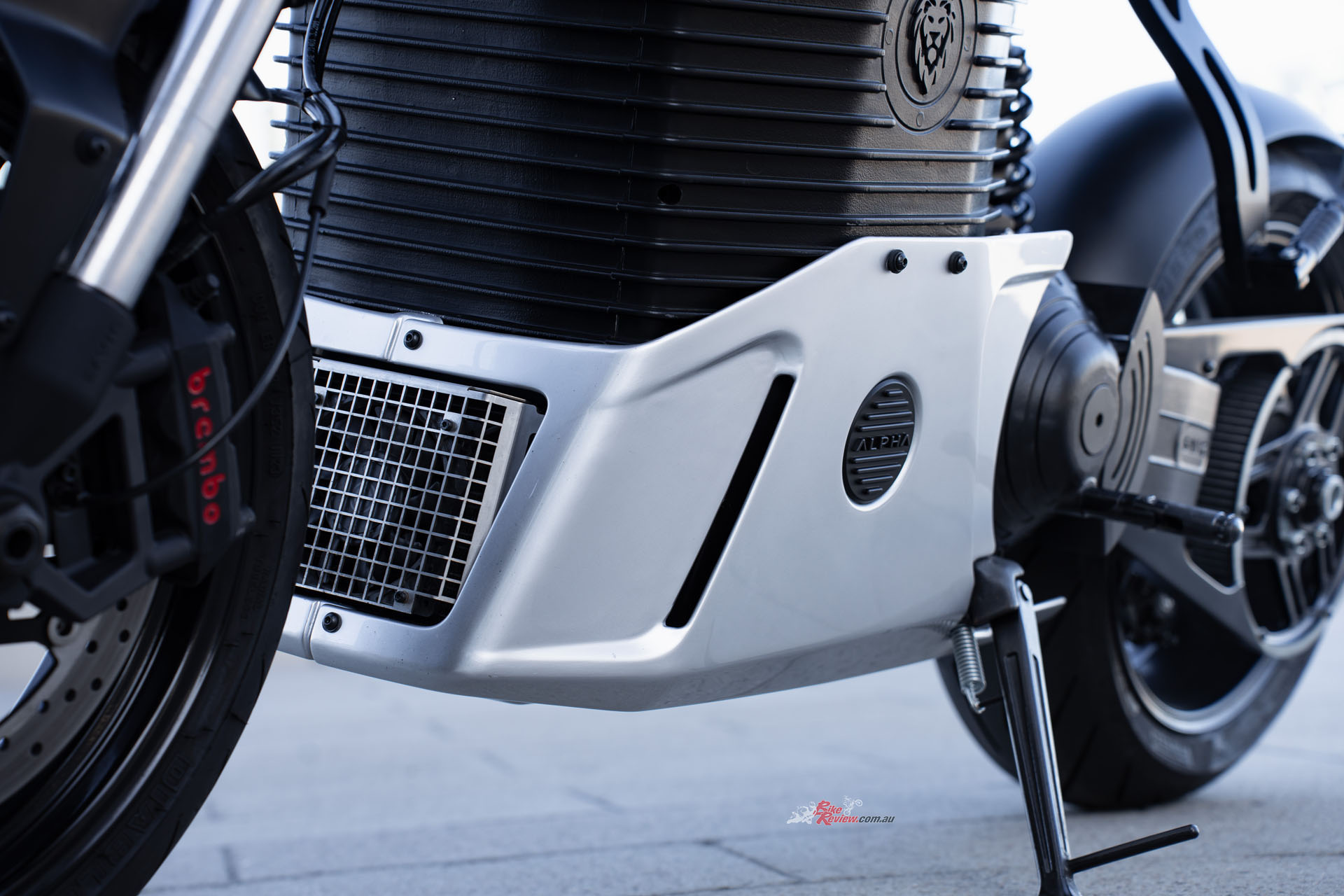
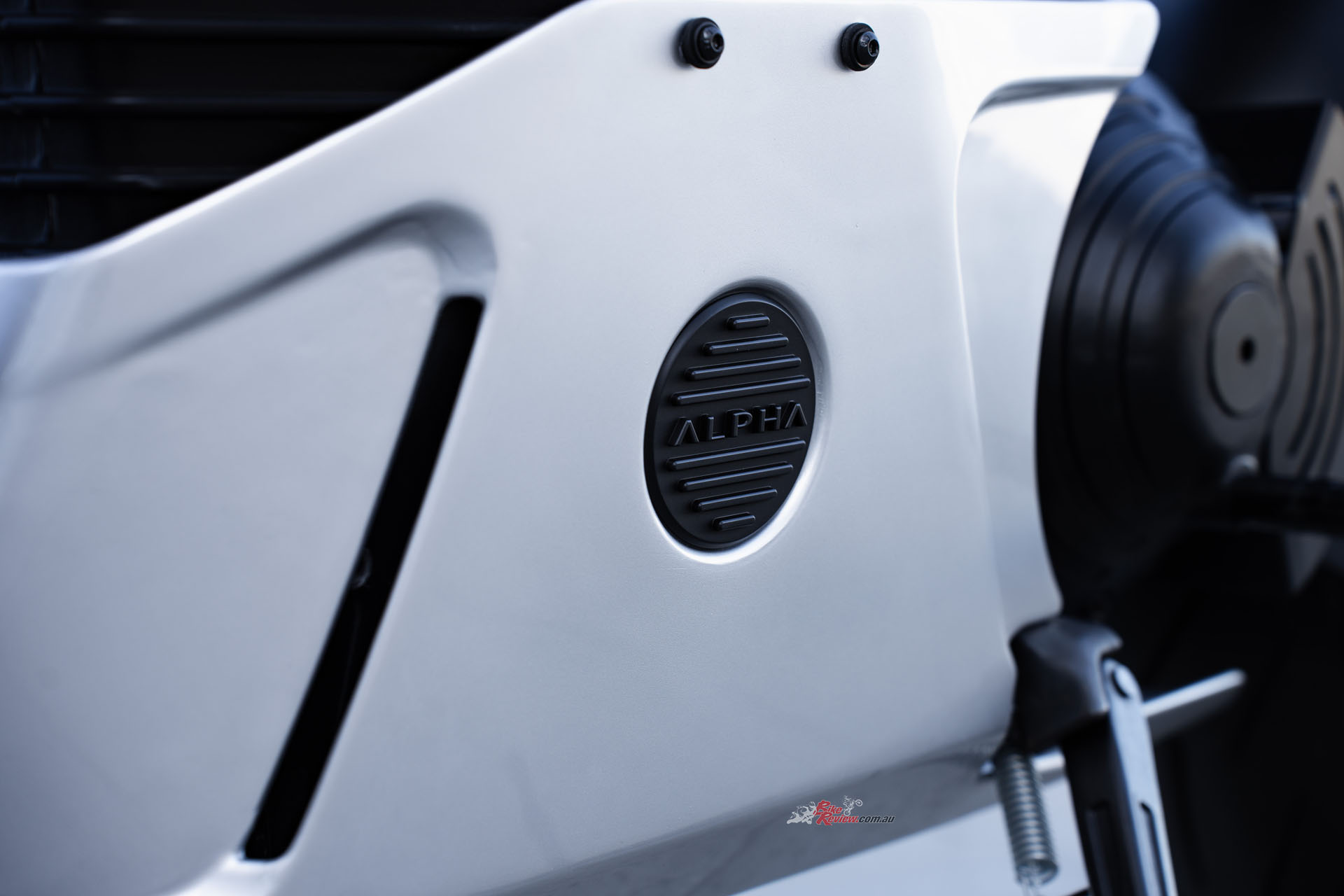
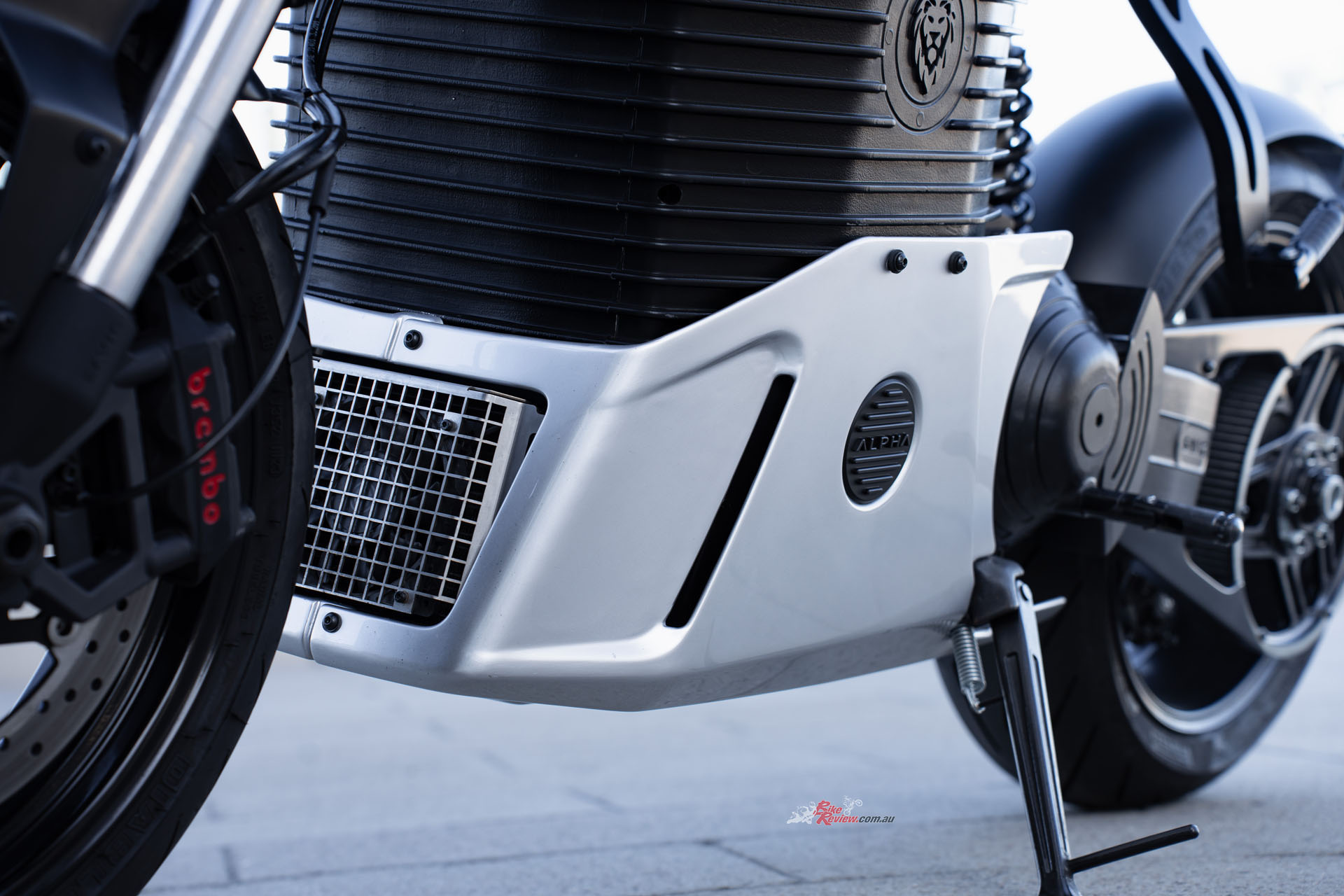
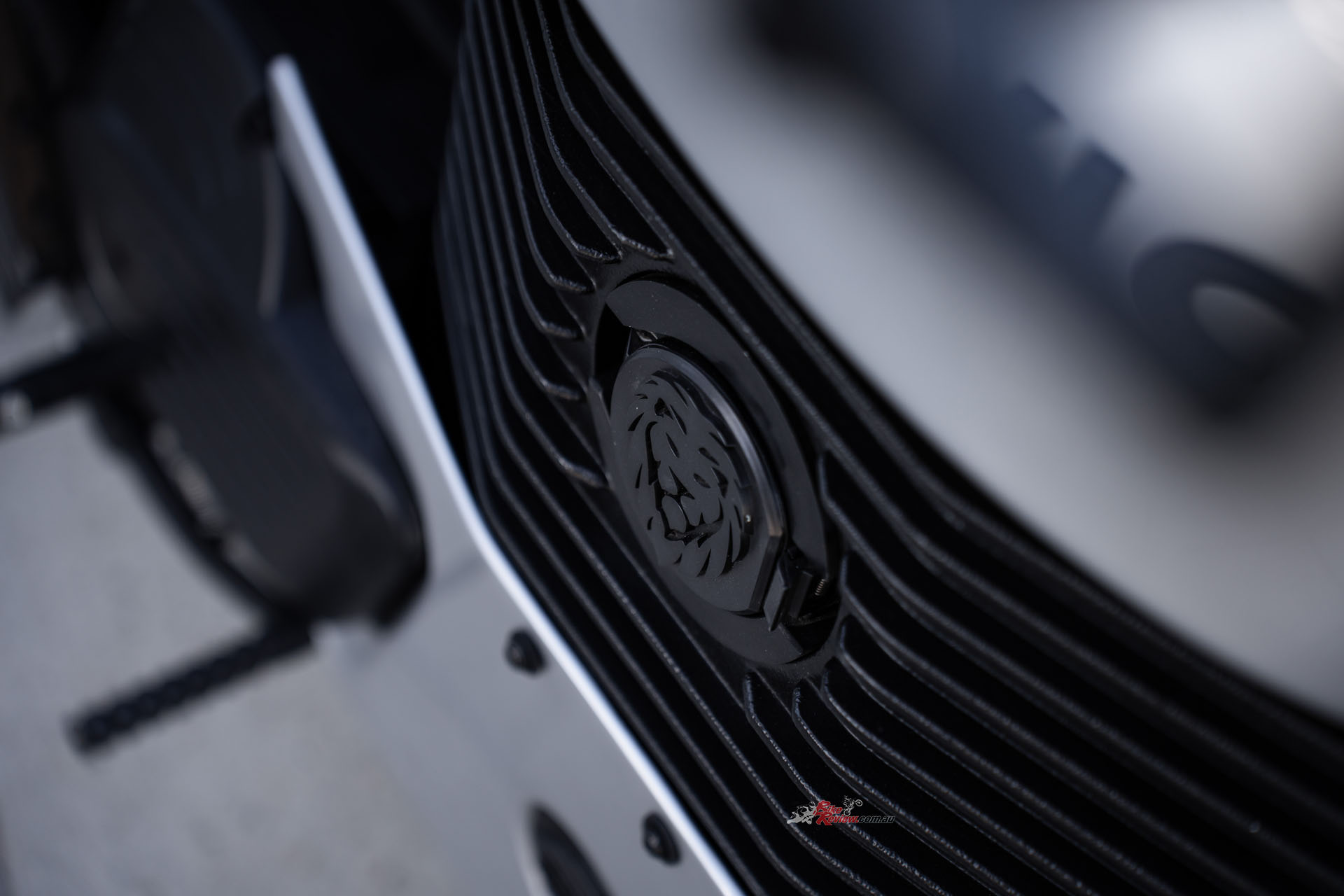
The finned anodised aluminium exoskeleton provides strength, durability and heat management.
At $29,990 plus on-roads, the C-Series Alpha isn’t cheap, but compared to other full-sized electric motorcycles it’s positioned well. Harley’s LiveWire costs far more, Zero’s 2024 DSR/X is priced at $46,600 (ride-away) and Energica’s offerings were north of $45,000 before the brand collapsed. Against that backdrop, the Alpha looks sharp, especially given the componentry: Brembo brakes, Pirelli tyres, a single-sided swingarm and a 7-inch touchscreen with cloud connectivity.
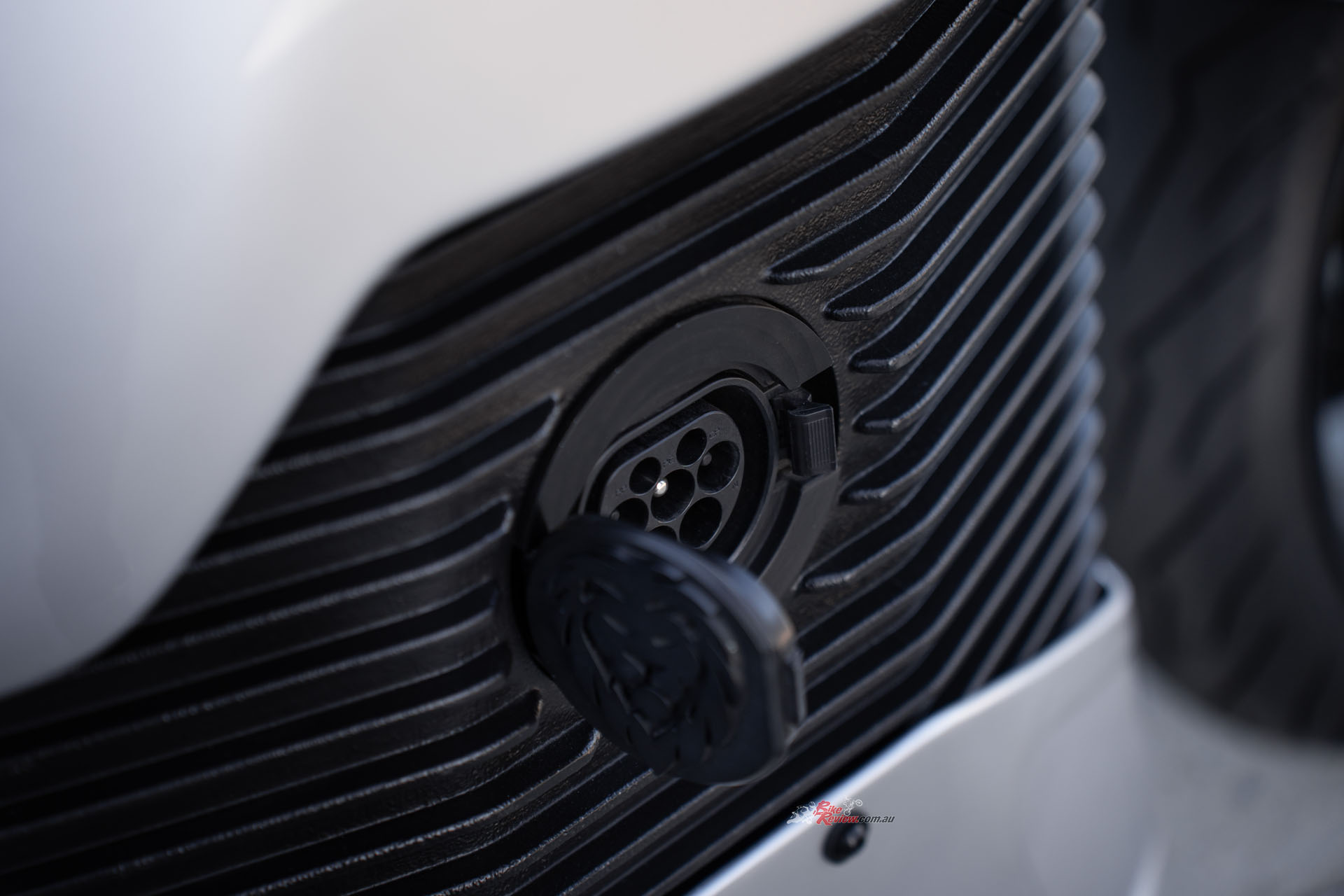
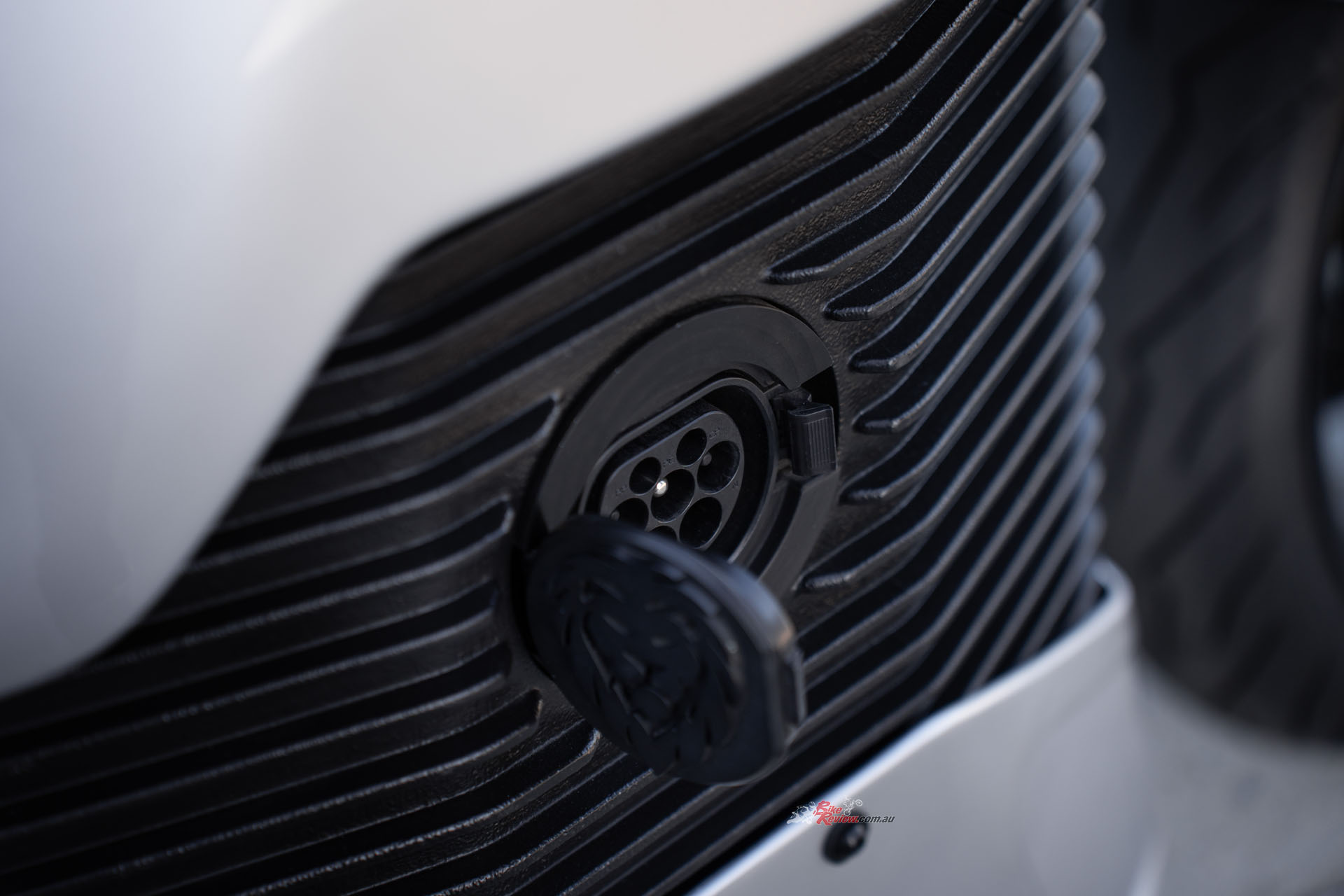
Charging is refreshingly simple. Plug it into a regular 240-volt wall socket and you’ll see around seven hours from empty to 80 per cent, which makes overnight charging the obvious choice. If you’ve got access to a 15-amp outlet or a Level 2 AC charger, the time drops to under five hours for a full battery. Every Alpha ships with a standard 10-amp cable, so you don’t need to install anything special at home – just park, plug in and it’s ready by morning. With a 16.2kWh pack and a real-world range of around 200km, it could even be feasible that some riders would only need to top up every few days.
“With a 16.2kWh pack and a real-world range of around 200km, it could even be feasible that some riders would only need to top up every few days”
Ownership looks reassuring too. Each bike comes with a five-year battery warranty and two years on everything else. Savic reckons the 16.2kWh pack should last between 1000 and 5000 charge cycles, which is the equivalent of at least 200,000km, before it needs replacing and even then it can be repurposed for stationary energy storage. Service intervals are listed at 1000km, 6000km and 12,000km, but with no oil changes or valve clearances to worry about, the focus is on consumables like tyres, brakes and suspension. The motor and battery are designed to be maintenance-free for life.
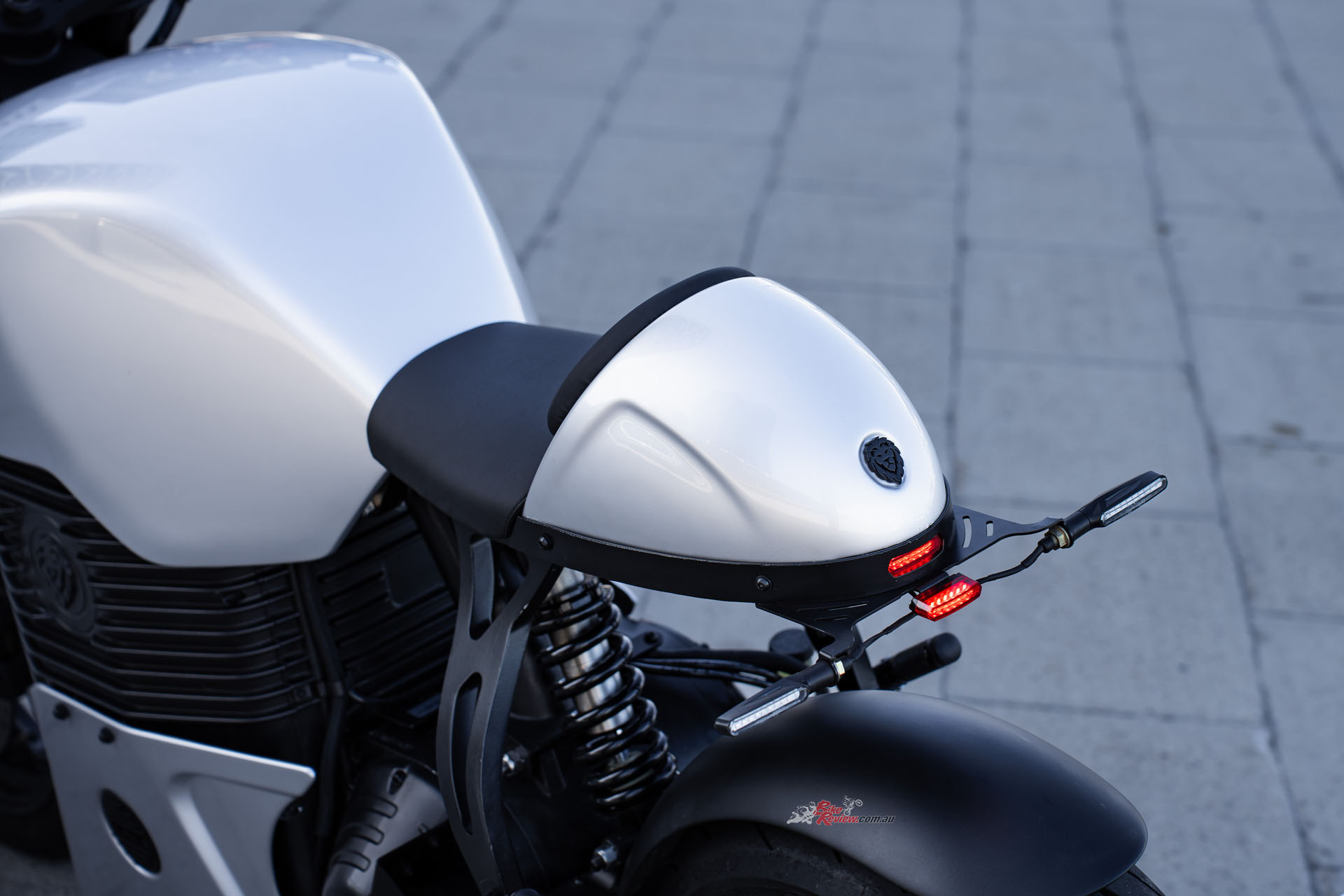
There are four colour options; Carbon Fibre, Atomic Silver (tested), Dark Matter Black or bespoke.
Those practicalities matter, but what stood out just as much was the curiosity the Alpha attracted on the road. Pedal-assist riders pulled over to talk, drivers wound down windows in traffic and people at lights familiar with the brand asked how soon they could get one. With only a handful of bikes delivered so far but more than a hundred orders already placed, there’s a sense that the Alpha has tapped into something bigger than its modest production numbers.
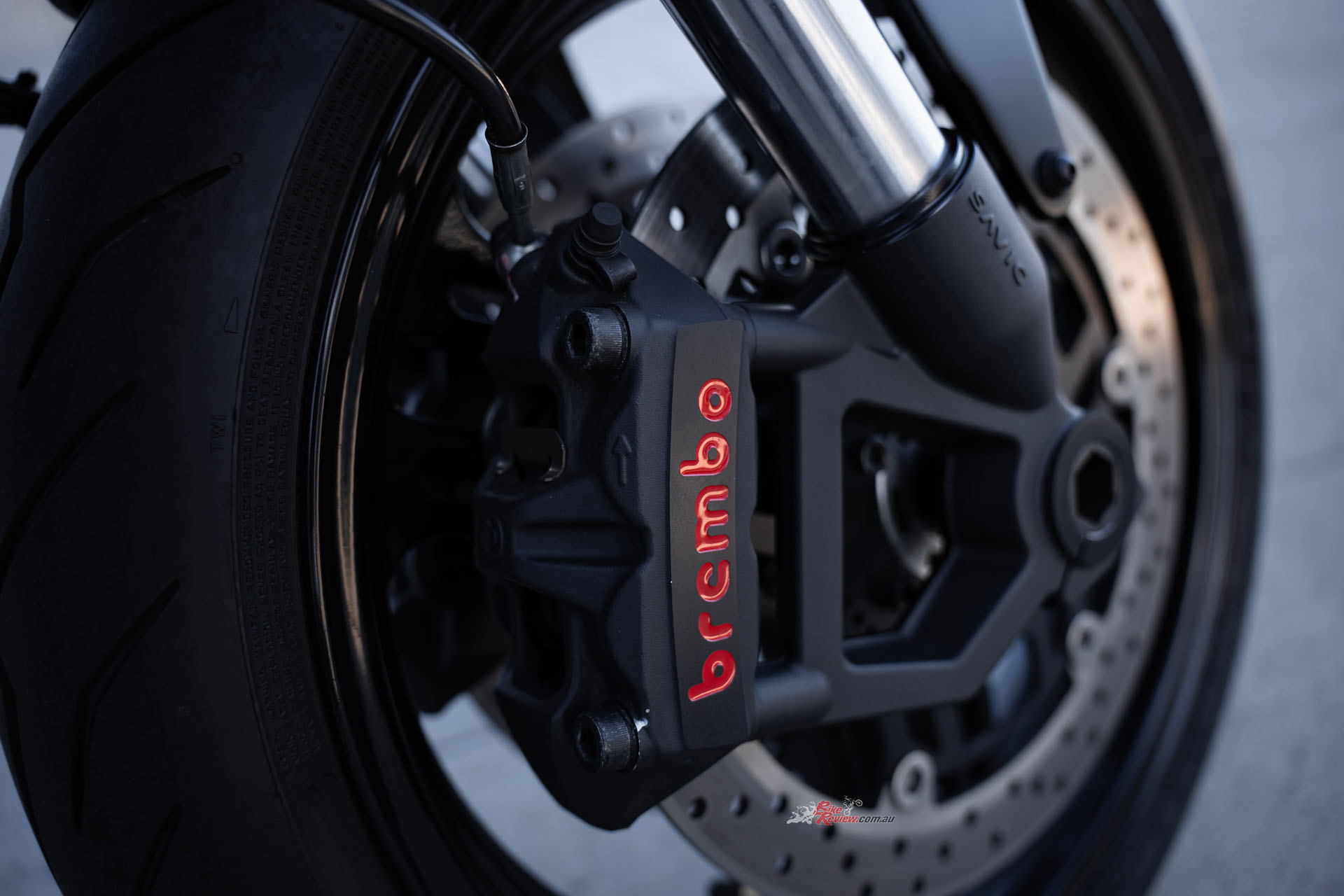
Savic haven’t skimped where it matters, with premium Brembo brakes and Pirelli tyres standard fitment.
Savic sells the Alpha directly rather than through dealerships, a model that suits a small manufacturer and avoids dealer overheads. It helps explain how the bike can be priced at $29,990 rather than edging closer to the LiveWire, Zero or Energica. Buyers also deal directly with the company from order through to servicing, which adds a personal touch you don’t usually get with larger brands.
There’s scope to make each bike your own too. Beyond the standard silver or black, customers can choose bespoke colours, opt for carbon bodywork or add a pillion kit. An expanding range of accessories and clothing rounds out the package, and for a first-generation Australian-made motorcycle the overall polish is impressive
The Savic C-Series Alpha is the outcome of more than a decade of determination and persistence. It’s impressive, well executed, ridiculously fast and like nothing you’ve seen on the road before. The torque is addictive, the throttle feel is progressive and the range is credible in real-world use. But it isn’t perfect. The weight is obvious at low speed, the seat is too hard for long stretches and some of the finishing touches don’t match the standard of the bigger-ticket components. But those drawbacks don’t take away from what Savic has achieved.
Savic’s 3-phase AC Interior Permanent Magnet Synchronous Motor provides the power delivery.
At $29,990 plus on-roads, it undercuts international rivals while matching or exceeding them where it counts. More importantly, it’s a motorcycle that really feels sorted, rather than experimental. It offers a genuine electric option with performance and presence and a story you won’t find anywhere else, and proves that local manufacturing and ambitious ideas still have a place on Aussie shores.
Why only the Alpha?
Savic originally planned three versions of its C-Series: the 20kW Delta, the 40kW Omega and the 60kW Alpha. Early demand quickly showed that most customers wanted the top-spec machine, despite its higher price. More than 80 per cent of preorders were for the Alpha, so the decision was made to drop the Delta and Omega and focus entirely on the flagship model. The move simplified production and allowed the small Melbourne-based team to concentrate resources on building a single, high-performance model.
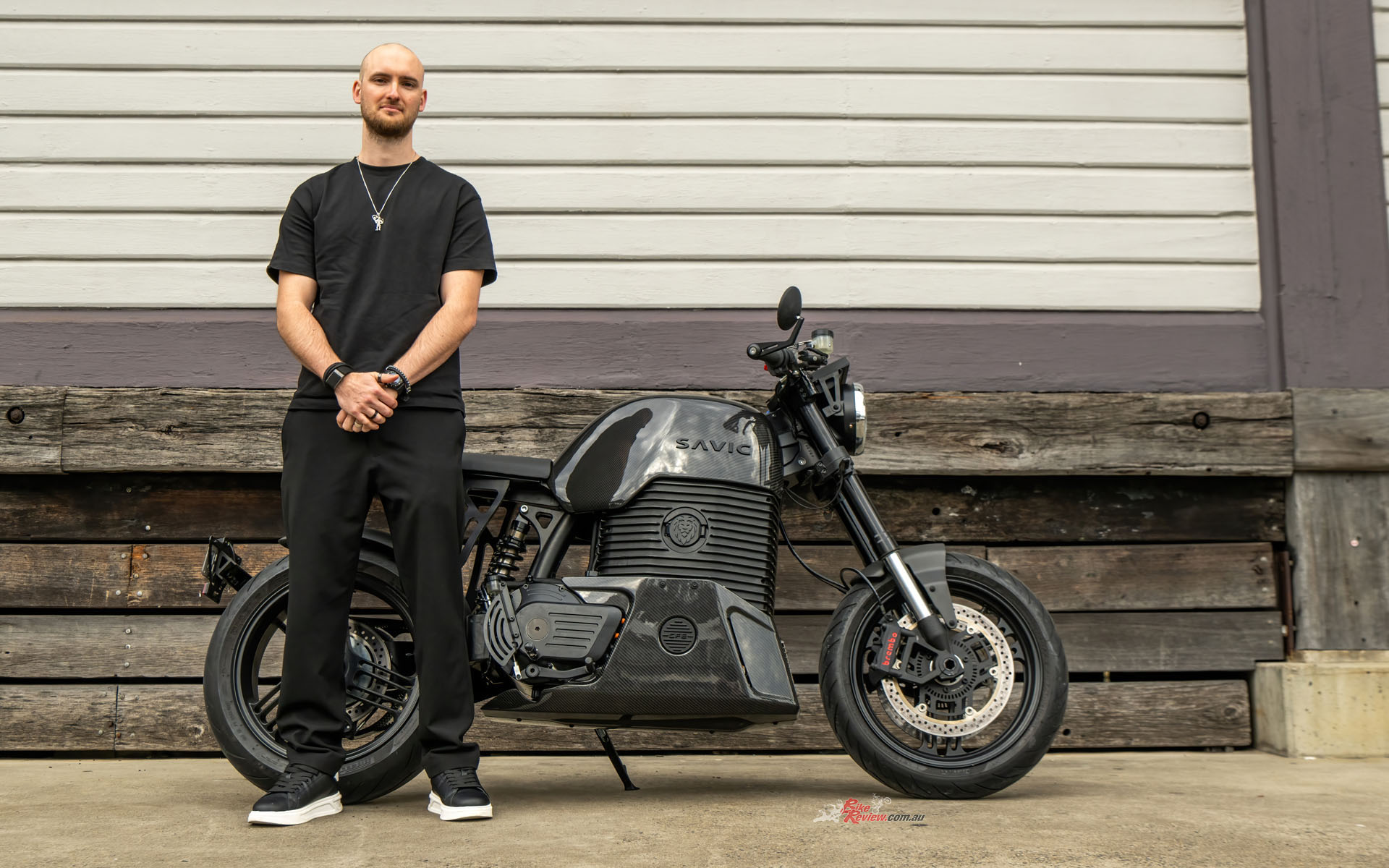
Dennis Savic with the top-shelf Carbon-Fibre option, we will take one of those any day, it looks absolutely awesome…
Savic C-Series Alpha Specifications
Price: $29,990 (plus on-road costs)
Colours: Metallic silver or metallic black
Warranty: Two years (Battery: five years)
Claimed power: 60kW [80.4hp]
Claimed torque: More than 200Nm [147.5ft-lb]
Top speed: 180km/h (est)
Weight: 280kg (including battery)
Range: Claimed (City): N/A (Highway): N/A
Range: km Claimed (Combined) 200km.
Servicing: First: 1000km Minor: 6000km Major: 12,000km.
Motor: SM1 3-Phase AC IPM motor with regenerative deceleration, clutchless direct carbon belt drive.
Power: NMC lithium-ion 16.2kW/h battery, 144 volts. 7h charge time (0-80%, wall socket), 4.5h (0-100%, Level 2).
Chassis: Cast steel, backbone-type with battery as a stressed member.
Rake: 24º Trail: 103.5mm
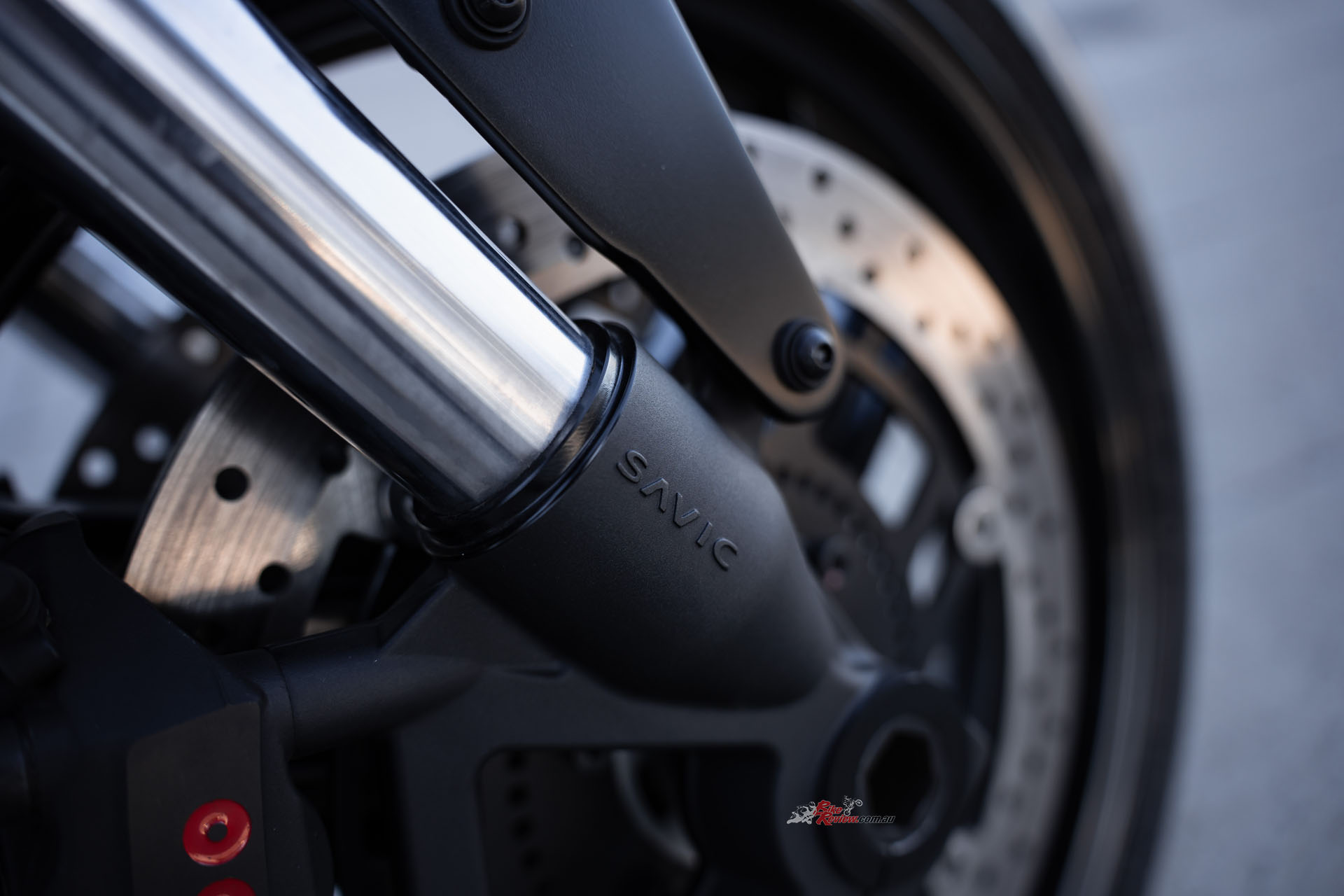
Suspension: 55mm USD telescopic forks, non-adjustable, 160mm travel (f); Monoshock, preload adjustable, 49mm travel (r). Brakes: Twin 320mm rotors, four-piston Brembo calipers (f); Single 260mm rotor, single-piston Brembo caliper (r). Bosch ABS. Wheels & Tyres: Cast aluminium, three-spoke, 3.50 x 17in (f), 5.50 x 17in (r), Pirelli Diablo Rosso III 120/70ZR17 (f), 180/55ZR17 (r).
Dimensions:
Wheelbase: 1440mm
Ground clearance: 145mm
Seat height: 780mm
Overall length: 2060mm
Overall width: 850mm
Overall height: 1020mm
Instruments & Electronics: 7-inch TFT dash with ABS, throttle response control, custimisable regen and reverse. Seven selectable modes (Sport, Normal, Rain, Eco plus three custom), cruise control and app connectivity.
2025 Savic C-Series Alpha Gallery
Ratings | Bike Review | 2025 Savic C-Series Alpha
Impressive
Australia’s first locally built electric roadbike, the Savic C-Series Alpha, delivers brutal torque, clever tech and a surprisingly high finish from a small Melbourne workshop.
The Author

You Might Also Like