
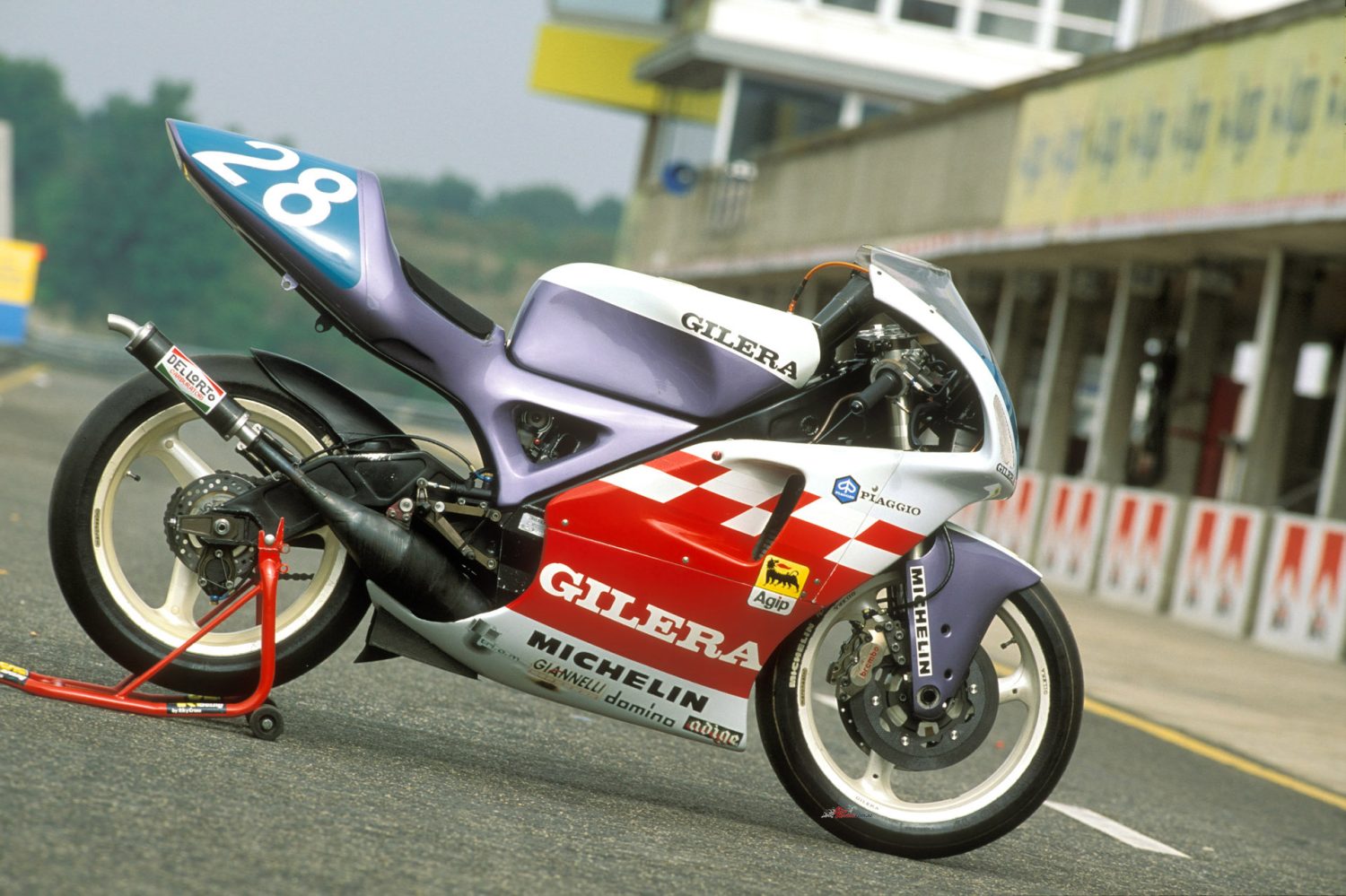

Gilera’s ambitious GFR250 marked the marque’s return to Grand Prix racing after 35 years. Cathcart rode the radical two-stroke to discover why its promise ultimately went unfulfilled.
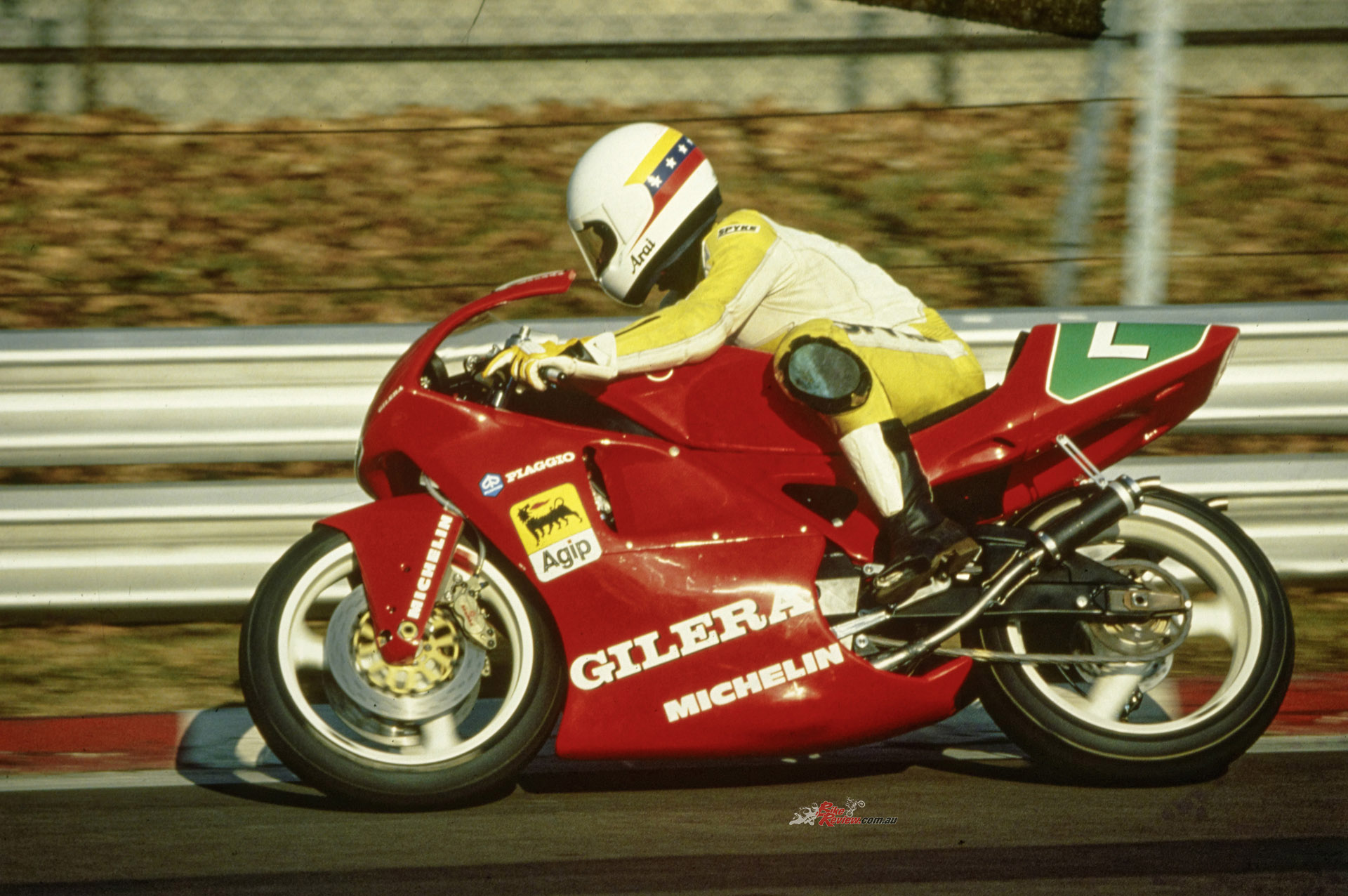
After 35 years away from Grand Prix racing, Gilera returned in 1992 with a new 250cc two-stroke with serious factory backing. The GFR250 looked the part, handled beautifully and promised plenty, but its return proved far more difficult than expected.
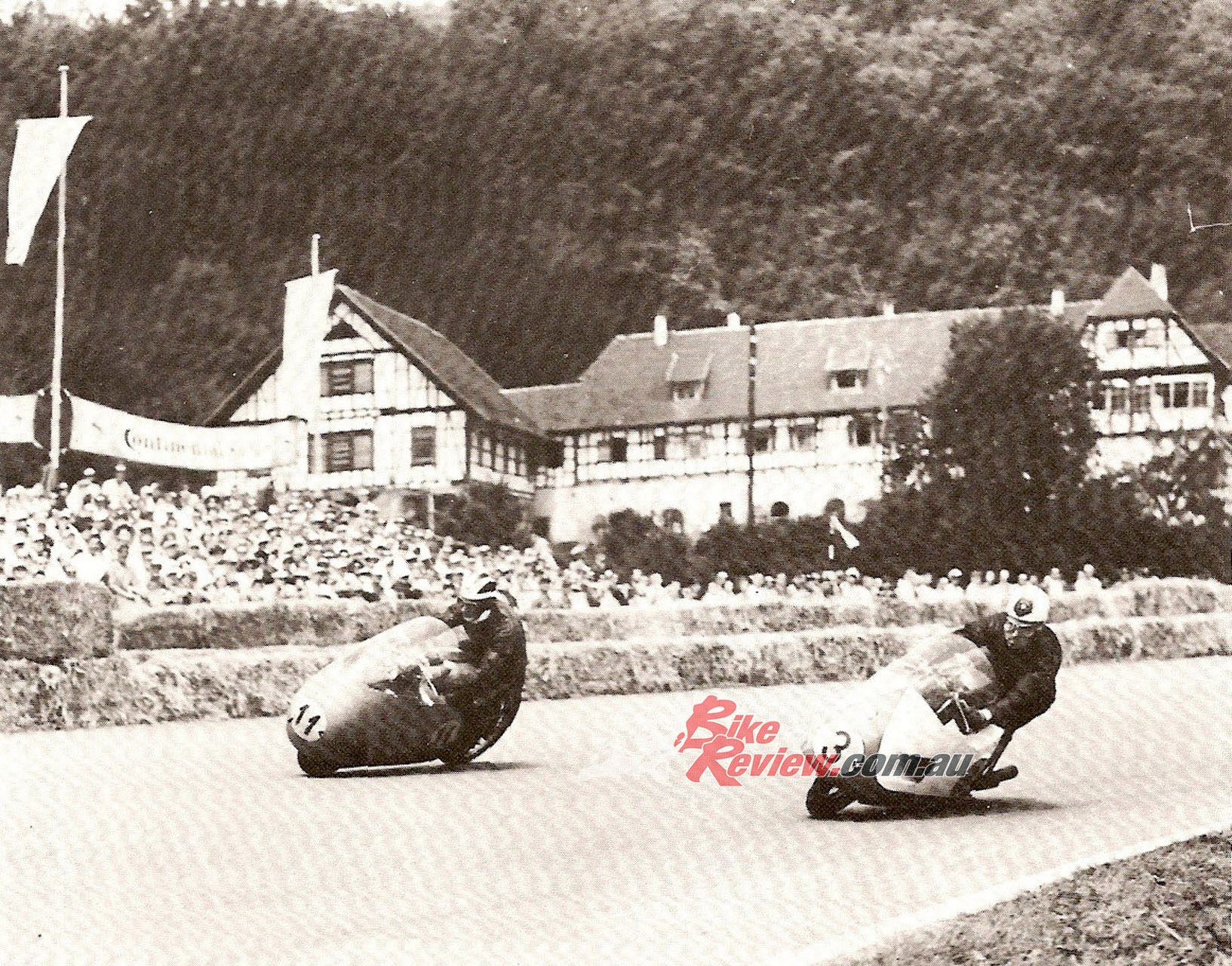
First off, a history class. Gilera is Italy’s oldest established (1909) motorcycle manufacturer. It invented the transverse in-line four-cylinder layout which later indelibly became the mark of Japanese-made bikes, it won the World 500cc Championship six times in eight years in the 1950s (most notably with the aid of the legendary Geoff Duke), stunned all concerned by retiring from road racing competition just days after clinching its final title in 1957 and, except for briefly supporting the semi-works Scuderia Duke team in returning to the GP arena in 1963, stayed away until 1992.
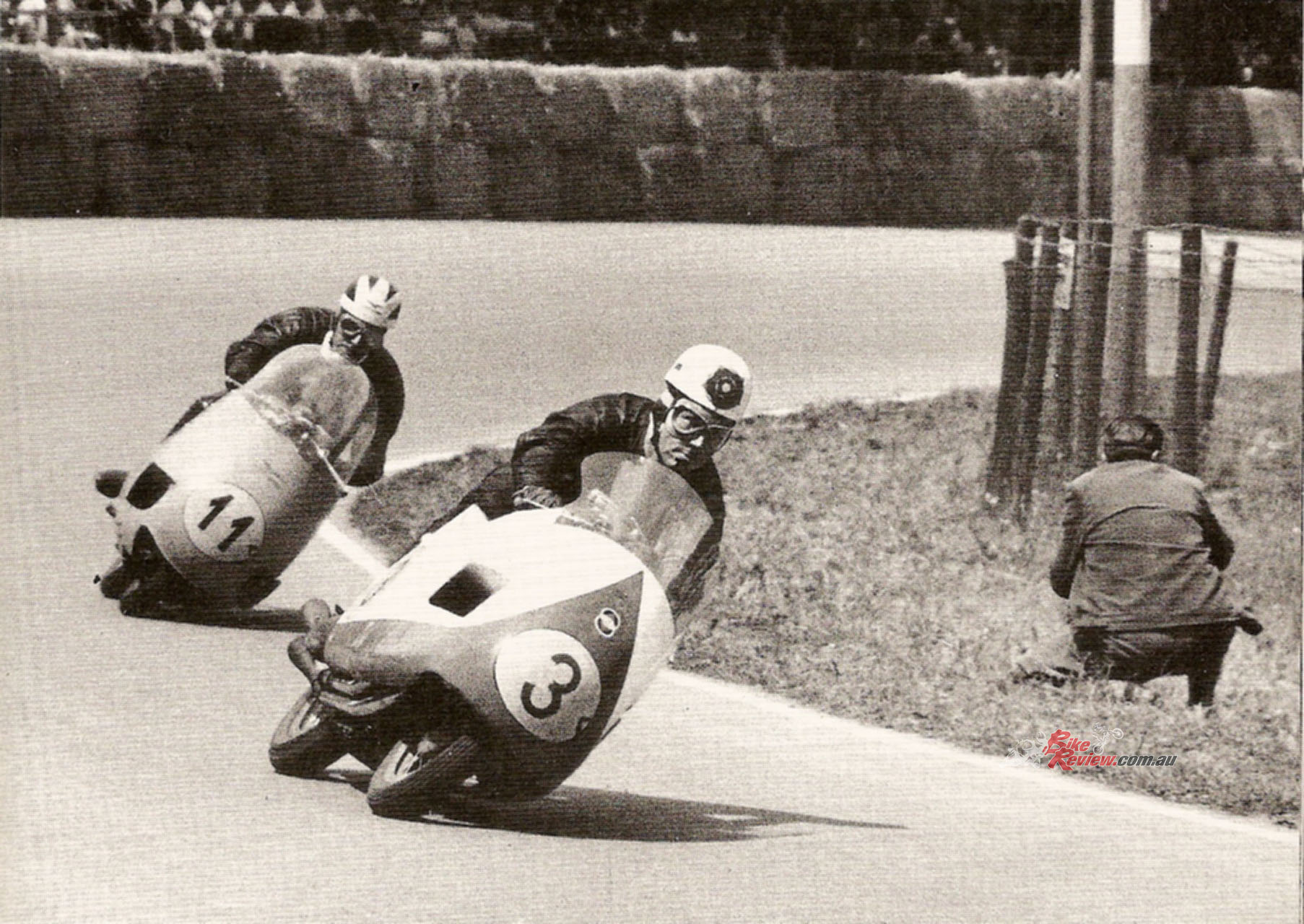
Until then, Gilera had never contested the 250GP class before, had never built a two-stroke road racer, had never carried sponsorship stickers on its factory bikes (not even those of its suppliers) and had never built a motorcycle employing any material more exotic than magnesium, nor any electronics more tricked out than a magneto.
Until then, Gilera had never contested the 250GP class before, had never built a two-stroke road racer and had never built a motorcycle employing any material more exotic than magnesium.
Yet in 1992 Gilera did all of those things, by returning to Grand Prix road racing for the first time in 35 years with a two-bike team comprising Venezuela’s two-time former world champion Carlos Lavado, and 250-class returnee, Frenchman Jean-Philippe Ruggia. In sanctioning this move, Piaggio management (the scooter specialist had purchased Gilera in 1969) were bowing to the inevitable. Because apart from companies like Harley and BMW, whose engineering ethos was completely alien to the then two-stroke dominated Grand Prix road racing world, Gilera and Kawasaki were the world’s only major street bike manufacturers not already participating in the rarified GP scene, with its ever accelerating technical spin-offs and equally crucial publicity benefits.
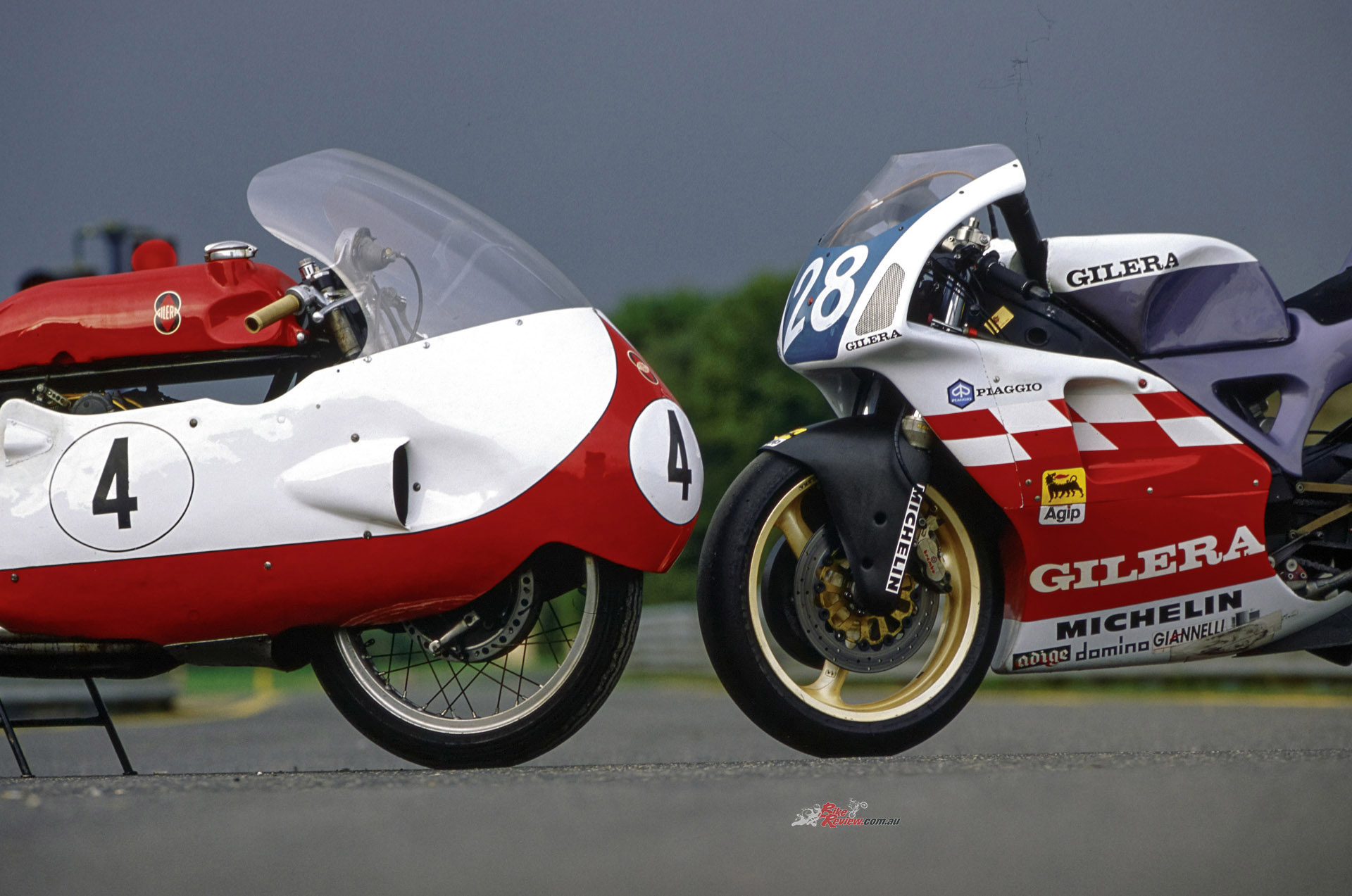
Thirty-five years apart, Gilera’s 1957 500-4 and 1992 GFR250 bookend two different eras of factory Grand Prix racing.
At the point that its five major rivals in the booming Italian street bike market – Aprilia, Cagiva, Honda, Suzuki and Yamaha – all had high-profile factory GP efforts, Gilera was practically forced to join them. Especially with the Agnelli family, who bankrolled Ferrari via their Fiat link and controlled Piaggio’s fortunes to pick up the tab. And once the go-ahead was eventually given, nothing was spared to ensure it was all done right.
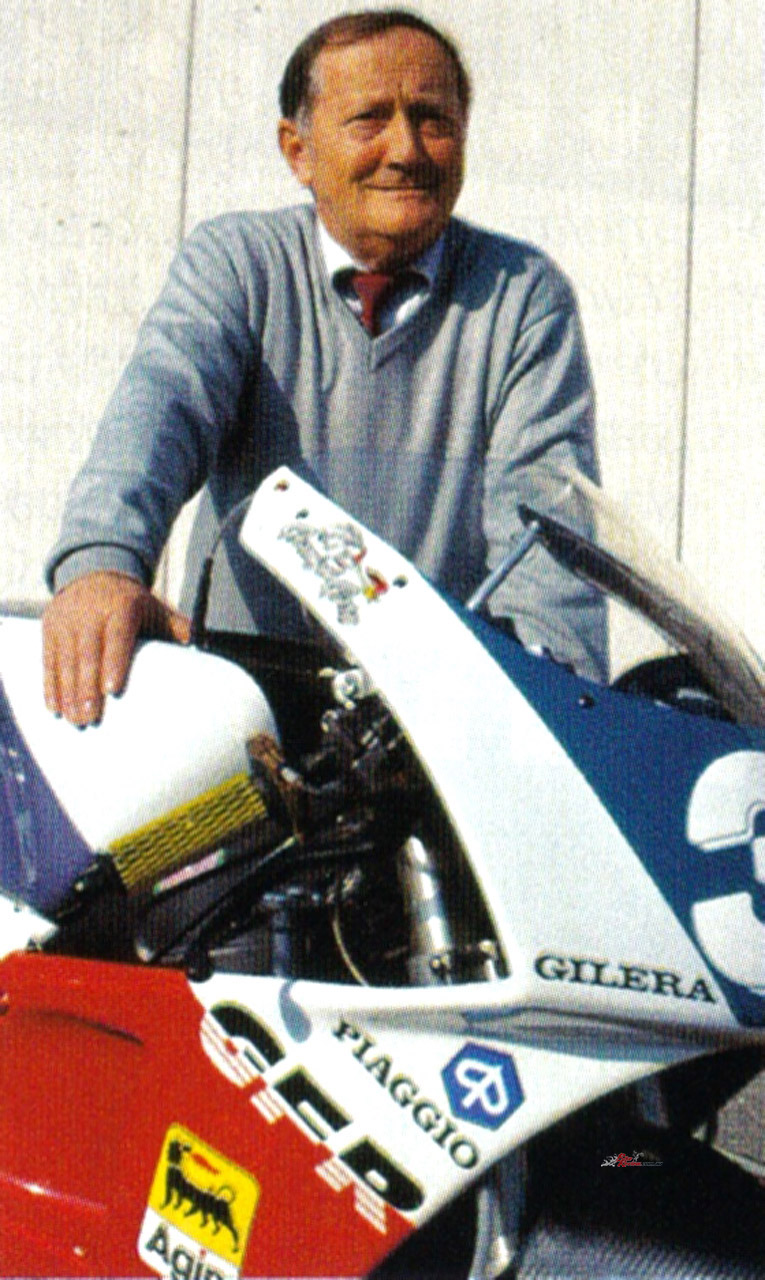
Working on an self-funded basis, without benefit of outside sponsorship, Piaggio devoted an extremely substantial budget (seven billion lire in 1991-92 alone, the equivalent of AUD$18.8 million today) to going racing, which included setting up its own racing department at Velate, northeast of Milan. Gilera Corse was established as a separate entity from both the Piaggio Group engineering HQ near Pisa, and the nearby Gilera factory itself, 5km away at Arcore, under the direction of Federico Martini.
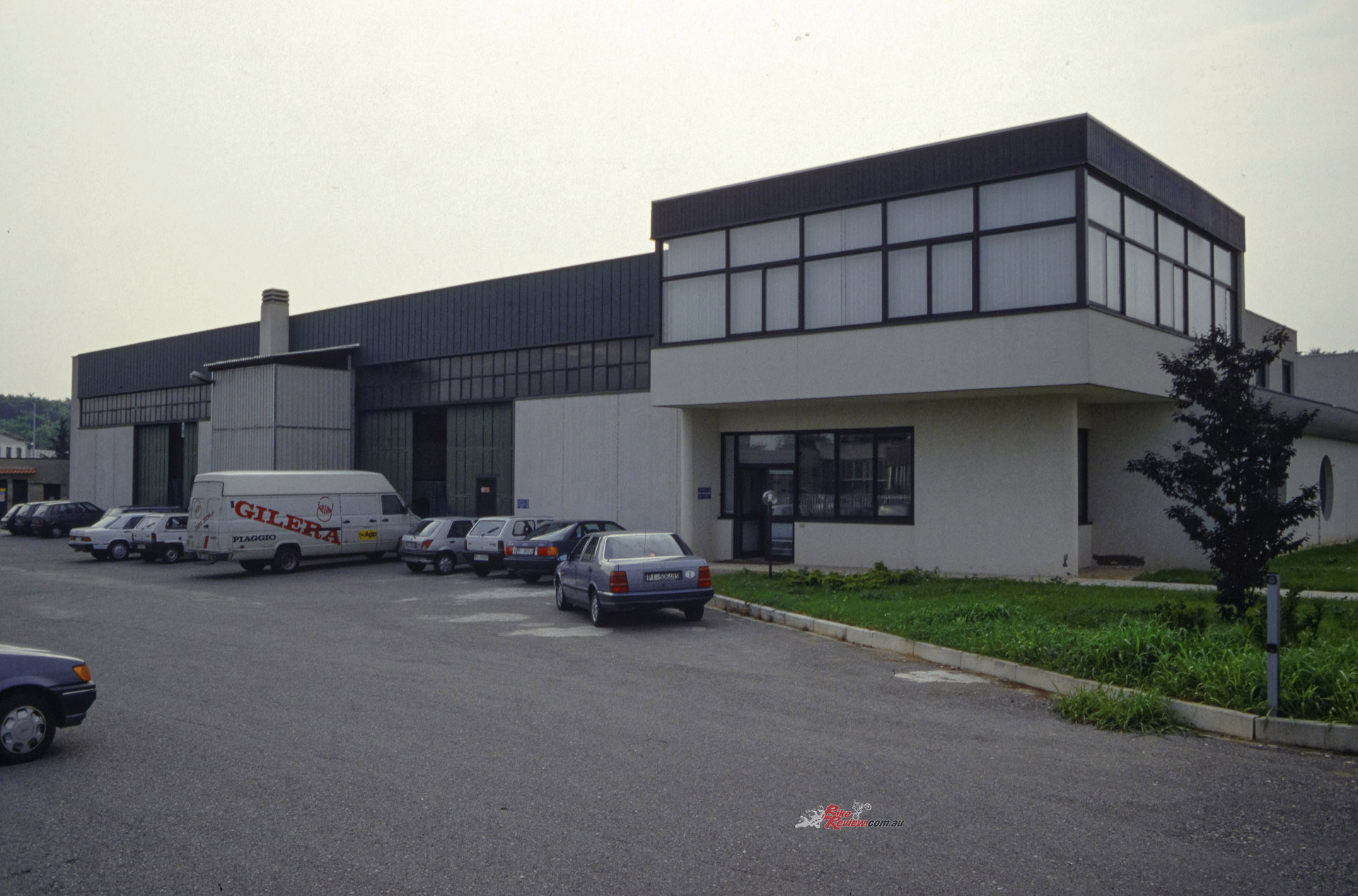
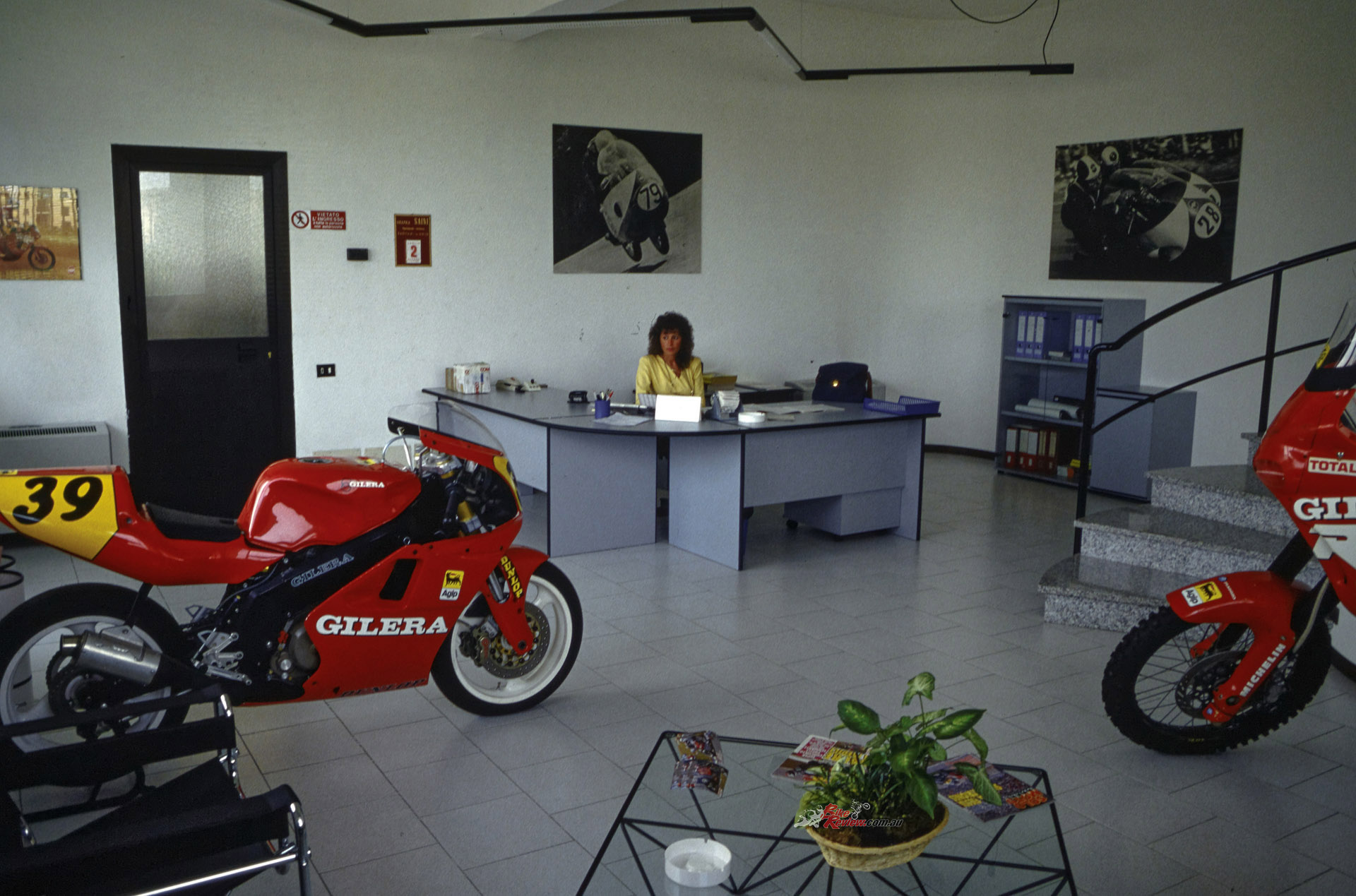
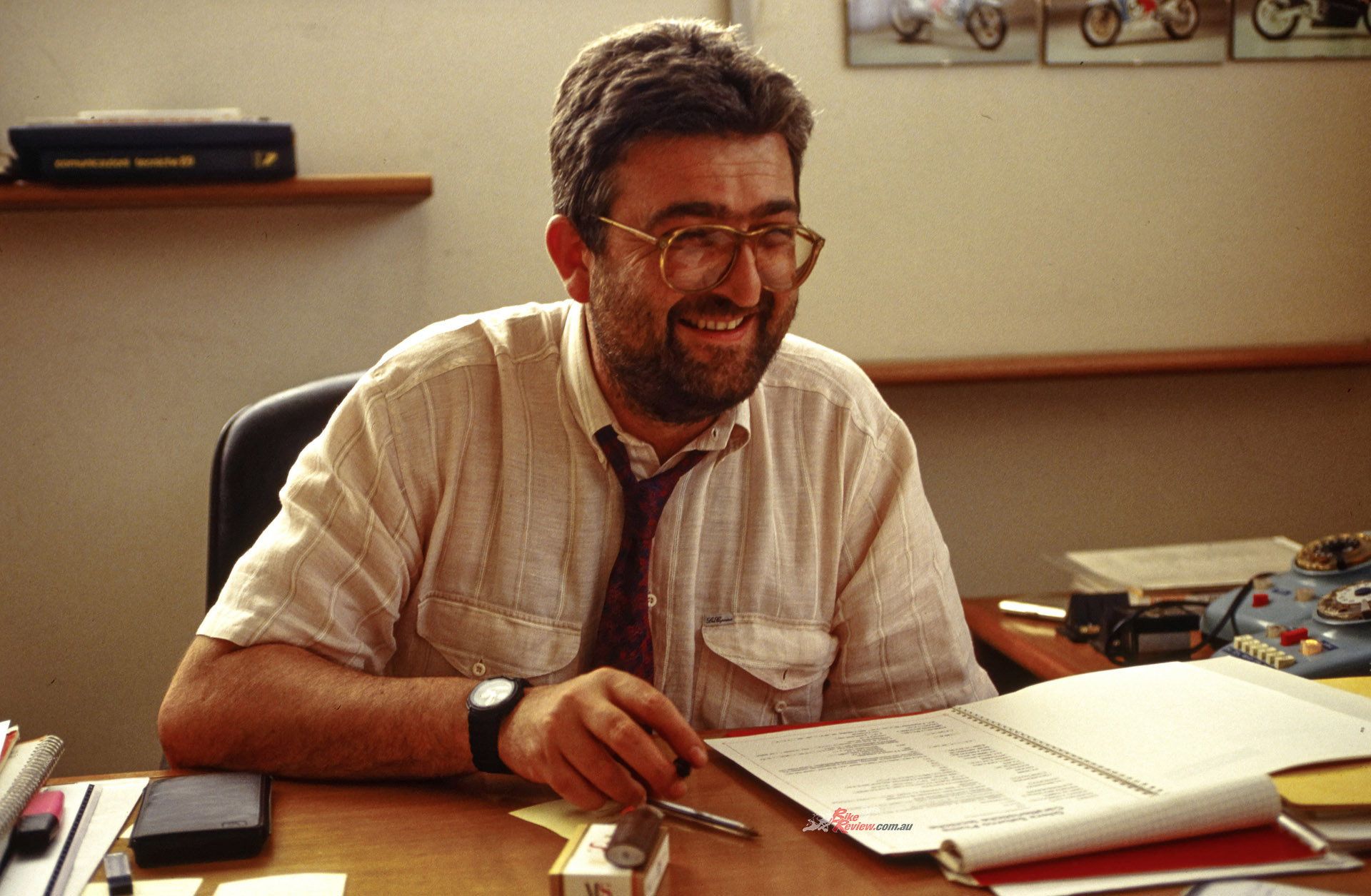
He was best known for his years as chief engineer at Bimota, where he created the company-saving Ducati-powered DB1 and the Yamaha FZ750-engined YB4EI, which narrowly failed to win the inaugural World Superbike Championship in 1988, before joining Gilera as Technical Director in 1989. The large new factory for the Gilera race team was equipped with the latest in machine tools and CAD design. No expense was spared in creating R&D facilities and Martini was given the task of delivering the first factory Gilera GP racer in over three decades to the starting grid of the first GP of the 1992 season at Suzuka – a mere 13 months after Piaggio gave the go-ahead on February 21, 1991.
Martini was given the task of delivering the first factory Gilera GP racer in over three decades a mere 13 months after Piaggio gave the go-ahead.
Martini made it, albeit narrowly, with the aid of a hand-picked group of engineers most of whom were sourced from within the parent Gilera factory, but only a few of whom were involved the last time Gilera had gone GP racing with a factory team. No, that wasn’t during the 1950s in road racing, but just a decade earlier in 125cc Motocross with the unique 1980 twin-cylinder B125 two-stroke designed by Dutchman Jan Witteveen. Ironically, he’d been Gilera’s chief race engineer back then, but now headed up its bitter rival Aprilia’s road racing department, free to focus on winning races and titles as he would shortly do, courtesy of Max Biaggi.
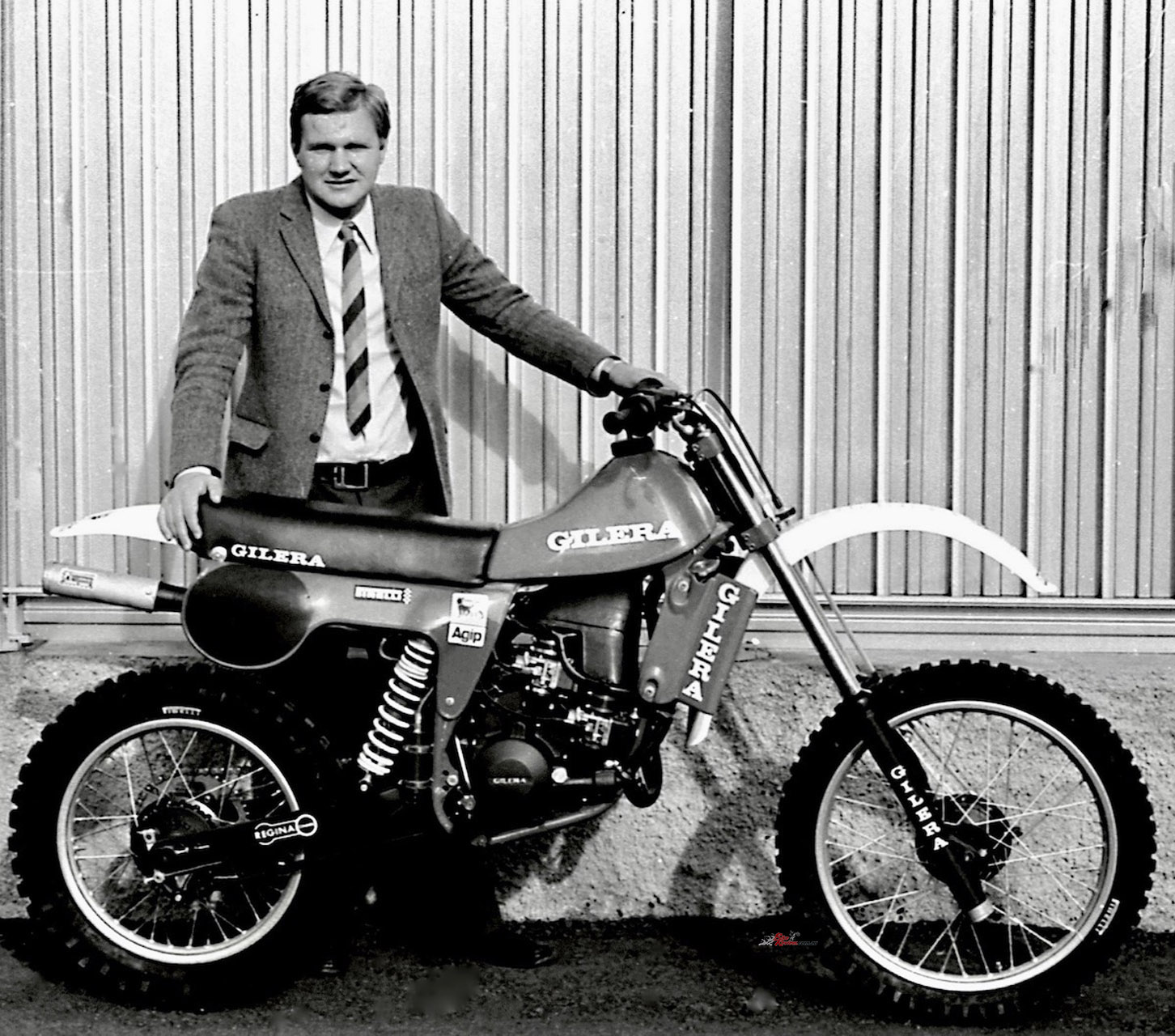
1980 Gilera B125 MX twin with designer Jan Witteveen.
But Martini and his team had to cope with several distractions, like developing the four-stroke Gilera RC750 single into an overall race-winner of the gruelling African rallies – it won both the 1992 Tunisia and Pharaoahs events. Still, right on schedule the first 250GP bike was tested at Monza in January 1982.
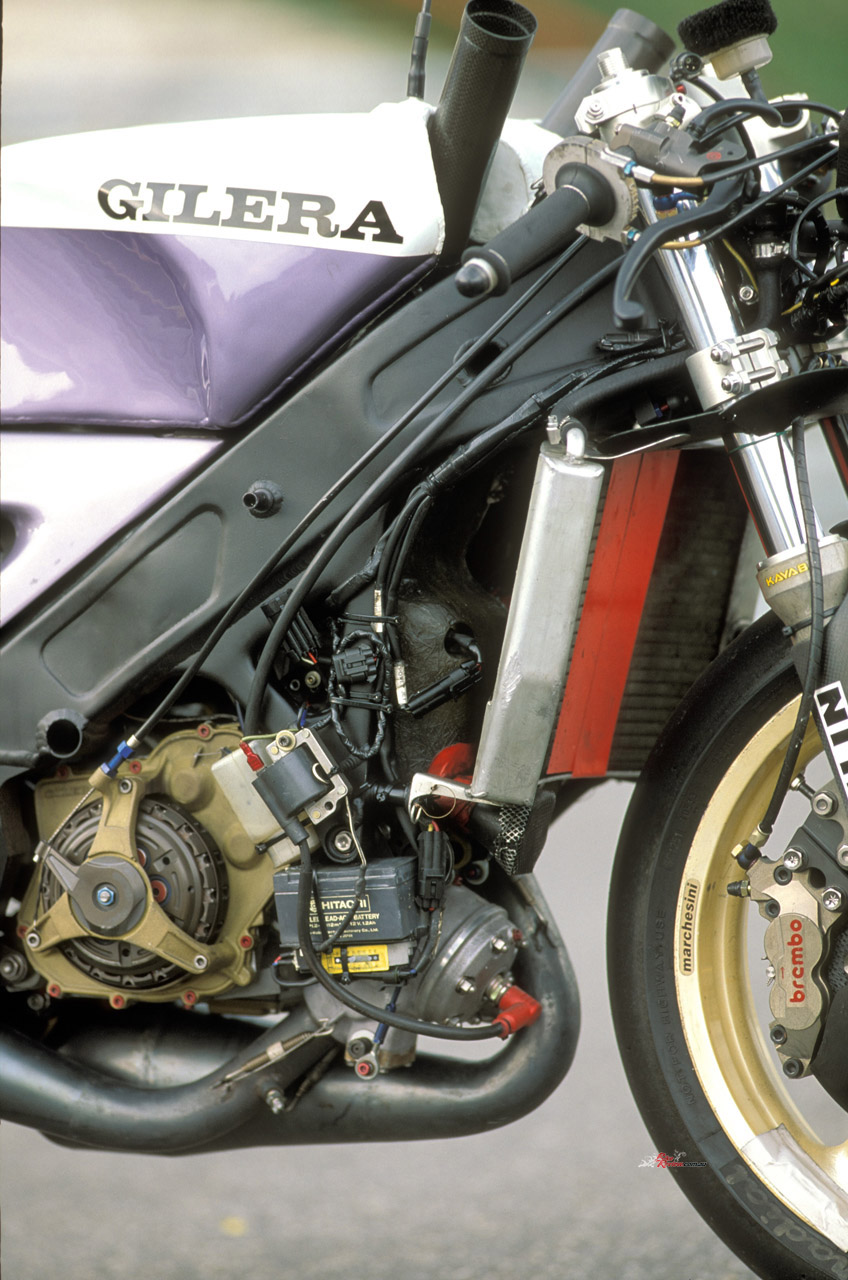
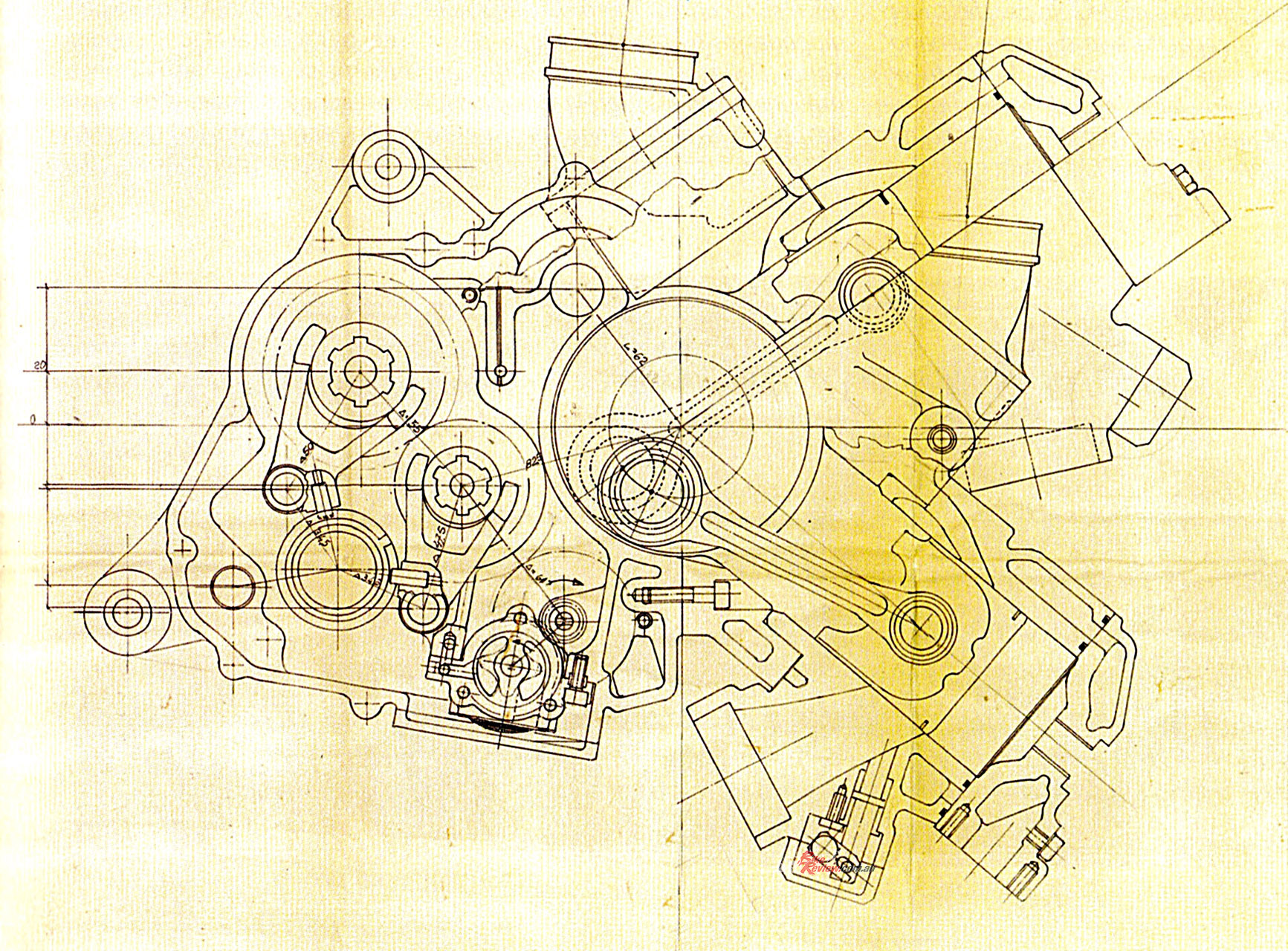
This employed a liquid-cooled 249cc single-crankshaft 75° V-twin crankcase reed-valve two-stroke motor sharing the same 56 x 50.7mm dimensions as the Yamaha Carlos Lavado had won his second world title on, with seven transfer ports/three exhausts, plus a gear-driven balance shaft and electronic power-valves controlled by the digital ECU. After Nippondenso and Kokkusan both declined to supply the Italian team with their latest electronic ignition package, Gilera inked a deal with the small but advanced EFI Technology firm in Bologna composed mainly of ex-Magneti Marelli technicians, to use their programmable ECU.
A liquid-cooled 249cc single-crankshaft 75° V-twin crankcase reed-valve two-stroke sharing the same 56 x 50.7mm dimensions as the Yamaha Lavado won his second world title on.
Created in-house by Gilera’s long-time engine designer Paolo Castelnuovo under the direction of Martini’s predecessor at Gilera, Lucio Masut, now technical Director of the entire Piaggio Group, the Gilera engine dead-heated on debut in the 1992 season-opening Japanese GP with Honda’s similar all-new NSR250 motor with the exact same cylinder angle. The 75º angle not only made for a more compact package but also minimised the difference in intake lengths between carburettors and crankcase compared to a 90° V-twin. But special carbs were needed to permit this, with Dell’Orto creating some very costly flat-slide devices for Gilera which had to function near-horizontally, and were available in 38mm or 40mm throttle sizes.
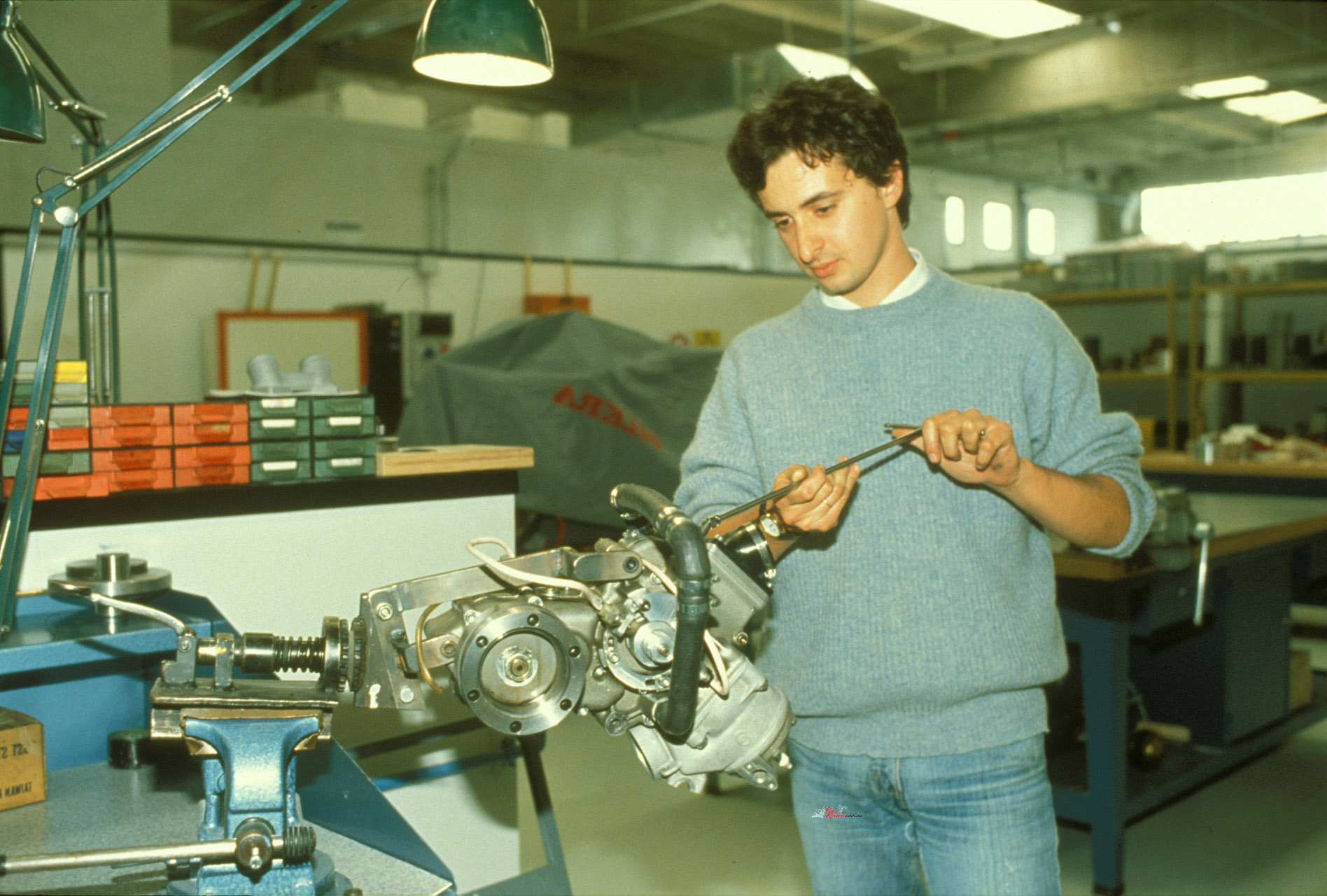
Paolo Castelnuovo, the GFR250’s engine designer, works on the 75° V-twin at Gilera Corse.
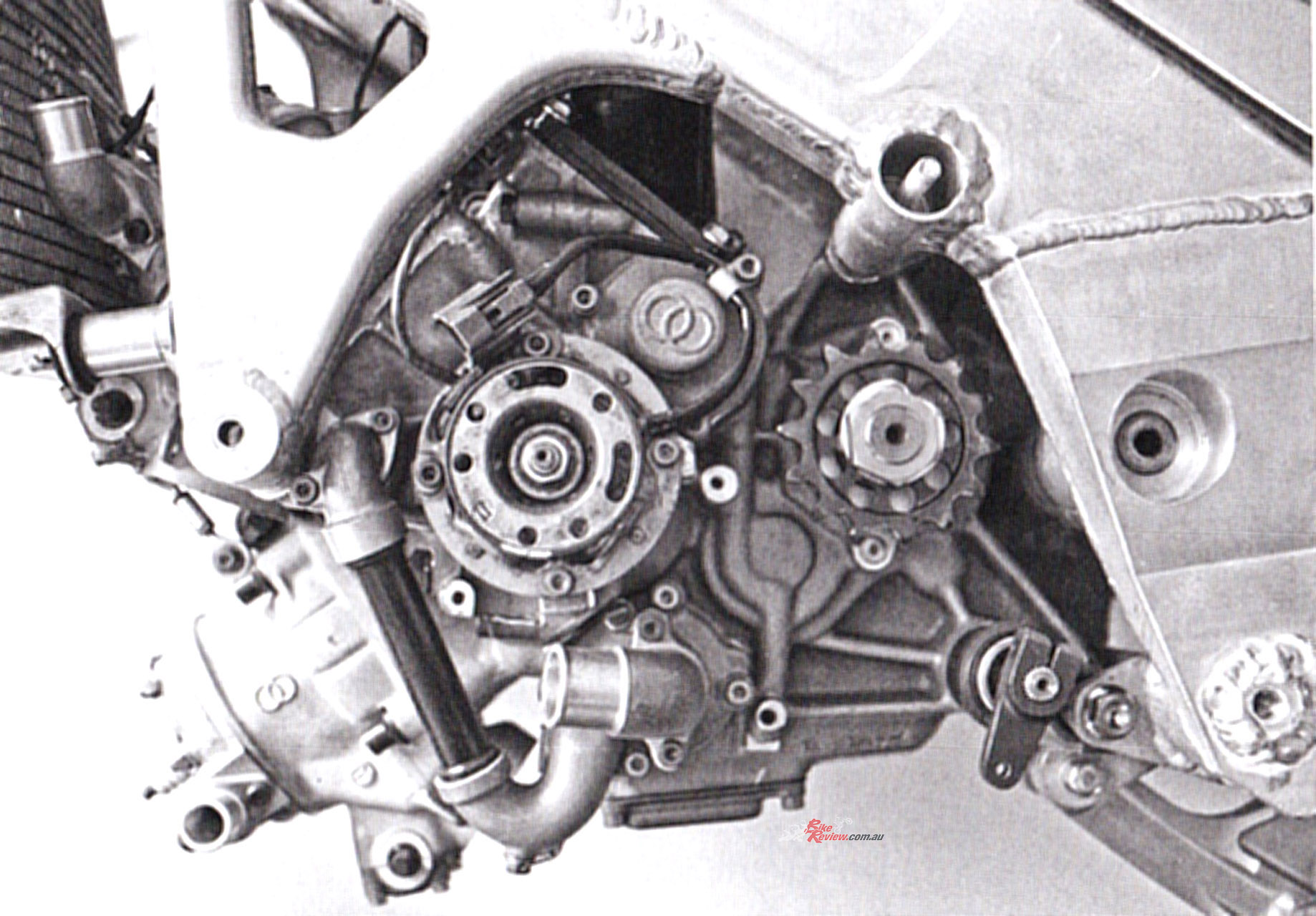
The GFR250 (standing for Gilera Formula Racing) motor’s crankcases and Nikasil-lined cylinders were cast in magnesium, permitting the whole engine minus carburettors to scale just 23kg. This featured an extractable six-speed gearbox made by Comex in Bologna, with a choice of five different options for each ratio, plus a 12-plate dry clutch with Rimoldi sintered bronze plates. The 75° V-twin configuration also allowed for a lightweight crankshaft which featured three main bearings (increased to four for 1993) using then-new lightweight ceramic ball bearings, and needle roller bearings for the conrods.
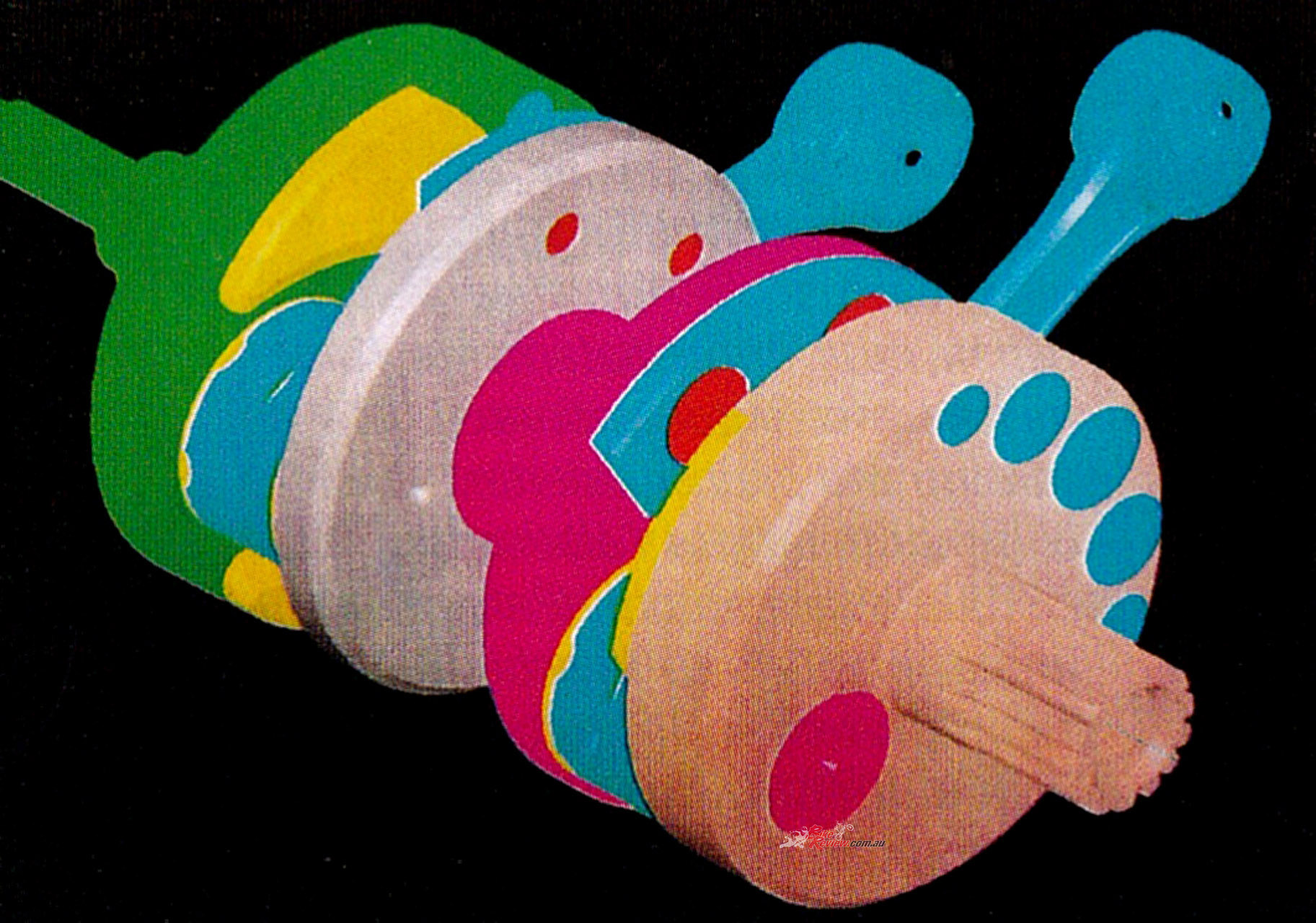
Several other weight-saving materials were employed, with the balance shaft made of titanium, as was the clutch basket, and the conrods, crankshaft, and gearbox made from VAR/vacuum arc-remelted steel for increased strength and durability. The engine fired up on the Velate dyno for the first time in mid-October 1991 and astounded all those present by delivering 84hp at 13,250rpm on the very first run – the same as Luca Cadalora’s 1991 World champion Honda NSR250. Game on!
It astounded all those present by delivering 84hp at 13,250rpm on the very first dyno run – the same as Luca Cadalora’s 1991 world champion Honda NSR250. Game on!
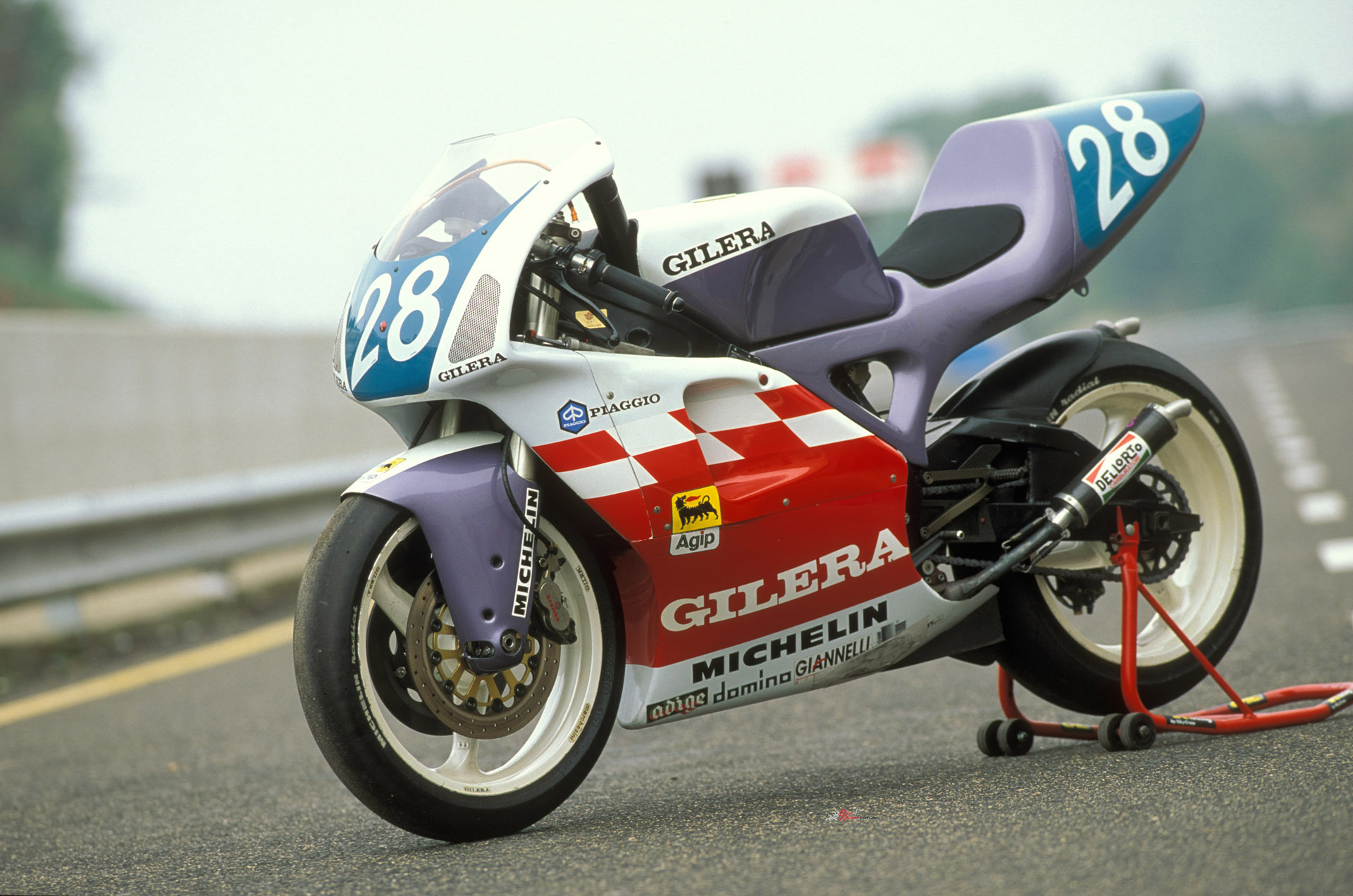
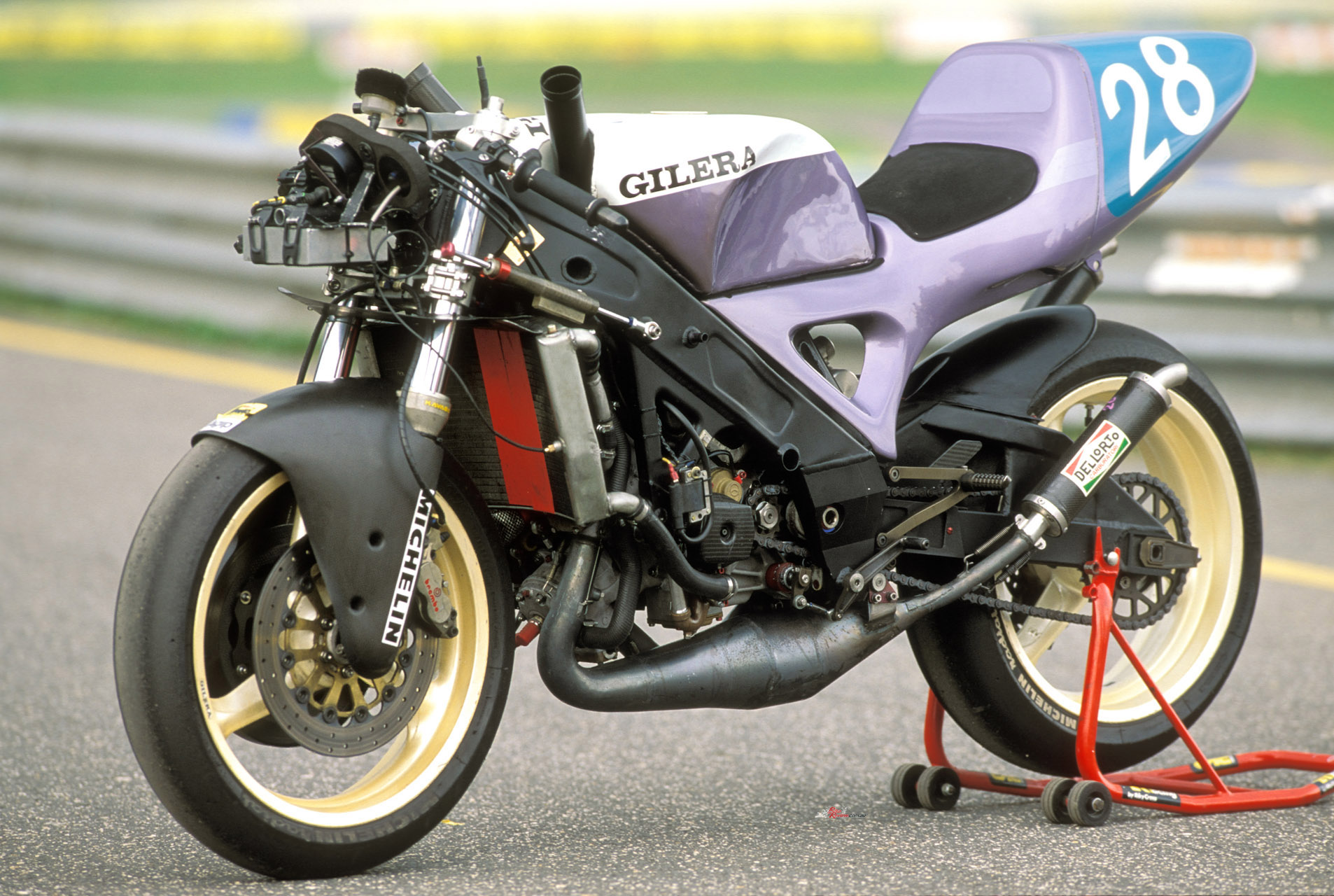
This motor was housed in a pressed Carpental aluminium twin-spar frame weighing just 10kg designed by a team headed by Federico Martini himself, and like the fabricated aluminium banana swingarm was built in Velate before being sent to Verlicchi for heat-treating. As an established supplier for Gilera road bikes, Kayaba’s latest and best fully-adjustable suspension was fitted, with the 41mm upside-down fork with titanium springs set at a steep 21.5° rake, with 80mm of trail. This tight geometry resulted in a compact 1320mm wheelbase for what was intended to be a small, agile and responsive motorcycle – and a light one, too, which ended up scaling right on the 250GP weight limit at 95kg dry, with a pronounced 54/46% forward weight bias.
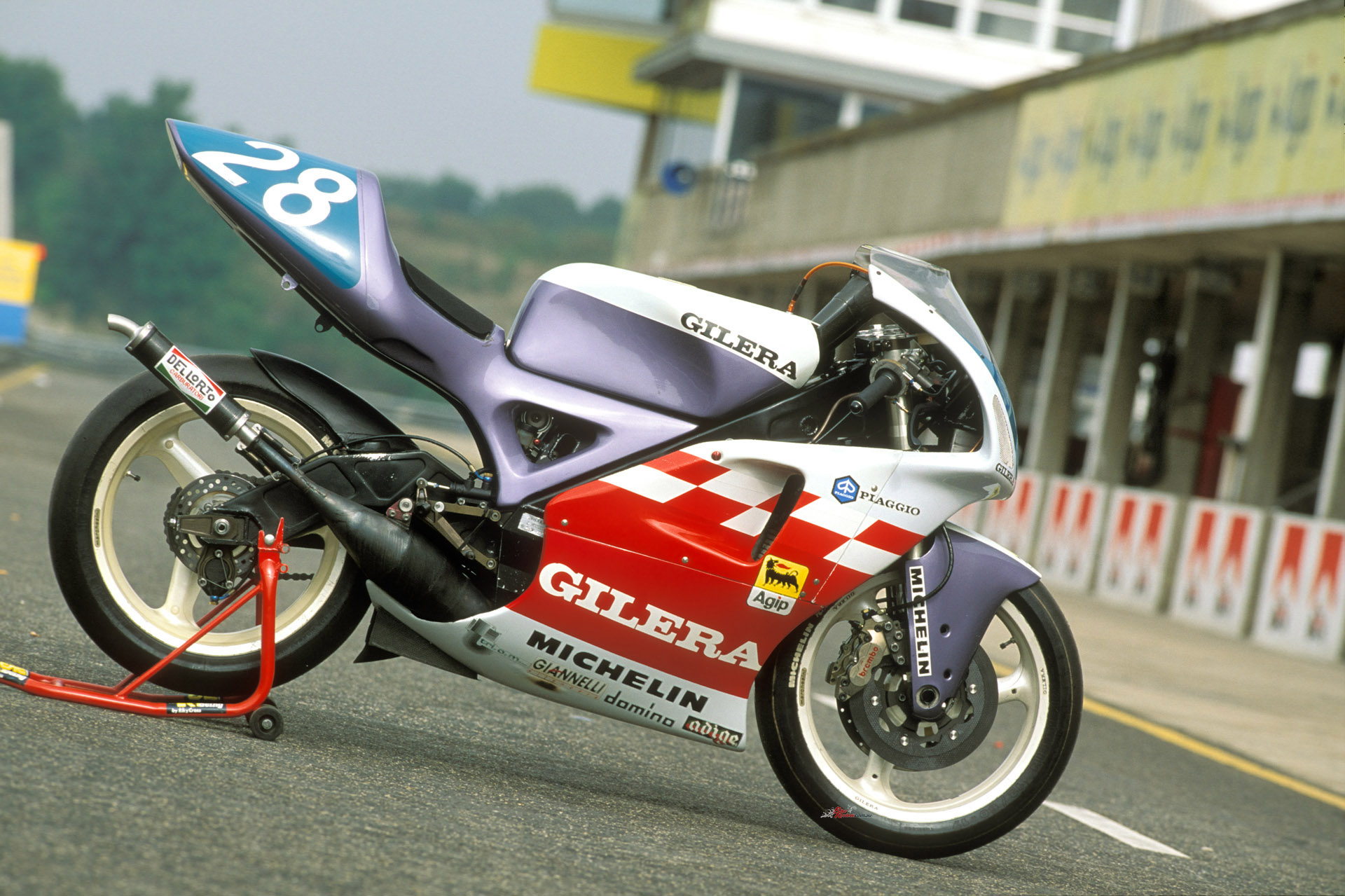
The GFR250’s 95kg package combined a compact 1320mm wheelbase with a pronounced 54/46% forward weight bias.
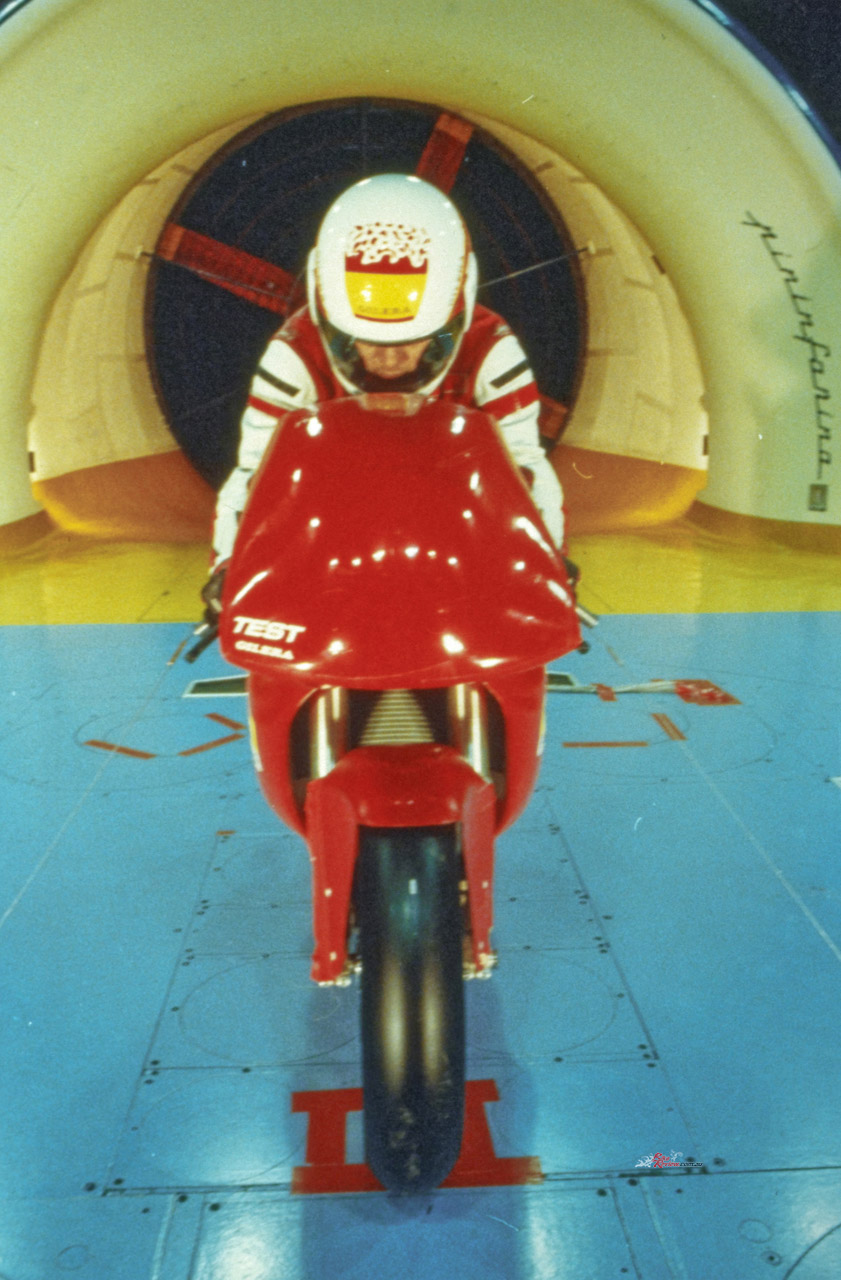
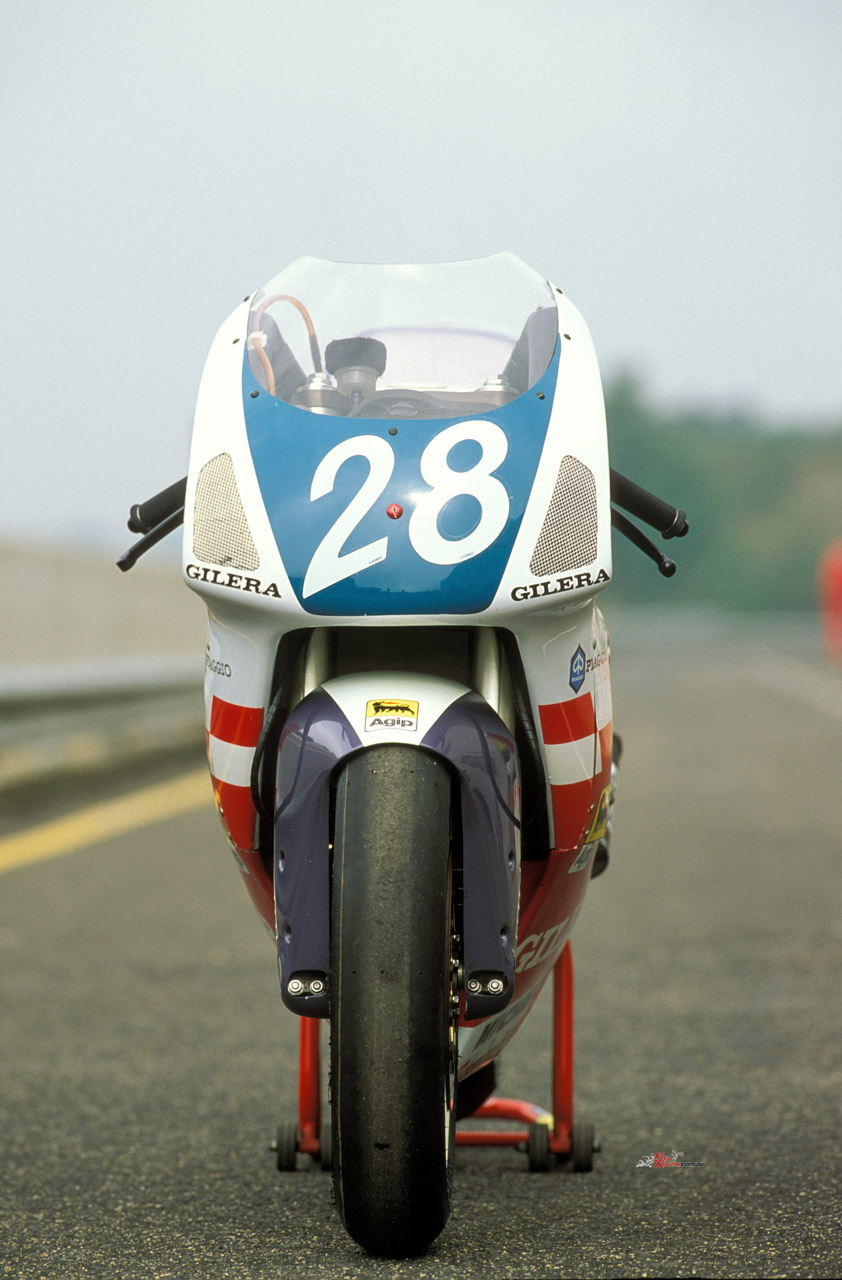
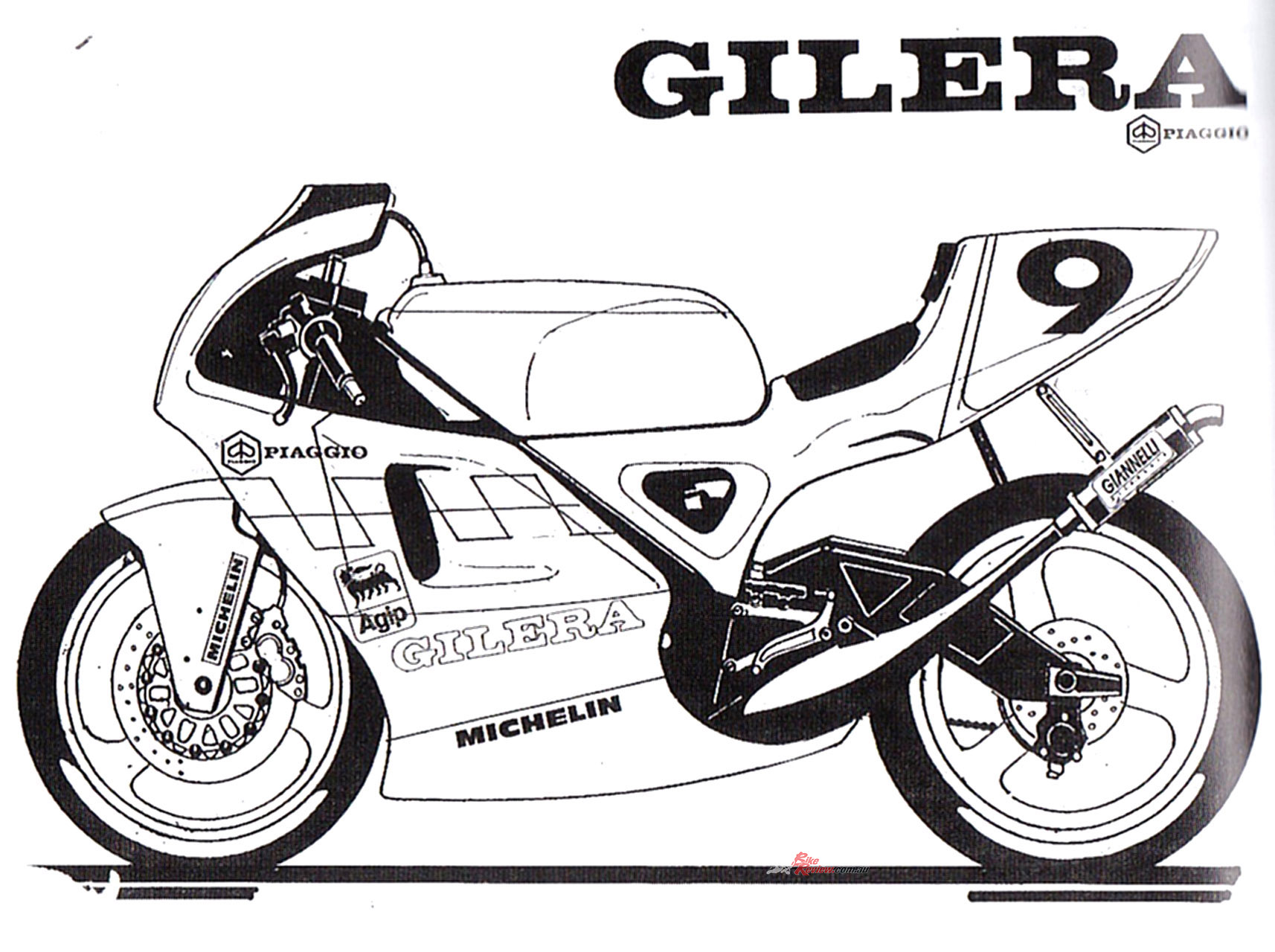
This was with a single 290mm steel front brake disc fitted alongside a 273mm carbon one, each gripped by four-piston Brembo calipers, with a 190mm steel disc with two-piston Brembo caliper at the rear. Michelin radials sat on 17-inch Marchesini cast magnesium wheels, the rear one 5.50in wide. Finally, the carbon/Kevlar bodywork was designed by Piaggio’s established designer Luciano Marabese and tested in the Pininfarina wind-tunnel in Turin. But its graphics aroused some controversy, with Gilera’s traditional red and white livery sharing a lilac expanse on the bike, supposedly to relate it to the Crono 125 Gilera streetbike battling for showroom supremacy in the sales charts with the products of those companies it was about to engage with on the racetrack.
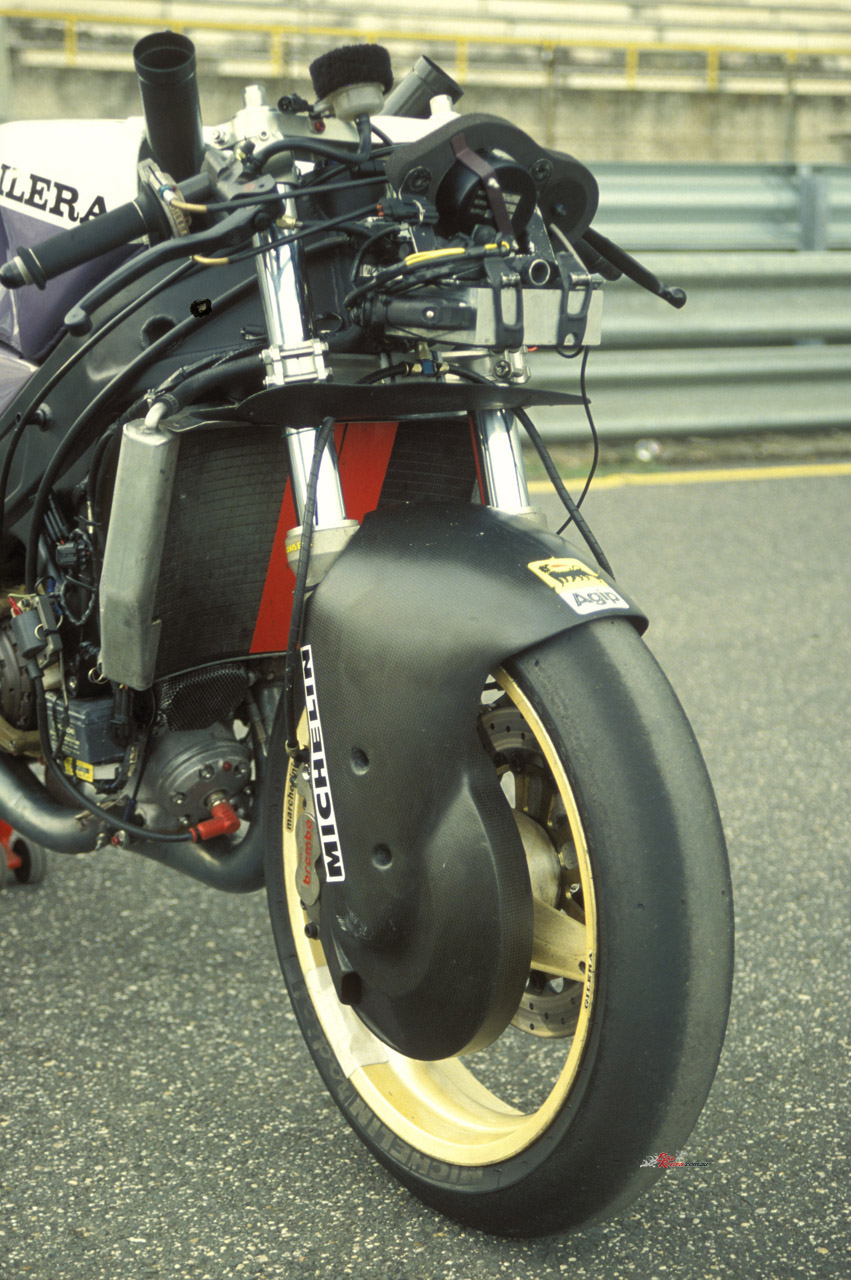
After just a couple of tests at a freezing Monza on January 29 followed by a rainy Mugello, the Gilera Corse team went to a soaking Suzuka for the GFR250’s first race with the bike greatly underdeveloped, yet managed third and fourth in the morning warm up before falling victim to drowned electrics in the race. But the Gilera then amazingly scored world championship points (just the top 10, back then) in only the bike’s second race (and its first in the dry), when Ruggia finished ninth in Australia. It was a promising start, even if Lavado could only manage 14th after a slow start.
Loving our historical racing content? You’ll find plenty more here.
Unfortunately, that was about as good as it was going to get, because although the riders scored points in four more GPs in 1992, they never ever placed better than ninth, never became true contenders for podium finishes and never really got on the pace in terms of development. Piaggio had subcontracted the day-to-day running of the race team to a man little known outside Italy, Oliviero Cruciani, rather than the other candidate they interviewed for the job, Giacomo Agostini – who ending up taking Cagiva to 500GP victory with Eddie Lawson instead!
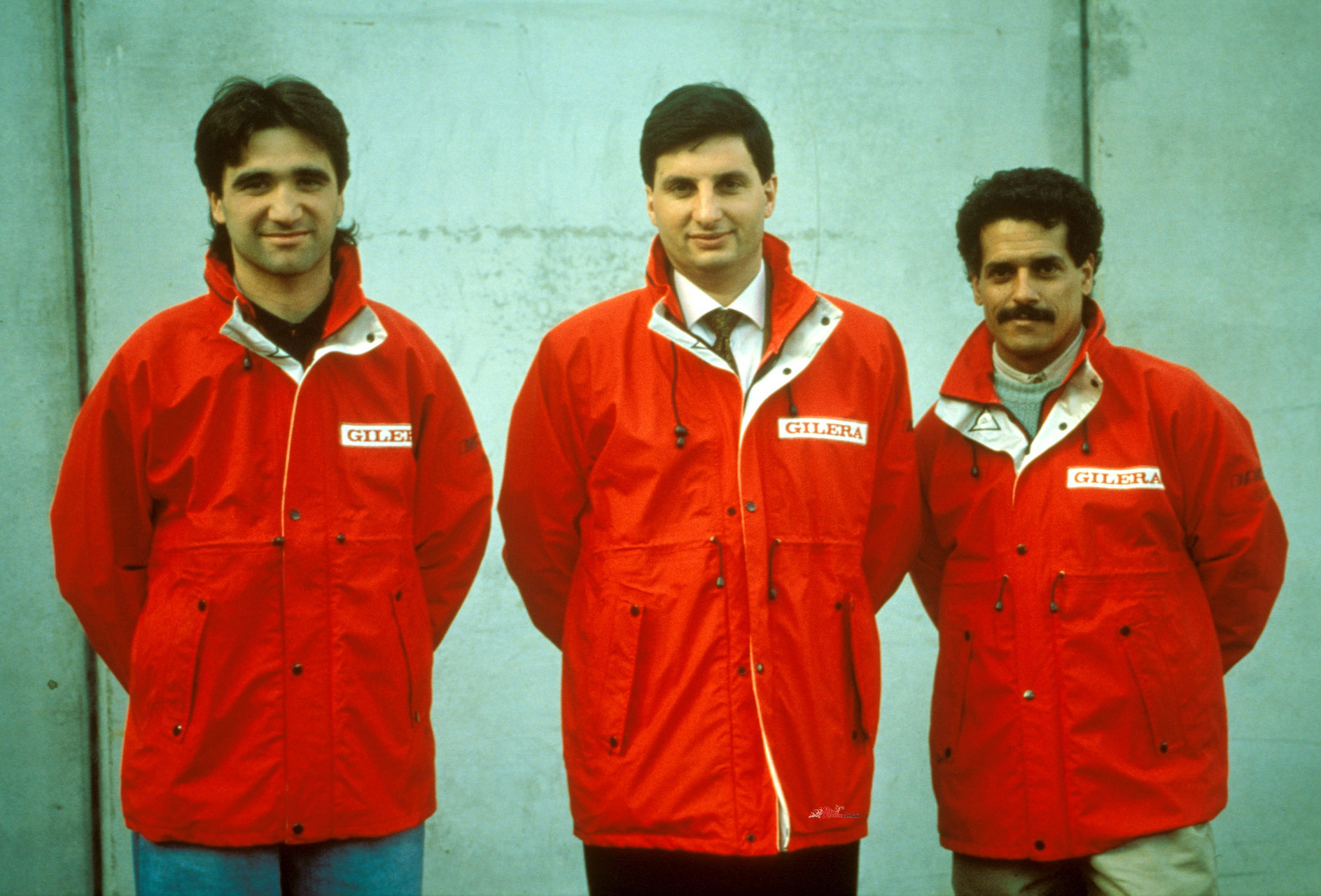
Team 1992 L-R Jean-Philippe Ruggia, team manager Oliviero Cruciani, Carlos Lavado.
It’s unclear why Piaggio management nixed Bergamo-based Ago, especially as Cruciani’s base near Rome at Vallelunga, 600km south of Velate, hardly made logistical sense. But to assist with the task of developing the Piaggio-designed engine, Martini lured Austrian tuning ace Harald Bartol away from Juan Garriga’s 500cc Ducados Yamaha team and put him in charge of the Gilera technical operation at races, while also furthering development via a succession of new cylinders and exhaust pipes on his dyno back home in Austria.
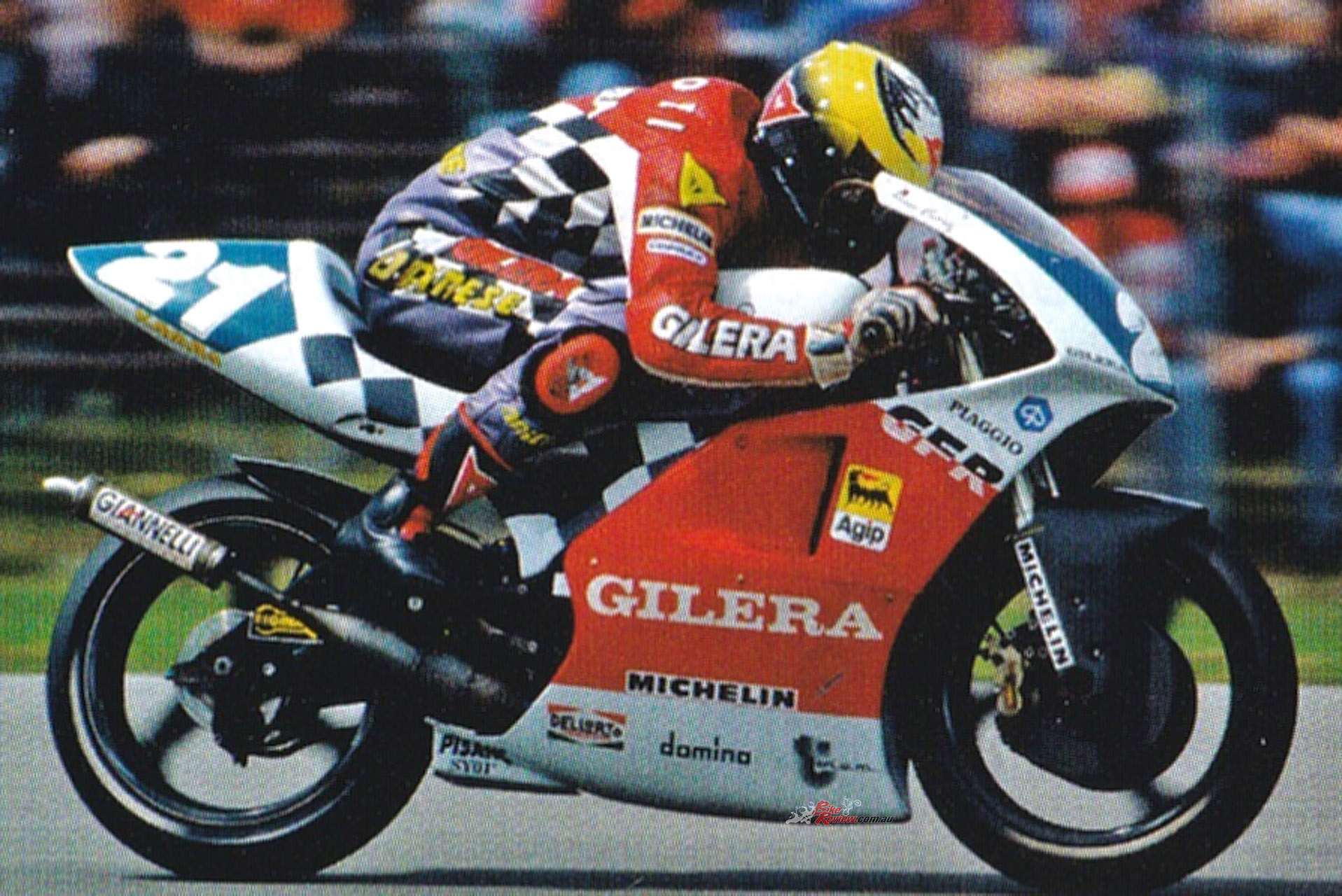
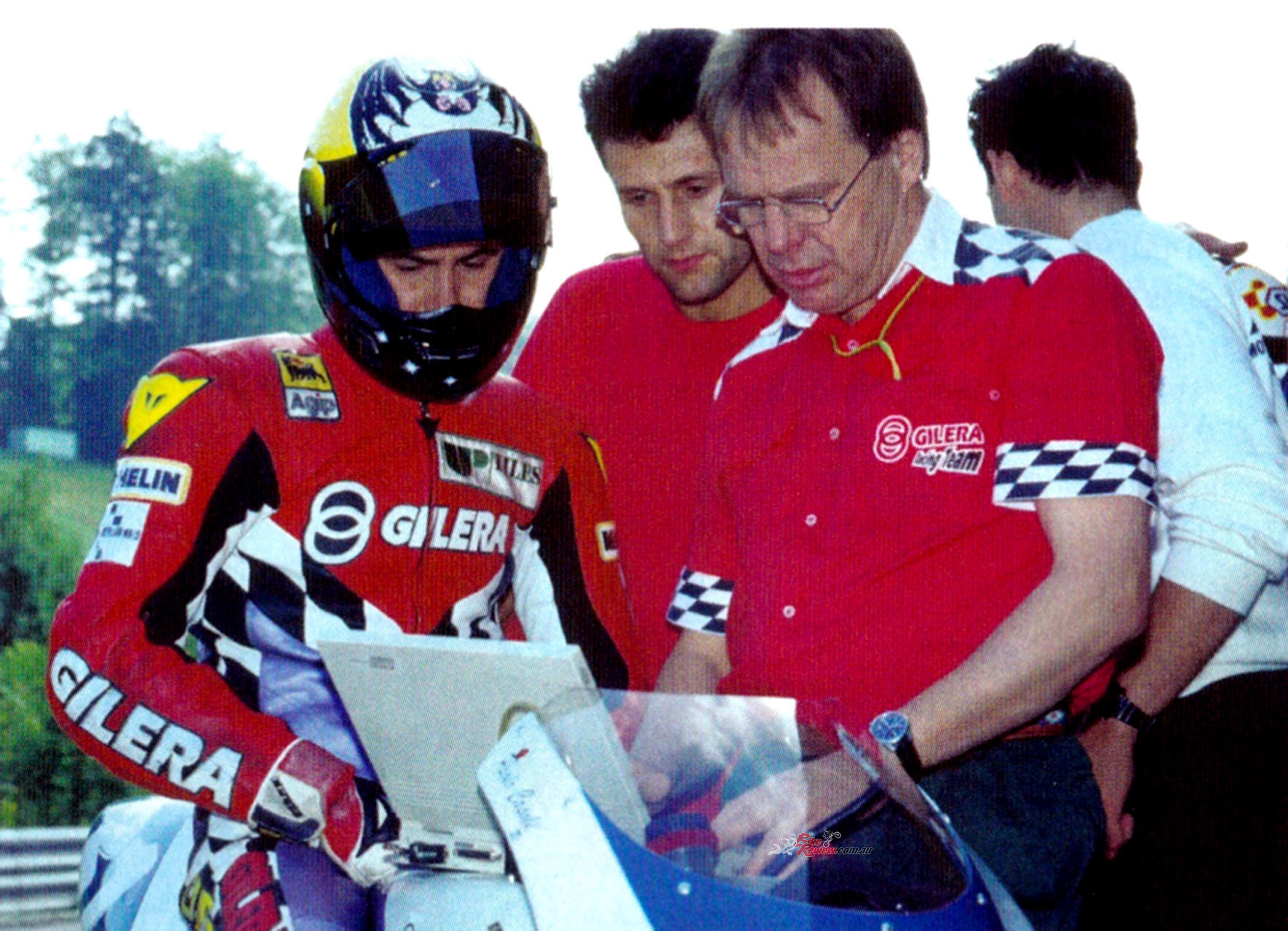
Meanwhile, Gilera’s B-team riders Paolo Casoli and Luca Pasini finished second and third respectively in that year’s Italian National 250cc championship, behind Aprilia’s GP-winning test rider Marcellino Lucchi, but ahead of a packed grid full of Aprilia and Yamaha customers headed by GP podium finisher Stefano Caracchi.
Martini lured Austrian tuning ace Harald Bartol away from Juan Garriga’s 500cc Ducados Yamaha team and put him in charge of the Gilera technical operation at races
The chance to ride the GFR250 Gilera at the end of the 1992 season on the Vallelunga circuit, showed up exactly where the bike then stood in the 250GP pecking order: nice frame, shame about the motor. Yet in opting for a single-crank 75° V-twin layout 13 months before its first race, Gilera had unconsciously followed the same design route as Honda with the all-new NSR250 on which Luca Cadalora won the 1992 world title.
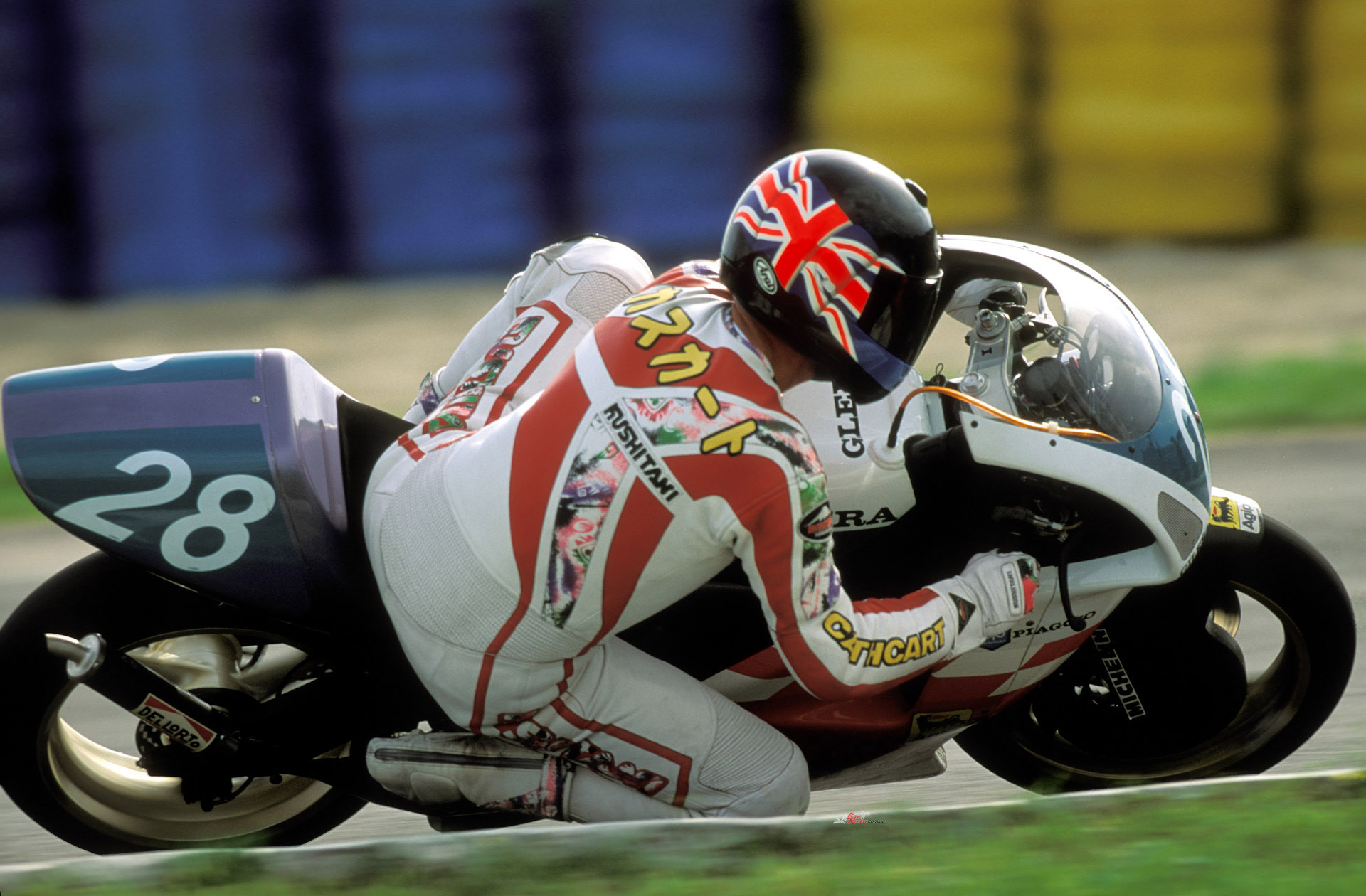
Alan Cathcart puts the GFR250’s celebrated chassis to the test at Vallelunga.
Retaining the same crankcase reed-valve format as all the Japanese 250s rather than Aprilia’s more powerful rotary-valve format was dictated, as Martini freely admitted, by Piaggio’s long-term desire to re-enter the 500GP class in due course, for which the current 250 project was merely a stepping-stone. While Aprilia-style rotary valves might make more power, reed-valve technology was needed to put the power on the road in manageable form with the bigger bikes, so Gilera was seeking to acquire technological know-how about that with their current 250.
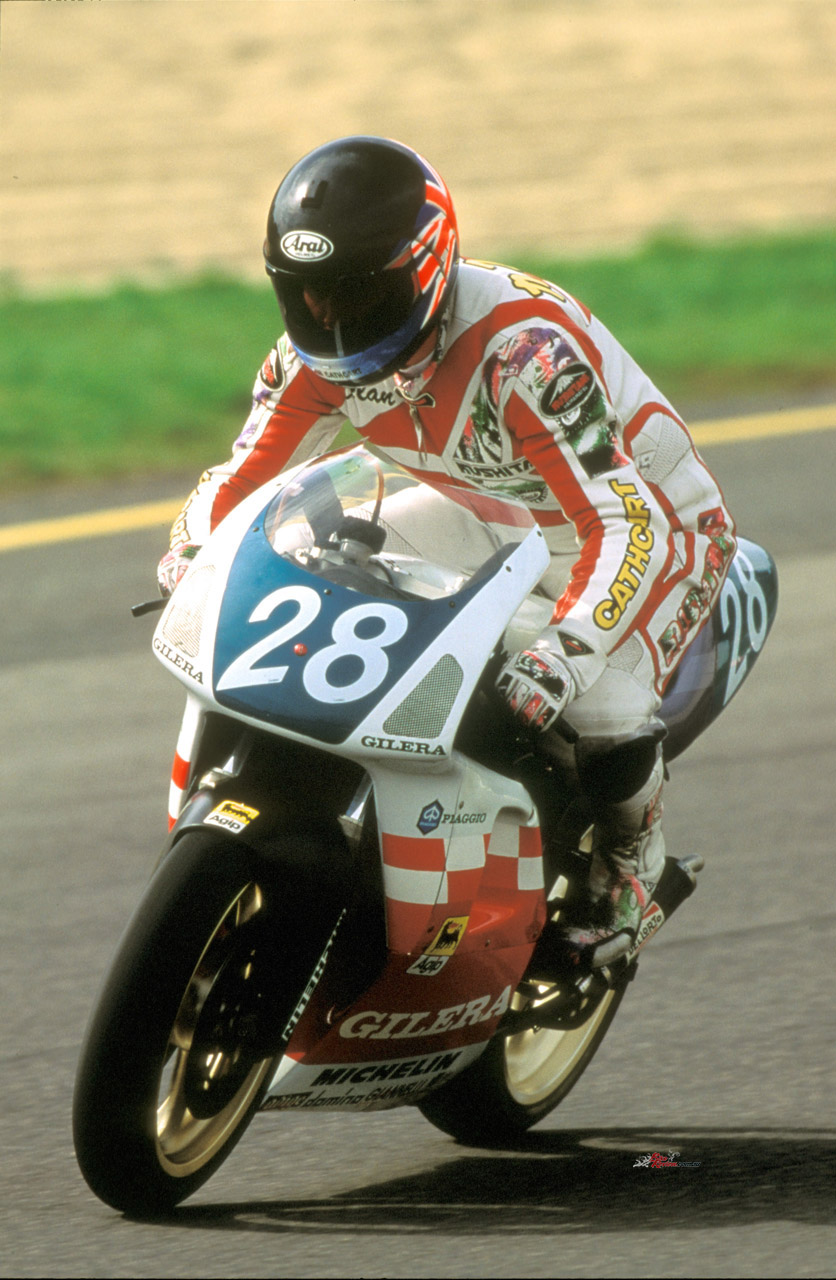
The most persistent problem Ruggia and Lavado faced in the 1992 season was that the engine repeatedly bogged down at the start, stranding the Gileras at the back of the field, leaving their riders to carve their way past backmarkers towards the front of the field. So, at the team’s home Italian GP at Mugello, Lavado qualified 15th but was 31st on lap one, before climbing to 12th place at the flag.
At Hockenheim Lavado qualified in a fine 8th place on the grid, was 20th on lap one, but then commenced a furious climb through the field which took him to 7th place.
At the Catalan GP in Barcelona, Ruggia was 24th on lap one, but climbed to a points-scoring ninth place finish. At Hockenheim Lavado qualified in a fine 8th place on the grid, was 20th on lap one, but then commenced a furious climb through the field which took him to 7th place behind Frankie Chili’s works Aprilia, only for him to outbrake himself trying for an overtake, and crash.
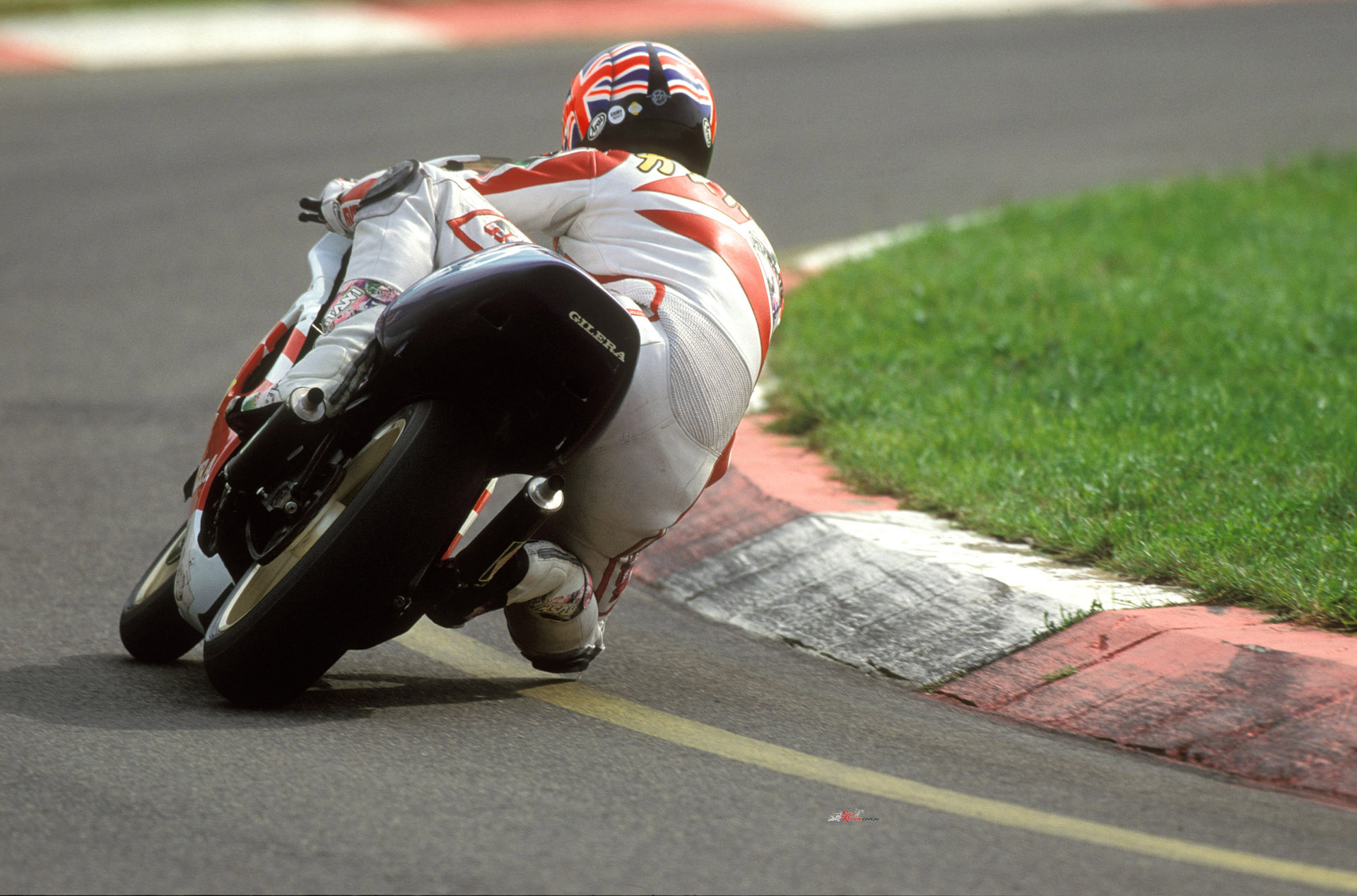
Cathcart found the GFR250 especially composed at lean over Vallelunga’s rougher sections.
This repeatedly happened all through the season to both riders, and was supposedly traced to interference from other bikes in close proximity disturbing the programmable digital CDI, but Martini insisted there were other factors in this, too, like the Dell’Orto carbs, which were supposedly however resolved by season’s end.
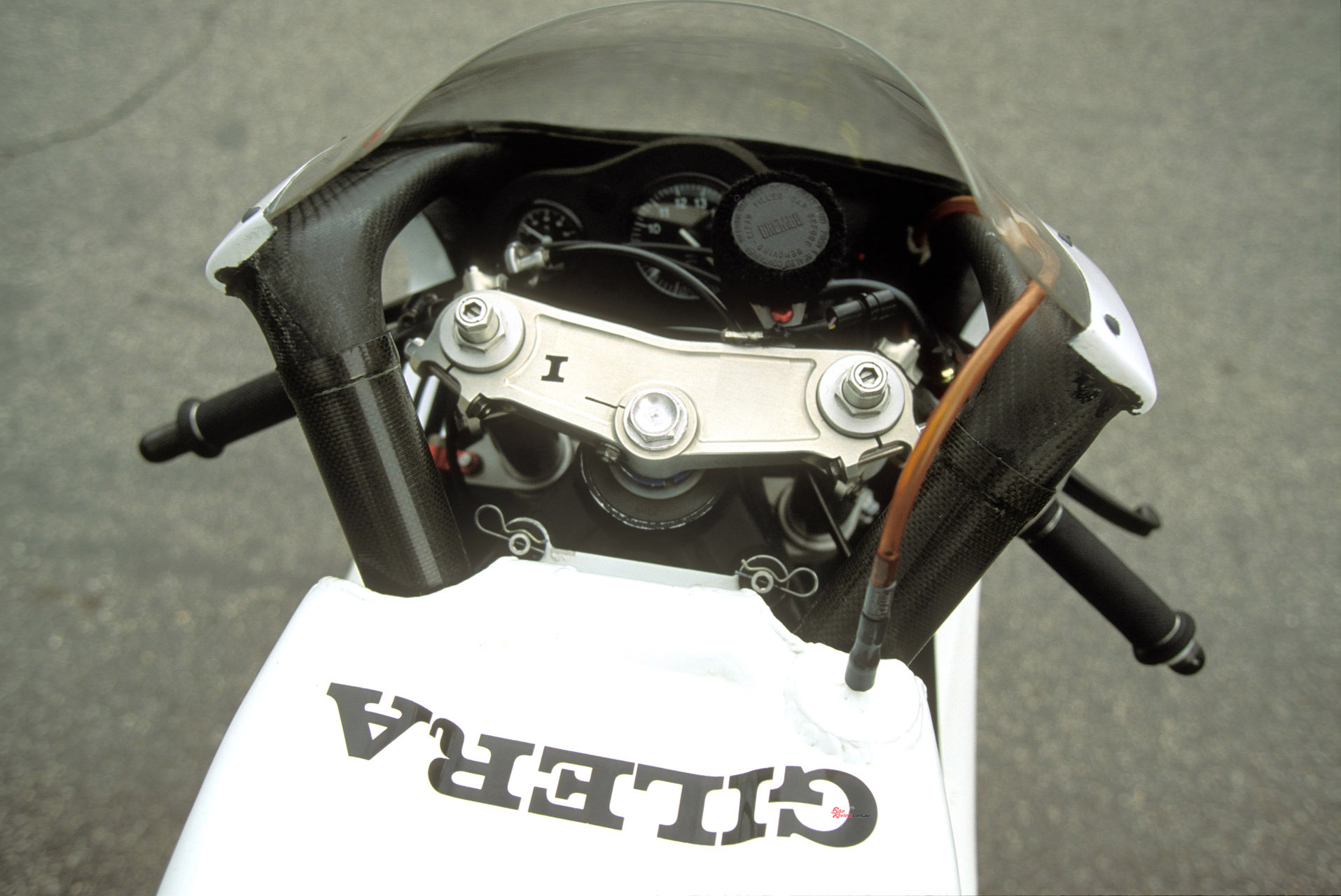
To check that out I did a practice start on my slowdown lap at Vallelunga, and I have to say even my ham-fisted two-stroke starting technique delivered a near-ideal getaway. But before then the Gilera had frankly felt short of breath during my dozen laps aboard it, most likely because it had been set up much too rich to cater for some of the Italian journalists at that press test, some of whom were very inexperienced in riding a two-stroke race bike, especially on a circuit with such a tight infield section.
As jetted the Gilera was seemingly lacking in midrange punch from 8,000 revs up, and was a slug at top end only reluctantly hitting 12,800rpm on the dial before power tailed off steeply with practically zero overrev – and even the last 500rpm had been a real struggle to attain. Considering that Gilera’s National team duo Paolo Casoli and Luca Pasini had ridden the bikes into second and third places in the Italian Championship race the day before behind Aprilia tester Marcellino Lucchi’s works rotary-valver, I found the assurance that the bikes had been untouched overnight hard to accept, because the Gilera just seemed so lifeless engine-wise.
I found the assurance that the bikes had been untouched overnight hard to accept, because the Gilera just seemed so lifeless.
Federico Martini wasn’t present at the test day – strange – but was very upset when I recounted my experience of the bike to him, claiming that it peaked at 12,800rpm, but ran cleanly to 13,400rpm when properly set up, which would indeed be a healthy amount of overrev. Only it wasn’t set up properly, which just about summed up the Gilera race operation back then.
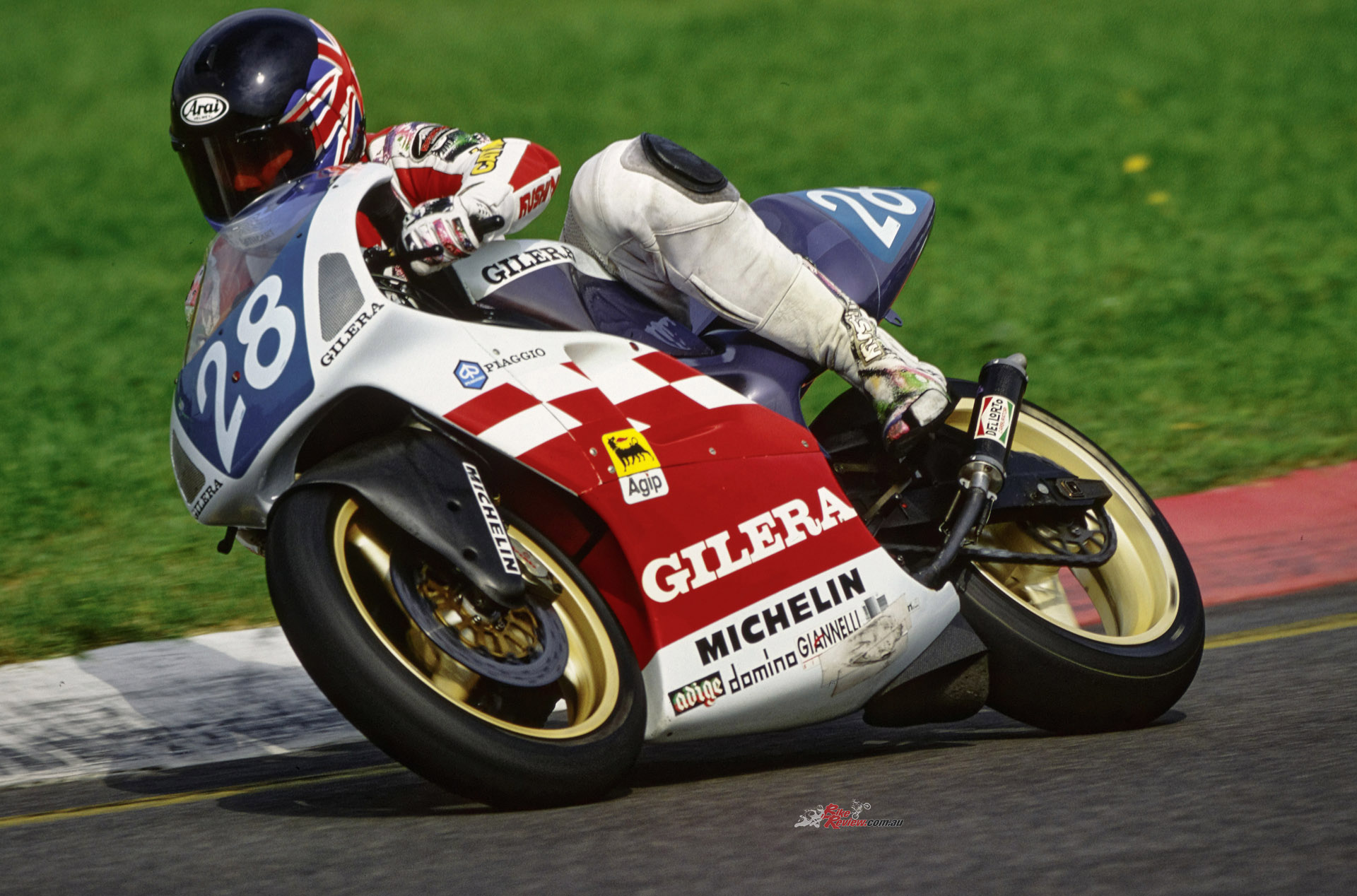
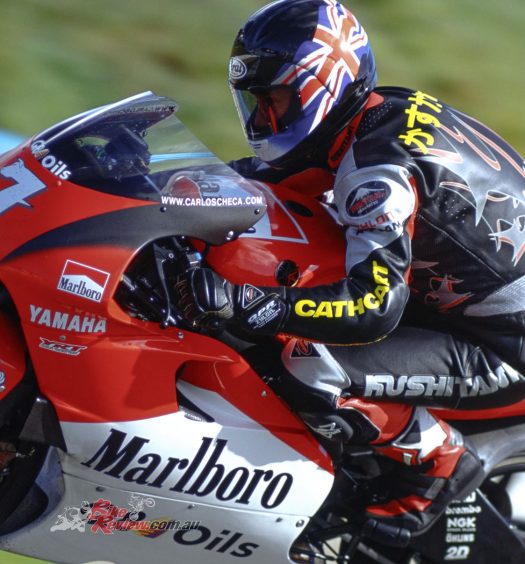
Cathcart exploiting the GFR250’s agility at Vallelunga, where its chassis proved the bike’s strongest suit.
The undoubted pressure for results from Piaggio HQ was underlined by their vast and costly paddock presence, with a hospitality area rivalling Marlboro’s for size and amenities, and PR staff seemingly outnumbering the race team quite heavily. The whole Gilera operation appeared to an outsider to be grossly unfocused. There were too many people in too many unimportant places all trying to grab their slice of the action, and justify their salaries.
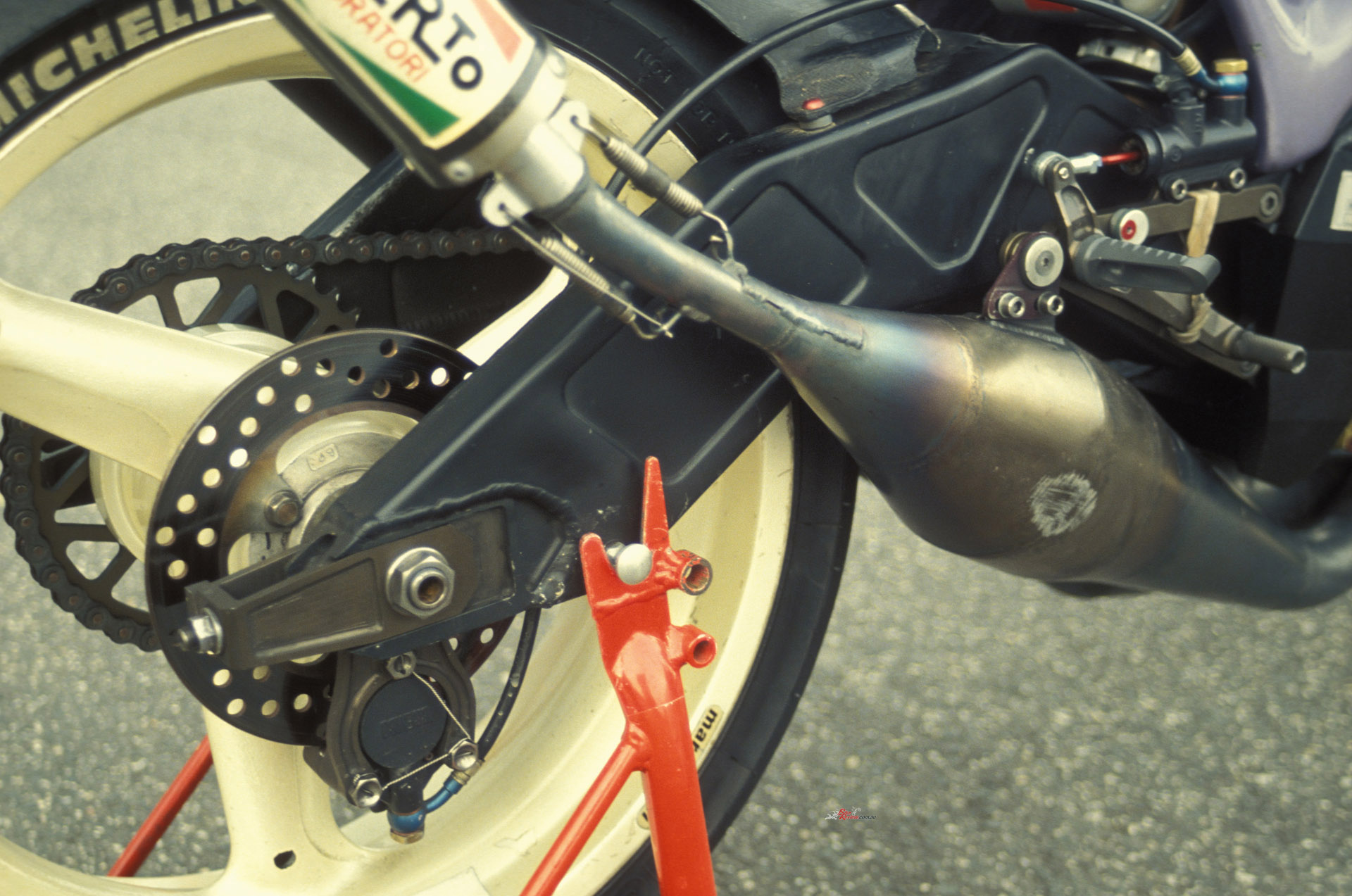
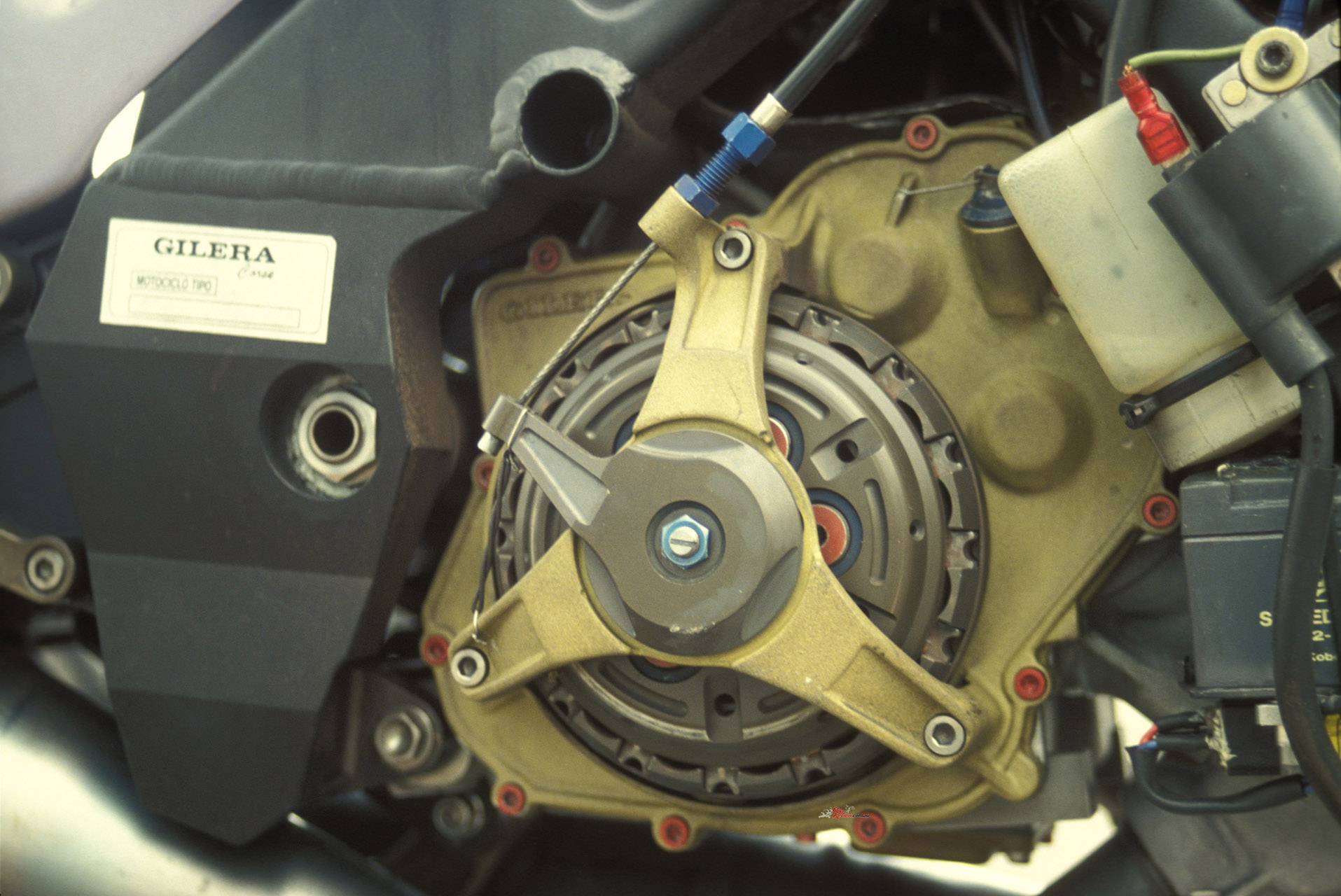
But the Gilera’s chassis worked as well as it looked: all Martini’s legendary talents in creating the best-handling street bikes of the 1980s for Bimota’s well-heeled clientele hadn’t been dulled in his years at Gilera – as the bumpy tarmac version of a Paris-Dakar special stage which the Vallelunga track surface represented duly showed all too well.
Kayaba suspension combined with the stiff yet responsive chassis delivered a bike that handled rough surfaces as well as any road racer I’d yet ridden.
The Gilera used Kayaba suspension at both ends which proved both supple and well-damped – “The best in the world!” said Martini, who’d had extensive experience with other suspension brands – and this combined with the stiff yet responsive chassis design delivered a bike that handled rough surfaces as well as any road racer I’d yet ridden. You could feed the power in hard halfway round the Parabolica sweeper before the start-line at Vallelunga, just as you hit a series of bumps that had every right to throw such a light bike as this one way off course.
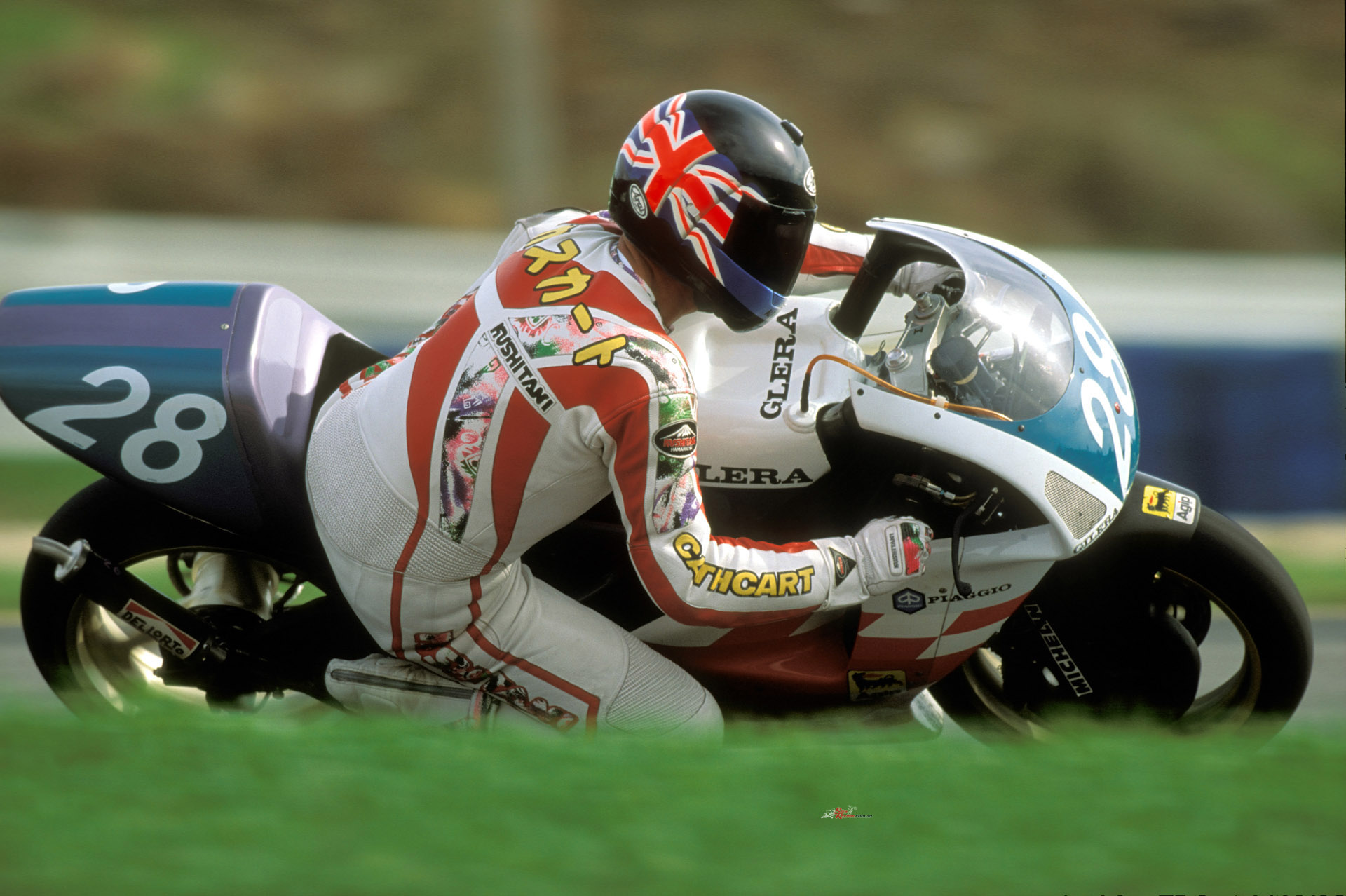
Cathcart makes full use of the GFR250’s compact chassis and cornering clearance at Vallelunga.
Instead, the supple Kayaba upside down fork just soaked up road shock without chattering the front wheel, while the progressive rate rear link combined with the Kayaba monoshock to let you keep the power on hard while riding out the bumps. It was really impressive how you could feel the bike just floating over the rough surface there, and the same again in the tighter infield turns cranked over while running on the car-induced ripples produced by hard braking on soft tarmac in Roman summer weather: outstanding.
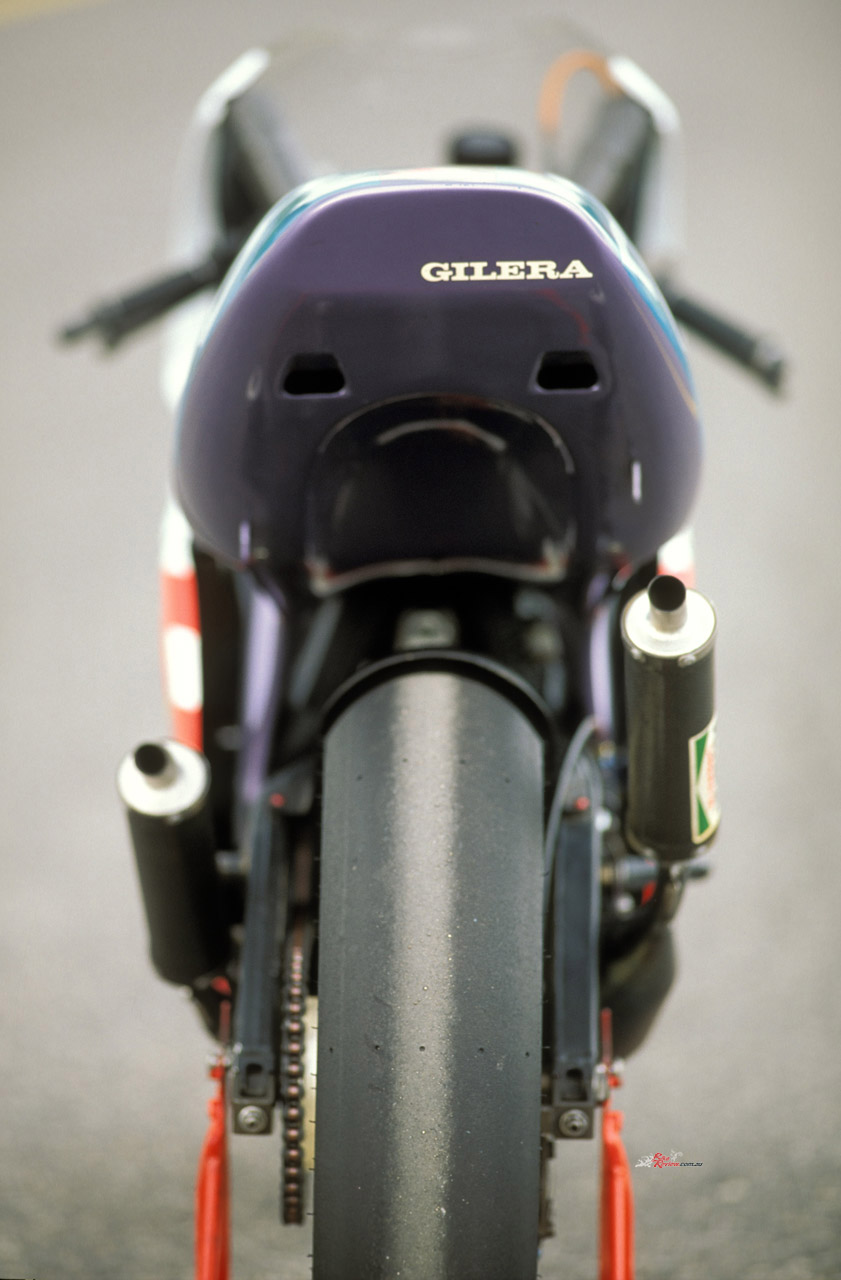
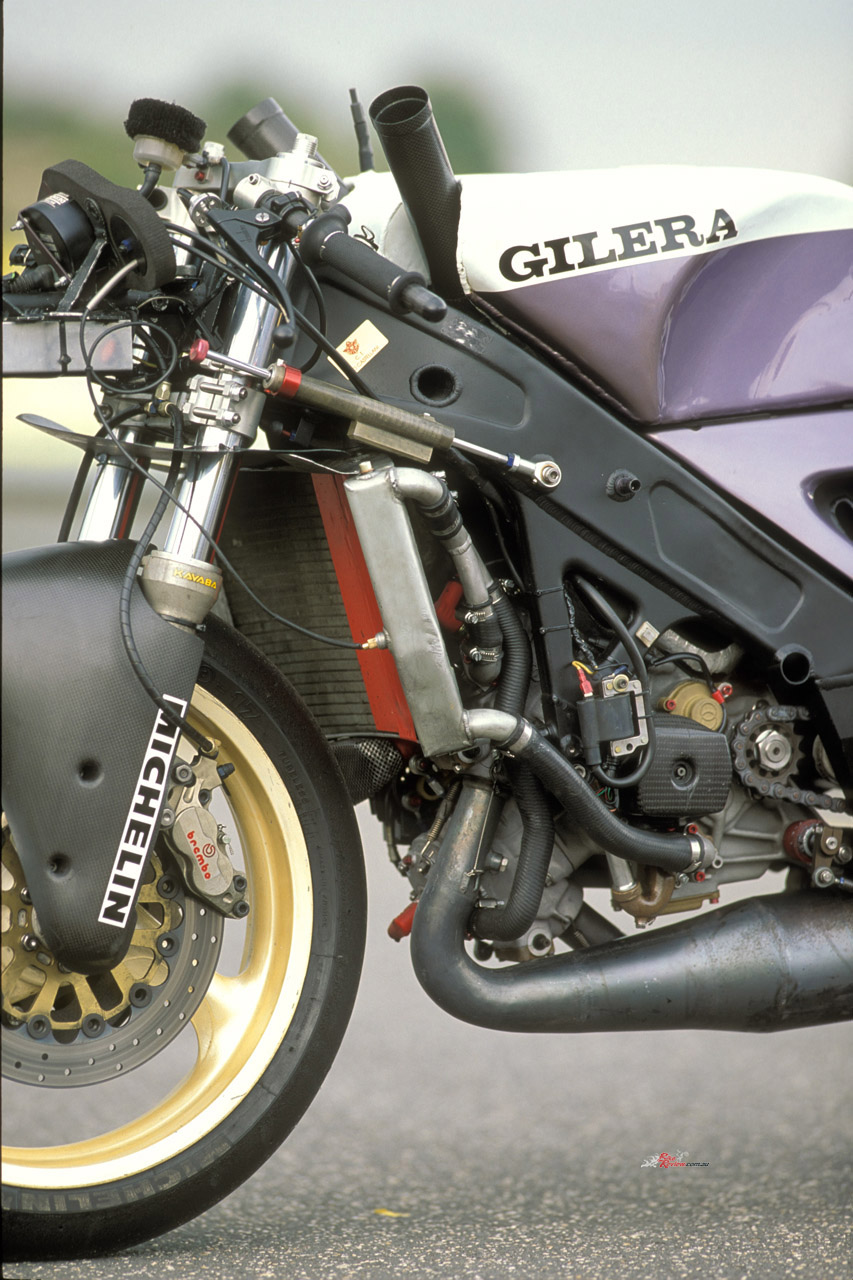
Martini said his aim was to build a bike which was as small and low as possible, with the centre of mass compacted and the centre of gravity low down, for quick yet predictable handling. He definitely succeeded in that aim: with its 1320mm wheelbase, the Gilera GFR250 was 20mm shorter than its Honda or Aprilia rivals (though not as short as the 250 Suzuki), but more importantly, it felt better balanced than any of them – and by then I’d ridden them all.
Amazingly, this bike seemingly had no vices in terms of handling.
The Gilera was especially agile yet reassuring in flicking from left to right in the third-gear Vallelunga chicane behind the pits – it was truly nimble in the ultra-tight infield turns. The pretty radical steering geometry was surely a factor here, but while the Vallelunga circuit only offered one reasonably fast turn, it didn’t seem to affect its stability there at all – amazingly, this bike seemingly had no vices in terms of handling.
Cathcart gets the GFR250 wound up at Vallelunga, making the most of its compact dimensions and sharp steering.
Even using the carbon/steel Brembo brake cocktail really hard didn’t unsettle the Gilera unduly despite the short wheelbase – presumably thanks to the low centre of gravity – though you did wave the back end in the air if you allowed your body to shift forward too much under braking. Lavado and Ruggia must have been glad to be able to keep up their hard-won speed in turns with this superb-handling chassis, after having to give so much away engine-wise.
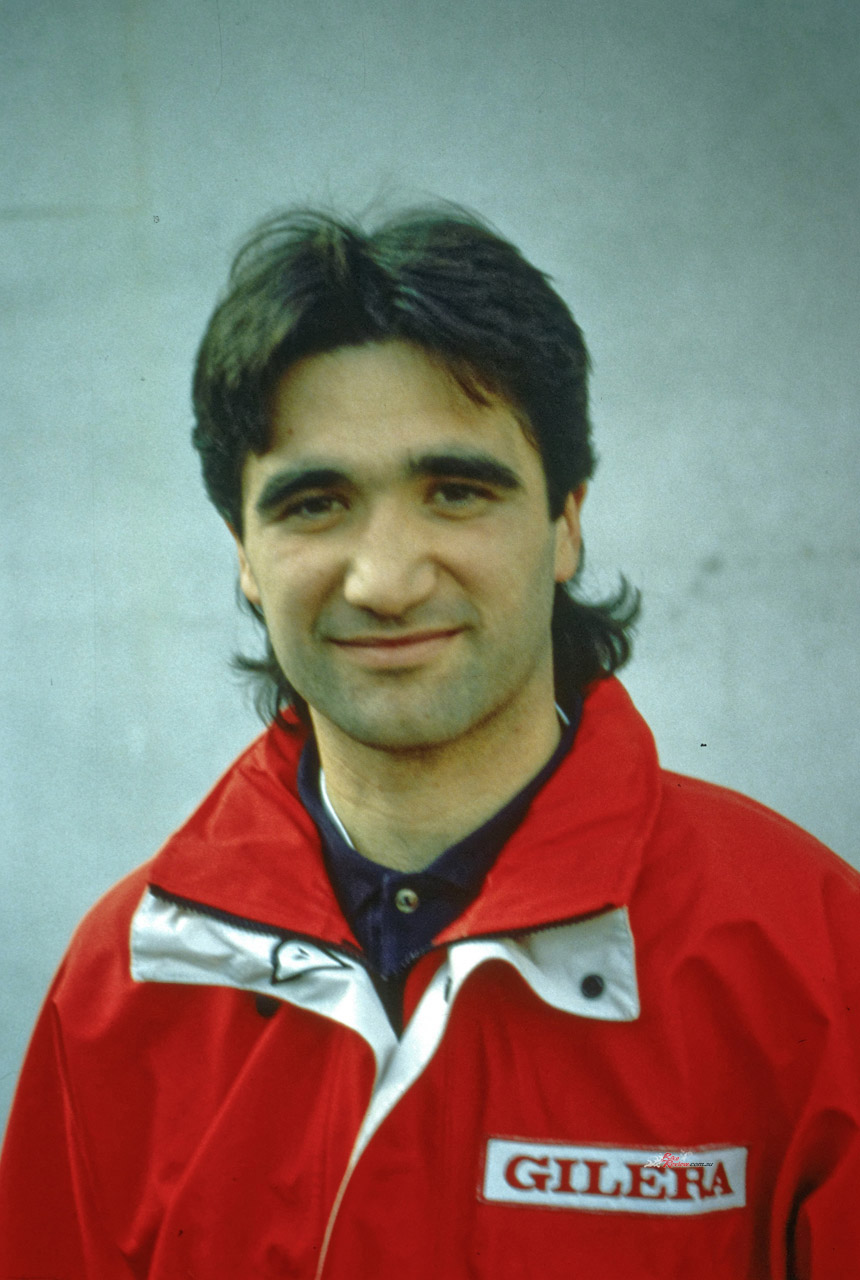
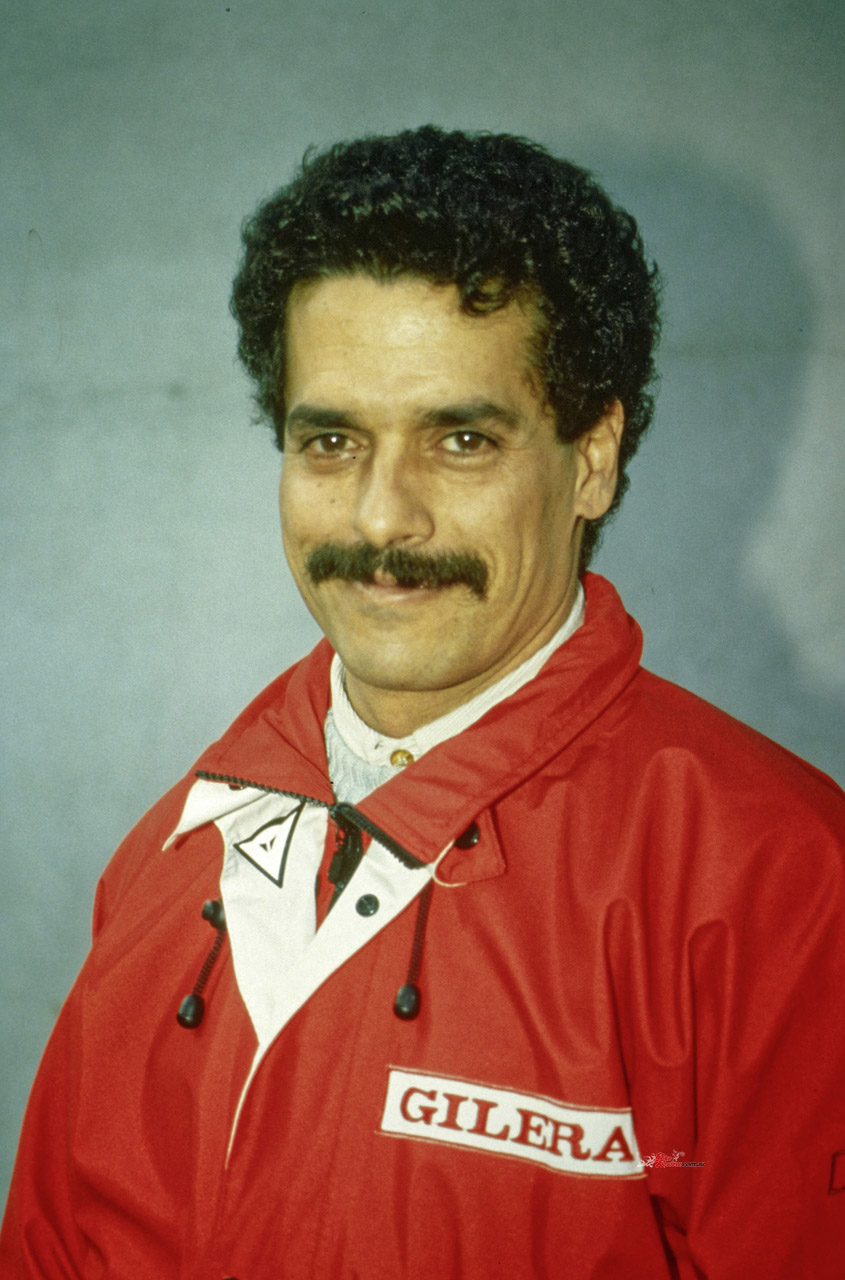
Gilera’s 1992-93 winter development work was supposed to be focused on seeking more midrange and especially top end power from the V-twin motor, while working on its successor – a Harald Bartol-designed 180° Boxer twin, fitted with the same cylinders as the present motor, but with two fewer crankshaft main bearings, aimed at reducing inertia and making for a much stiffer, more robust bottom end. One of Gilera’s persistent 1992 season problems was the fact that the supposedly lightweight crank in fact turned out to be too heavy, in turn causing the crankcases to deform, which allowed oil from the gearbox to seep into the crankcase.
Gilera’s winter development work was supposed to be focused on seeking more midrange and top end from the V-twin, while working on its successor – a Bartol-designed 180° Boxer twin.
The Boxer motor with a one-piece crankcase should have cured, while allowing Martini to design an even smaller, 20mm shorter bike with optimum weight distribution thanks to an engine format which in the early days was foreseen to have twin forward-facing powerjet carbs force-fed by cool air, but would later lend itself ideally to fuel injection, which Gilera Corse were already working on for the V-twin.
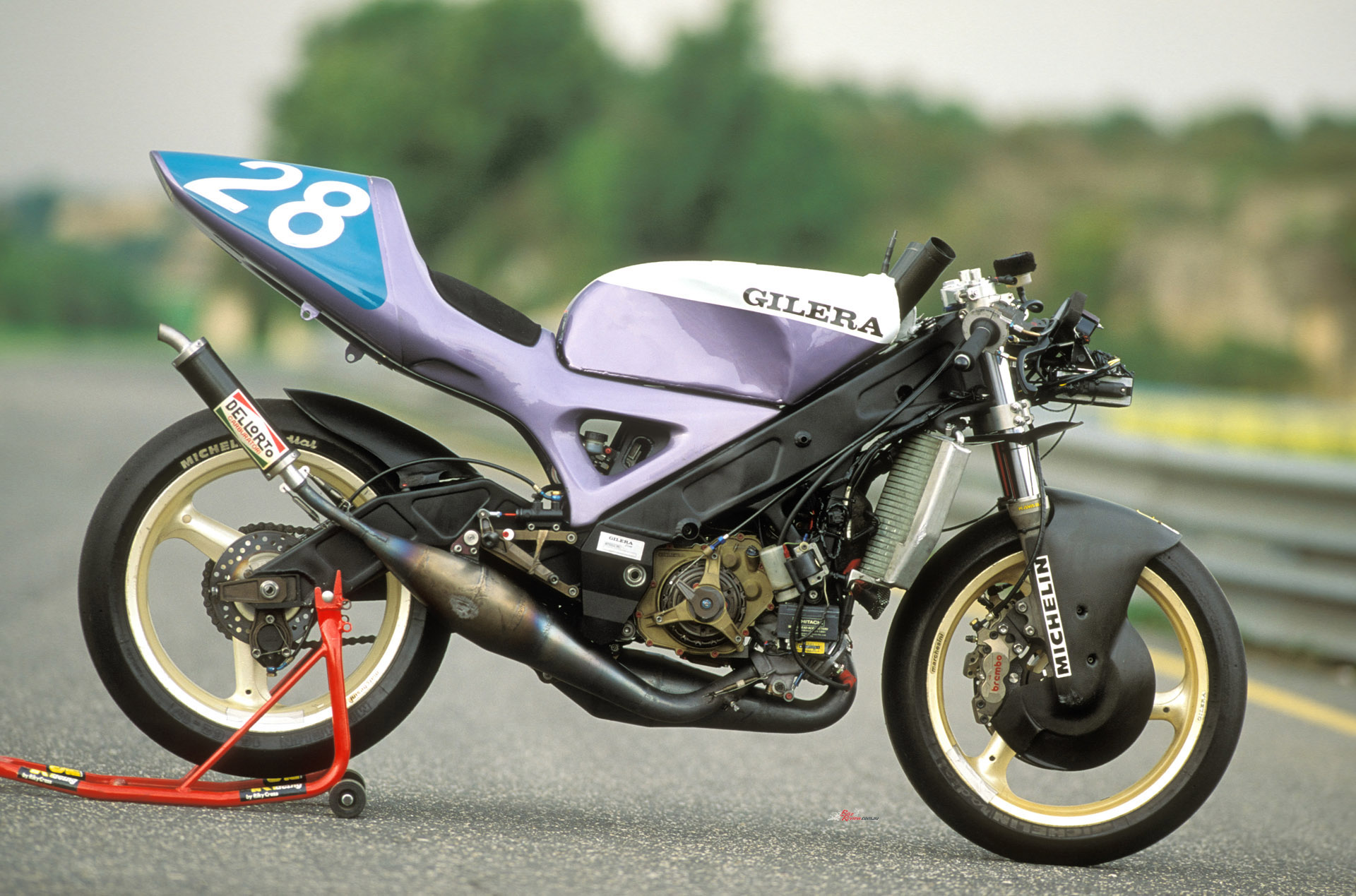
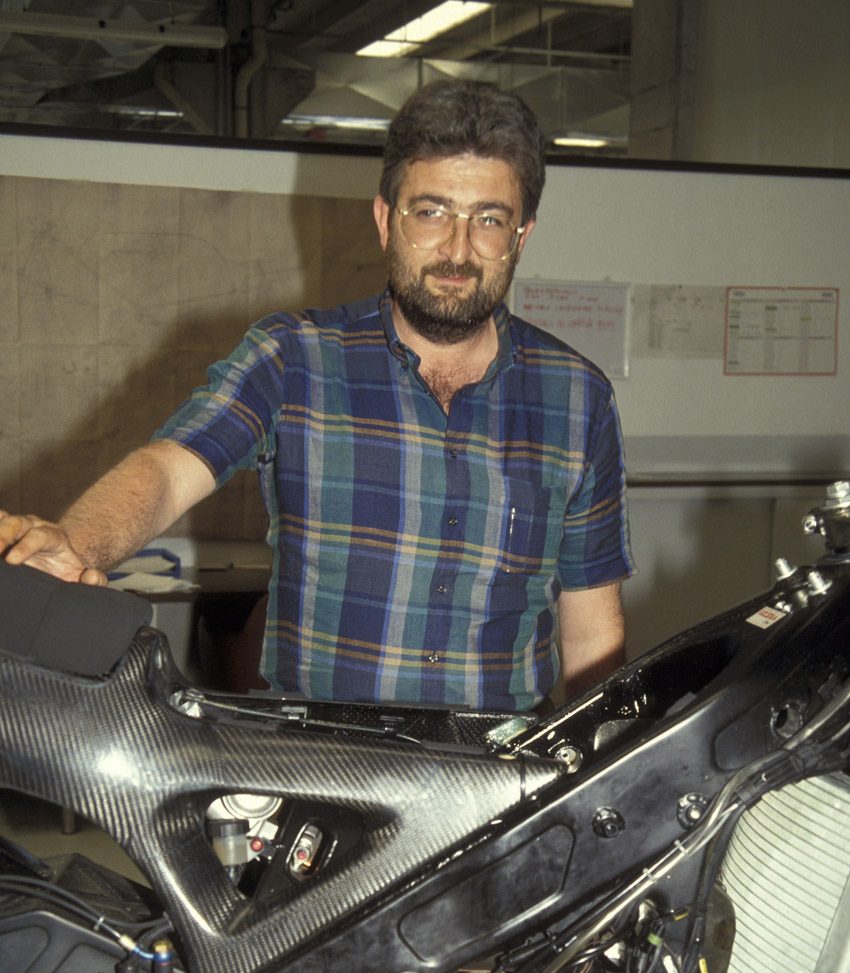
Stripped of its bodywork, the GFR250 reveals its 10kg aluminium twin-spar frame and tightly packaged V-twin.
The Boxer 250 was supposed to shortly begin dyno-testing in Velate in readiness for a 1994 season debut, while Gilera Corse continued to refine its existing V-twin design so as to finish higher up the top ten more regularly, with a return to the 500cc class slated for 1995 for one of the greatest names in two-wheeled racing history. With the prestige and pockets of Piaggio – the third largest manufacturer of two-wheelers in the world back then, remember – behind them, Gilera meant business. The 1992 season was just the beginning.
Except – none of that happened. At the end of 1992 Carlos Lavado retired from racing, and Ruggia was replaced by Paolo Casoli, who alongside his runner-up slot in the Italian championship had become Gilera’s main test rider. Newly-crowned 125GP World Champion Alex Gramigni was prised away from Aprilia with the promise of a 500GP ride in a couple of years – but he must have spent most of 1993 bitterly regretting his move.
It was just as well that world championship points now extended to 15th place, otherwise neither Gilera rider would have scored any at all that season.
For it was just as well that world championship points now extended to 15th place, otherwise neither Gilera rider would have scored any at all that season, with Casoli’s highest 12th and 13th place finishes, and a single 14th place for Gramigni. Despite a claimed improvement in engine output to 94 bhp at 12,800 rpm, on track the Gileras were slow and unreliable, with a host of DNFs that the Cruciani-run team never got on top of. Piaggio pulled the plug two races before the end after the San Marino GP run on the team’s test track of Misano after Casoli’s best 12th place finish of the season.
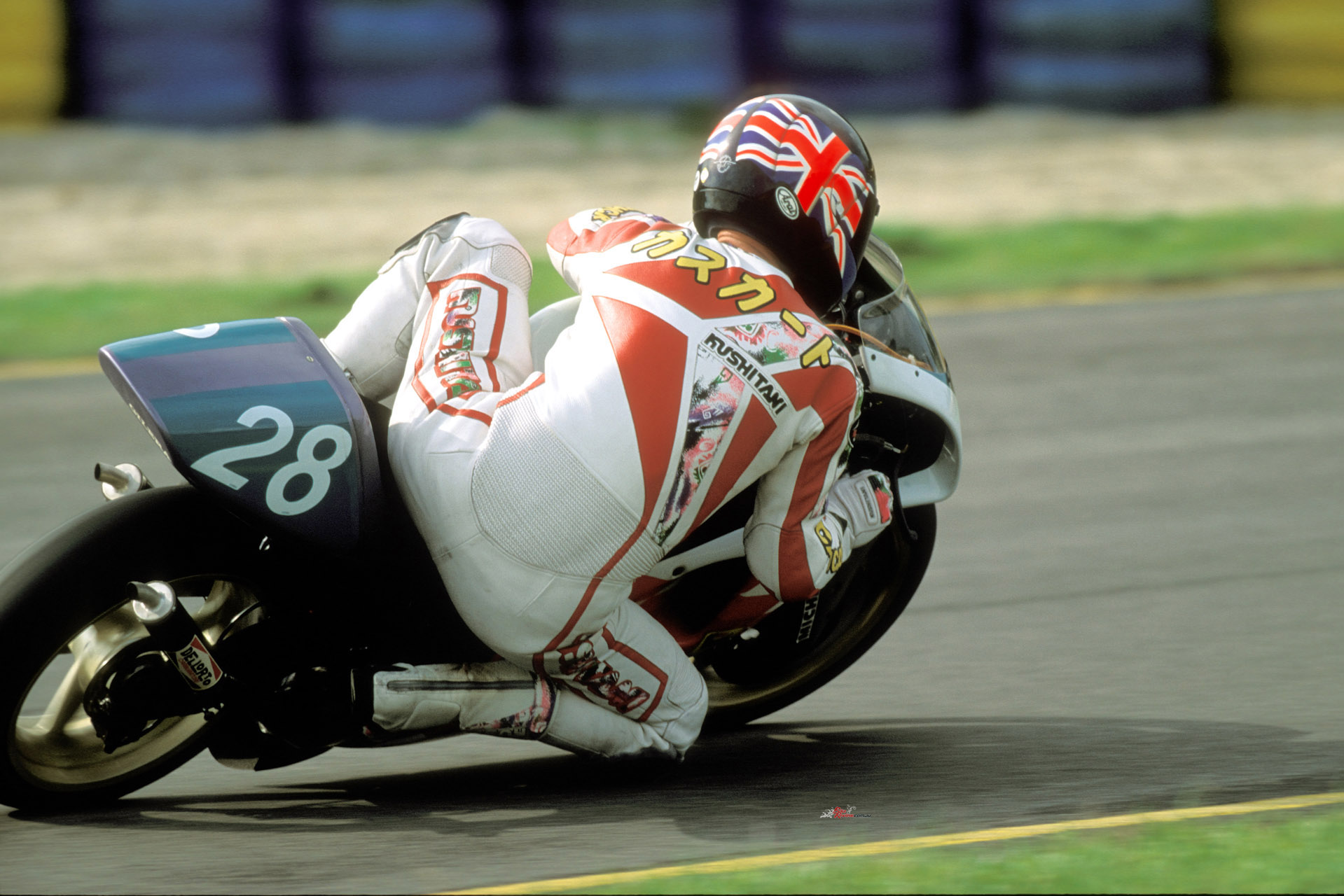
Cathcart found the GFR250’s short wheelbase and low centre of gravity made it super nimble.
But with the death of two of the team’s mechanics when a van carrying five of them to the previous Czech GP at Brno had crashed in a thunderstorm, it was a tragic end to a project which had promised so much, yet produced so little. Soon after, it was announced that after 75 years as one of Italy’s leading motorcycle brands, Gilera would cease to manufacture motorcycles at all, its historic Arcore factory would be closed with the loss of 1200 jobs, and in future Gilera would be the premium brand of Piaggio’s scooter range. The end of it all – not only racing.
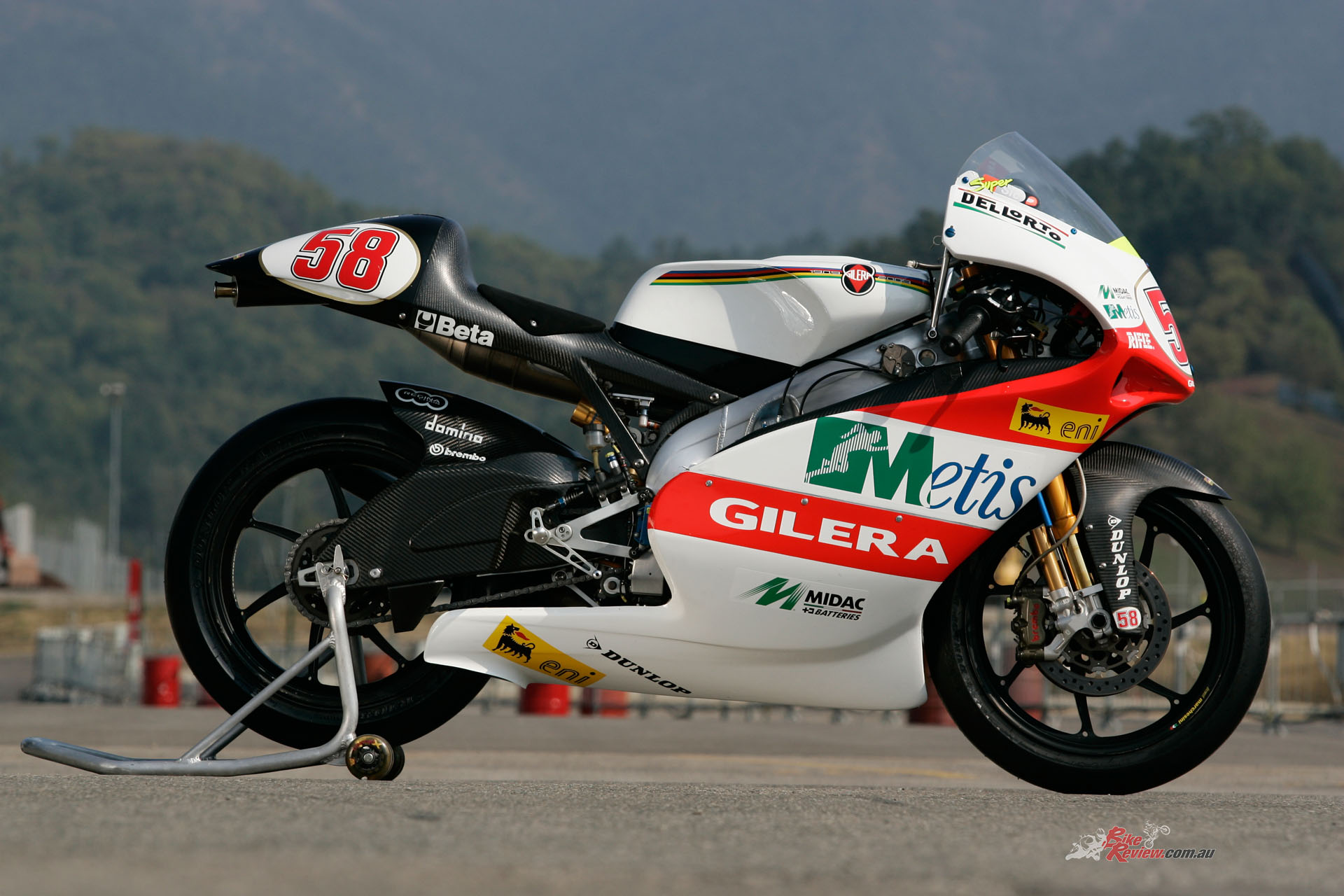
Yet 15 years later in 2008, after Piaggio had acquired the bankrupt Aprilia company in 2004 and labelled two of its 250GP rotary-valve racers with the Gilera badge, the late, great Marco Simoncelli would finally win a 250GP World Championship for Italy’s oldest and most historic marque. But that’s another story…
GILERA GFR250 Specification
Engine: Liquid-cooled single-crankshaft 75° V-twin crankcase reed-valve two-stroke with seven transfer ports and three exhausts, gear-driven balance shaft, electronic power-valve, 56 x 50.7mm bore x stroke, 16:1 compression, 249cc, 2 x 40mm Dell’Orto flatslide carburettors with powerjet, EFI Technology programmable electronic CDI, six-speed extractable gearbox, multiplate dry clutch.
Chassis: Fabricated/pressed Carpental aluminium twin-spar frame, 41mm fully adjustable Kayaba inverted fork, fabricated aluminium swingarm with Power Drive rising-rate link and fully adjustable Kayaba monoshock, 21.5° rake, 80mm trail, 1320mm wheelbase, 95kg weight with 54/46% distribution, 290mm steel and 273mm carbon Brembo front discs with four-piston Brembo calipers, 190mm steel rear disc with two-piston Brembo caliper, Marchesini cast magnesium wheels (3.50in and 5.50in), Michelin 12/60-17 and 13/61-17 radial tyres.
Performance: 86.5bhp at 12,750rpm measured at the gearbox, top speed 255km/h (158mph), year of construction 1992, owner Piaggio & C. SpA, Pontedera, Italy.
You Might Also Like