

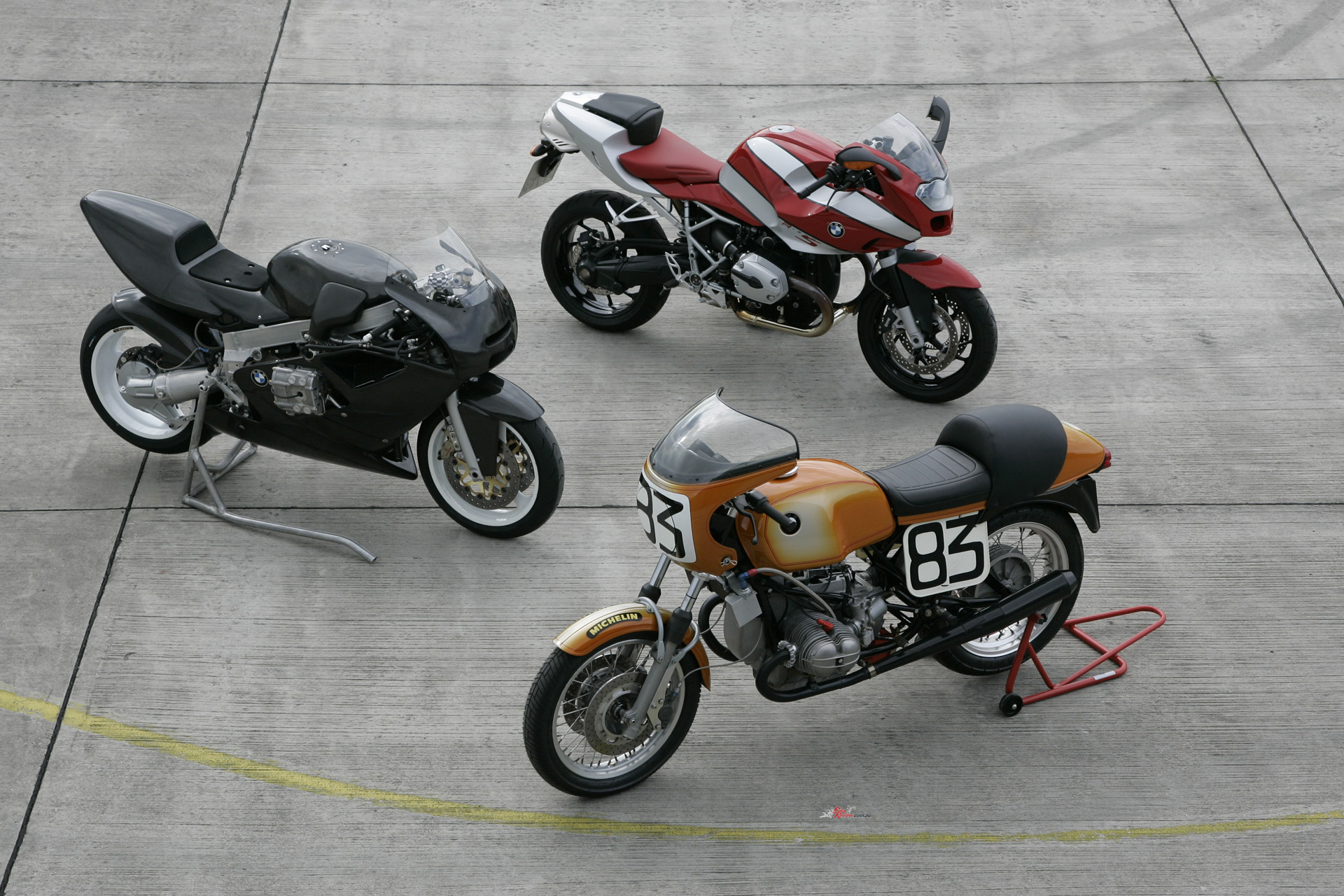
BMW’s SBK title success echoes a remarkable chapter from 1976, when Butler & Smith’s improbable R90S Boxers stormed the inaugural AMA Superbike Championship and changed BMW's image forever... Photos: BMW Motorrad/Arnold Debus
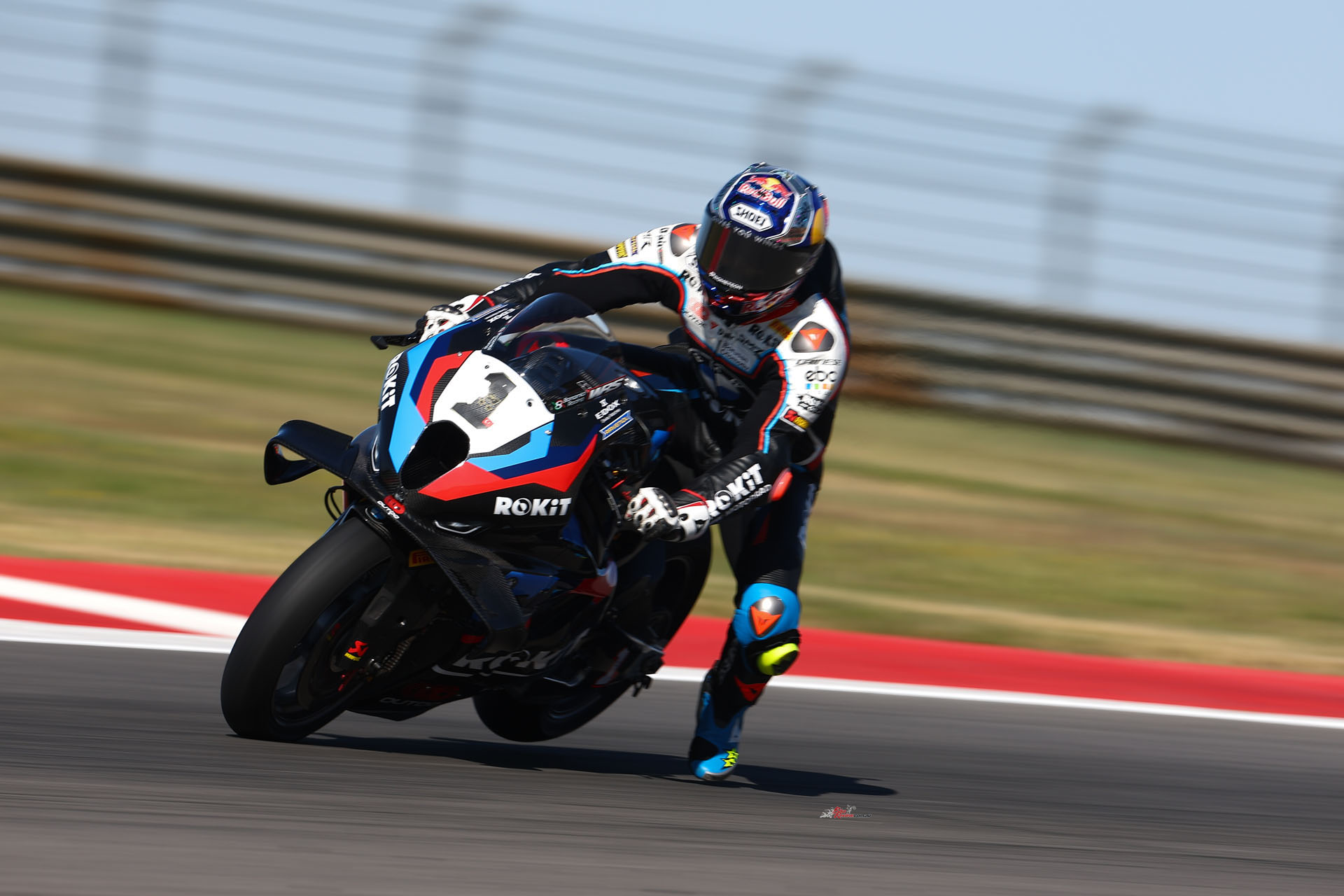
BMW’s success in the 2024–25 WorldSBK Championship with Toprak Razgatlioglu was the culmination of a strategy set in motion back in 2009 when BMW began reshaping its once-conservative image by taking an aggressive approach to the Superbike segment…
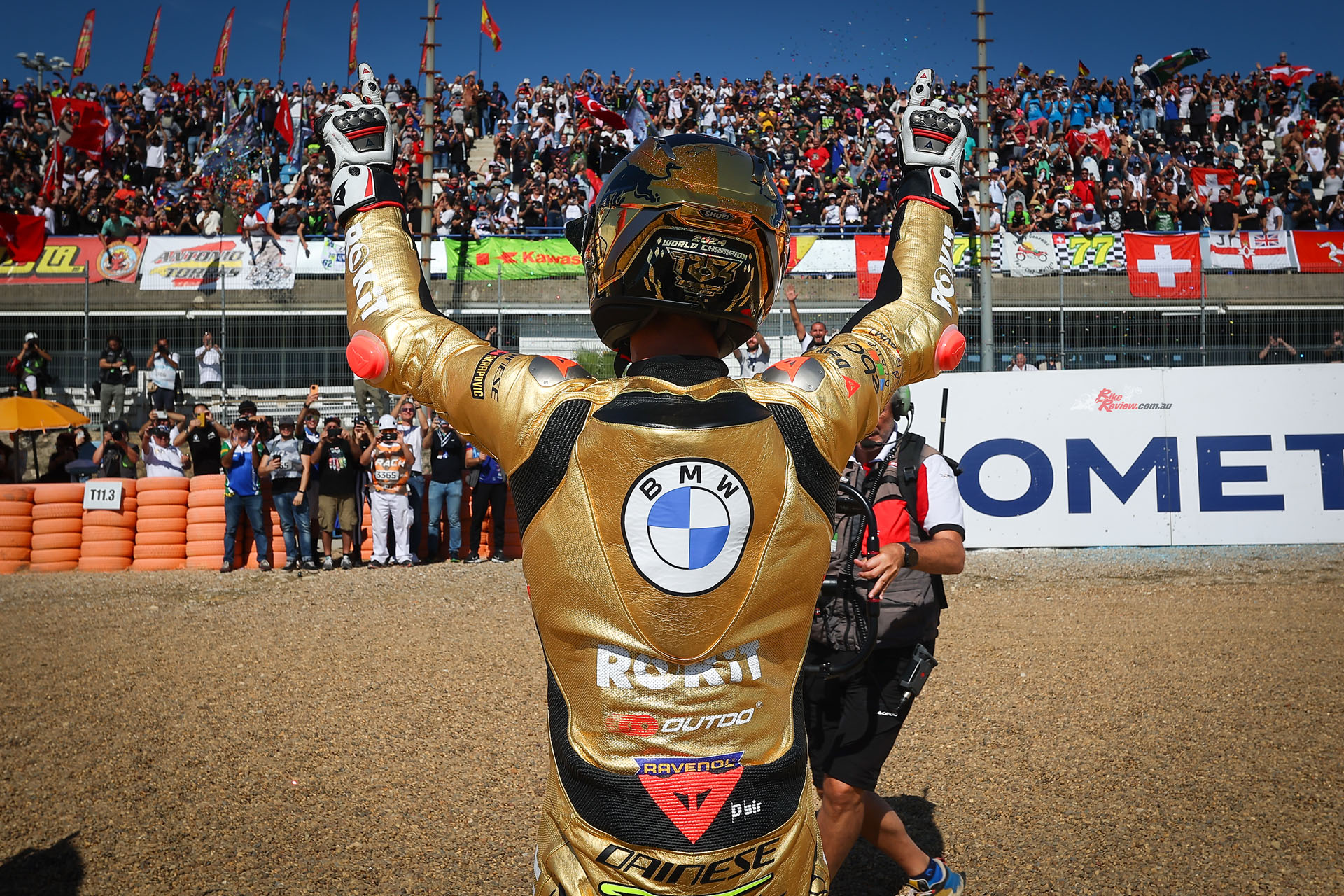
At the time, many younger riders viewed Europe’s largest premium motorcycle brand as somewhat staid. BMW addressed that perception head-on by entering the World Superbike arena and going toe-to-toe with its Japanese and Italian rivals. The aim was clear: prove the performance credentials of its sportbikes in the toughest possible environment – the racetrack.

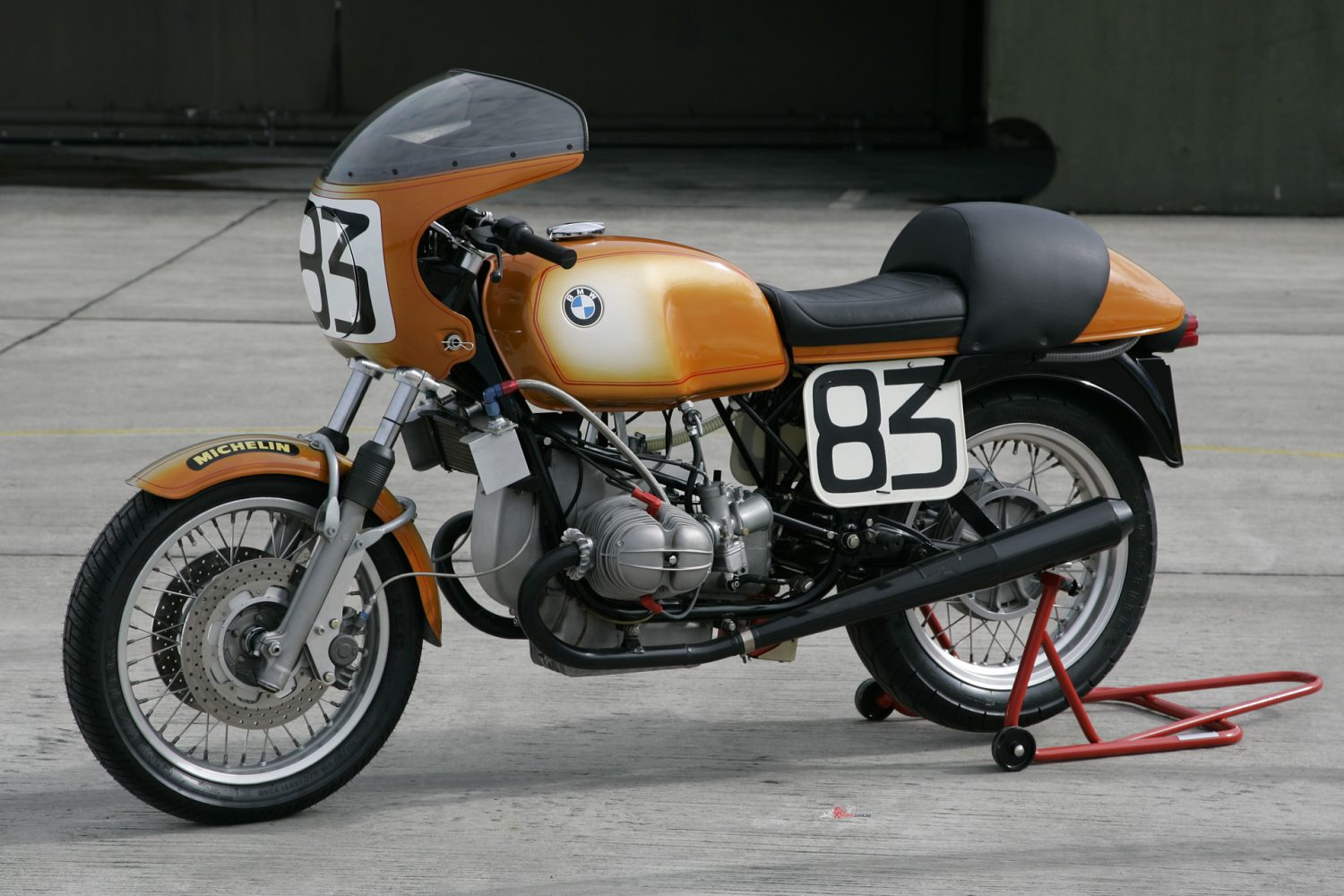
Yet, 50 years ago back in 1976, it was the decision by Peter Adams, owner of Butler & Smith, BMW’s US importer back then, to confront the very same issue in exactly the same way, which led to BMW improbably dominating the first-ever AMA Superbike championship with its team of R90S Boxers. These were brewed in-house at Butler & Smith’s New Jersey HQ by an R&D team led by Udo Geitl, with mechanics Todd Schuster and Kenny Augustine working alongside him.
Read Alan’s Test of the Butler & Smith Superbike here…
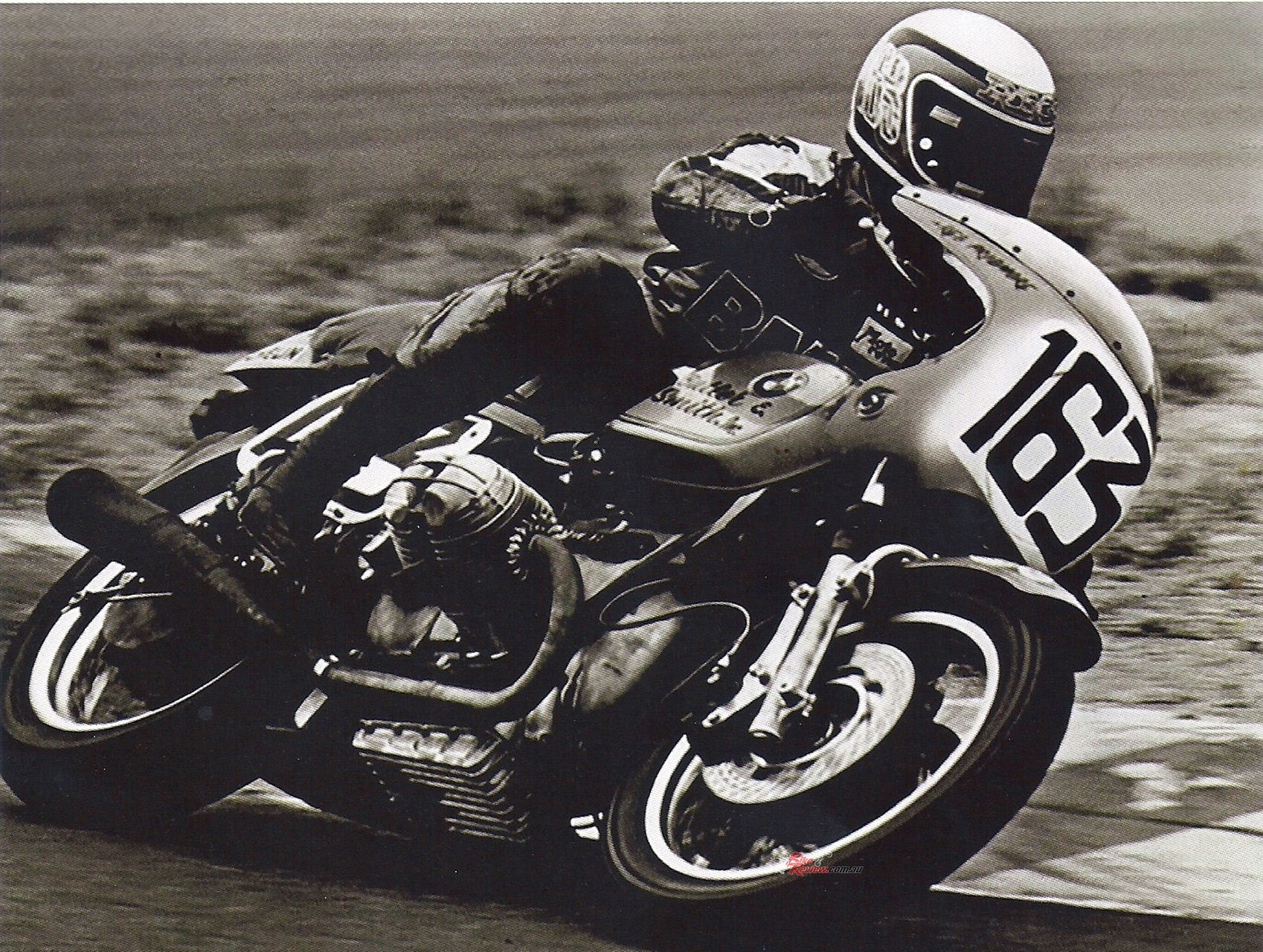
Not only did BMW rider Steve McLaughlin – ironically, the man who little over a decade later created the World Superbike series – win the first-ever Daytona Superbike race by half a tyre width from teammate Reg Pridmore in one of the closest-ever photo-finishes on the Florida speedway, but it was the California-based Pridmore, a transplanted British former Sidecar race driver, who went on to clinch the inaugural AMA Superbike title at season’s end – subsequently making it a personal hat-trick of titles in successive seasons after switching to Kawasaki.
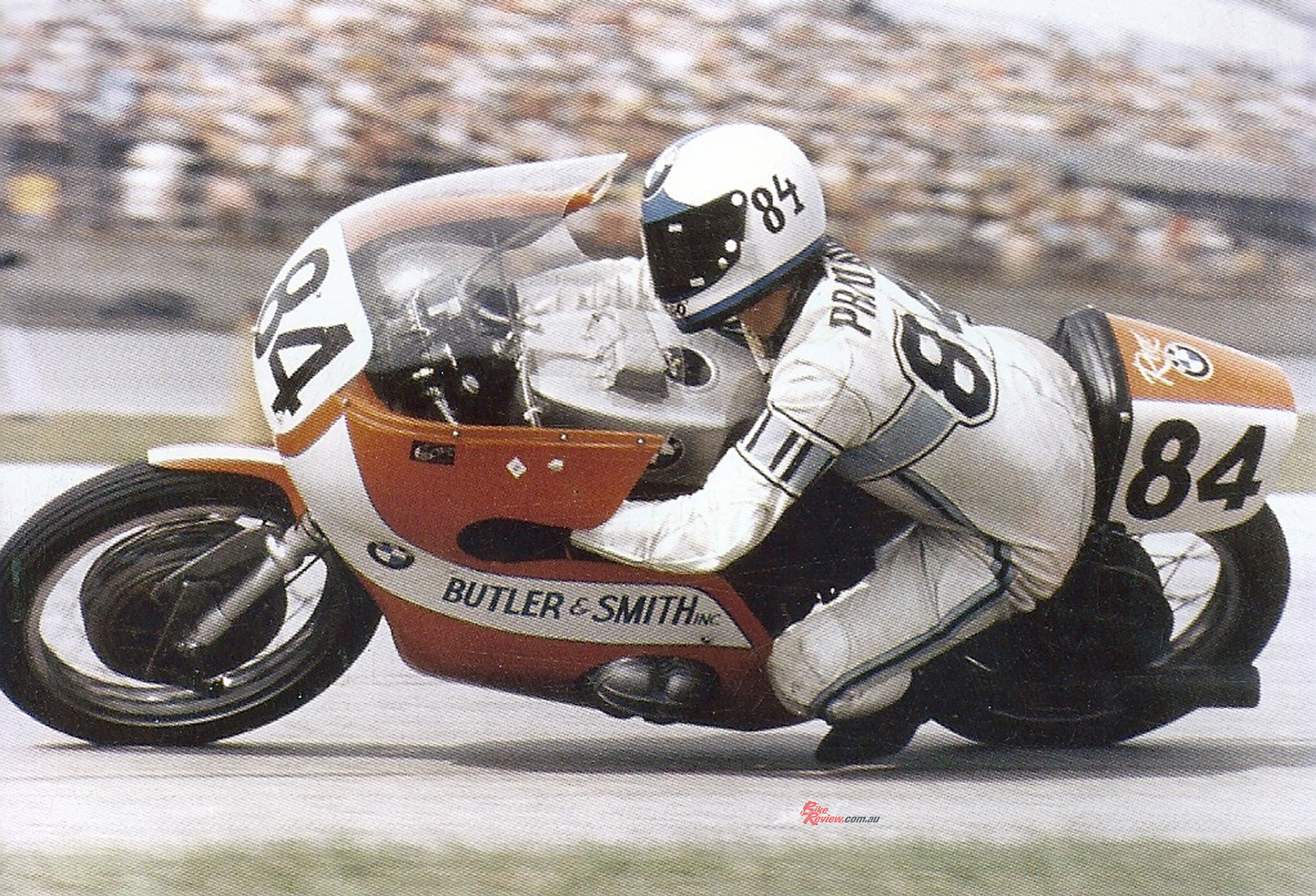
But 1976, the USA’s Bicentennial year, was the battling Boxers’ single Superbike season in the sun, and came as the culmination of a five-year race programme funded by the Adams family after they purchased New Jersey-based Butler & Smith in 1971. This was aimed at rejuvenating the stuffy pipe-and-slippers image of the BMW brand, and maximising sluggish sales of its R75/5 roadsters. Doing so initially entailed funding their Parts Manager and spare-time racer, German-born former NASA engineer Udo Geitl, with the resources to develop an F750 racer based on the 75/5 Boxer twin.
But although it achieved some success in regional races, this was outclassed by the Suzuki and Kawasaki two-strokes in AMA Nationals. Even wrapping the Geitl-tuned motor in a Rob North chassis for 1974, constructed by another British migrant to California along the lines of his ultra-successful race chassis for the BSA/Triumph triples, didn’t improve matters, and the debut that year of the Yamaha TZ750 simply meant that, like all the four-strokes in the F750 class, the BMW racers were now outclassed in terms of performance.
Gary Fisher’s achievement in qualifying his Rob North BMW on the front row of the grid for the tight, twisty Laguna Seca AMA National in 1975, then battling for the lead with future World champion Kenny Roberts’ Yamaha before the BMW’s monoshock rear suspension failed, represented a glorious finale for the F750 Boxers.
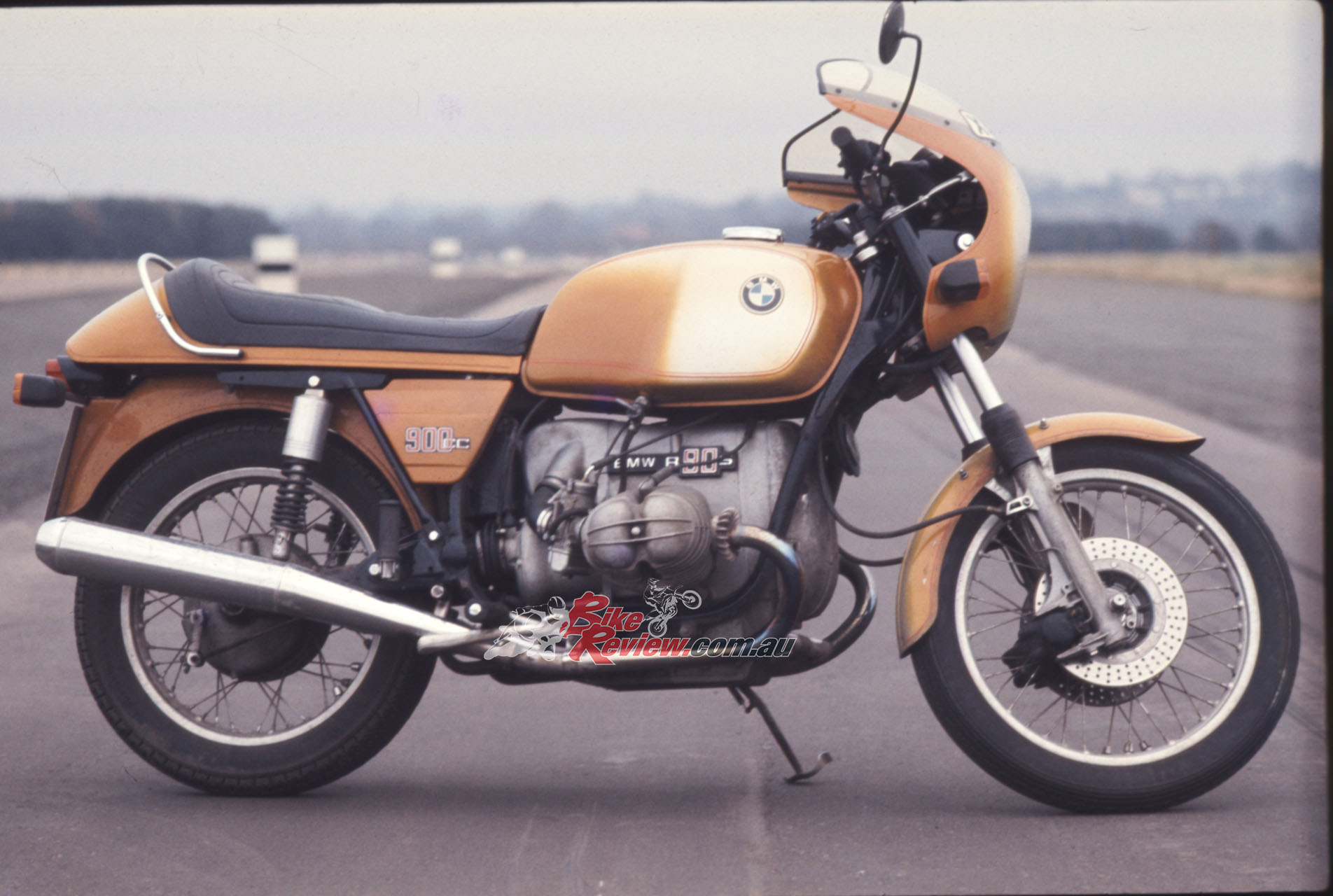
But the 1974 arrival of the new R90S sportbike in the BMW model range presented Butler & Smith with a much better arena for demonstrating the worth of its products, since the new 898cc performance Boxer – of which 17,455 examples were sold worldwide, before it was replaced by the R100S in 1977 – was more than capable of competing on equal terms in the Heavyweight Production class against the V-twin Moto Guzzis, four-cylinder Kawasakis and Hondas, and British twins and triples – no desmo Ducatis just yet.
With Butler & Smith’s new L.A. West Coast office now headed by the company’s former service manager and race fan Helmut Kern, backed up by sales manager Matt Capri, an inveterate gearhead who’d paid his way through college racing self-tuned Triumphs for big $$$ in the illegal street drags held on the uncompleted Interstate highways under construction back then, the way to promote BMW’s new shaft-drive sportbike to customers sceptical about the German marque’s sporting credentials, was to go Production racing with it, and win.
Which is exactly what the man Kern and Capri had initially hired back in 1972 to race BMWs in West Coast Production racing went and did, although former Norton club racer Reg Pridmore’s success in racing the downsized R75/5 in Californian Open Production events for Butler & Smith’s West Coast office, had already led to his nomination by Geitl to race the unsuccessful F750 bikes for the team run out of the firm’s East Coast HQ. But the R90S was a different matter, and in a one-off AMA National ride at Ontario in 1974 he finished so far in front of second place finisher Yvon DuHamel and third placeman Steve McLaughlin on their Kawasakis, that they were shocked to see him on the Victory Lane rostrum. “What are you doing here?” asked DuHamel of Pridmore, “I thought you crashed?!” Pridmore continued to race the race-prepped stock BMW in Heavyweight Production races with some success, finishing fourth at Daytona in 1975 – but it wasn’t till the AMA created the Superbike series the following year, that BMW really made its mark.
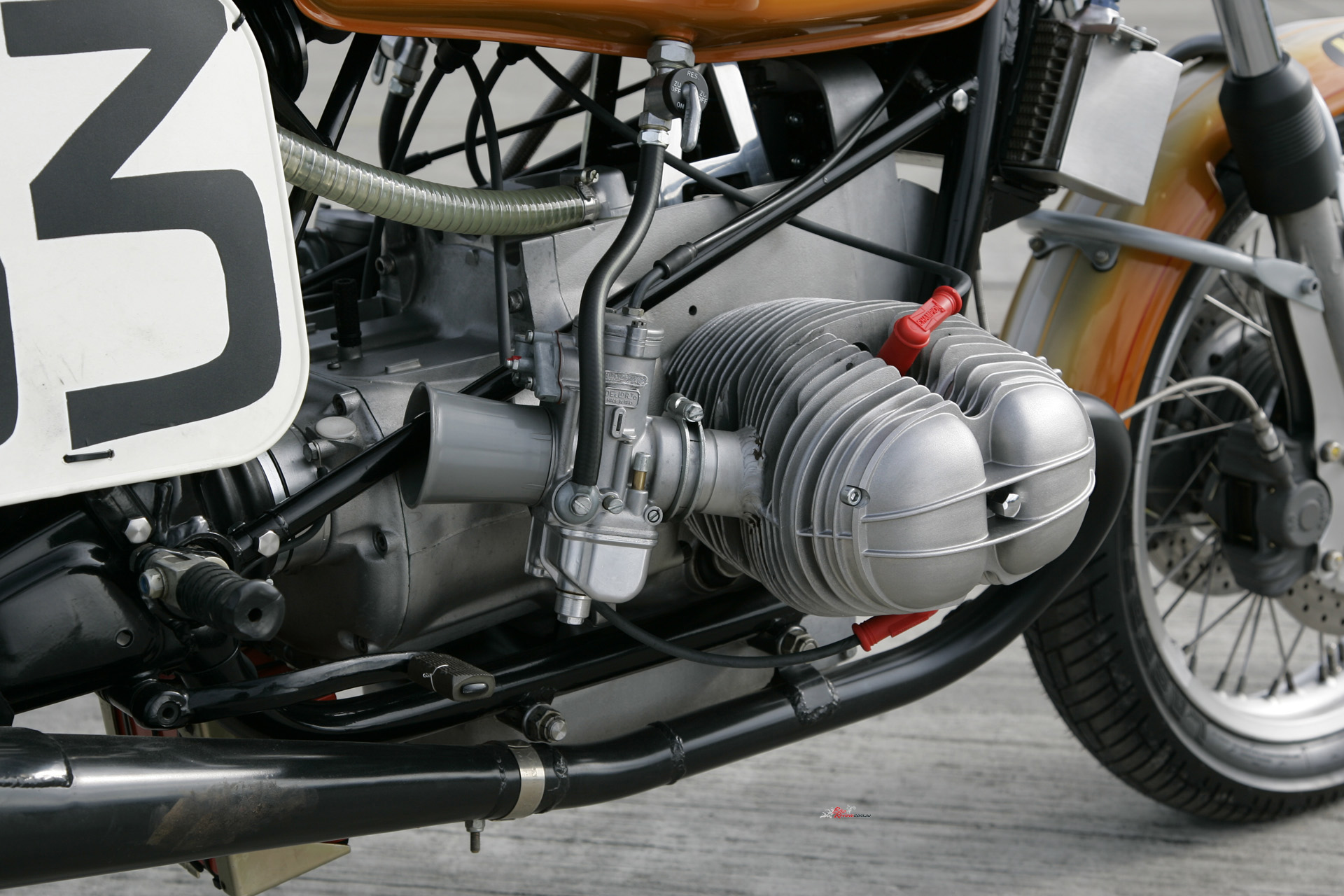
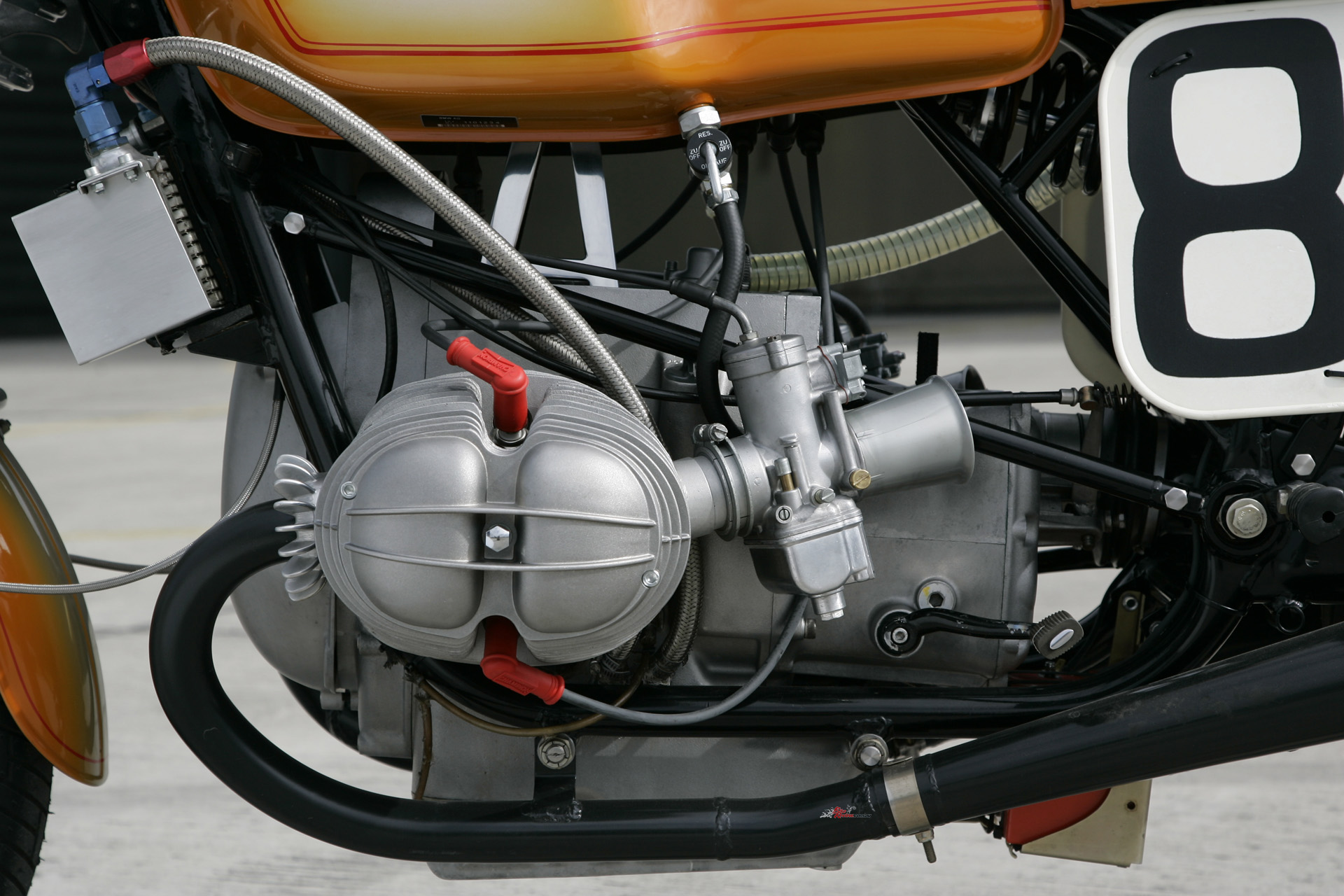
The acer’s 1001cc flat-twin layout in detail, showing the exposed cylinder head and intake hardware.
For with the TZ Yamaha swamping F750 entry lists, and AMA Nationals’ two-stroke domination proving a switchoff for four-stroke focused race fans and street customers alike, the AMA decided to establish the new Superbike class for 1976 as a modern-day revival of their Class C rules for modified streetbikes originally concocted back in 1934. So Peter Adams came up with a budget reputed to be a then massive $250,000 for Butler & Smith to win the title with a full race version of the R90S created by Geitl and his team. Starting in October 1975, a hard winter’s development work proved to be well spent when the three bikes made their public debut in the opening round of the first-ever Superbike series held at Daytona on March 5, 1976, in the hands of Pridmore, slightly-built Pennsylvania-based two-stroke racer Gary Fisher, both chosen by Geitl, and Californian Steve McLaughlin, plucked from the Racecrafters Kawasaki team by Kern and Capri to race the Beemer on behalf of Butler & Smith’s West Coast office. Originally, Geitl had intended to run just two bikes with a third spare, but Peter Adams wanted to try to fill Victory Lane with BMW Boxers, and insisted on a third rider, to be chosen by the company’s Californian office. This meant the BMW importer team was very much a sum of two halves, with serious internal rivalry between the company’s two geographic opposites, East and West.
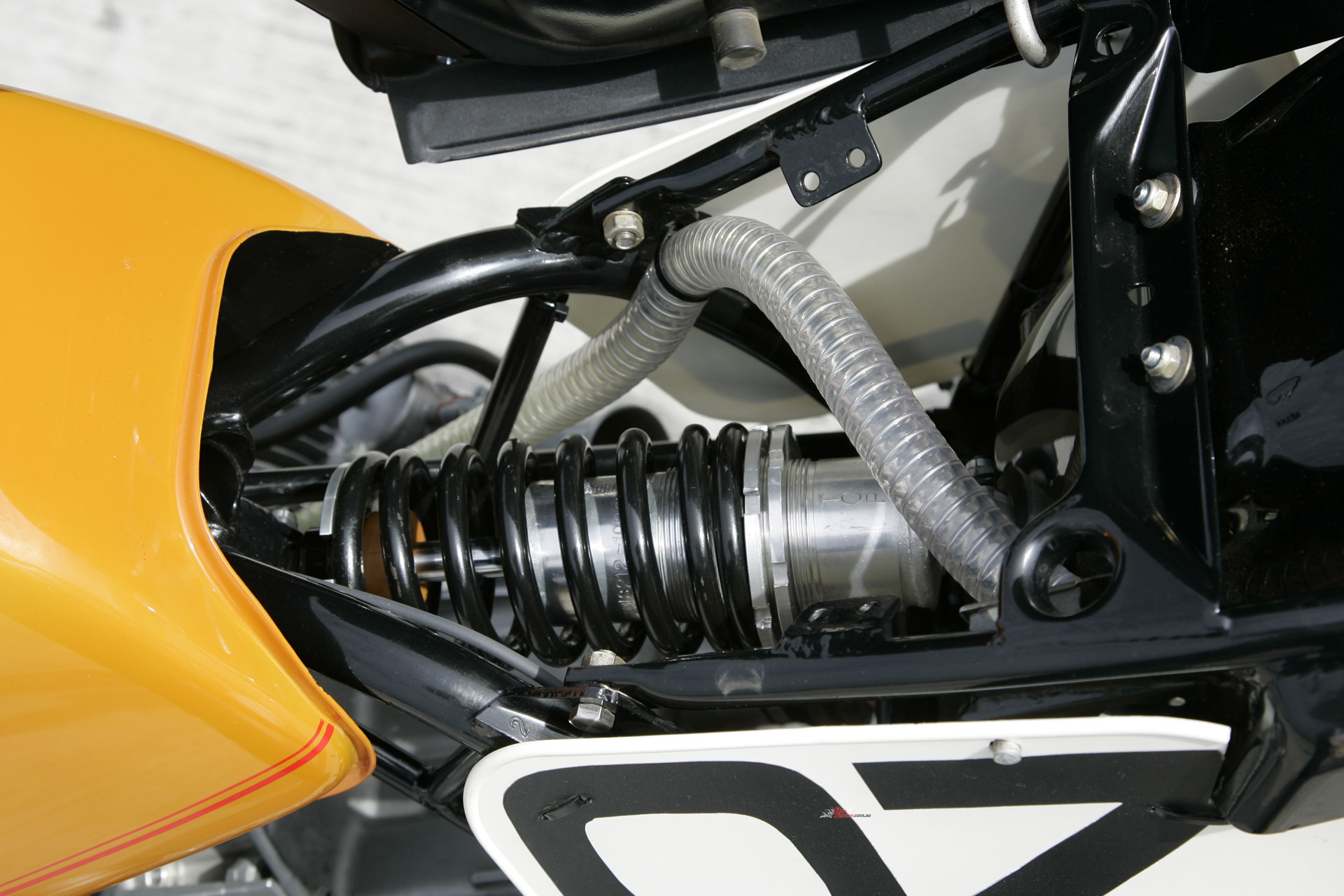
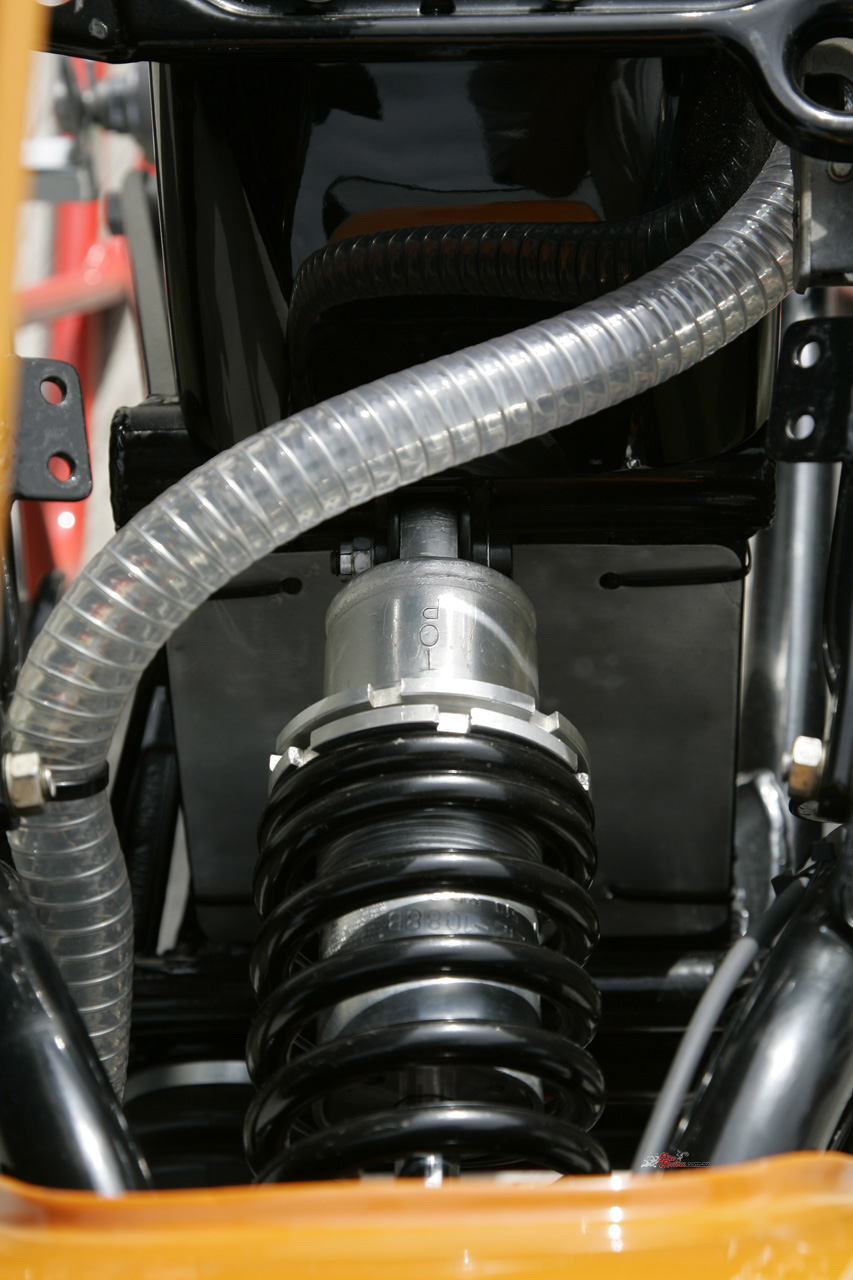
This explains why Kern and Capri were astounded, and irate, to discover that Geitl had secretly developed a monoshock rear suspension for two out of the three R90S Superbikes, after a creative reading of the Superbike rulebook which he himself had helped draft, as a member of the AMA’s Rules Committee. Then-Kawasaki rider McLaughlin had been nominated as Riders’ Representative to the same body, but he was just as surprised as his mentors to see what had been done – particularly when it transpired that the monoshock bike he was racing had been crashed by Geitl in testing on the street, and was barely repaired!
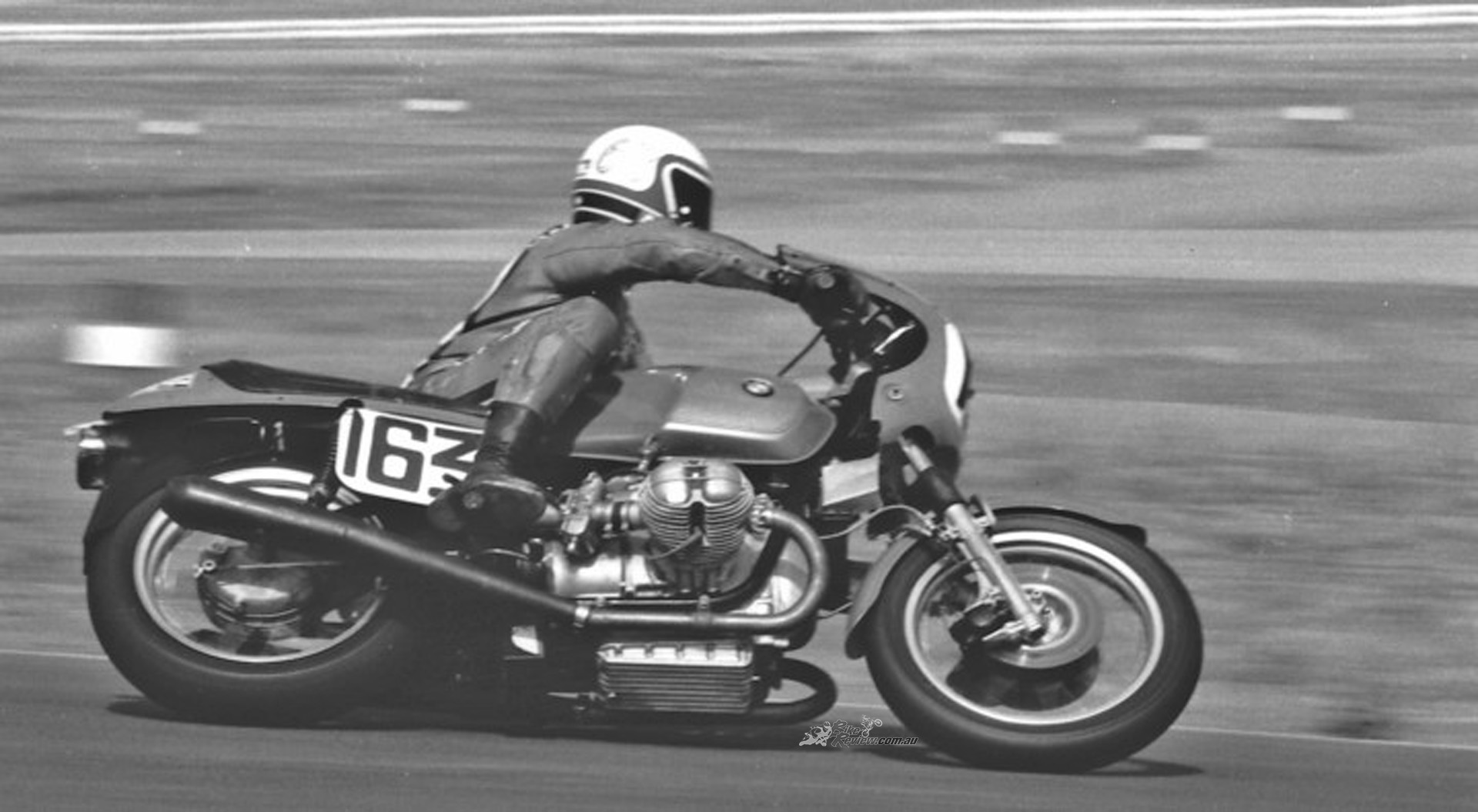
Pridmore had declined to race with a monoshock on the grounds that he couldn’t get on with its restricted compliance, though it was widely speculated at the time that Butler & Smith welcomed this just in case the tech inspectors rejected Geitl’s interpretation of the rulebook, and forced them to convert the bikes back to twin-shock guise. This didn’t happen, though – but the upshot was that McLaughlin’s mechanic Matt Capri had to work flat out through race week trying to fix the damaged bike. “It seemed each lap Steve ran, something else would break,” he recalls. “He hardly did two laps at a time before the Heat race.”
Back in those days grids for all AMA road races were determined not by qualifying times, but by short dirt-track style Heat races, and such an event for the new Superbike class held on the Thursday of Cycle Week 1976 saw Peter Adams’ wish for a 1-2-3 BMW blanket finish come true, with Fisher running out an easy winner, a long way in front of his teammates with Pridmore second and McLaughlin close behind, running in his slipstream. Cycle magazine editor Cook Neilson on his 883cc desmo Ducati SS finished fourth, ahead of future 500GP star Mike Baldwin on Reno Leoni’s fleet Moto Guzzi 850.
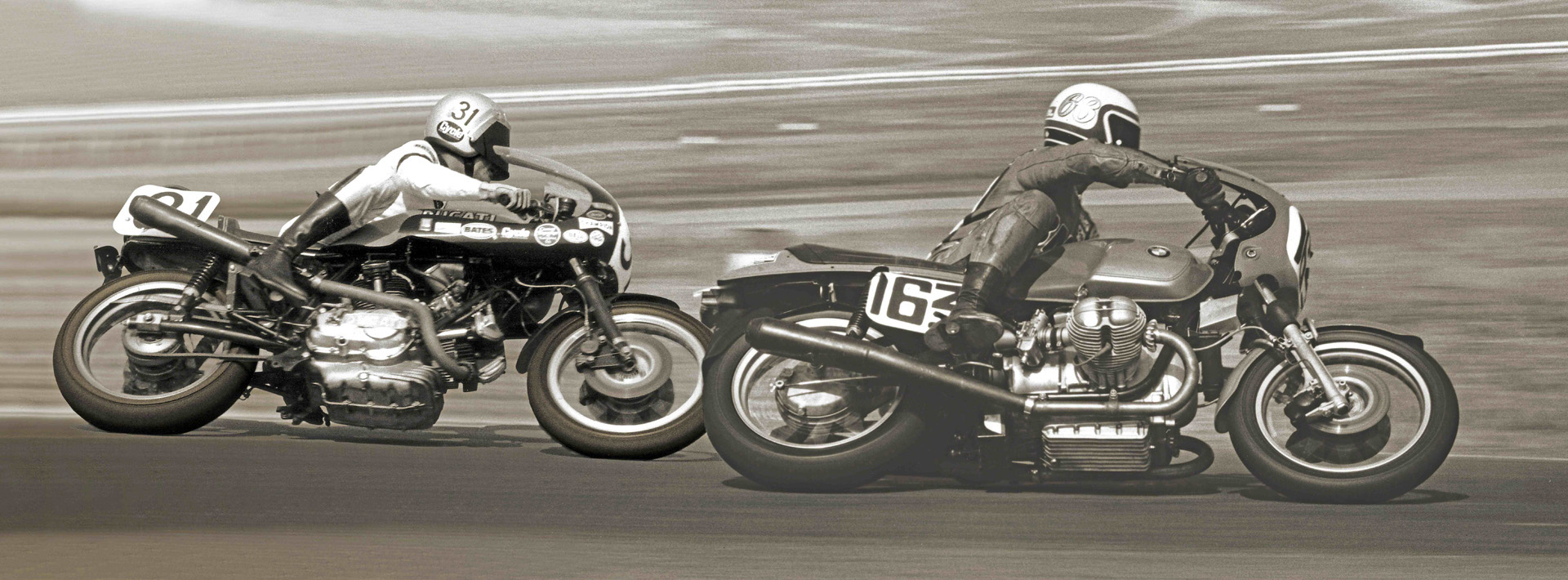 The following day’s inaugural AMA Superbike final saw Neilson lead off the line on the Ducati (later of course to win the same race the following year), before dropping back as Fisher passed him on the BMW, followed by McLaughlin and then Pridmore. Fisher continued to lead until a loose exhaust clamp apparently rotated and interfered with his gearchange, causing him to miss gears and overrev the engine, leading to his retirement with a broken rocker arm two laps from the finish. This left McLaughlin in the lead, but as a student of the so-called ‘Art of the Draft’, knowing he had no chance of pulling away from his teammate on a similar bike, he allowed Pridmore to lead into the last lap, then lined up to slipstream past him on the Tri-Oval banking between the chicane and the finish line.
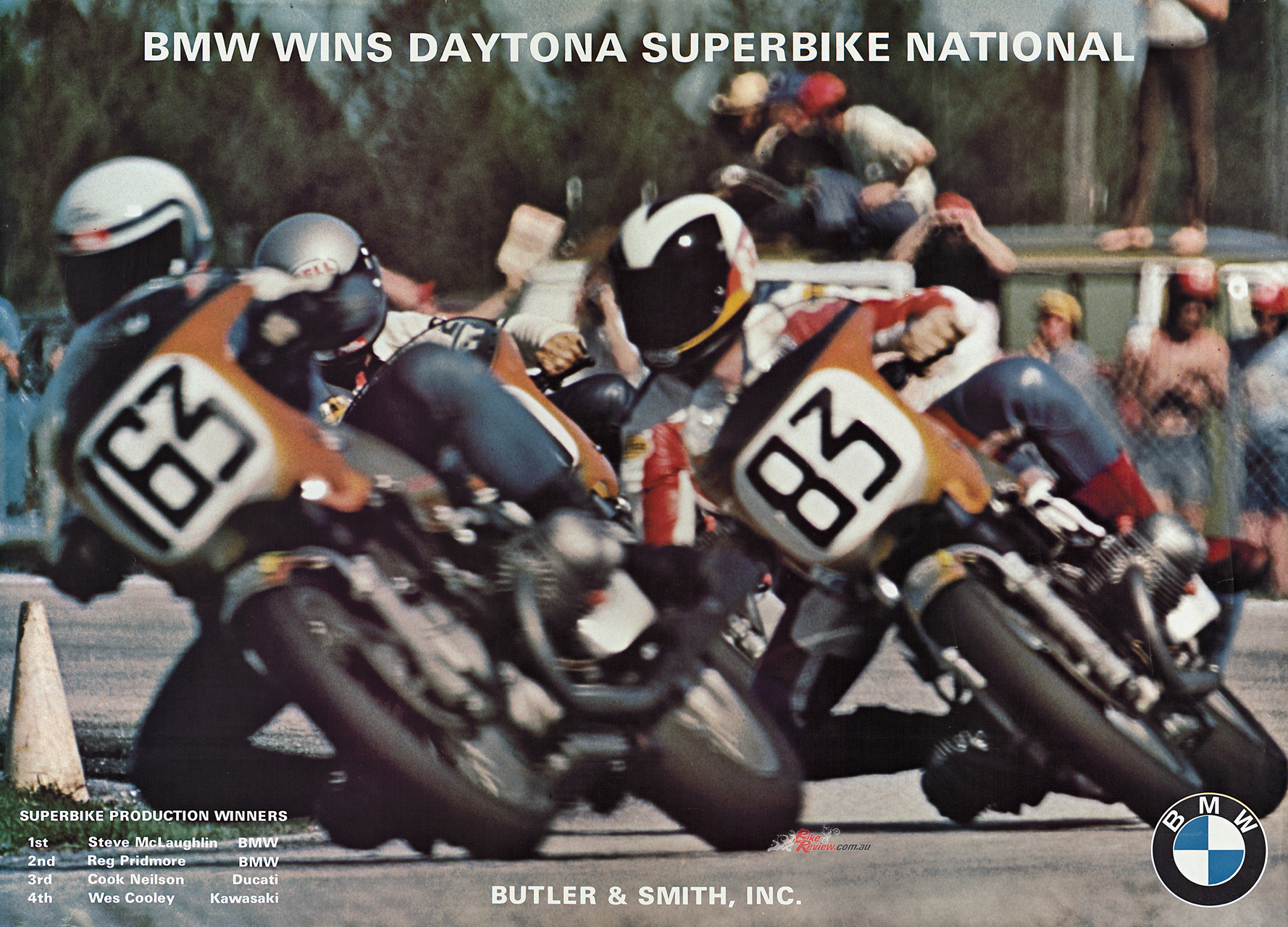
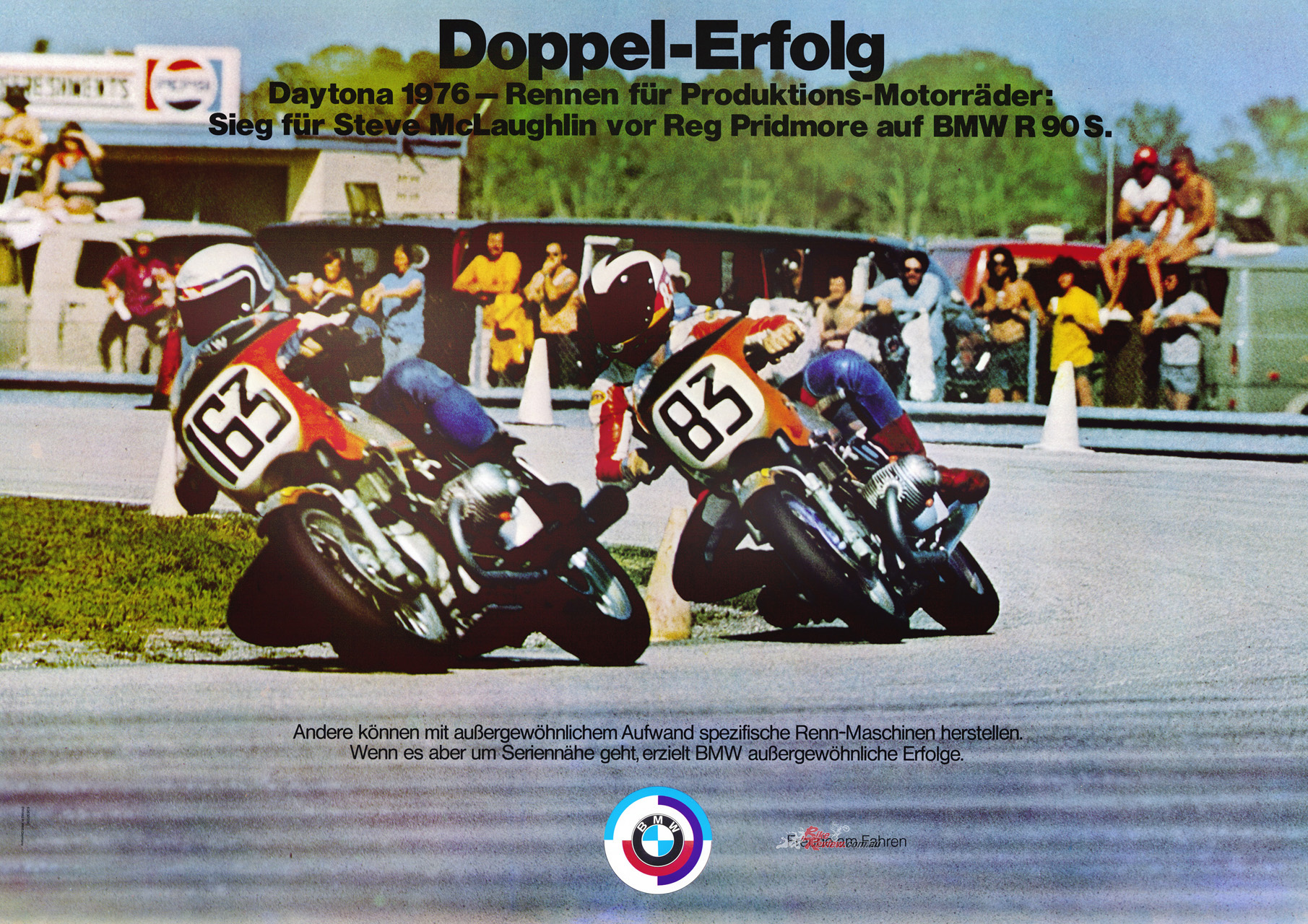
 He nearly didn’t make it, though, practically rubbing cylinders with his teammate as the two Boxers droned side by side towards the stripe, but in the final few yards the West Coast monoshock bike just sneaked ahead, for McLaughlin to win by what turned out on the high-speed NASCAR photo-finish camera print when it finally arrived 45mins later, to be three inches, or less than the width of the front tyre’s sidewall! Victory came at an average speed of 99.80 mph/160.61 kmh – just short of the ‘ton’, and some going for a 50-mile 13-lap test of streetbike-derived speed. Neilson’s Ducati was third, with Wes Cooley’s Yoshimura Kawasaki fourth after wobbling its way past Baldwin’s fifth-placed Guzzi.
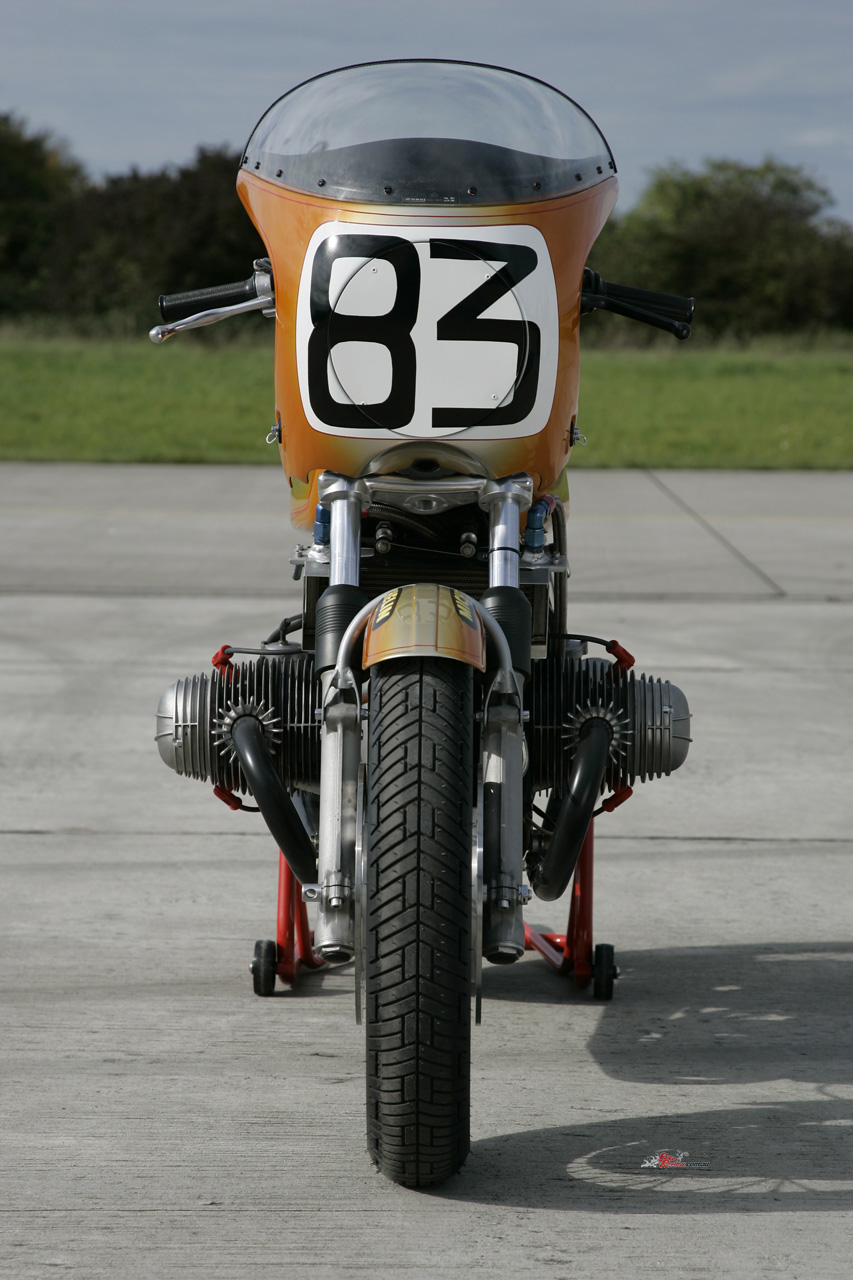
The signature Boxer engine defines the R90S’ silhouette.
The subsequent publicity for this 1-2 victory alone, at a crucial time in the calendar at the start of the spring buying season, would alone have justified Adams’ investment in the project, with dealers around the country selling R90S streetbikes as fast as Butler & Smith could deliver them – a substantial proportion of the 17,378 such bikes which BMW produced in the model’s three years of production from 1974-76, before it was replaced for 1977 by the full one-litre R100S, were sold in the USA that year, and BMW’s fuddy-duddy reputation was literally transformed overnight.
But there was still a championship to be won, and in the next round at Loudon Baldwin’s sweet-stopping Moto Guzzi’s big cast-iron Brembo brakes proved infinitely more effective than the BMW’s much smaller aluminium front rotors, gripped by stock ATE calipers with half the number of pistons, allowing him to score a decisive victory in front of Fisher and Pridmore on the BMWs. Daytona-winner McLaughlin sheared the flywheel off his Boxer’s engine, after missing a gearshift.
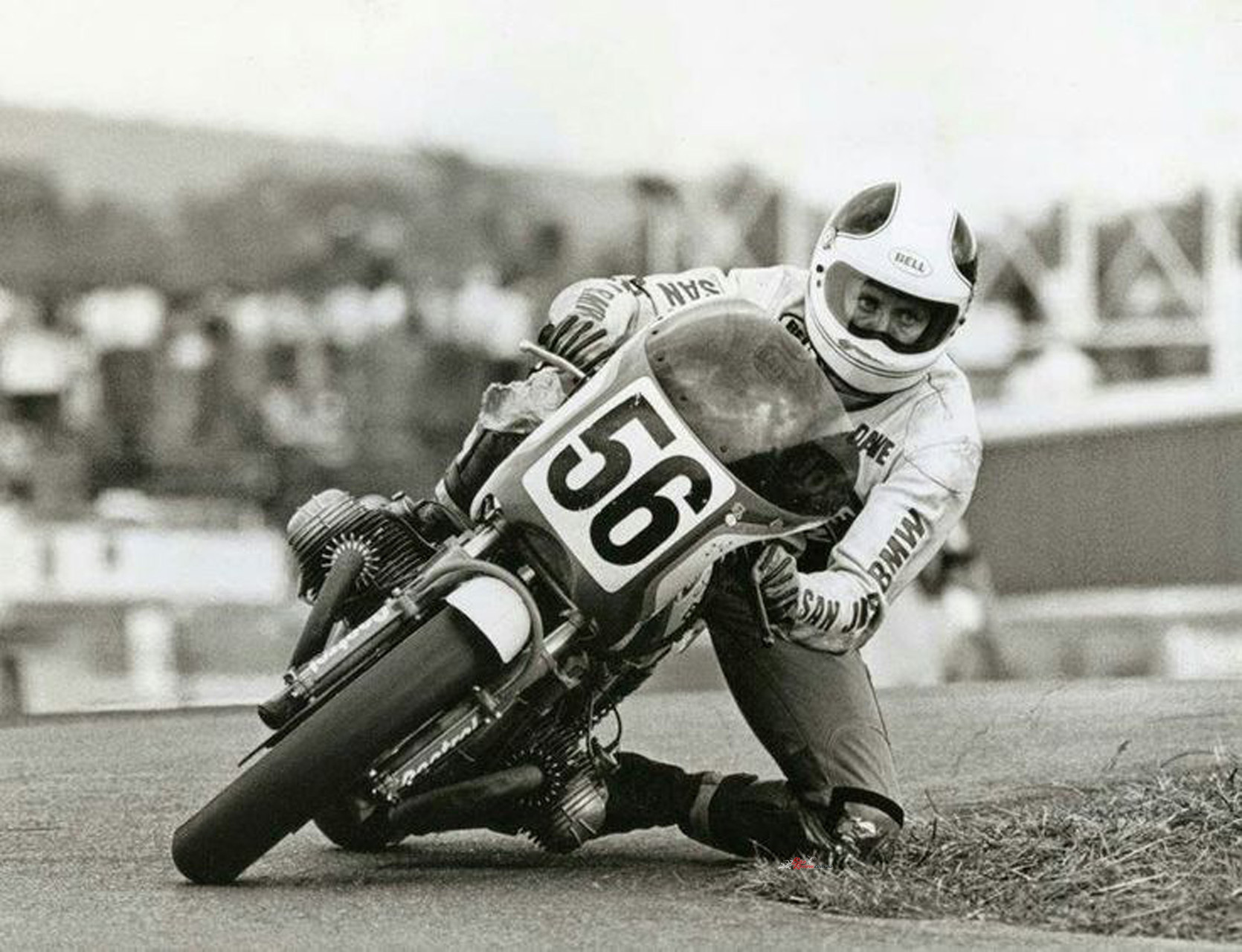
The third round of the debut AMA Superbike series was at Laguna Seca, and for this race on another twisty track Geitl had equipped the three BMWs with much larger Hurst-Airheart steel front discs, matched to benchmark Lockheed two-piston calipers. Fisher retired early on with a leaking oil cooler, leaving Pridmore and McLaughlin to battle for victory in a no-holds contest. On the final lap, with Pridmore ahead, McLaughlin experienced the full potential of the bigger, better brakes to the max, performing a gigantic stoppie in seeking to avoid ramming his BMW teammate as he closed the door on an overtaking move into the final turn.
The Daytona-winning bike cartwheeled upside down over its front wheel and flew through the air in one of the most spectacular crashes of all time, having already fortunately decanted its rider. Photographer Mush Emmons was there to capture it on celluloid, and when the photo appeared in California’s leading daily paper the Los Angeles Times, it made Steve McLaughlin famous outside the world of motorcycling – for all the wrong reasons! Pridmore went on to win the race, then clinched the inaugural AMA Superbike title with another victory in the final round at Riverside, his home track.
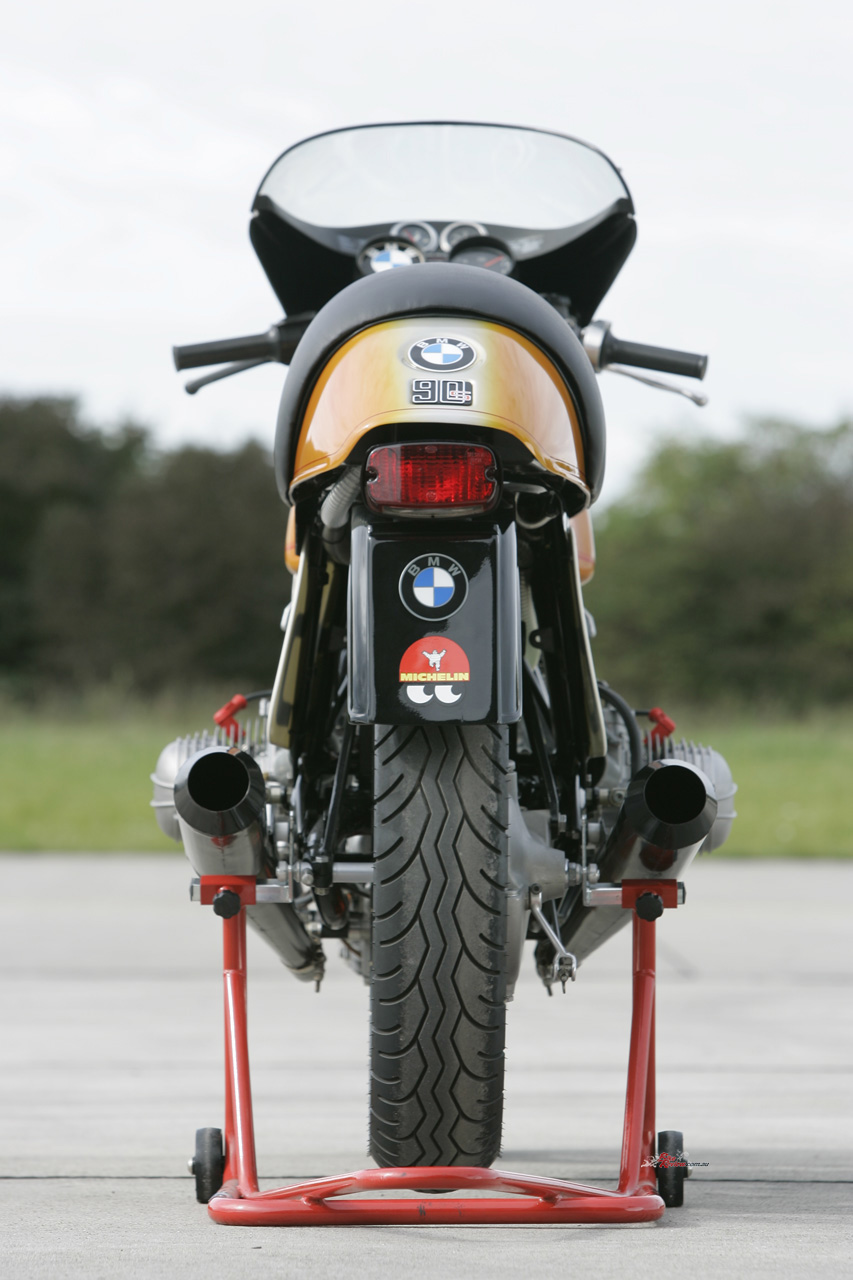
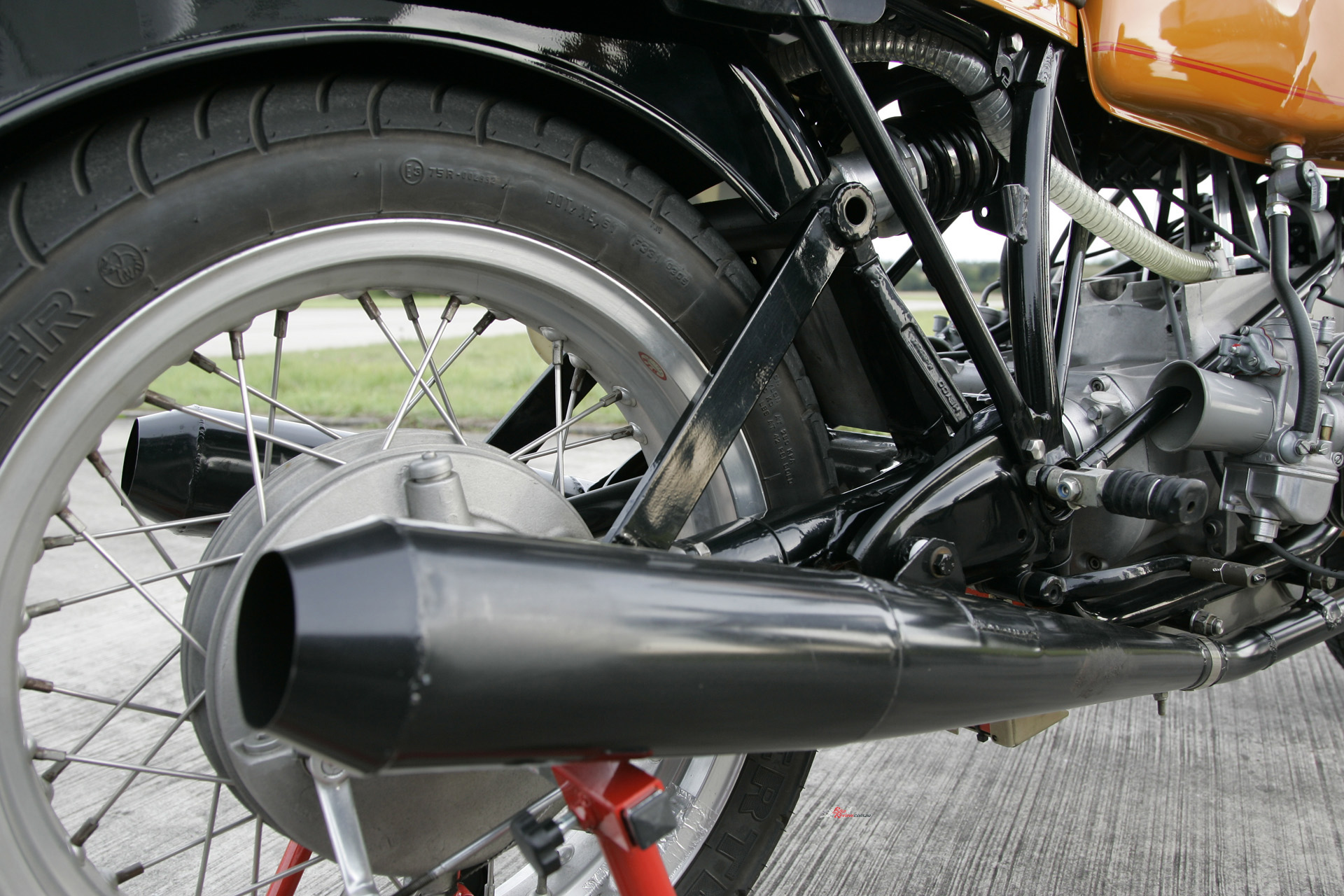
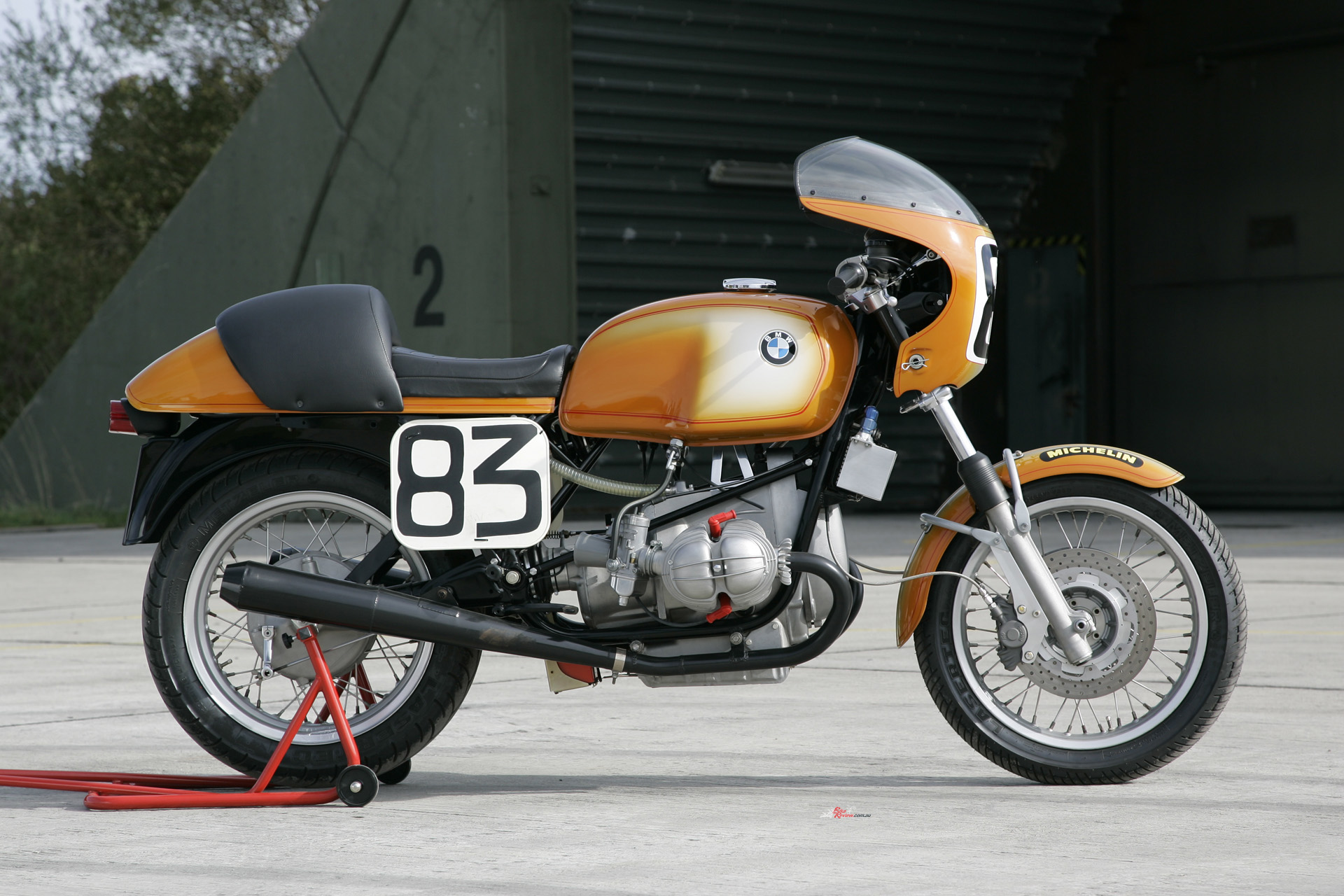
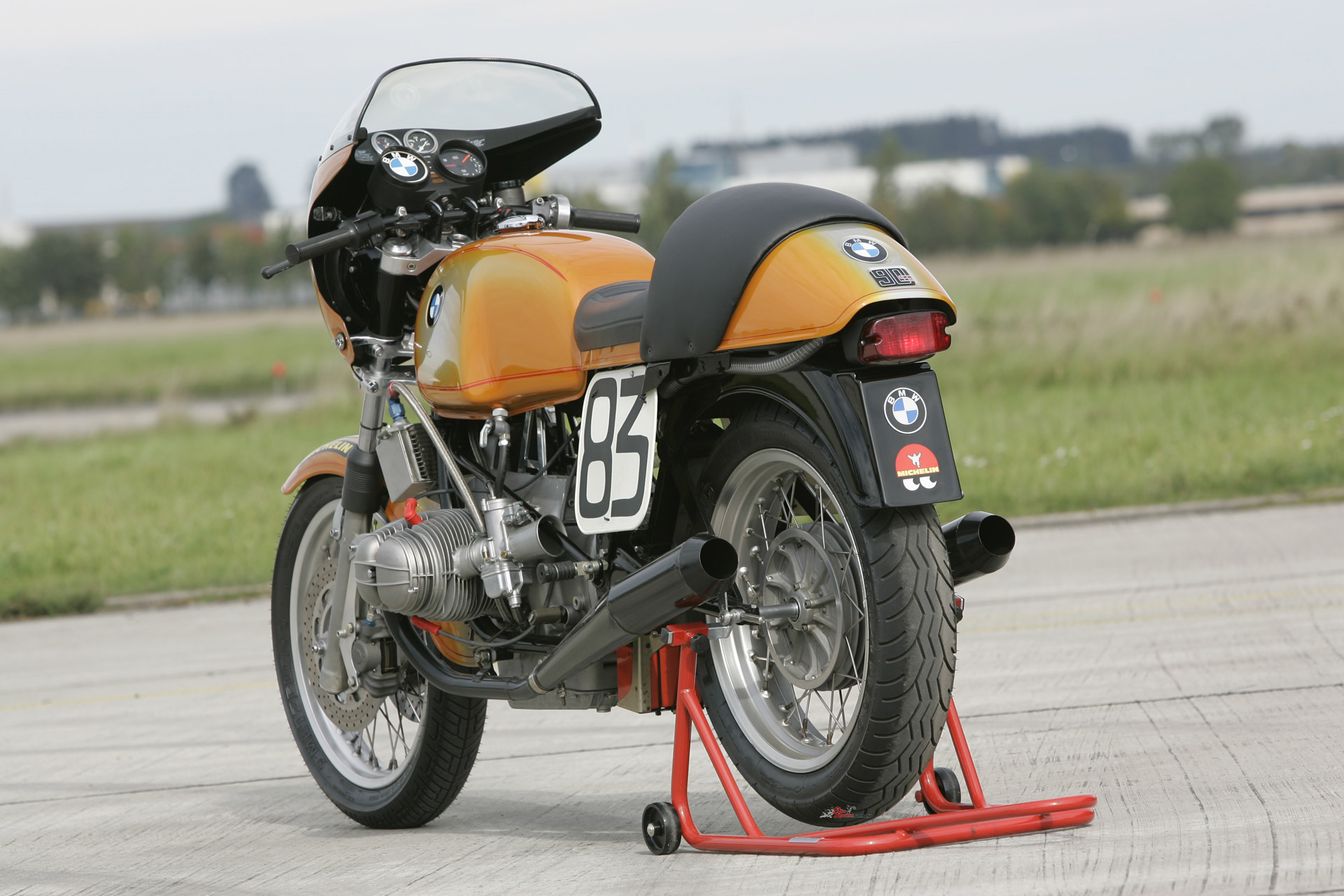
The race hump and megaphones give the stock-based BMW a purposeful Suoerbike stance.
With the PR mission fully accomplished, and BMW’s image transformed via success in racing – B&S race mechanic Todd Schuster’s ‘Bavarian Murder Weapons’ tag summed it up nicely, especially when given wider coverage by Neilson in Cycle magazine! – Peter Adams shut the race operation down, sending the three Butler & Smith bikes out West, where they ended up in the hands of various BMW dealers. The rebuilt McLaughlin Daytona-winner went on to take victory in the hands of Ron Pierce in the 1977 Loudon AMA Superbike National, a win repeated the following year on the same tight track by Harry Klinzmann on the Fisher bike by now owned by San Jose BMW, en route to fifth place in the championship – the German Boxer twin’s final race victory in AMA Superbike.
Adams appointed Gietl as B&S Service School Manager, but with permission to continue running a new bike at his own expense that he’d built himself as an after-hours project in conjunction with Todd Schuster, first with McLaughlin at the helm, then for 1978, John Long. As a final chapter in the BMW Boxer’s North American Superbike story, Long won the Canadian Superbike title that season with the Gietl & Schuster BMW R100S, and tied with the now Kawasaki-mounted Reg Pridmore on points for the AMA championship, before being declared the winner on countback. Only several months later was Long’s title rescinded owing to a purported startline error at Loudon, when the BMW rider was waved into the wrong place on the grid by an AMA official. So, to most minds, BMW actually won two AMA Superbike titles with their improbably successful battling Boxers – just that they supposedly lost one owing to official incompetence!
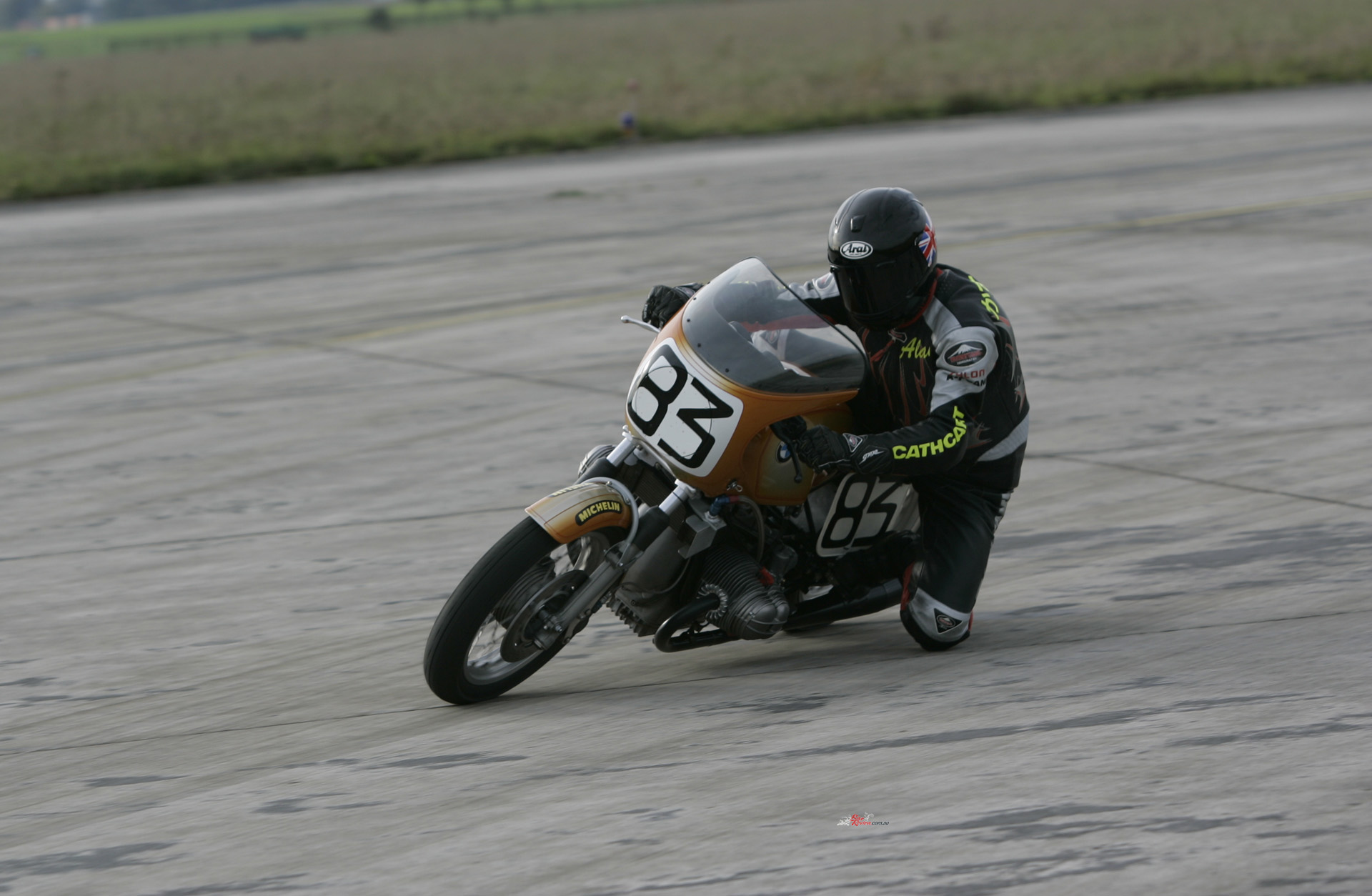
Steve McLaughlin on his BMW R90S Superbike Daytona Victory
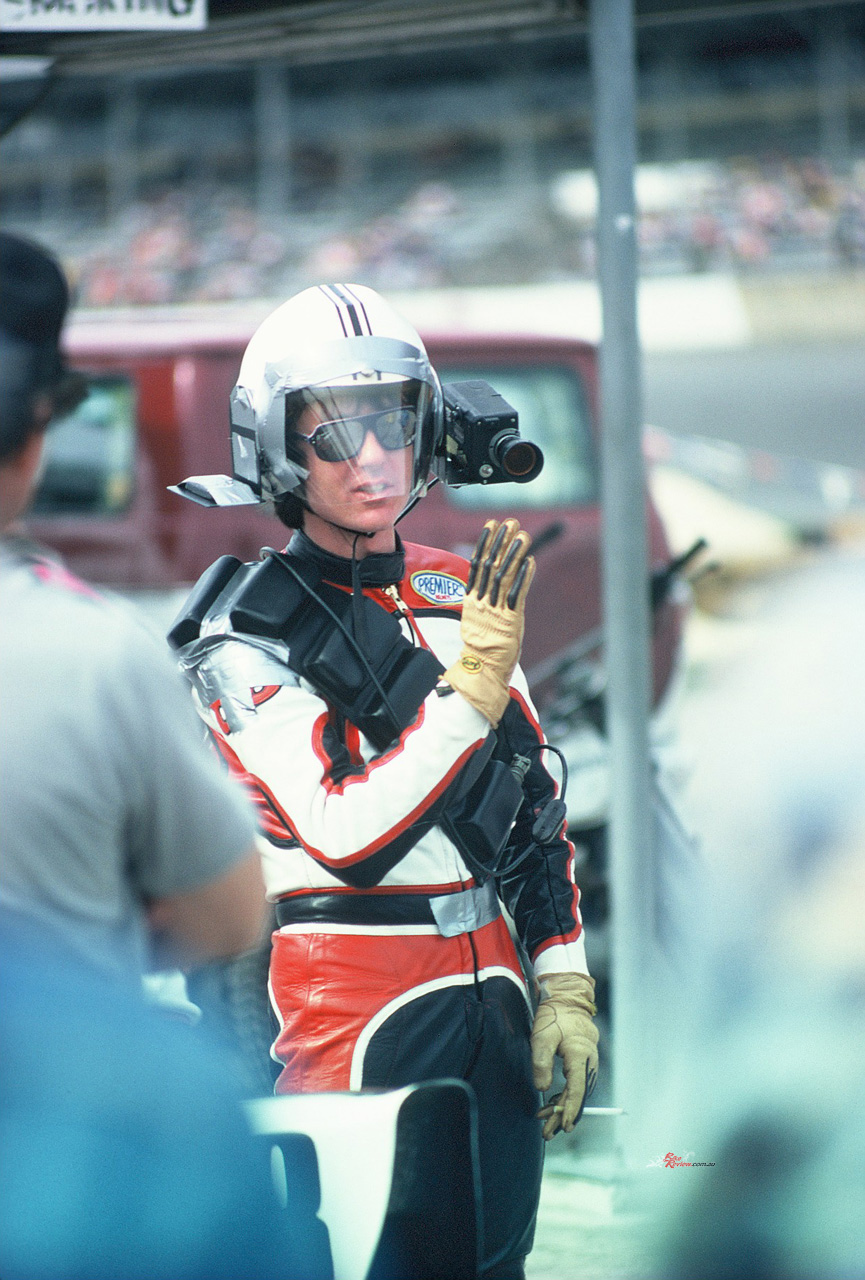
Steve McLaughlin is one of the road racing world’s multi-achievers, with a list of credits from rider to team manager to promoter to entrepreneur that would fill this page on its own. Best known for creating the World Superbike Championship, he isn’t known as ‘Motor Mouth’ for nothing – so let’s get him to tell us in his own words about his Daytona Superbike victory on the Butler & Smith BMW R90S….
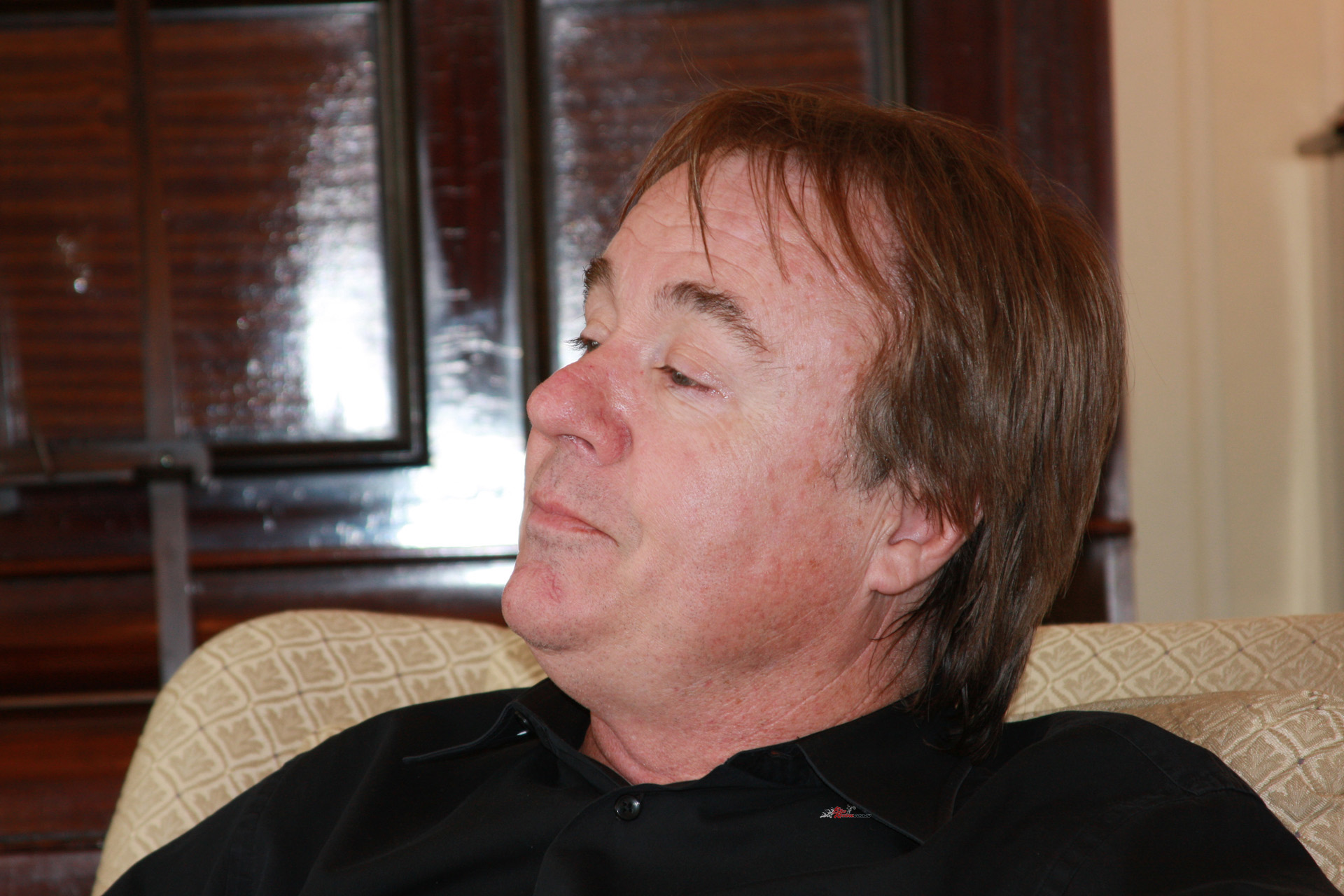
“In 1975 I was doing OK – I had led the Daytona 200 on a Yamaha TZ750, and I’d been racing in Heavyweight Production on a Racecrafters Kawasaki, and won a few races for them by getting the thing to handle. I first heard from Yoshimura when a guy from Pops calls me up before the 1976 season and says, we want you to ride for us next year in this new AMA support race called Superbike, and I said, cool, how much? And he said, no no no, for the honour of riding for Pops. And I said – well, thanks, it is indeed an honour, and I understand that you make the fastest bikes that go around tracks, but that can’t stop or go around corners, and you need me to fix them.
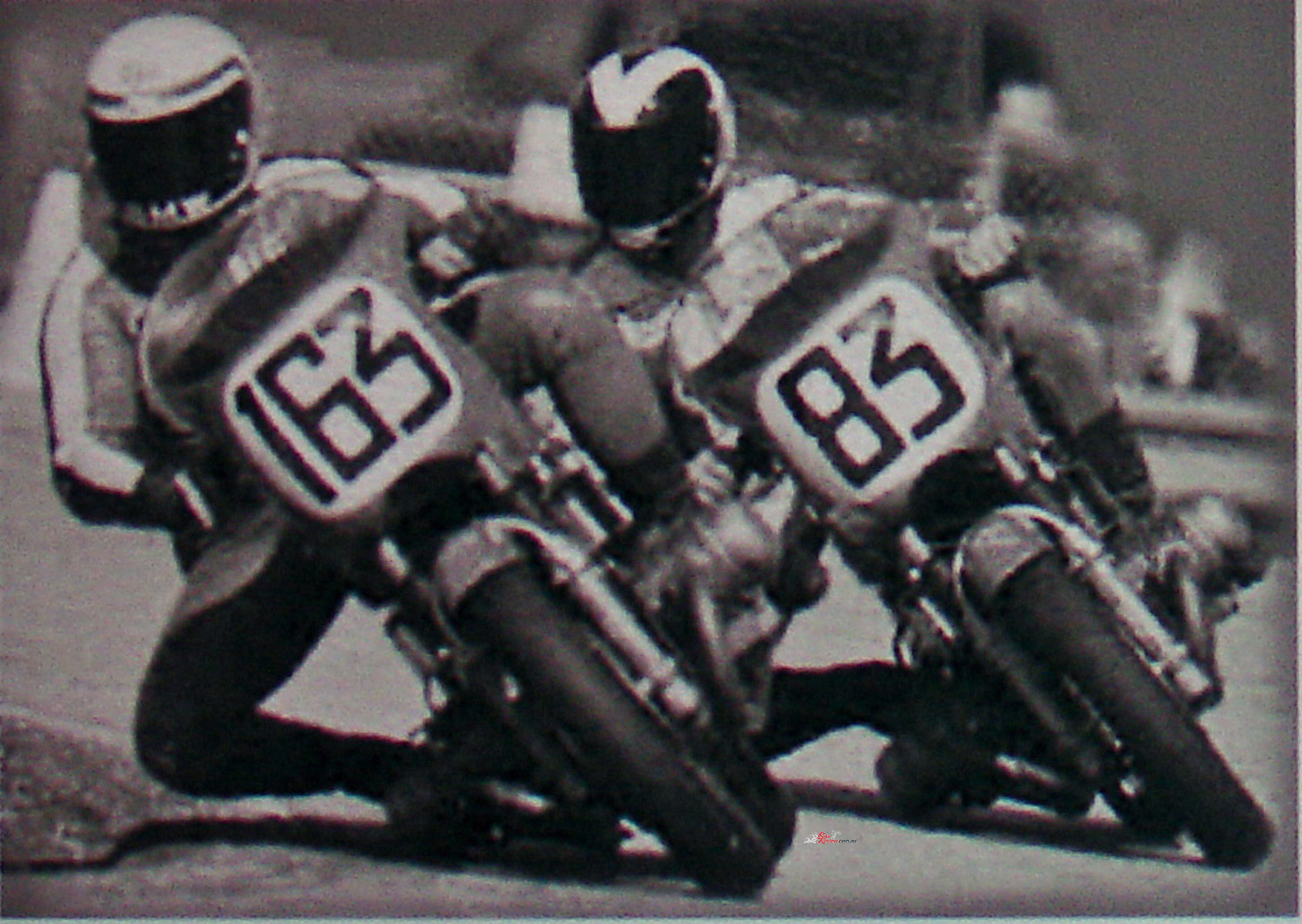
Pridmore leads McLaughlin at Daytona in 1976.
But honour doesn’t pay the rent, and I make money from this. So the discussion ended there – they wanted me to ride just for prize money, no salary, oh – and the honour. No thanks. In Heavyweight Production, I’d been developing the chassis of the bikes I had ridden to make them better. One of the reasons Yoshimura had contacted me was that they had this incredible engine, but besides the bikes being totally dirty and filthy all the time, they wobbled everywhere and wouldn’t stop.”
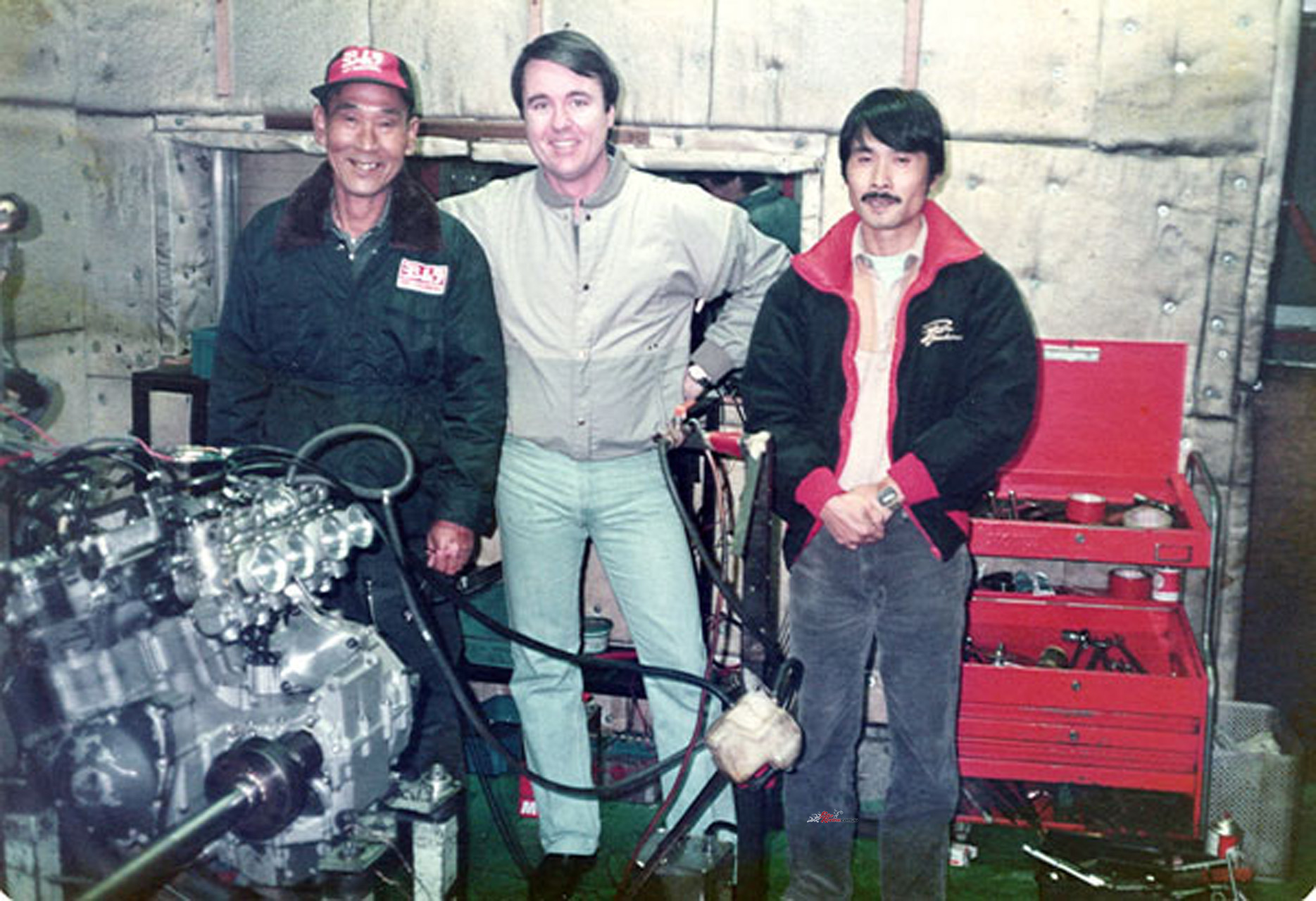
Steve McLaughlin with Pops Yoshimura (L) and Pop’s son and now Yoshimura head Fujio Yoshimura (r).
“So the day after Pops contacts me, Helmut somebody from Butler and Smith calls and asks me to ride for BMW on their R90S. What had happened was that BMW had heard that Yoshimura was going to get me, and they got worried and came in to make a bid. Well, it turned out that I was able to charge them more money than they paid Reggie Pridmore, who Butler and Smith had actually been racing with all these years. He later on won many Superbike championships, but back then was considered more of a West Coast clubbie racer, not an AMA national rider. I got paid $500 for each race plus bonuses, and I think Reggie got $1000 for the season.”
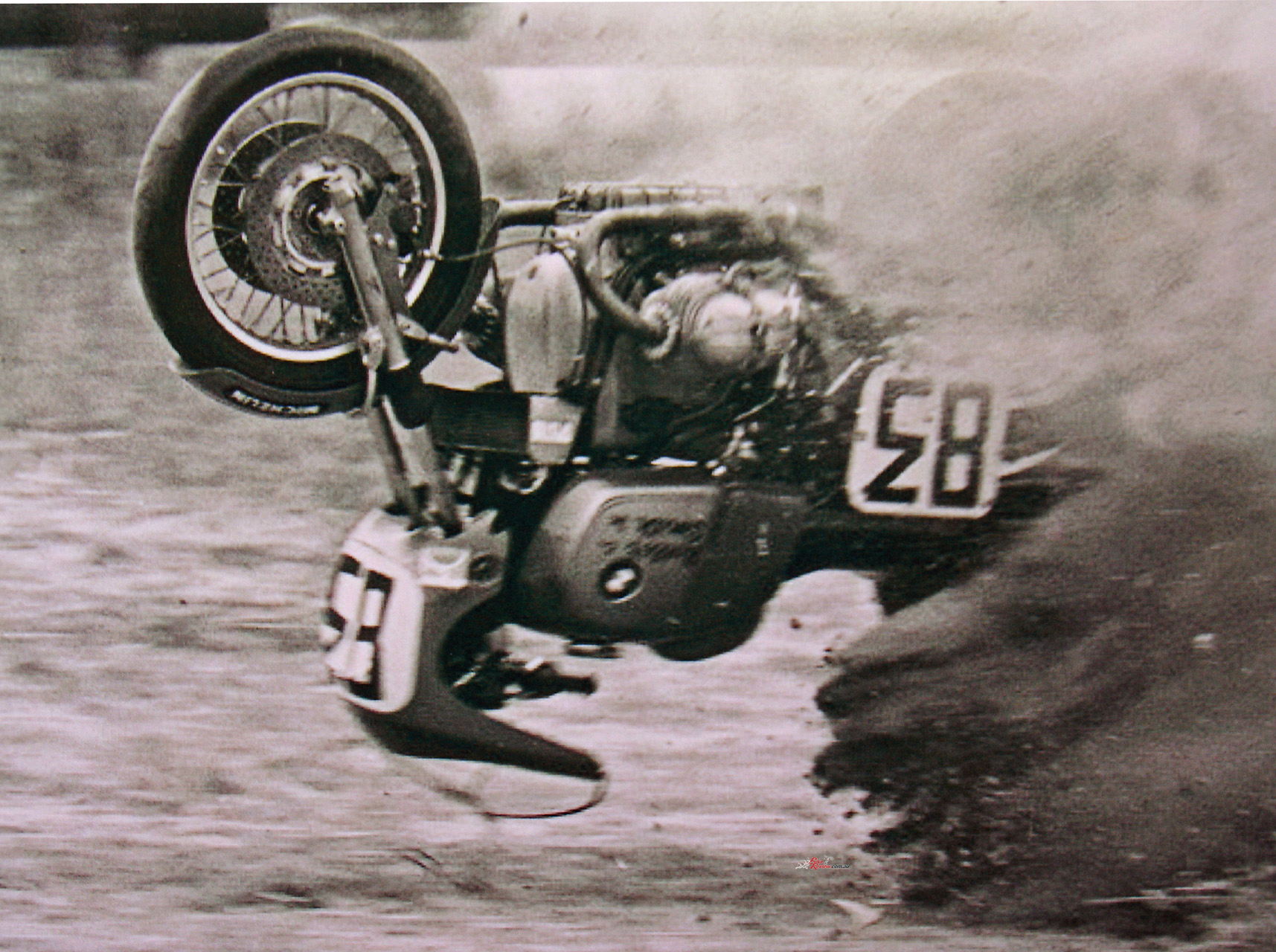
McLaughlin take an off-track excursion at Laguna Seca the same year.
“So we get down to Daytona, and they have three really tricked out bikes for three riders. Udo Geitl, who’d read the rules closely and had gotten creative, had built these monoshock bikes – one shock instead of two at the back, which was all you really needed. Reggie didn’t like this so much, so he kept the two shocks on his, but Gary Fisher, who was a National number also and one of the best 250GP riders in the world back then, he and I went for the mono. So the truck shows up, Udo gets out of the cab before he takes the bikes off the back, and there he’s got a big bandage on his arm from where he’s fallen off one of them.
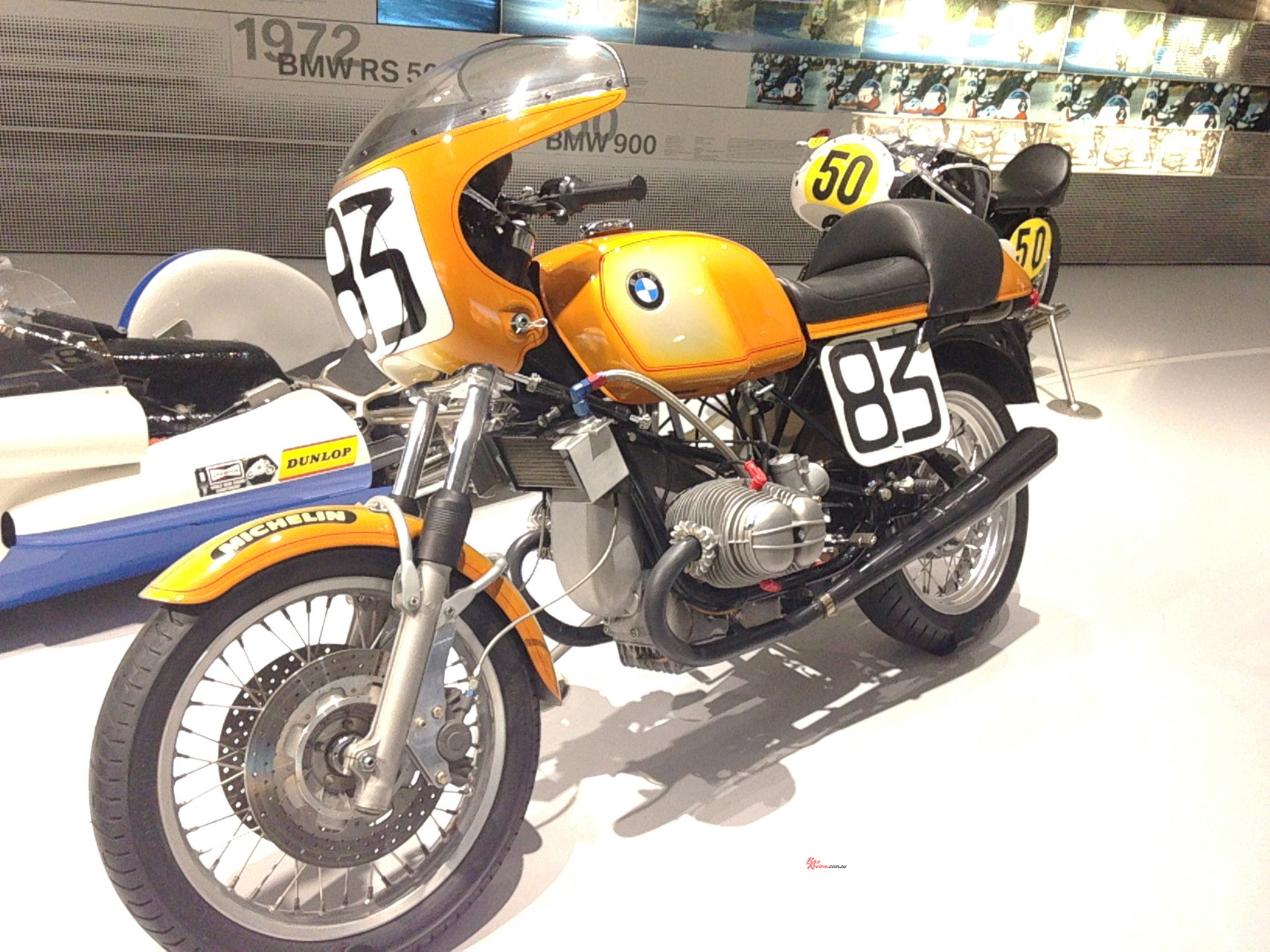
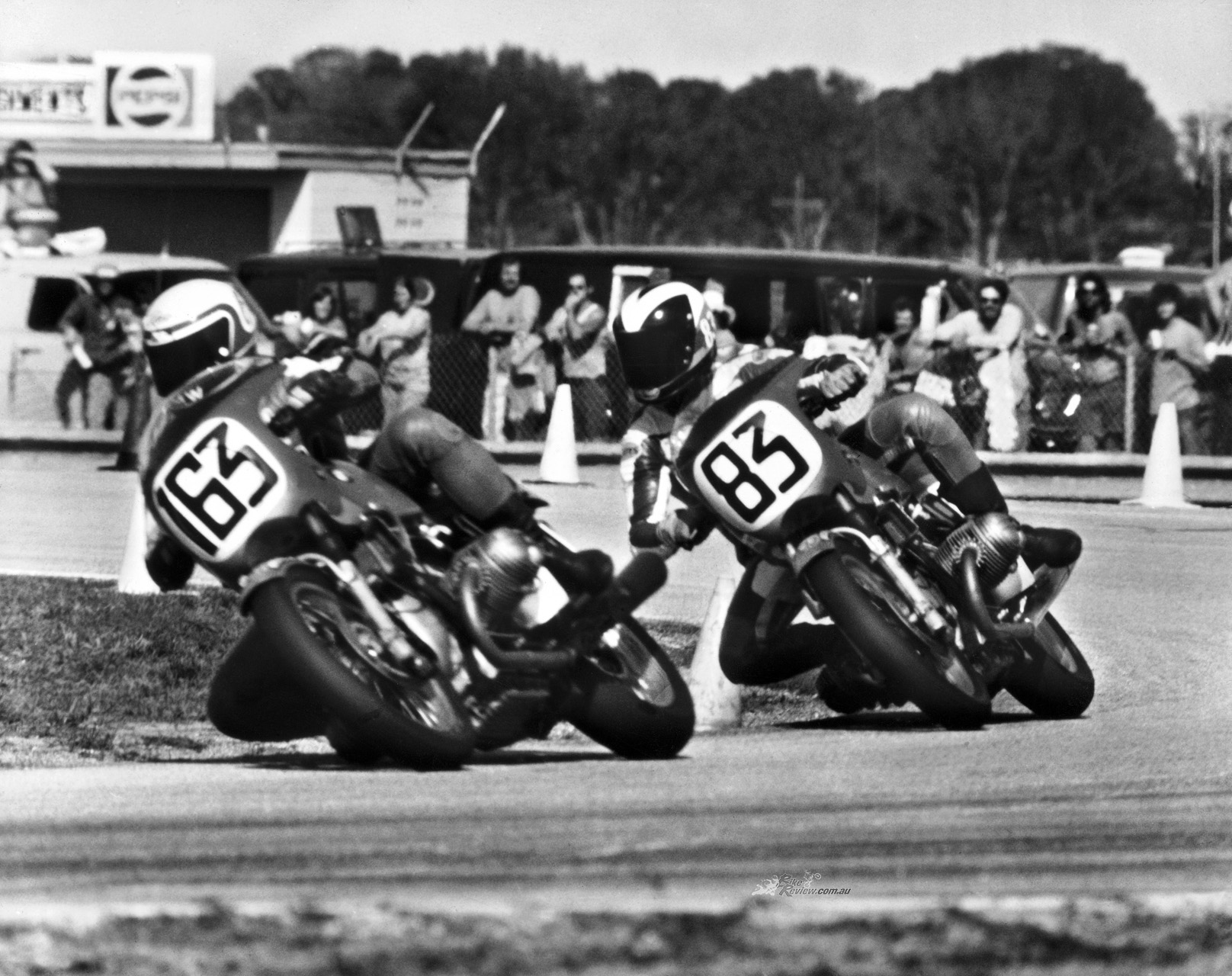 So I tell my wife, I bet it’s my bike that’s got the scrape. Sure enough, the #83 bike comes out of the truck, and it’s got the crash damage that’s sorta been fixed. Every day in practice the bike never went more than two laps running – it lost oil pressure, cables came off, everything went wrong on the thing. And Matt Capri, who was the West Coast sales manager and was my mechanic, was going, don’t worry Steve, it’ll be OK. I’m telling him, Matt, they obviously hired me as a tactical diversion to get me off of Yoshimura’s bike, away from the opposition, and they want Reggie to win this thing. It didn’t look good….”
“Anyway, along comes the race, and in practice and the heat race you could see Gary Fisher didn’t understand he wasn’t on a TZ Yamaha, he wanted to rev the thing past 11,000 – I mean, this was a pushrod Boxer twin, with a shaft drive too. I was watching Gary downshifting way too soon and revving it way too high and thinking, there’s no chance he’s going to finish, he’s either going to drive the drive-shaft off the back of the bike, or else cut this thing in half – for sure he’s going to overrev it. So we get into the race, sure enough Fisher blows up, so it’s me and Reggie. And Reggie has a faster bike, as we all knew he would – but he doesn’t have a lot of Daytona time under his belt, so he didn’t really understand The Draft. And so, I could lead him in the infield, no problem, then let him pull by so on the back straight and then the front straight I’m just practising the draft – we had the Chicane in between, of course.”
“So each lap I’m just practising and looking for where the draft is, until I finally find it, and where the real tow is it’s about eight or nine bike lengths behind his bike – a lot more than on other bikes, probably because of those cylinders sticking out the side. So I lay in the draft on the last lap, I flatshifted out of the chicane, what we call powershifting nowadays, and – phew, it’s a squeaker. Because I had to come from a long way back, I just inched past him on the line. I wasn’t even sure – I thought I’d won, but I wasn’t sure.
And the announcer, a man called Roxy Rockwood who was very decidedly not my friend, he decides from his perch up above that Reggie has won, even though Bill Boyce who was the AMA referee, has told him that I’ve won, and he should wait for the photo. But Roxy’s gone and organised the Victory Lane winners circle, and he puts Reggie in the middle. Then the photo comes in, and it turns out that indeed I have won by half the width of the front tyre – except now I have to get my trophy off Reggie. Reg says, well – if you won, let’s just split the prize money between us, and I said, what are you talking about, get outta here. Reggie’s never talked to me again since that day…..”
1976 Butler & Smith BMW R90S Superbike specifications
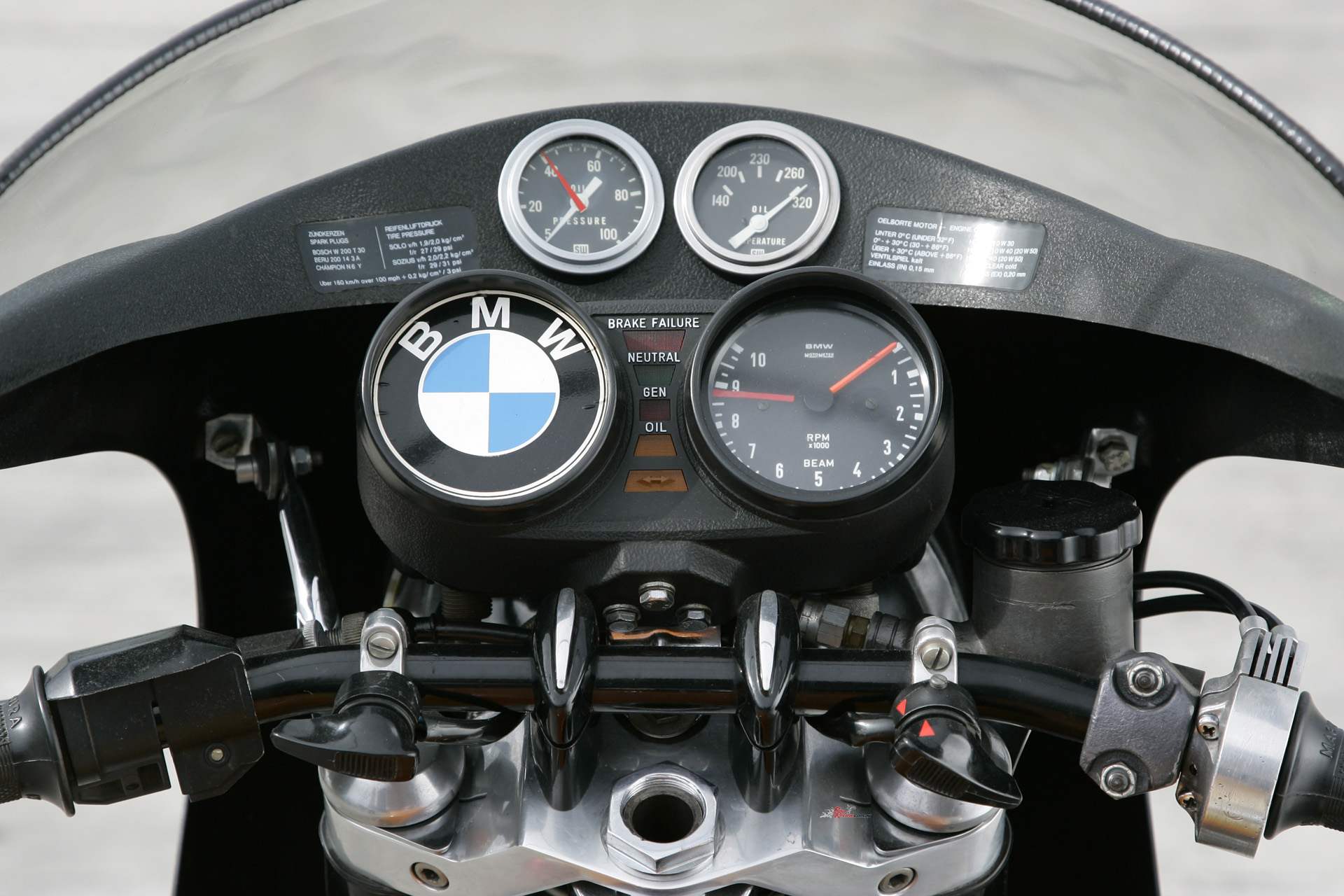
ENGINE: Air-cooled pushrod OHV 180° boxer twin-cylinder four-stroke, 95 x 70.6 mm bore x stroke, 1001 cc, 102 bhp at 8,600 rpm (at clutch), 12.6:1 compression ratio, 2 x 40 mm Dell’Orto carburettors with accelerator pumps, Bosch CDI ignition with dual ignition and four coils, 5-speed close-ratio gearbox with shaft final drive, single-plate all-metal diaphragm clutch with steel flywheel unit.
CHASSIS: Tubular steel duplex cradle frame with dual reinforcement struts, 36 mm BMW leading-axle telescopic forks with three triple-clamps, tubular steel swingarm incorporating shaft final drive inside right leg with cantilever Koni monoshock, 28-degree head angle, 80 mm trail, 1465 mm wheelbase, 175 kg with oil and no fuel, 48/52% weight distribution with 12 litres of fuel, twin 290 mm Hurst-Airheart steel front discs with 2P Lockheed calipers, 200 mm BMW single leading-shoe rear drum.
WHEELS/TYRES: Front 110/60-18 Metzeler Lasertec on 2.65in WM4 wire-spoked rim, rear 130/80-18 Metzeler Lasertec on 3.00in WM5 wire-spoked rim.
PERFORMANCE: 145mph / 233 km/h top speed (Daytona 1976).
OWNER: BMW Mobil Tradition, Munich, Germany.