


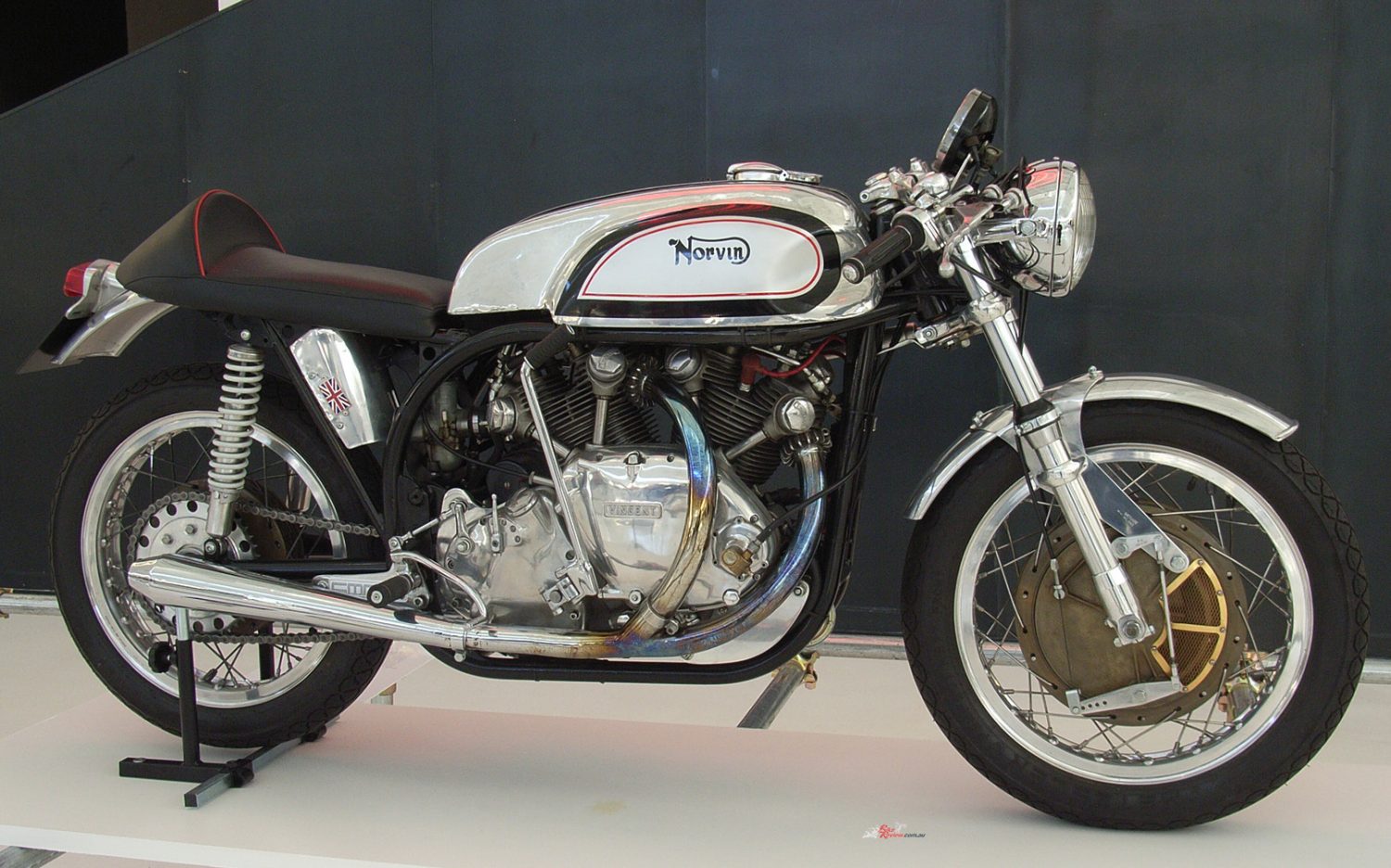

You and your mates might have a few interesting bikes between you, but cop this! I reckon it’s more than worth the plane fare to Milan Italy to see these rare motorcycles...
It’s not what you know, it’s who you know or actually “whom you know”. I just happen to know Roberto Crepaldi, the affable boss of CR&S Motorcycles. Unlike a lot of less fortunate bespoke motorcycle builders who specialise in going broke, Roberto has a few euros to spread around.
As a result, CR&S in Milan is a class operation. His friends seem to be similarly well funded, especially the ones who make up the exclusive club called Collezione Motociclista Milanese.
This one presents in the CR&S racing livery with the checkered line and was nicknamed “Black Beauty” by John Britten himself…
Members own motorcycles the way Rupert Murdoch owns politicians; not only the important ones but also some really unusual examples. Roberto himself, for instance, has a V1000 Britten. Not only a Britten, but a black Britten. The black Britten; all the nine others are blue. This one presents in the CR&S racing livery with the checkered line and was nicknamed “Black Beauty” by John Britten himself. It has been raced (successfully) more than any of the others. It has an enviable success rate of 50 per cent wins from more than 40 starts including Daytona.
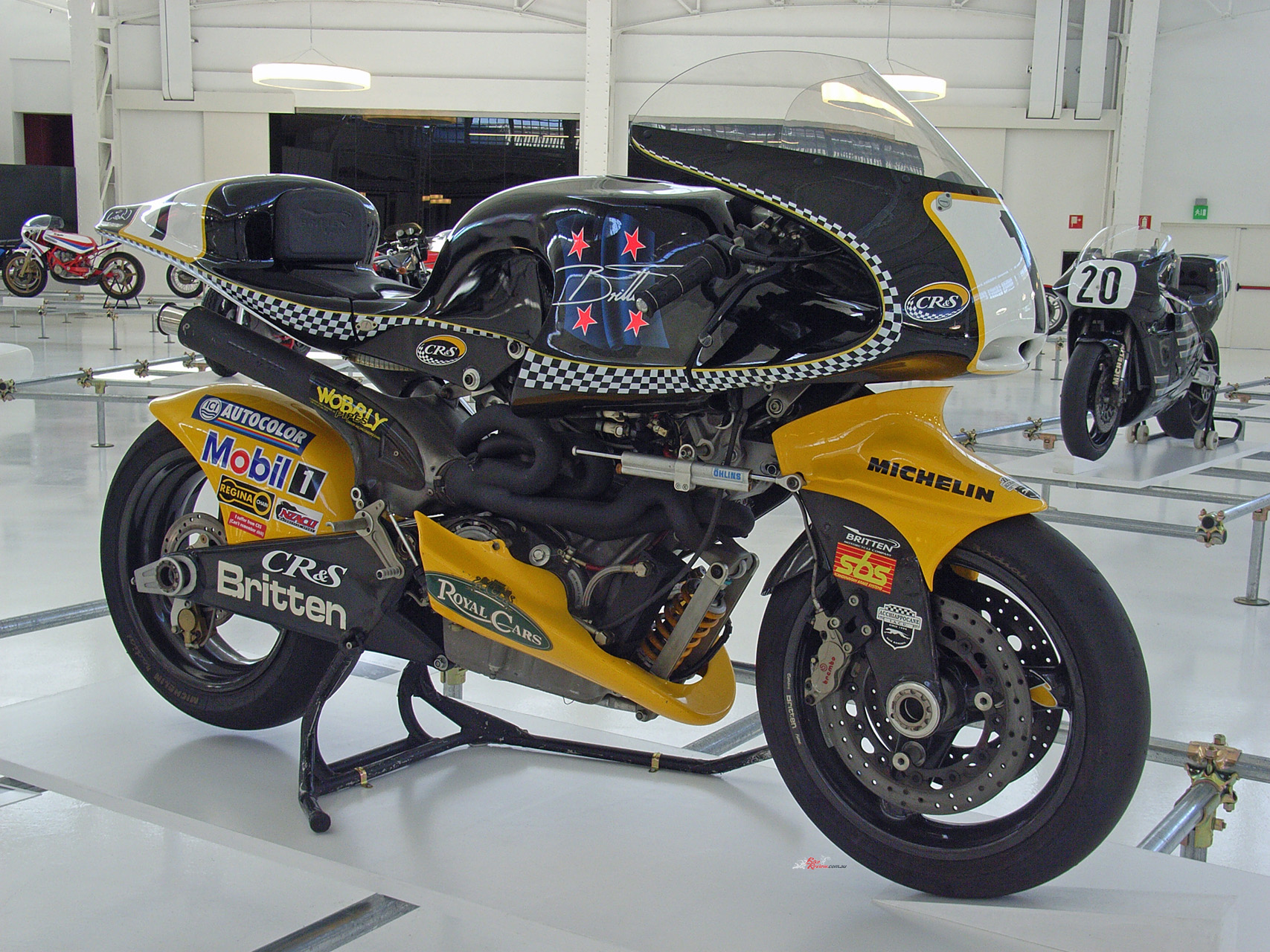
Black Beauty, the rare and only black Britten V1000.
Very occasionally, usually to coincide with Milan’s EICMA motorcycle show, the club’s members put on a Moto Arte Design (MAD) exhibition. I have been to two of these and have been blown away both times. The exhibitions are very simple; they consist of the bikes and very simple, small descriptive placards. Here are my photos and a few words about each bike.

The amazing 350cc Moto Major concept motorcycle.
The Moto Major is not only one of a kind. It is one of the most unusual motorcycles ever built, created to promote the technology used to design it. Turin-based designer Salvatore Maiorca built the 350cc motorcycle in 1948 in association with Fiat, who were interested in seeing their design technology and prototyping equipment demonstrated.
The flowing, all-enveloping fairing is not fibreglass but steel…
The flowing, all-enveloping fairing is not fibreglass but steel; suspension is by rubber cylinders inside the wheels; those jet-like silver attachments are the exhausts. Maiorca’s intention was to produce a truly avant-garde motorcycle both mechanically and aesthetically, and except for the unfortunate colour he succeeded. Sadly, the Moto Major would have been expensive to build, and Fiat was not interested in manufacturing it anyway.

The Konig story is amazing, from outboard boat engine to world Grand Prix podiums…
Wherever you go in the world of motorcycling, you’ll find New Zealanders. German motorboat engine builder König became a manufacturer of motorcycle engines after Kiwi Kim Newcombe started work there. Newcombe thought König’s 500cc two-stroke engine had potential in the motorcycle World Championship. With the enthusiastic support of management, he built a frame and the resulting bike took 10th place in the 1971 West German Grand Prix. More success followed and the bike, ridden by Newcombe, finished second in the 1973 Grand Prix – behind Phil Read and ahead of Giacomo Agostini on their MVs. More engines were produced and were quite successful in sidecar racing.
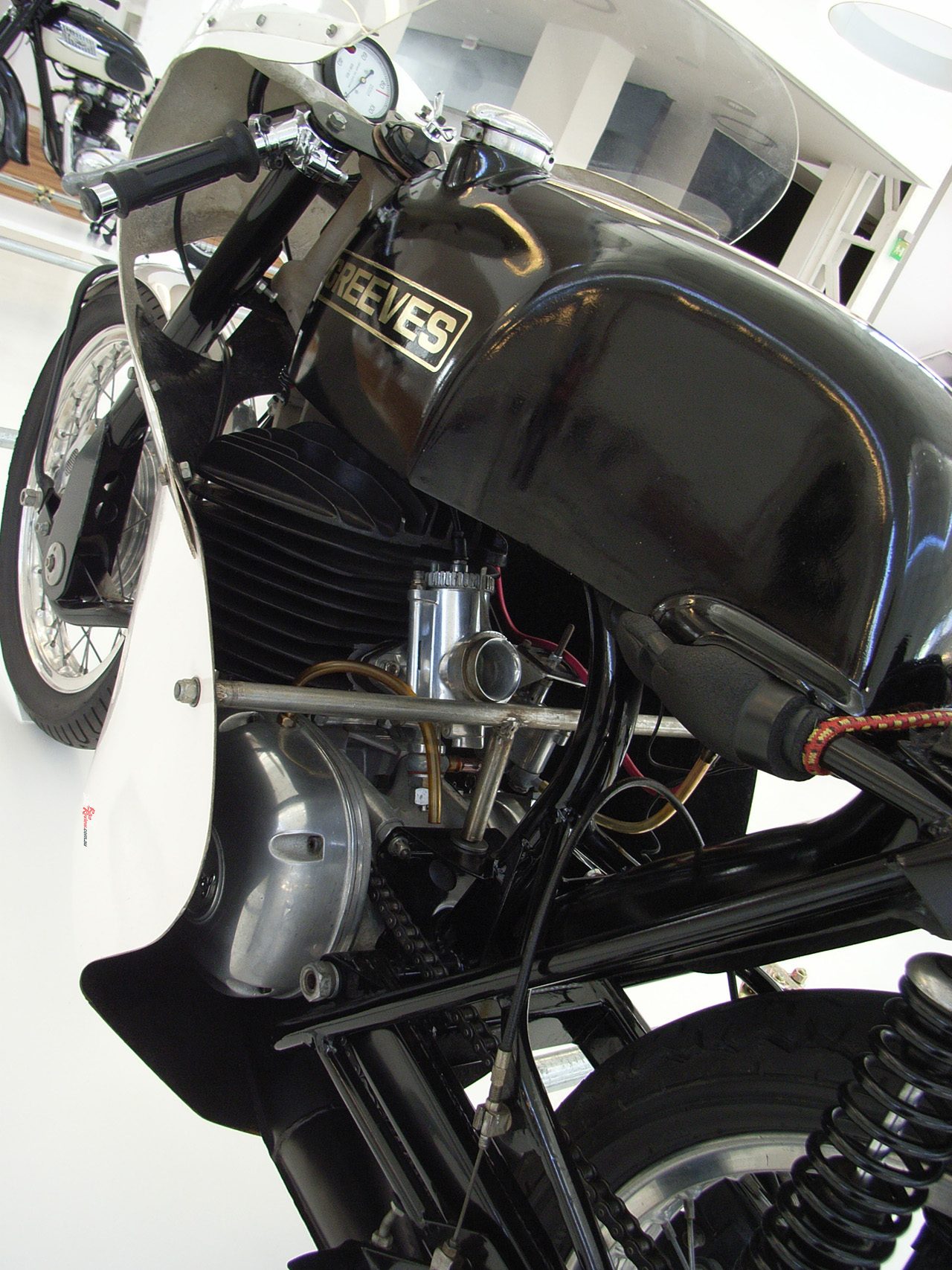
Greeves’ Oulton 350 was a failure on track and they only built 20 units.
MAD does not only celebrate success. “Motorcycle racing history is filled with failures;” writes Italian motorcycle scribe Giovanni Cabassi, “bikes which looked good on paper but proved disappointing on the track. Greeves’ Oulton 350 is an excellent example…” The prototype had considerable potential, but the bike that was built had too many compromises, cost too much and didn’t work. It was light at 230 pounds and offered a respectable 40bhp but simply had too many problems. Greeves built 20 of them in 1968 and they were all sold but did little on the track. Isn’t this one pretty, though.
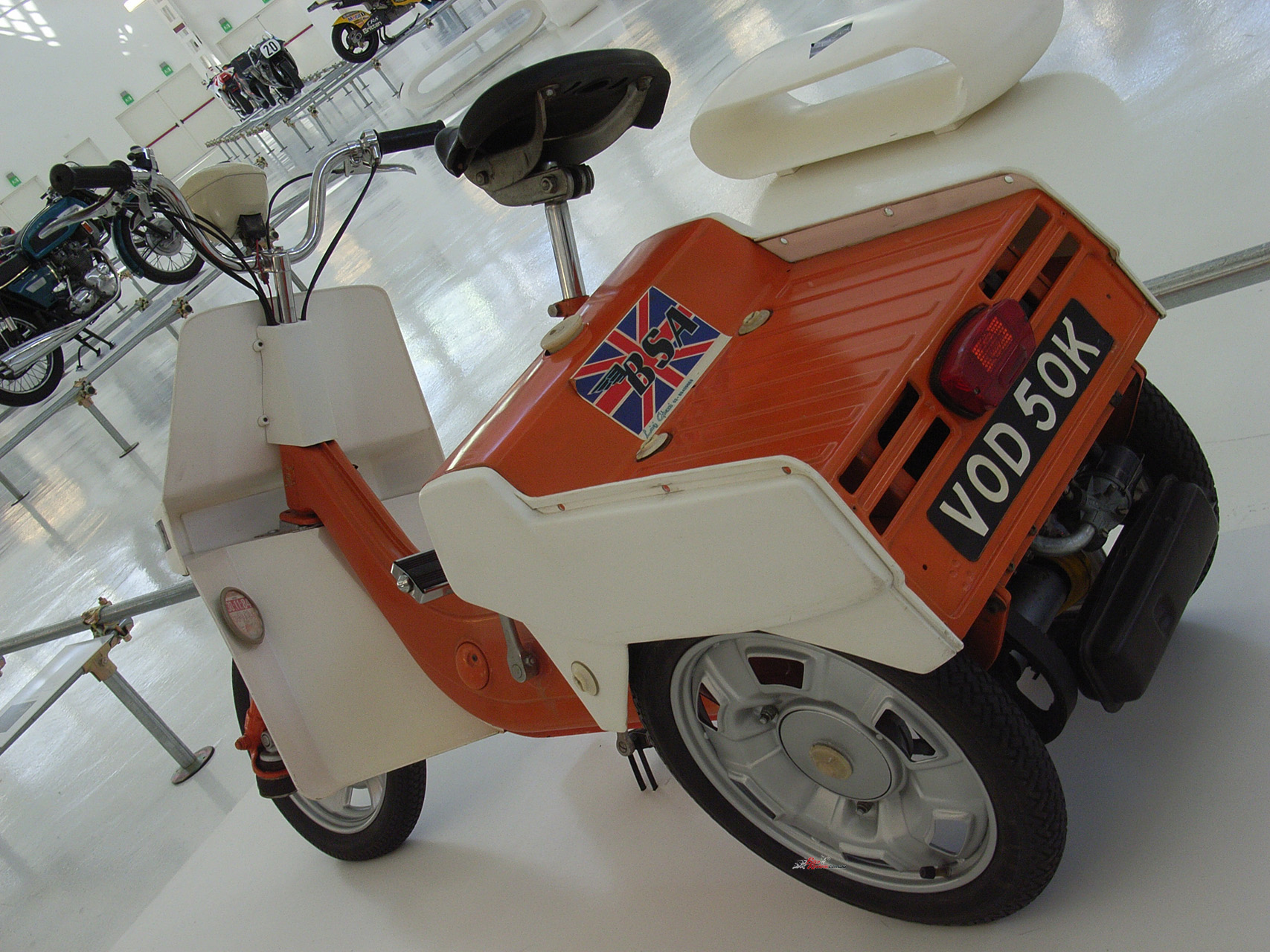
Some say the Ariel 3 killed the British motorcycle industry…
Now here’s something to show that the British could do things outstandingly well. Failure, that is. The BSA Group was looking for ideas and happened on a prototype developed by GL Wallis & Sons. They bought the rights and then proceeded to change just about everything on the design. When it was finally (badly) developed and (poorly) assembled it was sold as the Ariel 3. Well, it was marketed as the Ariel 3. Not sold. Nobody bought it, not least because its supposedly innovative leaning system didn’t work. Some say the Ariel 3 killed the British motorcycle industry. I say it was suicide.
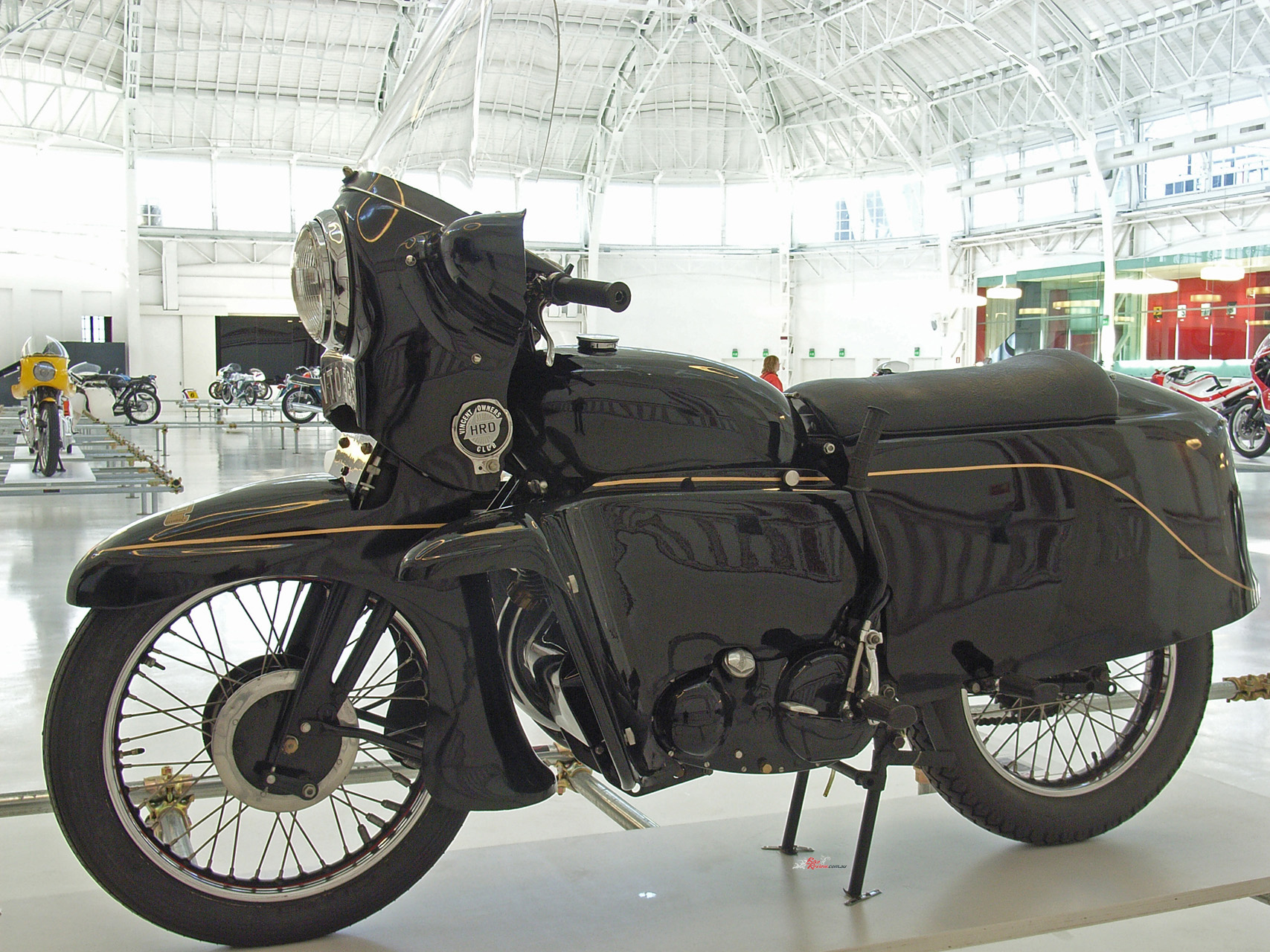
The amazing Vincent HRD Black Knight.
But if you were a motorcycle cop in the British police force in 1984, you would have had a Vincent HRD Black Knight as your duty vehicle. That’s “1984” the movie of George Orwell’s novel, and there is a connection between writer and bikes. Orwell had a 1930 Rudge, while he was writing the book – my friend Jock MacNeish even tracked it down on the Scots island of Jura.
Some people see Aermacchi as nothing more than a victim of Harley-Davidson’s marketing incompetence, but it made beautiful bikes in its day…
“Orwell had left London to live on Jura in 1945,” Jock writes. “He retreated to an abandoned farmhouse called BarnHill to write “1984”. He would have had few interruptions. BarnHill is a remote and isolated building, 10 kilometres from the nearest neighbour and 40 kilometres from Craighouse, the one village on the island. Orwell’s only transport was his bike and I can assure you he was some rider. Just getting there was an epic trip.”
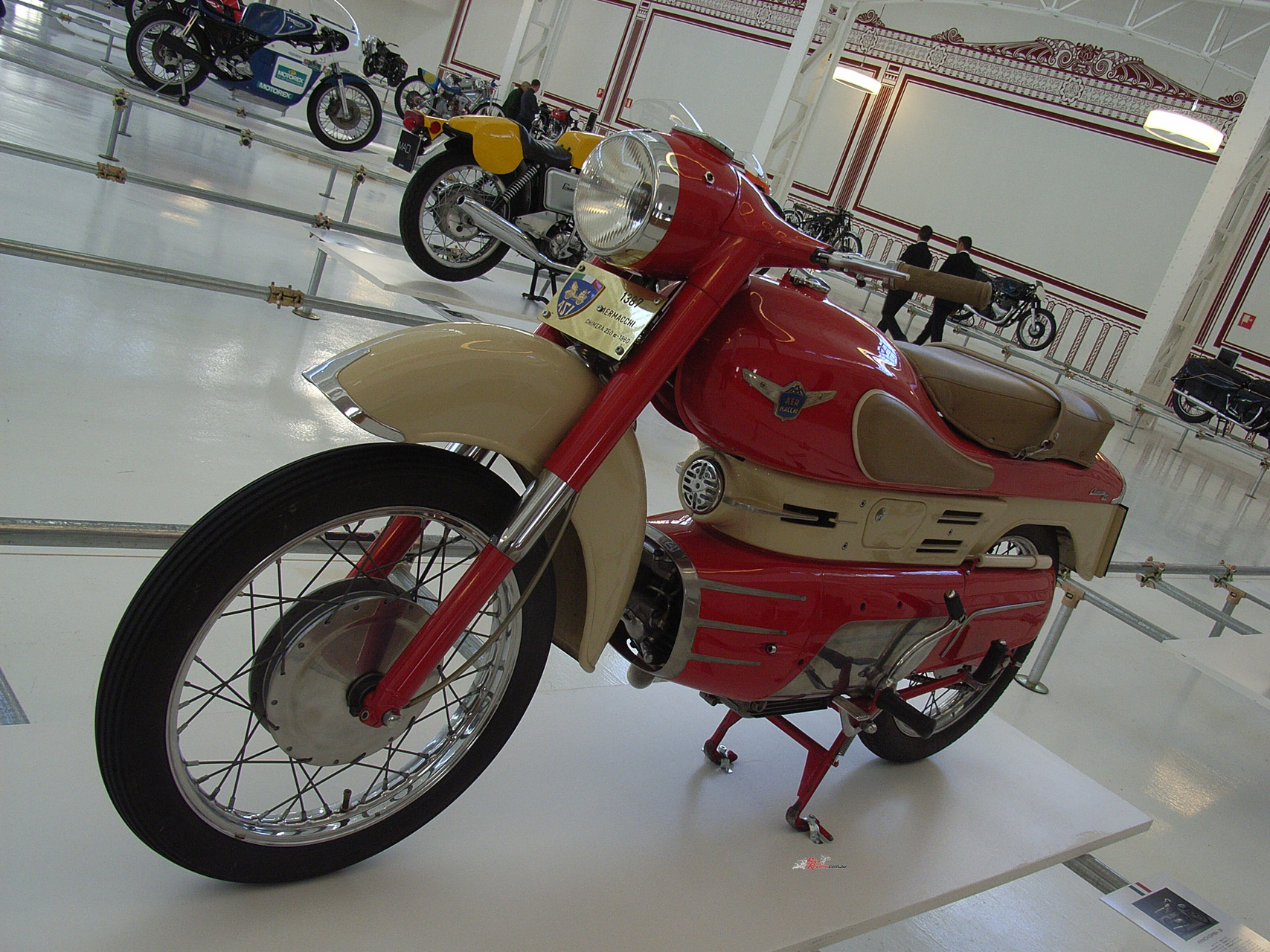
The stunning Aermacchi Chimera did not catch on and only 300 were built…
What is it about failure that makes it so attractive? Here are a couple of Italian examples.
Some people see Aermacchi as nothing more than a victim of Harley-Davidson’s marketing incompetence, but it made beautiful bikes in its day. The Chimera 250, built from 1956 to 1961, was one of the most elegant motorcycles ever produced. Fully enclosed both for looks and for the rider’s convenience, it was designed by Count Mario Revelli De Beaumont who had worked at Stabilimenti Farina, Fiat, Pininfarina and Bertone. The engine was the work of Alfredo Bianchi and both the single-tube frame and monoshock suspension were innovative. Unfortunately, the Chimera did not catch on. Only 300 were built.
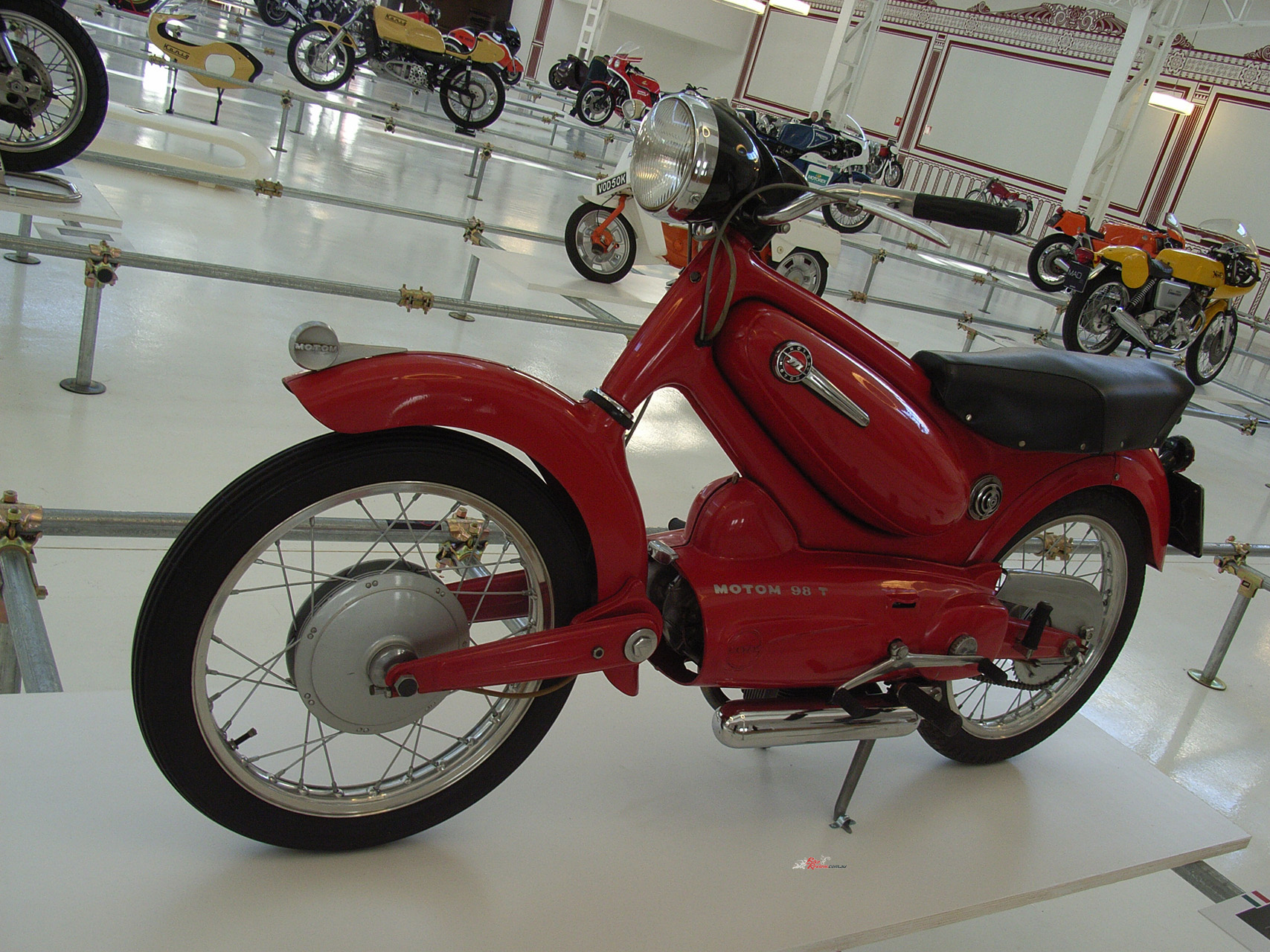
Motom’s spectacular T-98 was more successful than the Chimera.
Motom’s spectacular T-98 was more successful than the Chimera but in the end, it didn’t sell enough units either. Designed by Piero Remor, it is as pleasing aesthetically to us today as it was mechanically innovative when it was built from 1955 to 1960. The oval bulge which appears to be the fuel tank serves in that role only on the left-hand side. On the right, it holds tools. Front suspension is a swingarm design which includes the front guard and damping is by rubber discs. I have read a comment that suggested “the public was both intrigued and confused by [the bike’s] futuristic features” but it was manufactured some 1736 times.
There was much more at MAD, as you can imagine. If they put on another one, I reckon it’s nearly worth the plane fare to Italy.
The Author

You Might Also Like










December 19, 2025
great work, would like to add that Kim Newcome was second after his death at Northampton while he was leading the Grand Prix, would likely have been NZs only world title holder of motogp if he had lived