
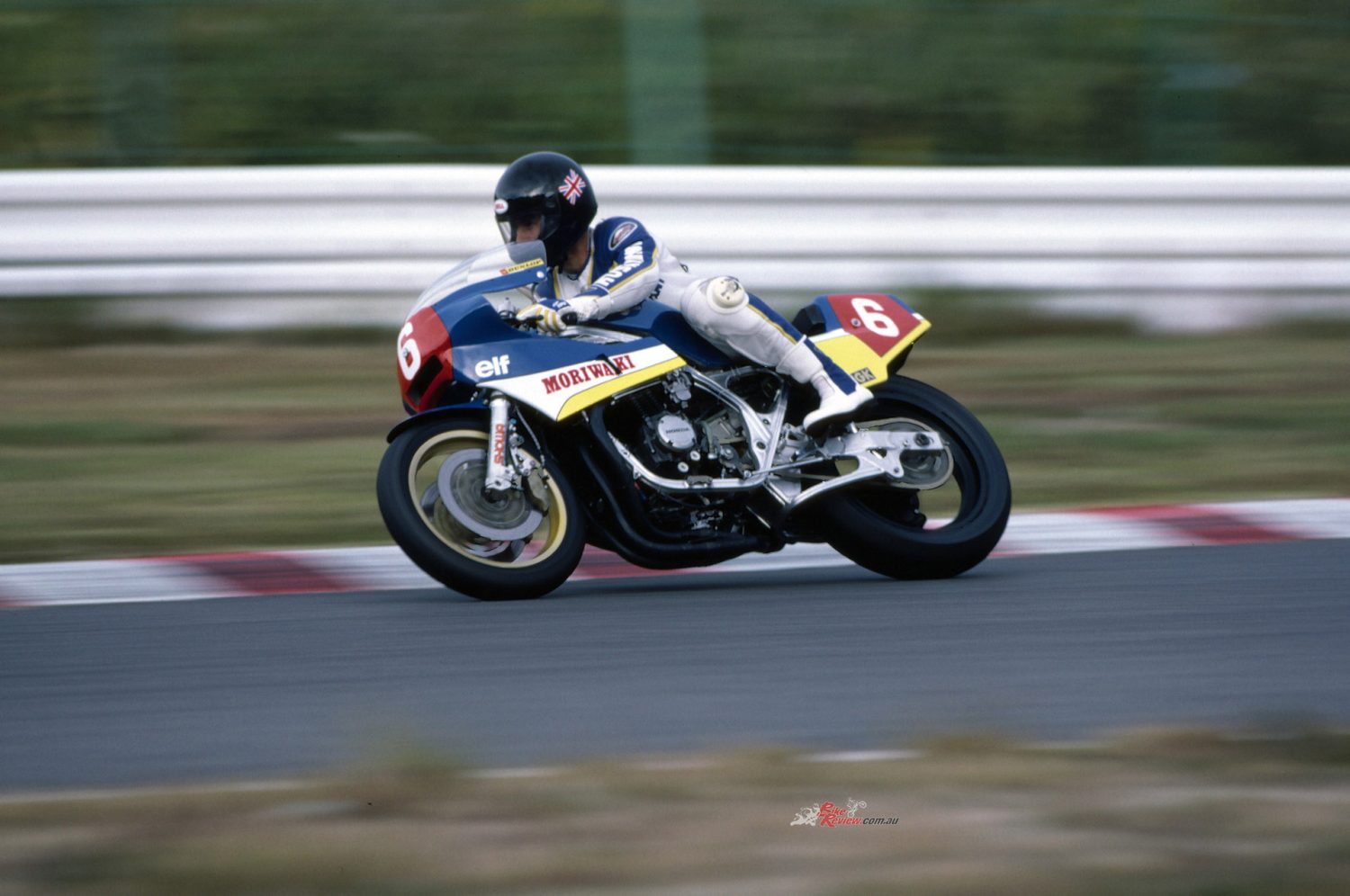

Alan Cathcart rides the forgotten Moriwaki-built Honda CBX750TT1 that proved air-cooling still had plenty to offer at the end of the Superbike era. Photos: Hidenobu Takeuchi
Overshadowed by Honda’s more famous V4 race bikes, the Moriwaki CBX750TT1 became one of the most intriguing Superbikes of the 1980s. Alan Cathcart rides the forgotten air-cooled racer and discovers why it deserved far greater recognition than history allowed.
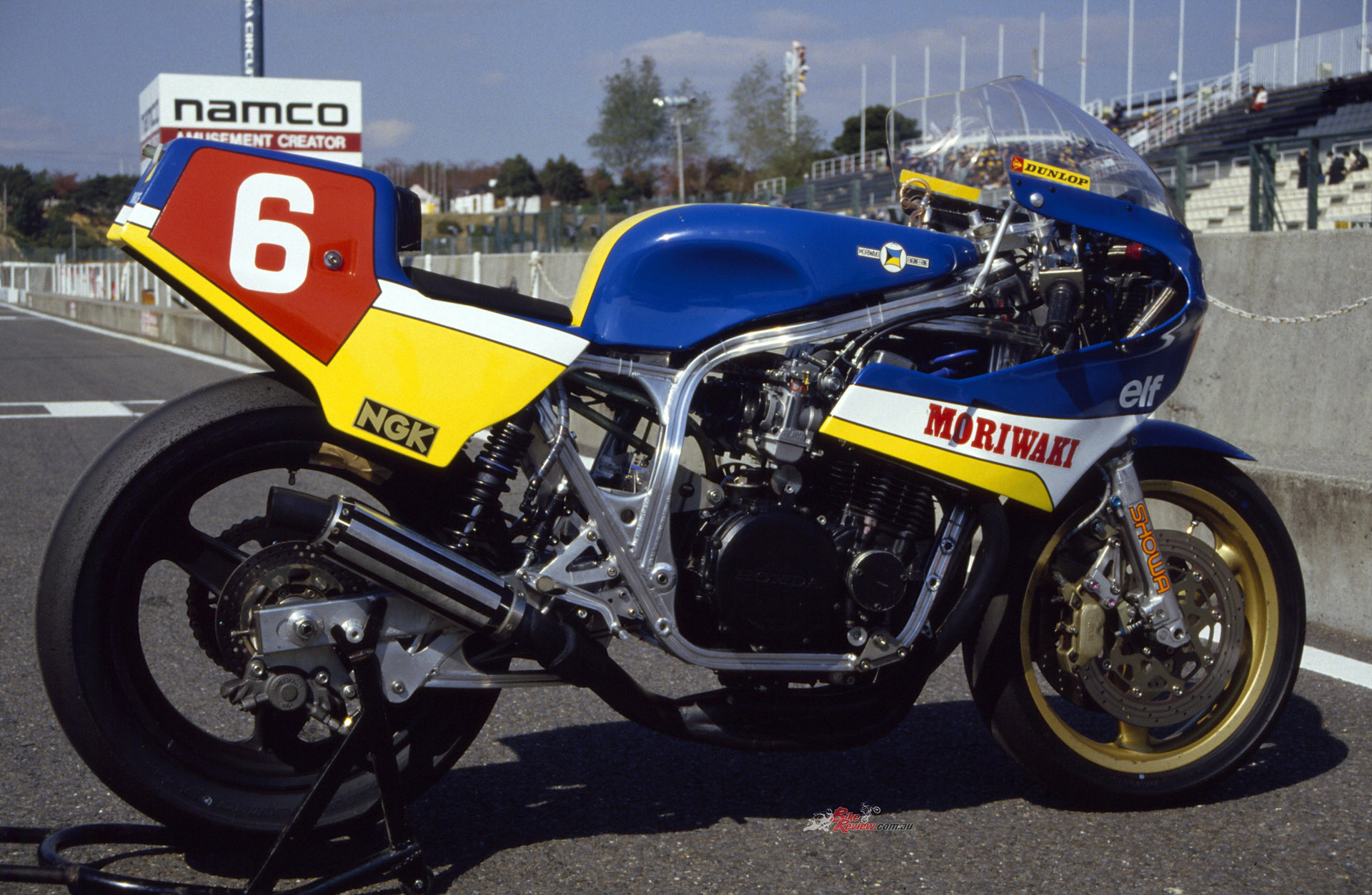
The air-cooled 16-valve DOHC CBX750 in-line four, known internally within Honda as the RC17, was manufactured for just five years from 1984 to 1988. The ultimate evolution of the legendary CB750.
There have been several key moments in motorcycle development. The introduction of rear suspension, telescopic forks, electronic fuel injection and disc brakes, etc., were all landmark stages in producing the bikes we ride today. But one key step we kind of take for granted was the adoption of liquid-cooling for engines. On streetbikes this was partly for noise reasons, but on racers it was all down to harnessing the extra horsepower that constant development brought in its wake.
As power increased, so did heat, and that heat had to be dissipated before engineers could extract even more performance. By the early 1980s, that meant either water- or oil-cooling had become ubiquitous on high-performance motorcycles. Air-cooled bikes had already disappeared from the Grand Prix arena, with the demise at the end of 1976 (through unrelated noise reasons) of the last of the classic era’s glorious-sounding four-strokes, the MV Agusta fours. By then, all the two-strokes which came to usurp the supremacy of the Italian bikes were water-cooled, and in the following decade that trend spread to the new generation of large-capacity four-stroke racers based on volume production streetbikes – first the TT Formula 1 category featuring production engines mounted in racing chassis, then today’s Superbikes.
The last air-cooled four-cylinder bike to be produced by any major manufacturer was, somewhat improbably, a Honda…
The last air-cooled four-cylinder bike to be produced by any major manufacturer was, somewhat improbably, a Honda – improbable, given Big H’s track record of pushing the envelope of four-stroke engine development. But the air-cooled 16-valve DOHC CBX750 in-line four, known internally within Honda as the RC17, was manufactured for just five years from 1984 to 1988. The ultimate evolution of the legendary CB750, it was marketed primarily in Europe, South America and Australia, but also sold as a Police bike in Malaysia, Singapore, Hong Kong, Turkey and Gibraltar.
Read our other Throwback Thursday articles here...
It’s widely accepted that the CBX750 was a stop-gap model which Honda produced in a relative hurry using proven existing air-cooled technology, in order to fill the gap between the unreliable VF750F (aka RC07/RC15) debuting in 1982 – the subject of no less than eight factory recalls for the camshafts alone in a single year! – and the VFR750 (the RC24), which replaced it in 1986. Considering the development lead time needed for a new model, Honda must have worked pretty fast to produce the CBX once its engineers had realised the extent of the problems with the VF750F.
The awesome TTF1 era of production based engines in custom fabricated frames, prior to WorldSBK came along.
But it’s quite possible that while pouring millions of yen into the revamped V4 model, Honda may have developed the RC17 as a back-up just in case its new replacement bike flopped too, should the mistrust for V4 engineering generated by the VF750F have been carried over to the VFR750. To begin with, it indeed did, but as customers eventually realised the new V4 was a much improved version of its predecessor, sales took off, leaving the CBX/RC17 in limbo.
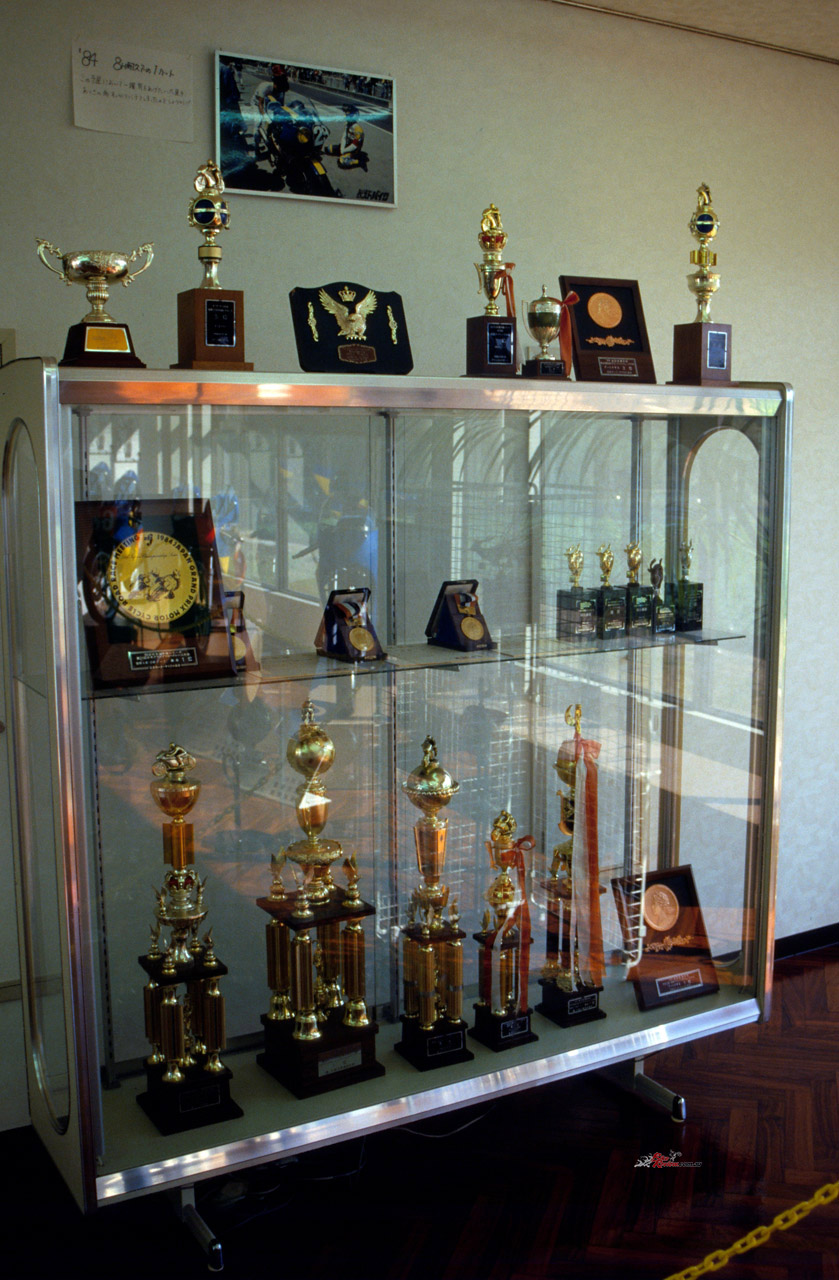
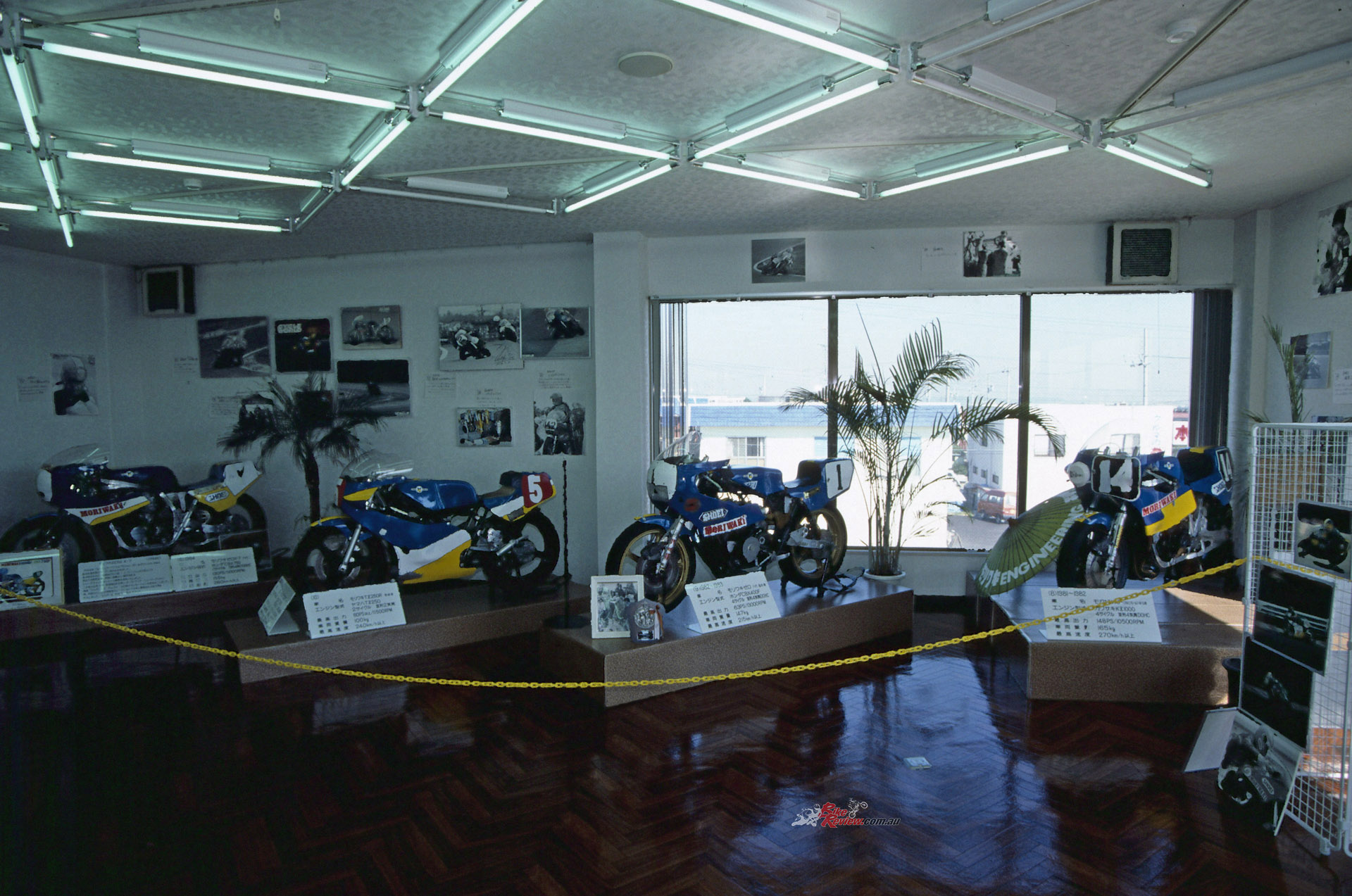
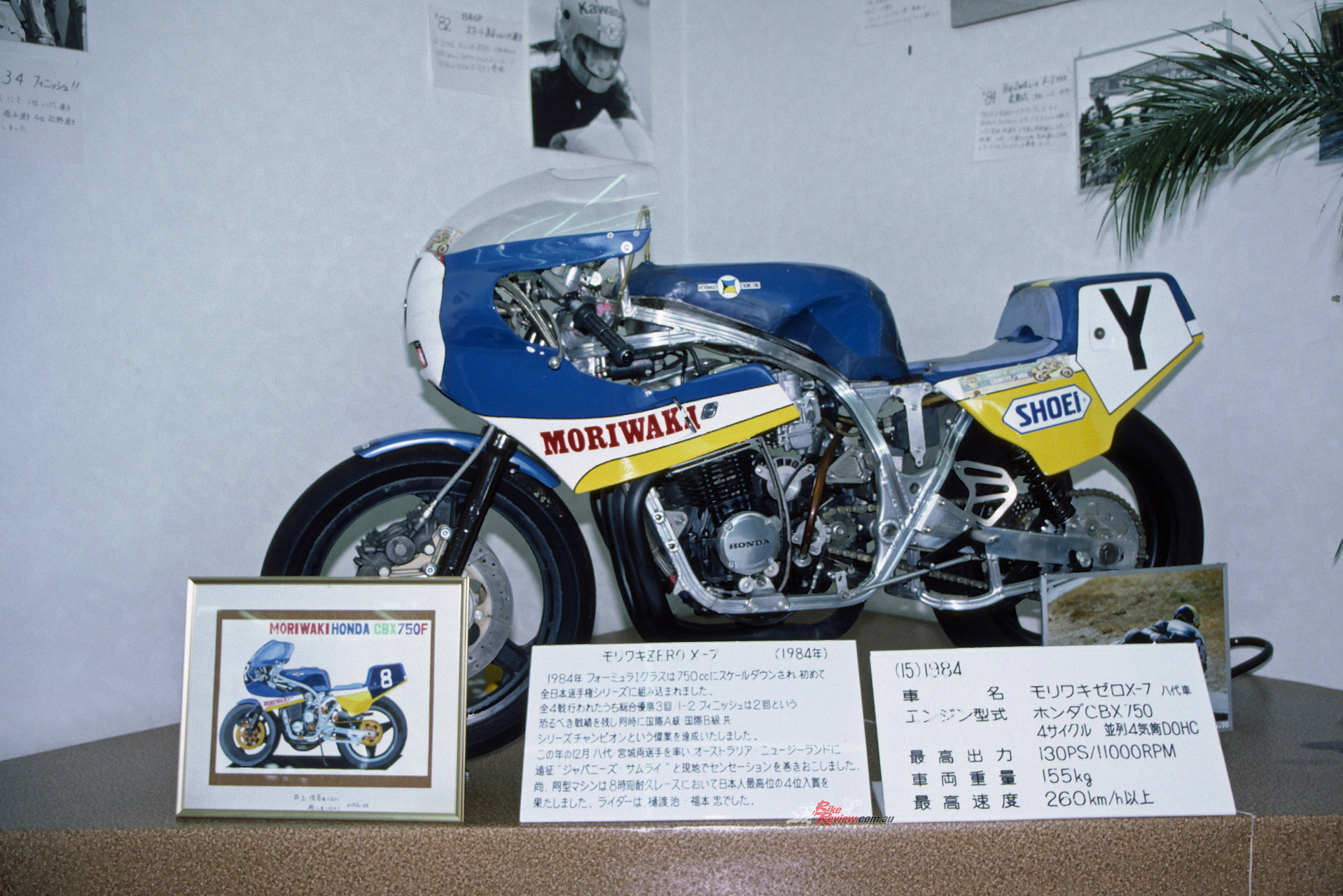
However, having spent the money needed to develop the bike, Honda probably figured they better get some mileage out of it, and that involved racing it to promote its worth. Not by the factory HRC race operation, though – it had world championships to win in Grand Prix racing with the NSR500/250 duo, and in the TT Formula 1 category with the VF-based RS750 in 1984, and the VFR750 thereafter. But like every Japanese manufacturer’s racing department, HRC had a back door link with a local tuning house, and in Honda’s case by 1984 that was already Moriwaki Engineering.
“Honda figured they better get some mileage out of it, and that involved racing it to promote its worth. Not by the factory HRC race operation, though – it had world championships to win”…
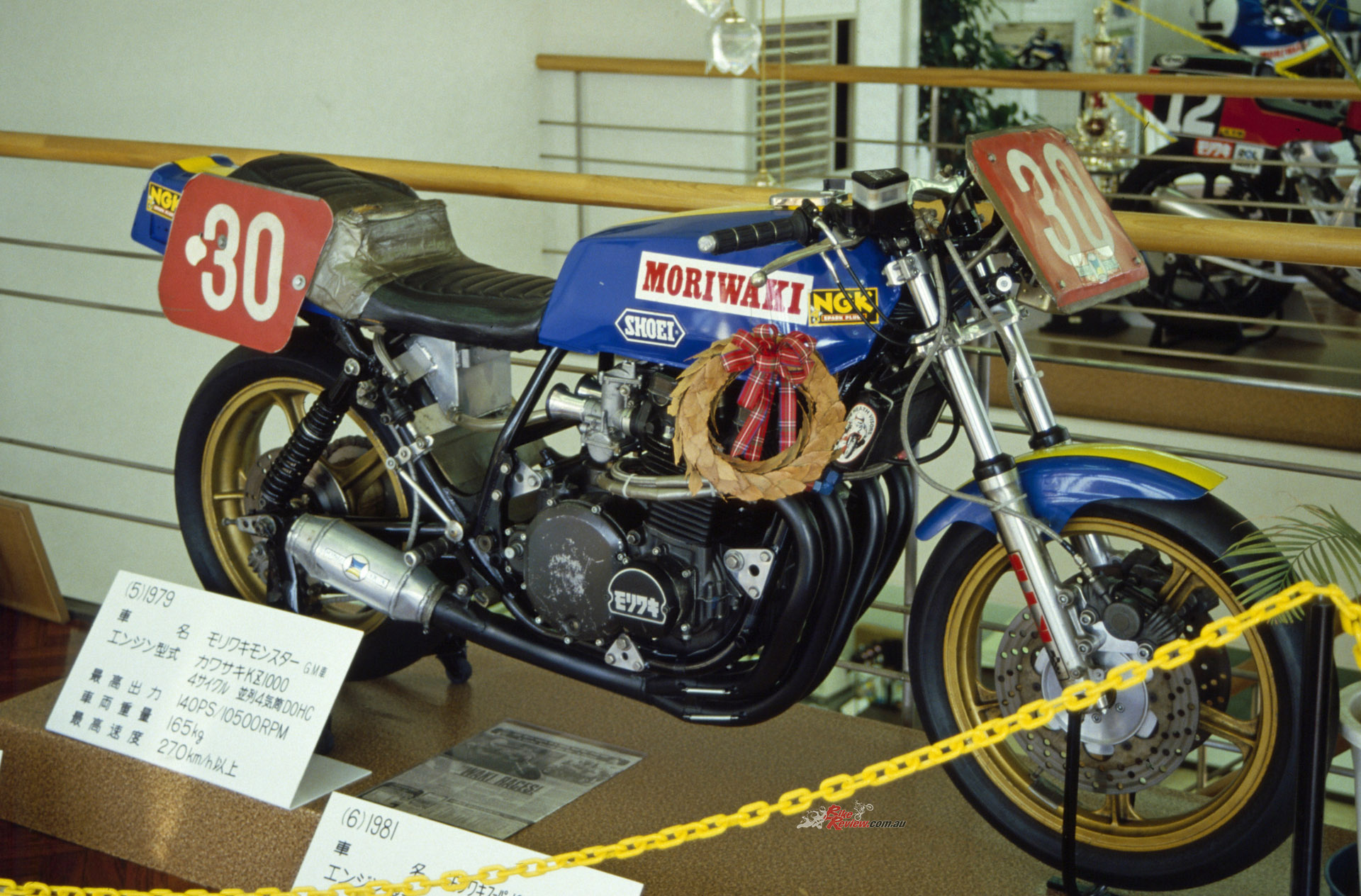
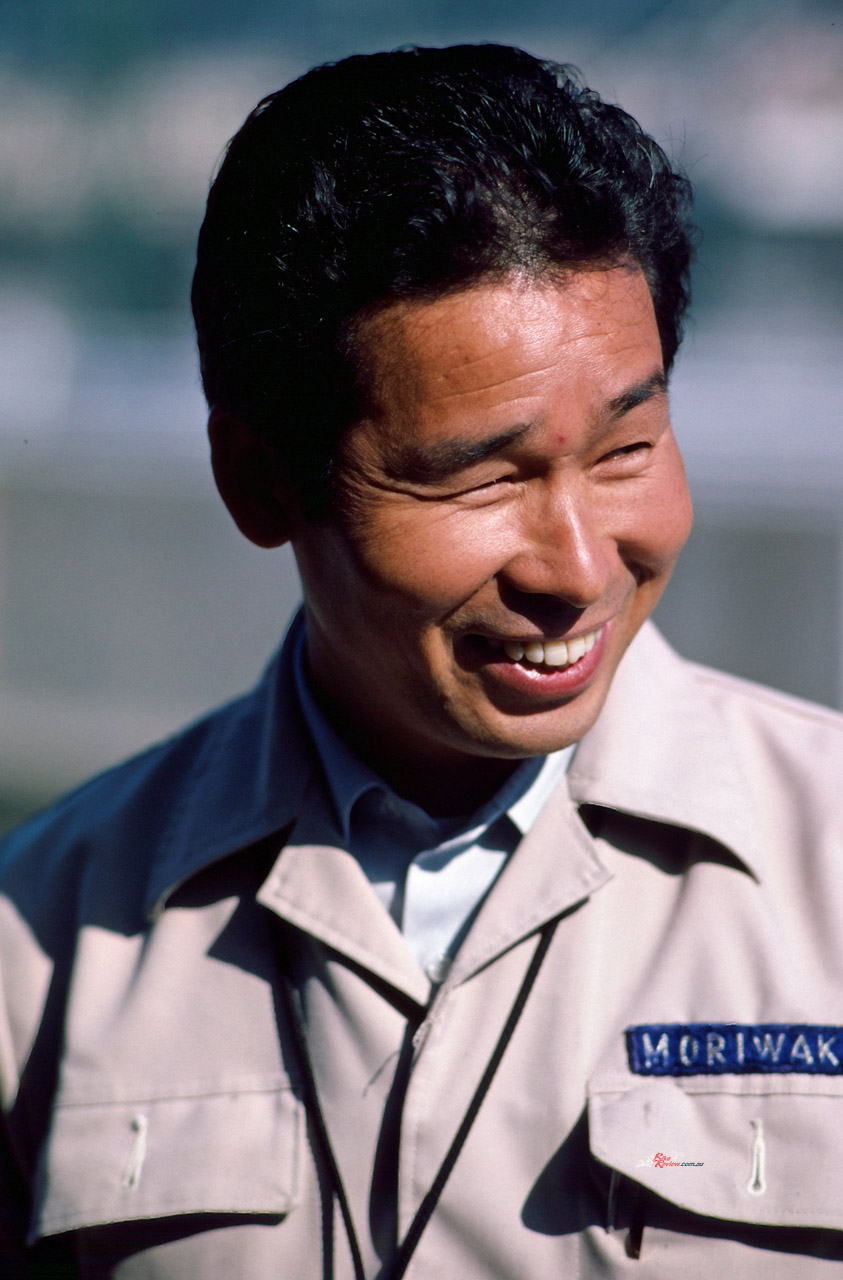
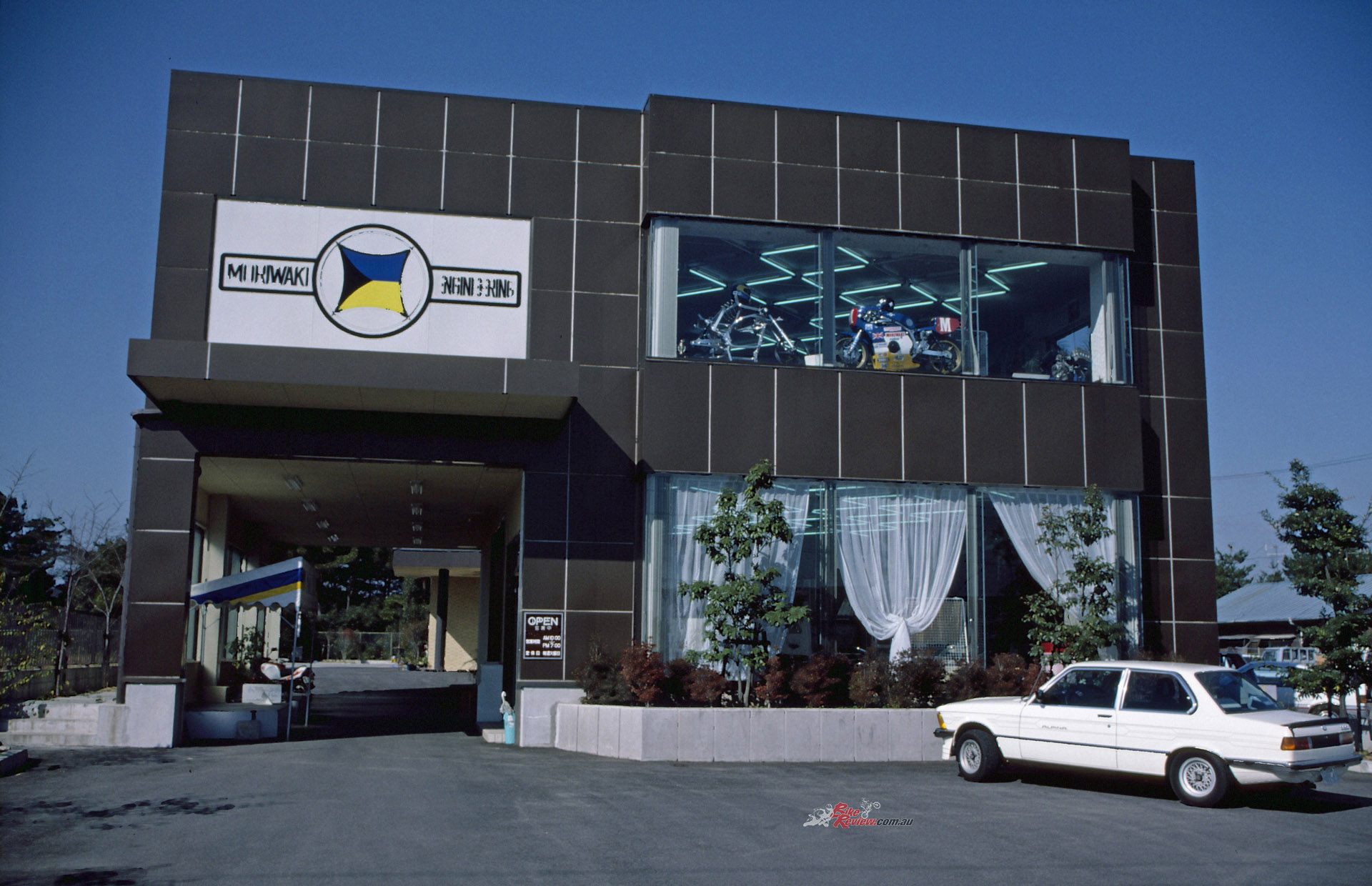
Mamoru Moriwaki had founded his eponymous company in Suzuka in 1973, before which he’d worked for Pops Yoshimura, whose eldest daughter Namiko he’d married. Like his famous father-in-law, Mamoru started out developing tuning parts for the new Kawasaki Z1 superbike, and then when Pops made an ill-fated but short-lived move to Los Angeles, and switched allegiance to Suzuki for 1978, it left Moriwaki as the top Japanese Kawasaki tuner.
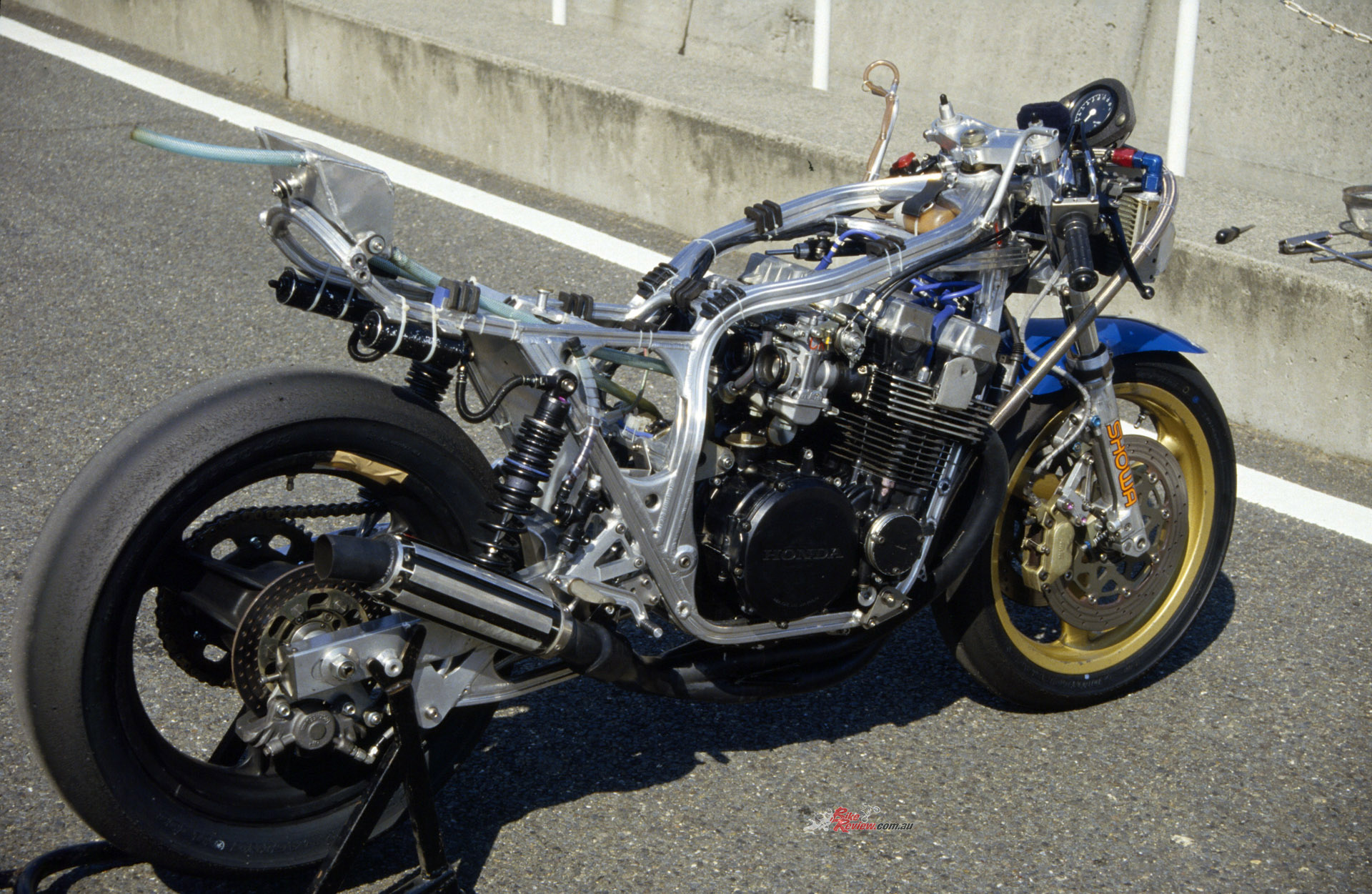
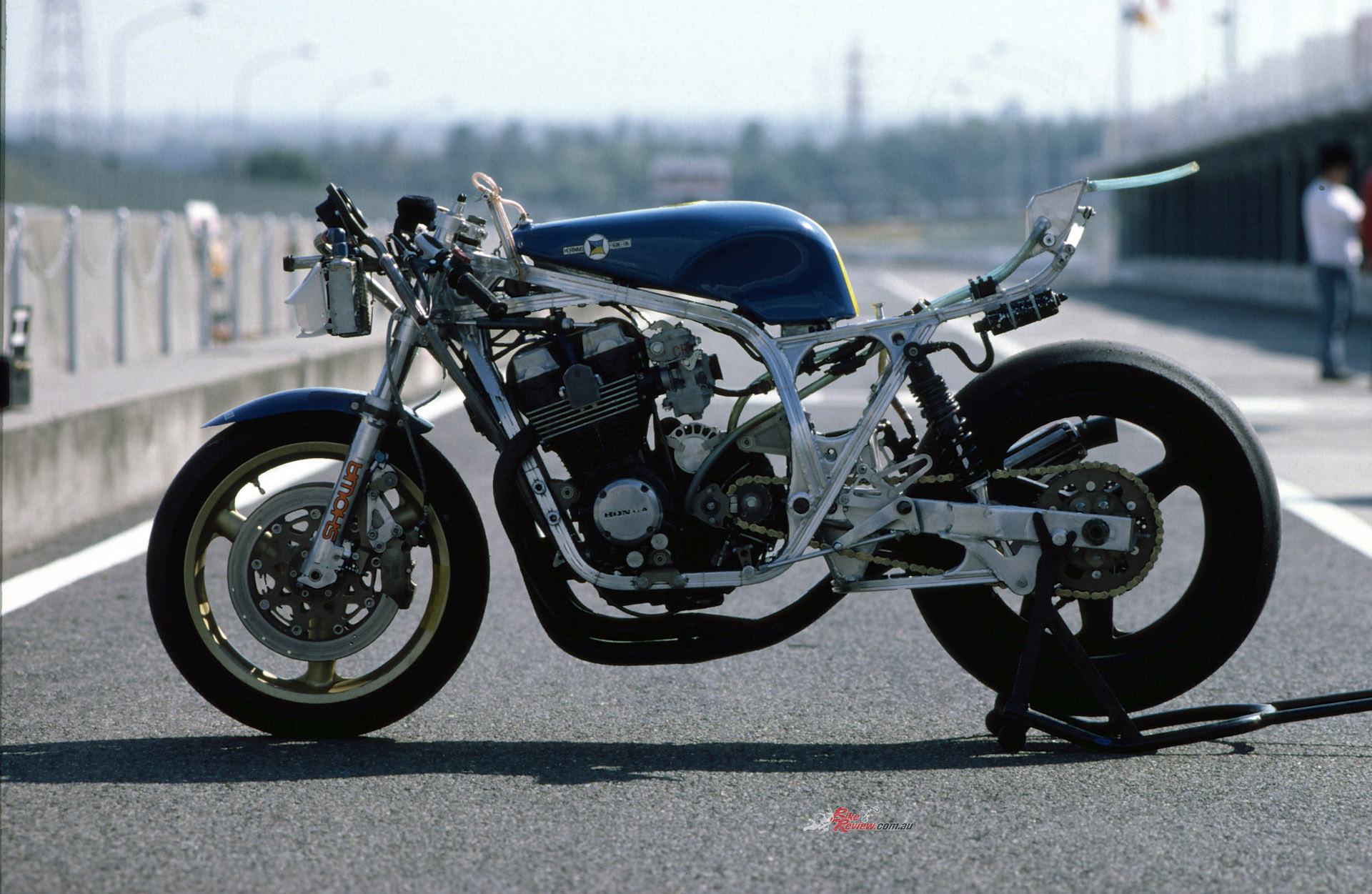
The alloy-framed twin-shock Moriwaki Honda CBX750TT1 RC17 racer is a work of art and was the beginning of the legend of Moriwaki and HRC.
First Graeme Crosby, then Wayne Gardner brought Moriwaki Kawasakis to global prominence via their exploits with such bikes in Europe in the 1979-81 period, before the foundation of HRC in 1982 left the door open for a closer collaboration with Honda, which Mamoru-san gratefully accepted. One of his first collaborative projects was the creation of a TT F1 race version of the CBX750 in 1984, to relieve HRC of the burden of developing a race version of a bike which its corporate masters had dictated should be raced, but which didn’t fit in to HRC’s gameplan.
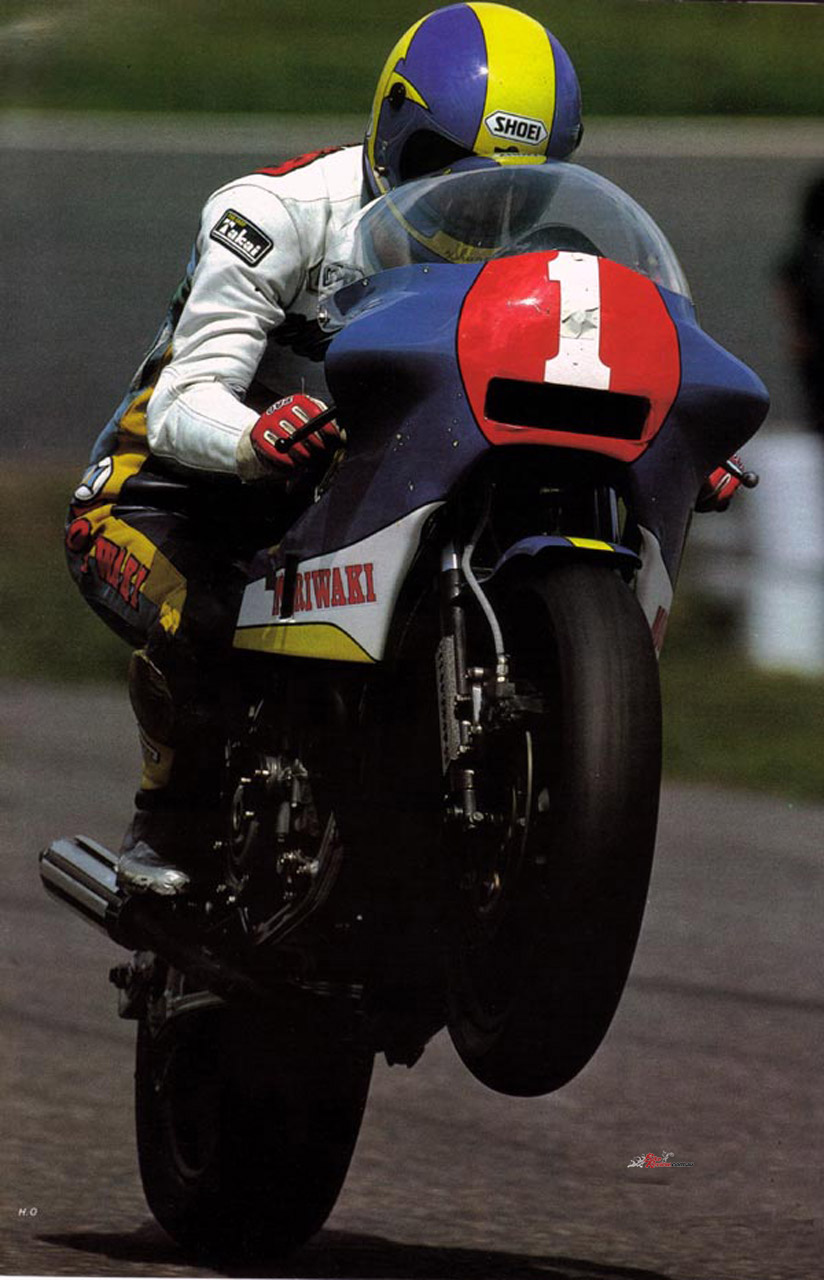
The alloy-framed twin-shock Moriwaki Honda CBX750TT1 RC17 racer was the result, a prime example of original thought which, if not for an excess of enthusiasm on two occasions by team rider Shunji Yatsushiro, when he crashed while well placed in two crucial rounds, would have won the 1985 Japanese TT Fl title convincingly. In doing so, he’d have beaten all the new factory RVF750 Honda V4s, plus the Yamaha Genesis and Yoshimura Suzuki teams into the bargain – the latter racing the new oil-cooled GSX-R750 with comparable extruded aluminium chassis to the Moriwaki Honda, albeit with a rear monoshock.
If not for an excess of enthusiasm on two occasions by team rider Shunji Yatsushiro, when he crashed while well placed in two crucial rounds, [the CBX] would have won the title…
As it was, Yatsushiro still won one of the nine rounds comfortably at Suzuka, and finished second to the non point-scoring Wayne Gardner in another race there, en route to third place in the 1985 title series and an NSR500 ride for him in GP racing the following season. In July that same year Aussie future 500GP ace Kevin Magee came to Japan for the first time, to ride in the Suzuka 8-hour race on a Moriwaki CBX750 with established Superbike star Rob Phillis, but in the second qualifying session Magee highsided on some oil and broke his scaphoid. He didn’t go to a doctor, even though he knew something was broken, but amazingly finished the race after he and Phillis crossed the line in ninth!
Yatsushiro’s less experienced colleague Hikaru Miyagi took over riding the Moriwaki CBX in 1986 after finishing sixth in the ’85 series on the team’s back-up bike, and finished third again in the championship that year, all on a bike using allegedly outmoded twin-shock rear suspension, and a supposedly uncompetitive engine. Yet it was impressive how well the Moriwaki CBX750 performed at Suzuka with its two long straights, quite apart from its remarkable reliability which saw both team bikes finish practically every race they ever started, rider error excepted, such as guest rider Rob Phillis’ first-lap retirement in the TT F1 International at Suzuka in November 1986 with a fried clutch. A sad ending to the CBX750’s final appearance at the top level of racing.
Kevin Magee came to Japan for the first time, to ride in the Suzuka 8-hour race on a Moriwaki CBX750 with established Superbike star Rob Phillis.
Having followed the Moriwaki CBX’s progress from afar with increasing interest over the previous two years, I was honoured to become the first person outside the team to ride the bike at Suzuka the week before Phillis’ short-lived reacquaintance with it there. One look at the twin-shock rear end of the Moriwaki CBX was enough to tell you that its creator wasn’t one to be swayed by fashion, but even so the choice of Honda’s vastly underrated (because under-marketed, and undersold) air-cooled 16-valve in-line UJM four to power a GSX-R/FZR/VFR challenger was – well, idiosyncratic, let’s say.
Never mind that the main reason for the street version’s less-than-brilliant sales figures was Honda’s own marked lack of enthusiasm in promoting it, doubtless for fear of diverting attention and sales from their own heavier, more complicated and (initially) less reliable watercooled V4s, so that by then the CBX750 lived on only as a top of the line model in countries like Brazil and Argentina where technical simplicity was then a sales asset. The irony was that what turned out to be the last-ever air-cooled Japanese in-line four ever made was also arguably the best ever: it had taken Mamoru Moriwaki to make lemonade out of the lemon, and prove this.
“The irony was that what turned out to be the last-ever air-cooled Japanese in-line four ever made was also arguably the best ever”…
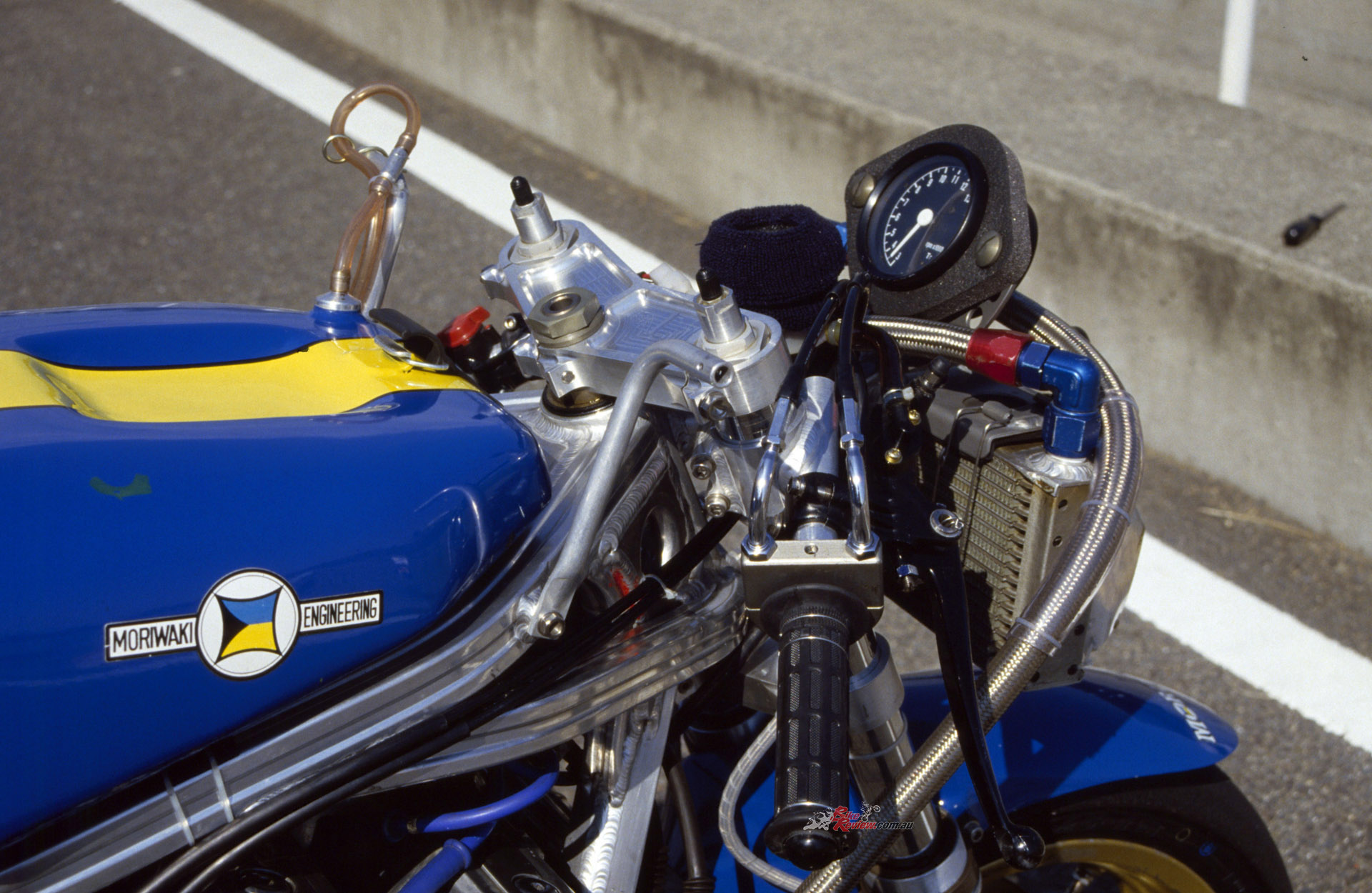
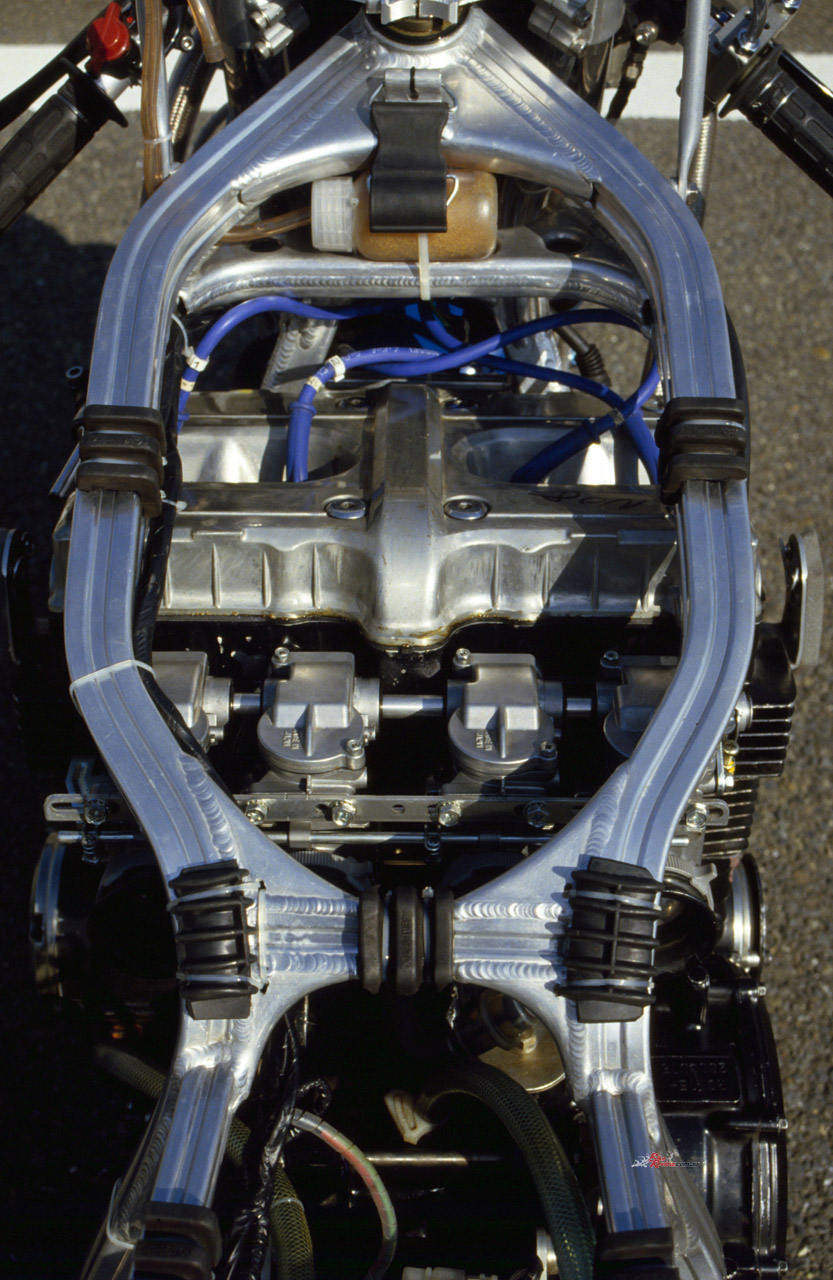
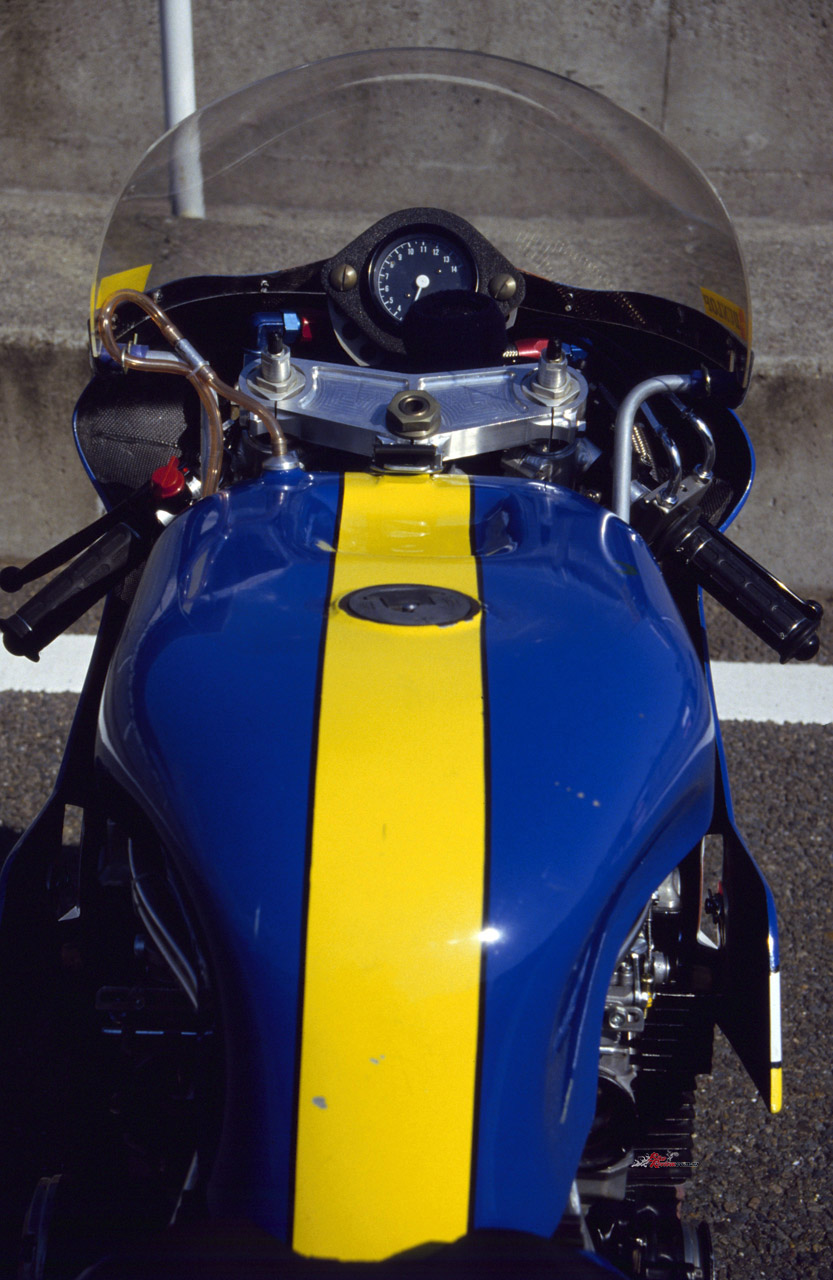
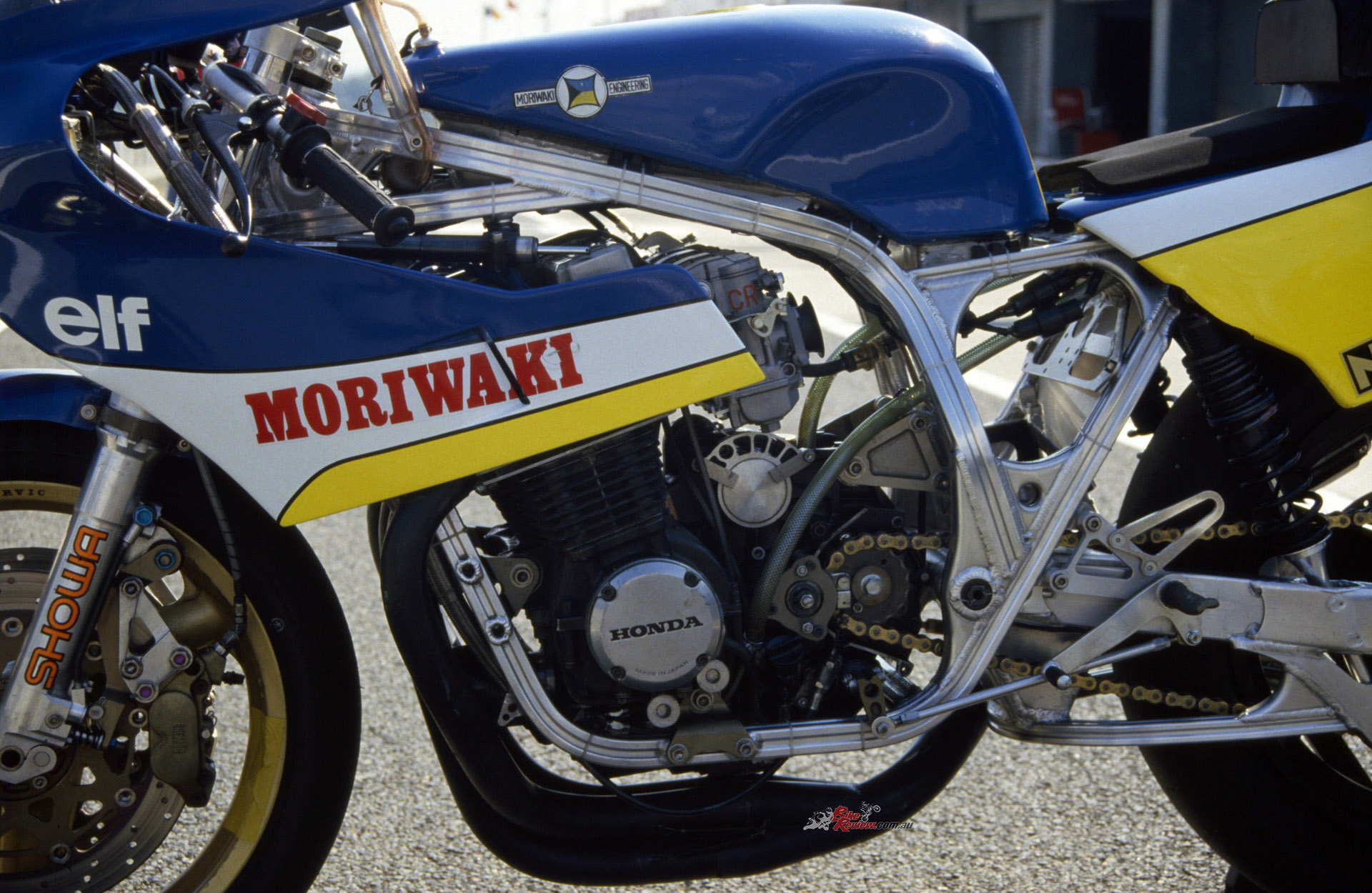
To any nostalgic admirer of the good old days of meaty, mighty, air-cooled in-line racing fours from the early days of Superbike racing just a decade earlier, the CBX750TT1 seemed like a smaller-scale version of those spectacular bikes of yesteryear, representing a pragmatic return to the days when engines were relatively easy to work on and to wrap chassis tubes around, unencumbered by radiators, with just a 16-row oil cooler to assist with cooling. The clean-looking, compact, in-line four-cylinder motor was slotted into a simple but beautifully-constructed double-cradle chassis made from small-section extruded aluminium tubing previously seen only on Yoshimura Suzukis, with longitudinal ribbing for additional strength and rigidity. Oh, and twin rear shocks. Light (156kg with oil, but no fuel), compact and uncluttered.
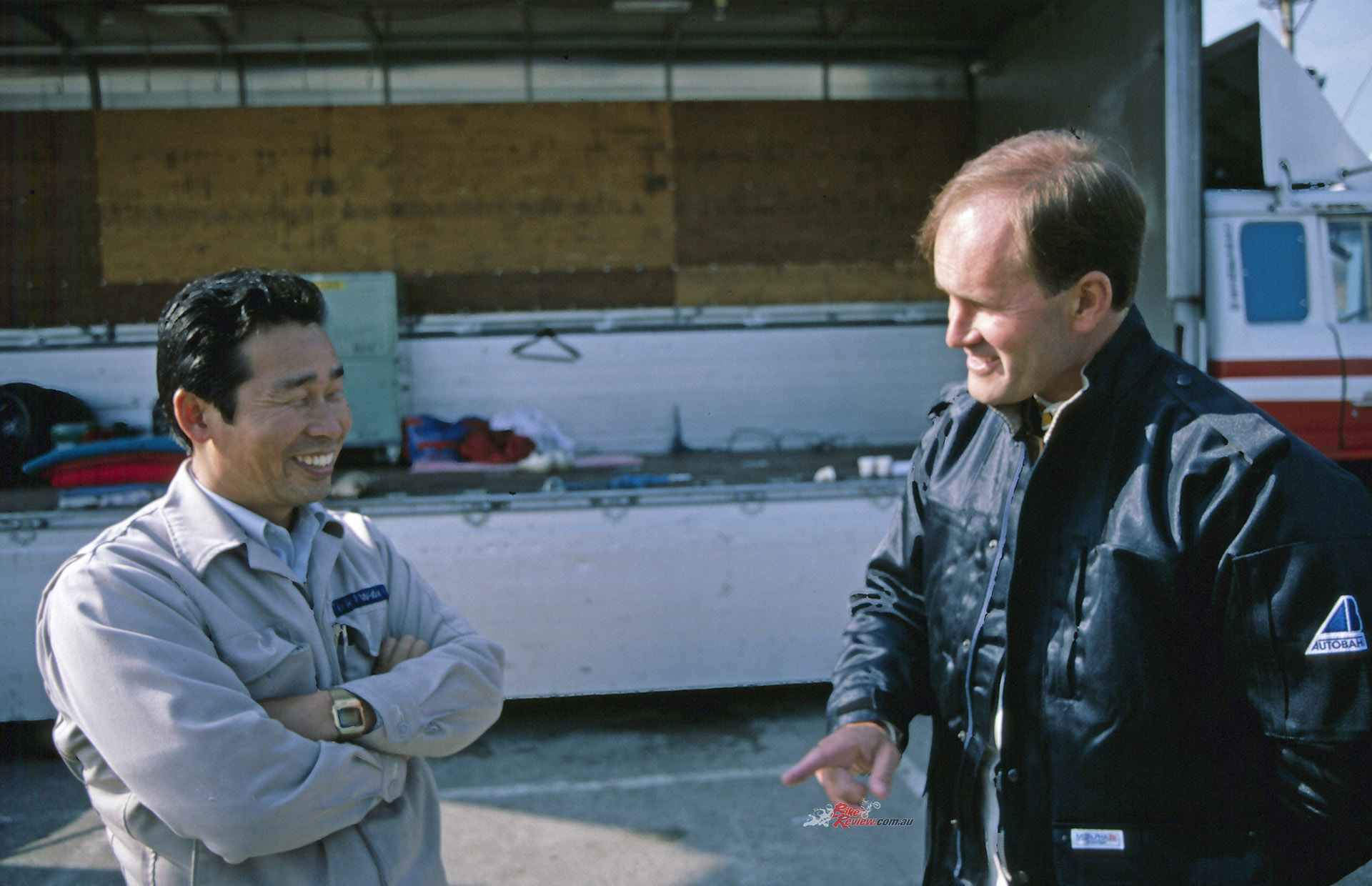
Mamoru Moriwaki and Sir Al chatting at Suzuki during the exclusive test of the 156kg Moriwaki CBX in early 1986.
However, once I started questioning Moriwaki-san about his bike, I discovered that his reason for selecting the CBX750 power unit was even more pragmatic than I’d thought. Moriwaki Engineering’s then closer-growing links with HRC enabled Honda’s racing division to pass over race development of the CBX engine to them, so that the blue and yellow Moriwaki CBX750TT1 was effectively a privateer bike with a factory engine. Like I said, even Honda has a back door to its HRC race shop! What’s more, without apparently advertising the fact anywhere outside of Japan, HRC had developed a series of racekits for the bike under the CBX750RK designation, ready for purchase by anyone wanting to follow in Moriwaki’s free-thinking, fashion-bucking footsteps.
Once I started questioning Moriwaki-san about his bike, I discovered that his reason for selecting the CBX750 power unit was even more pragmatic than I’d thought…
These incorporated extensive engine modifications, including a set of forged two-ring pistons which with Moriwaki/HRC cylinder-head work delivered a 12.5:1 compression ratio (stock was 9.3:1). These however had quite a deep skirt to stop them rocking in the bores, a problem experienced with the slipper-type prototypes. The standard crankshaft was retained, polished but otherwise unmodified, fitted with steel racing conrods, though titanium ones were tried at first before being rejected on reliability grounds. For the same reason, the 0.5mm oversize valves all-round (four per cylinder, remember) became steel after originally being titanium, because these had to be changed every 1000km, an expensive luxury.
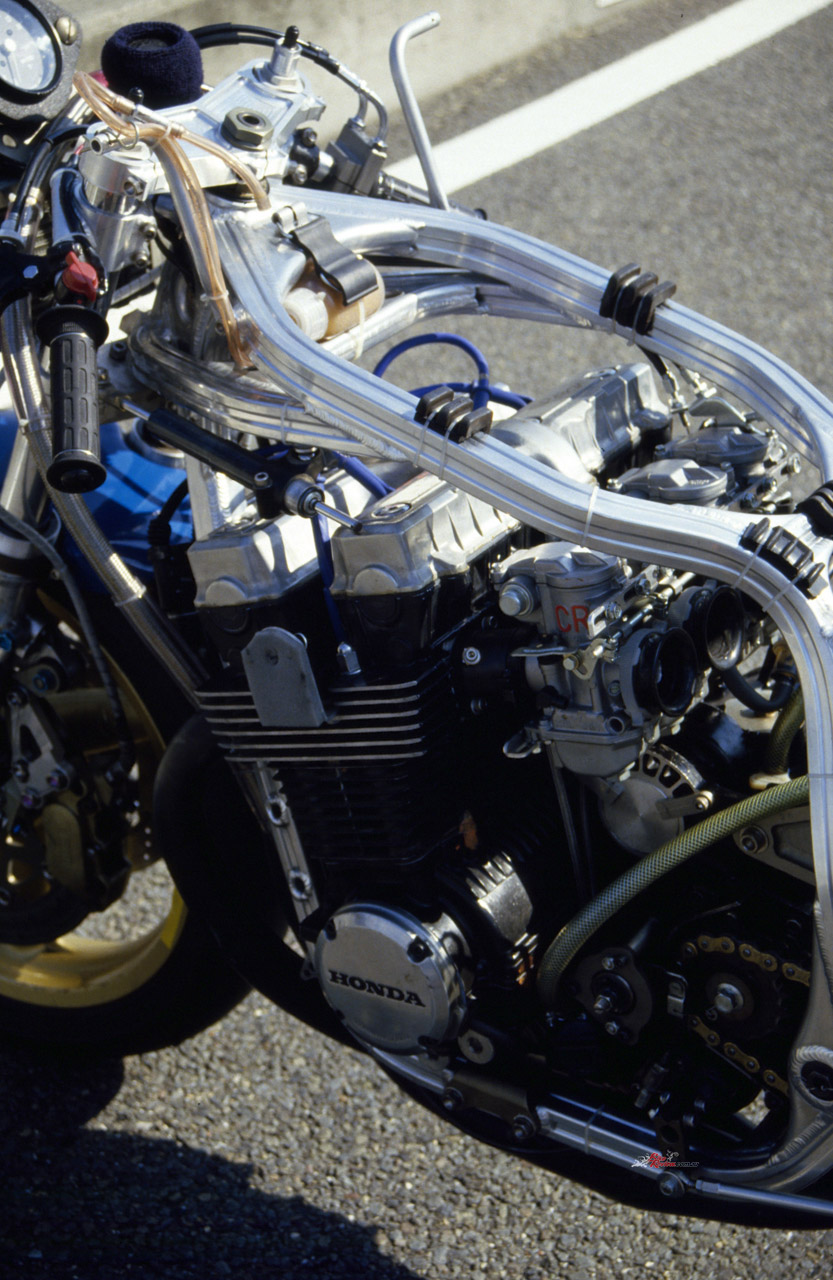
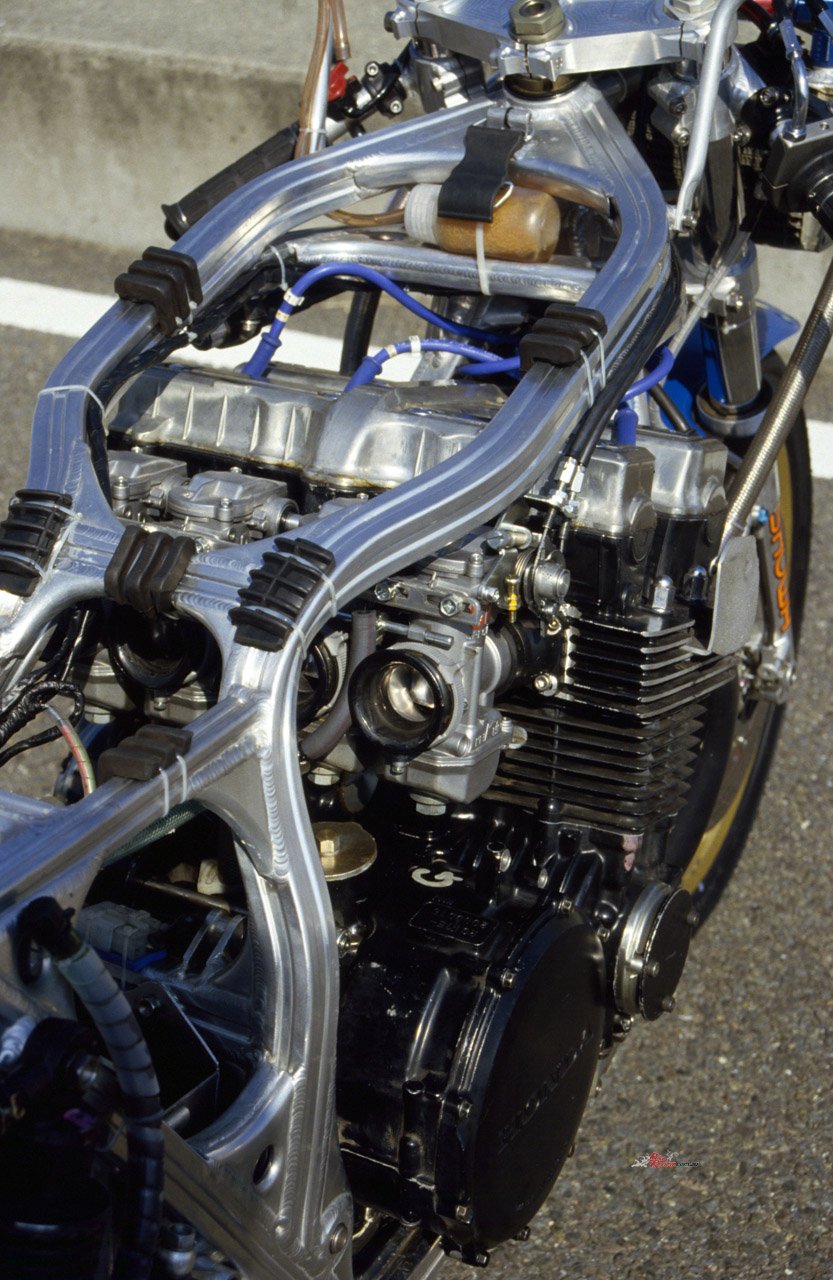
The twin overhead camshafts were HRC racekit components, ditto the valve springs, but the stock cam chain was retained. Finally, a beefed-up version of the standard oil-bath clutch was mated to a special HRC six-speed close-ratio gearbox, and the result fitted with a special 4-1 Moriwaki exhaust with bigger-bore headers compared to stock pipes aimed at producing more top-end power, but at the cost of low and midrange grunt.
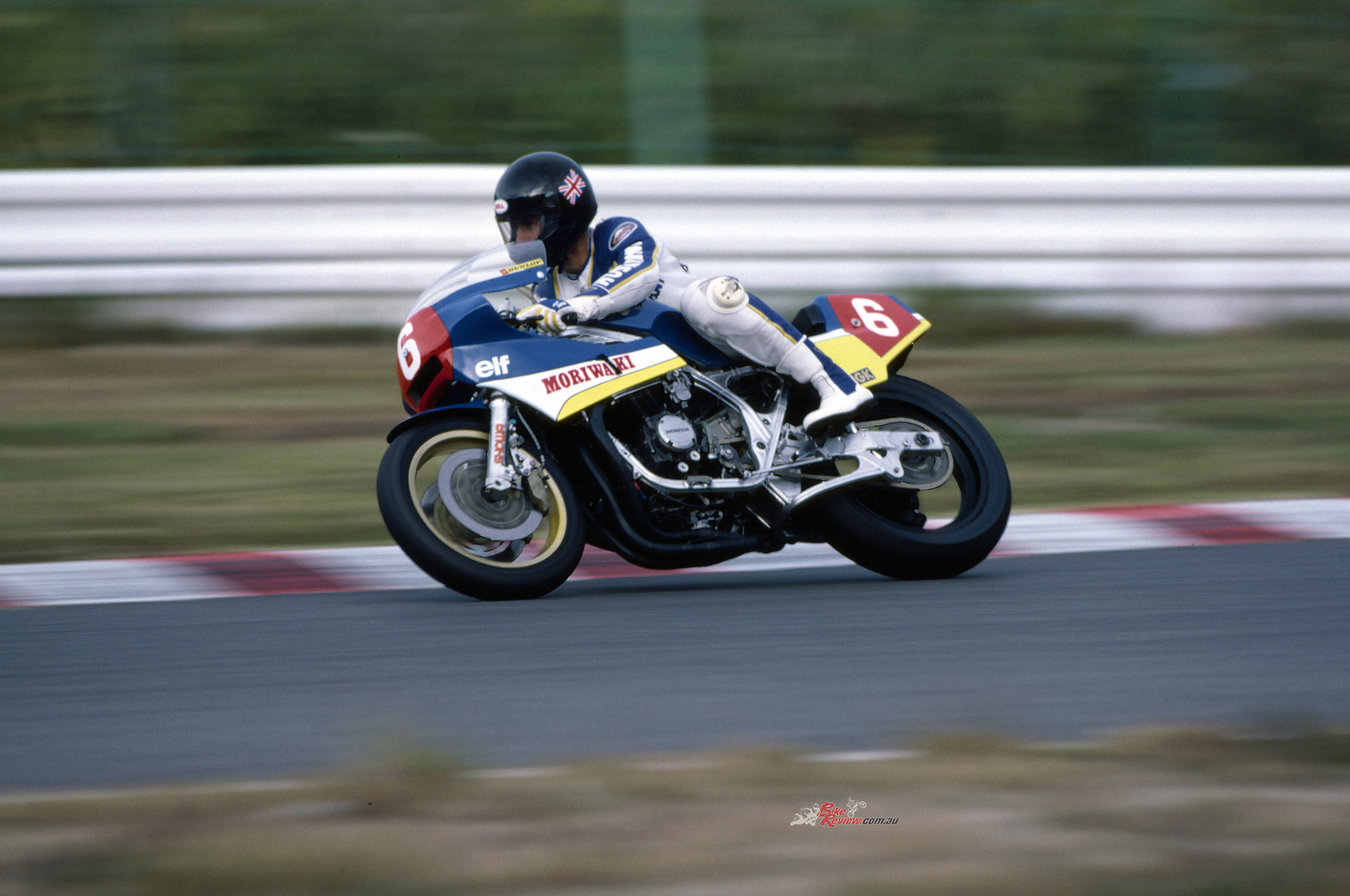
17in front and 18in rear wheels wearing Dunlop crossply front and radial rear hoops were used back in the early 1980s.
The result of all this was an increase in horsepower from 96hp at 9,800rpm at the crank in standard street form, to 118hp at 10,500rpm at the countershaft sprocket on the racer running on 33mm Keihin CR carbs, with the engine safe to 11,500 revs. But power tailed off above 11,000rpm, so there was no inducement to overrev it unduly. Still, this was a pretty good output in the 1980s for any 750cc road-based four-stroke engine, let alone an air-cooled one.
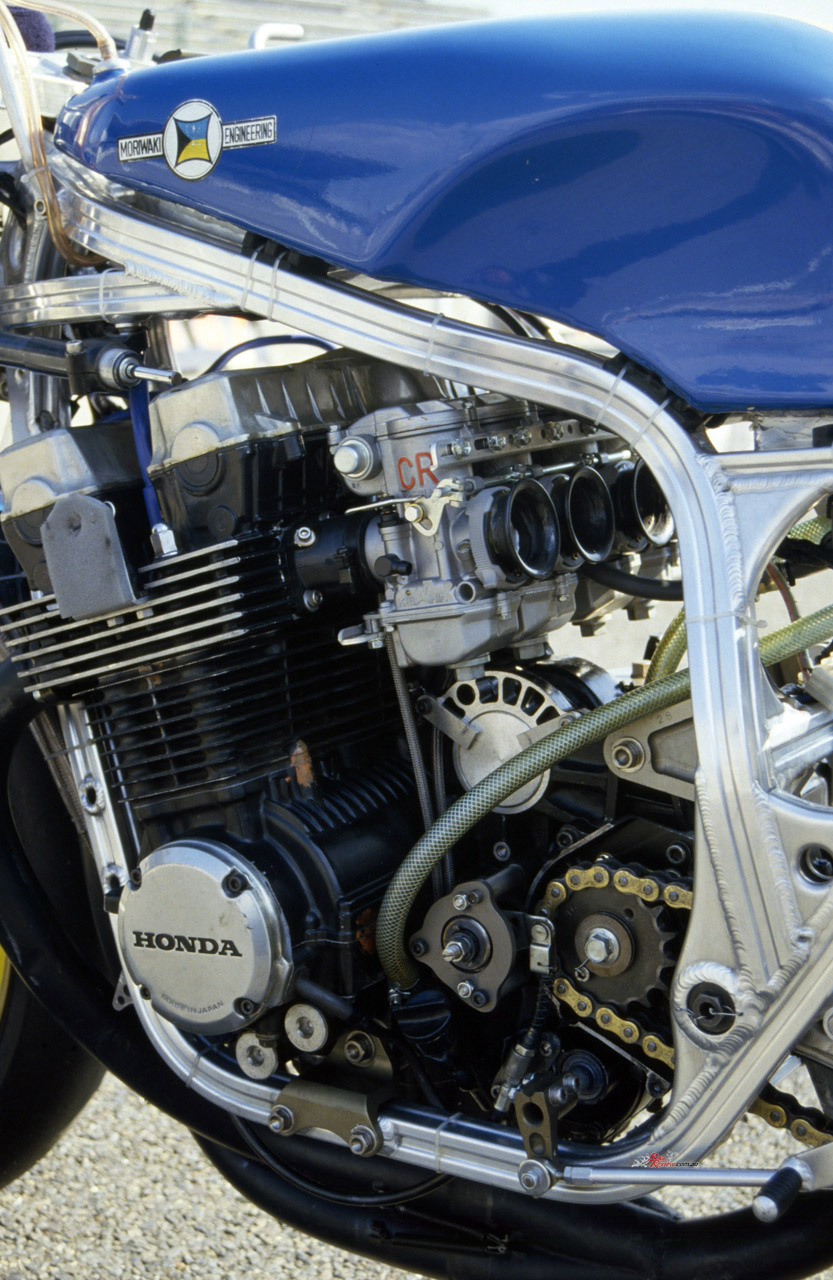
Compare that with the 106hp shown in 1984 on the Heron Suzuki dyno by their air-cooled Yoshimura-developed GSX750R power units (which were also chronically unreliable until detuned), or the 103hp of the Kawasaki GPZ750TT1 motor fitted to P&M and Harris frames for the British F1 series, to see the measure of the CBX’s performance, as borne out by results. Okay, it was still 10 per cent down on horsepower for not a lot of weight-saving compared to HRC’s own V4 RVF750 which dominated TT1/Superbike racing in Europe and the USA after the capacity limit was reduced to 750cc in 1984, but that’s no disgrace.
The result of all this was an increase in horsepower from 96hp at 9,800rpm at the crank in standard street form, to 118hp at 10,500rpm at the countershaft sprocket…
More to the point, using the results of the Heron dyno once again (108hp for their less than reliable first-generation oil-cooled GSX-R750TT1 race engines in 1985/86) and Yatsushiro’s results in the Japanese F1 series as a guide, the humble air-cooled CBX750 unit was more than able to hold its own against anything else – and that included the liquid-cooled FZ750 Yamaha.
The humble air-cooled CBX750 unit was more than able to hold its own against anything else – and that included the liquid-cooled FZ750 Yamaha.
The superiority of Honda’s V4 RVF in terms of power over the CBX was well illustrated when I rode Joey Dunlop’s 1986 title-winning V4 that same morning at my Suzuka test, and was passed by the Moriwaki test rider on the CBX just before the back straight – my excuse was that he’d had a lot more practice getting the tricky Spoon Curve leading on to it right than I’d had! But the way ‘my’ factory bike’s watercooled V4 motor ate up the air-cooled semi-works one in a straight line after that showed just why it was the king of the Superbikes, allowing me to get him back before braking for the high-speed 120R.
But when I came to ride the Moriwaki in the afternoon, I found its engine performance still pretty impressive in terms of the rest of the opposition: it was just that the RVF made almost anything comparable look pretty mediocre back then, especially via the rideability provided by its smooth power delivery and ultra-flat torque curve. The air-cooled CBX on the other hand was much peakier, and where the V4 pulled from practically zero rpm, the in-line motor just spluttered low down without very much happening below 7,000 revs, where it all chimed in big time, and came strongly on song.
“The motor just spluttered low down without very much happening below 7,000 revs, where it all chimed in big time, and came strongly on song”…
Still, there was noticeably less power at 8,000rpm than at 10,000, so with maximum horsepower on tap at 10,500rpm you had to work the sweet-shifting left-foot race-pattern gearbox good and hard to get maximum benefit from the HRC engine mods, and that Moriwaki exhaust. The ratios of the six speed gear set were well chosen – with an average 1,200rpm drop between gears they made the engine seem a lot less fussy than the similar ultra-close ratio gearbox on the TT F1 Suzuki GSX-R, where you’d be forever changing gear despite having an extra 2,000 revs to play with compared to the CBX.
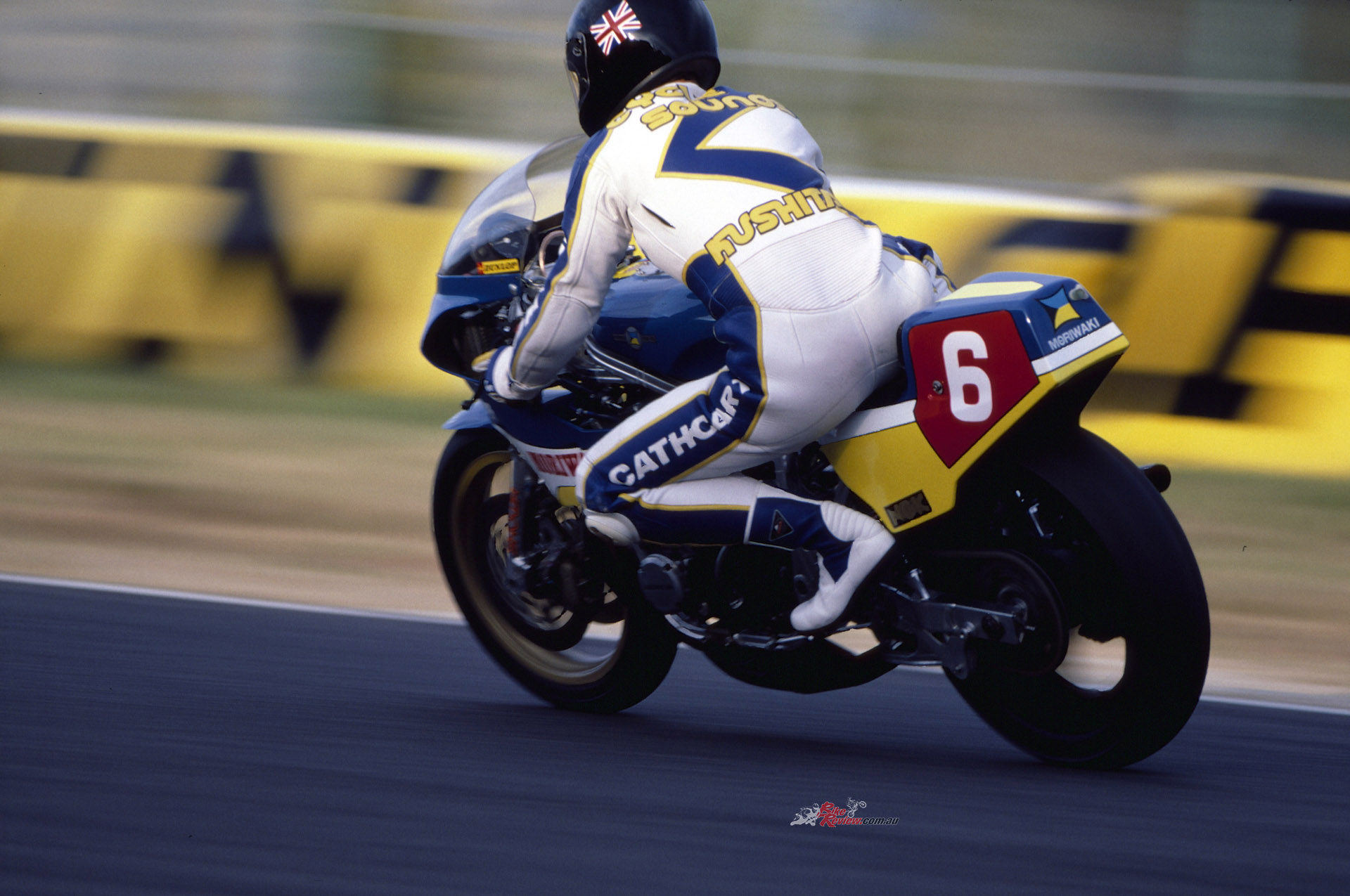
“The ratios of the six speed gear set were well chosen – with an average 1,200rpm drop between gears”…
The air-cooled Honda did have a narrow gap between fifth and top gear – just 700 revs – but this according to Moriwaki was to keep the engine pulling peak revs at places like the uphill finishing straight at Sugo, where it acted as a kind of overdrive of the kind that Italian teams always used to employ on their GP racers on their ultra-fast Monza home track. This was an implicit recognition of the engine’s character, with a pretty steep torque curve peaking at 10,000rpm. With a 4,000rpm revband, the CBX was in fact very different from the grunty old one-litre TT1 ‘diesels’ it initially reminded you of simply in terms of architecture, and in fact you really had to keep it spinning in the upper 2,500rpm band for maximum performance.
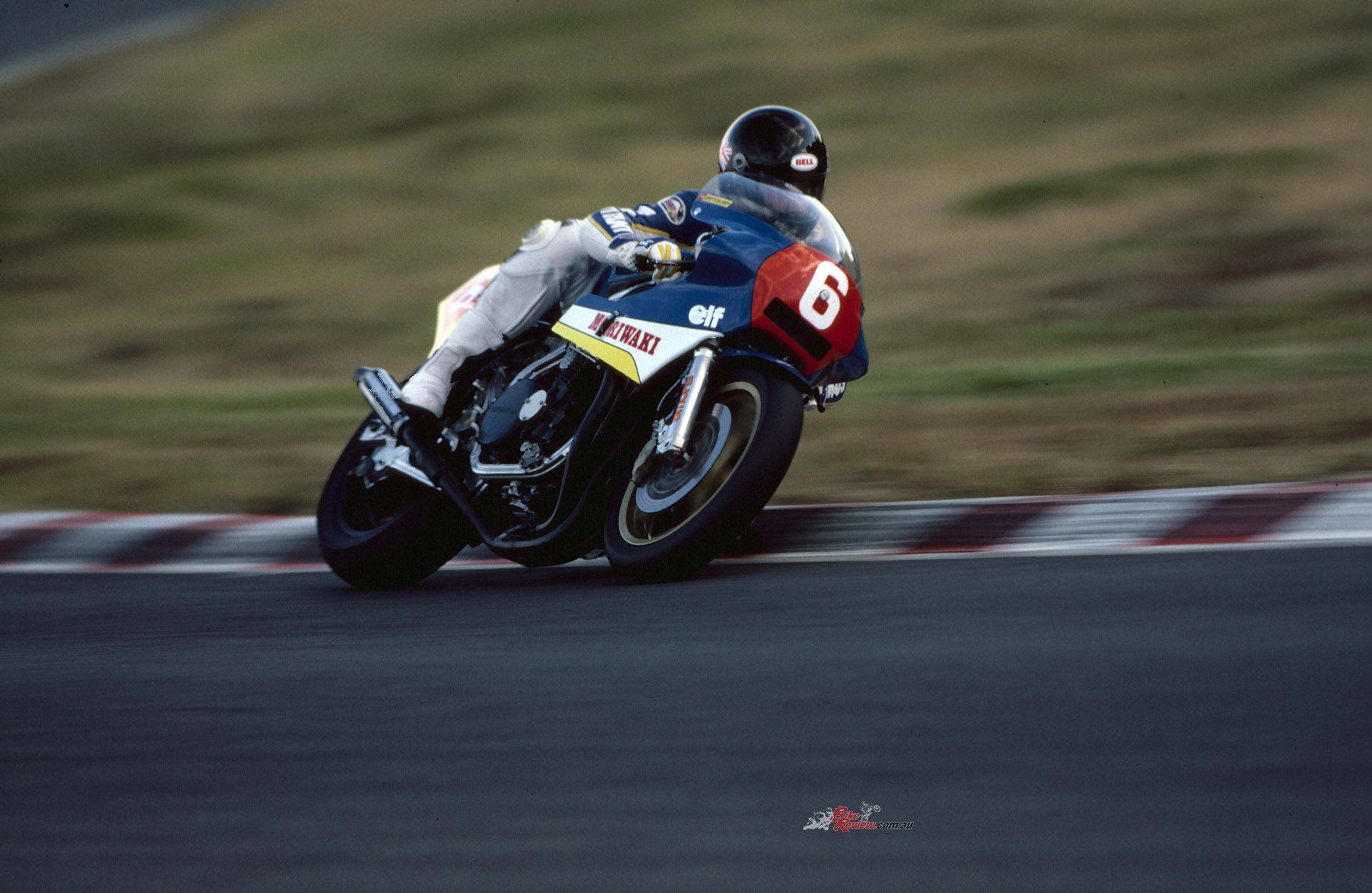
It took me a while to adjust to this mentally after riding the RVF that morning, because you absolutely couldn’t just let the CBX slog out of corners at low revs like you could with the V4, not only because of the engine characteristics, but also how it affected the handling. Initially, I was surprised to find the Moriwaki chassis tended to wash out the front-end, especially on the winding uphill twists and turns behind the Suzuka pits leading up to the Degner Curve, where there was quite a noticeable amount of understeer when getting on and off the gas to the accompaniment of the incredibly musical exhaust note – this had to have been the best-sounding bike of that era in world-class four-stroke racing!
This had to have been the best-sounding bike of that era in world-class four-stroke racing!
Crouching flat on the tank in the bends, in an effort to shift as much of my body weight over the front wheel as possible, helped a bit in countering the understeer, but not as much as when I started using more revs, and a gear lower. The steering immediately improved, indicating that this was a bike which demanded to be taken through corners on the power, though the 1420mm wheelbase was quite normal then for a big four-stroke, and the non-adjustable 25º head angle unremarkable for the day.
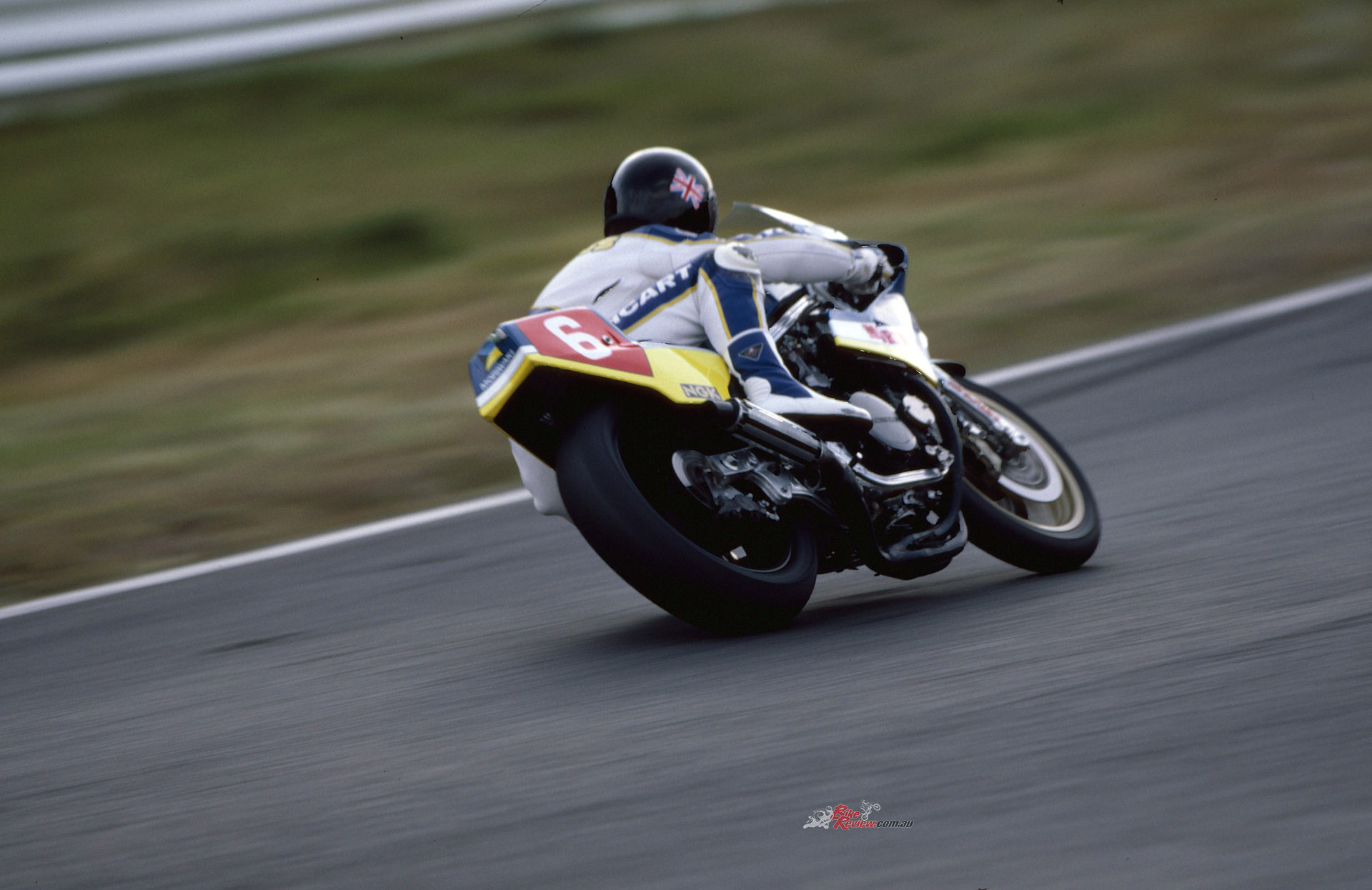
“Initially, I was surprised to find the Moriwaki chassis tended to wash out the front-end, especially on the winding uphill twists and turns behind the Suzuka pits leading up to the Degner Curve”…
I was surprised, though, to discover that the weight distribution was as much as 55/45% frontwards, more by accident than design since Moriwaki-san told me that in designing a frame, he placed more importance on a low centre of gravity than a front-heavy weight distribution. What this meant, however, was that when you did start taking corners hard on the throttle aboard the CBX, the front-end stayed glued to the road and the steering became nicely neutral, aided by the confidence-inspiring grip of the 17-inch front Dunlop crossply, matched to an 18-inch 3.85/6.50 radial rear.
Ah, the rear. Well, there they were, two of ’em. Suspension units, I mean – shocks, you may prefer to call them. In donning his chassis-designer cap, Mamoru Moriwaki told me he was unconvinced of the benefits of monoshock rear suspension, convinced he could obtain equivalent or superior compliance with twin shock units at the back offering greater overall torsional rigidity. If lengthened, these could yield the same degree of wheel movement, and thus offer as soft and compliant a ride, leading to enhanced ride quality and grip.
Gas-damped with remote cylinders, these were fitted with multi-rate springs which Moriwaki believed would offer the same progressive-rate variation as a monoshock.
Kayaba were enthusiastic partners in this experiment, and made the special twin rear units fitted to the CBX (as well as to its companion NSR250 GP racer of the same period, also with twin-shock Moriwaki chassis). Gas-damped with remote cylinders, these were fitted with multi-rate springs which Moriwaki believed would offer the same kind of progressive-rate variation as a monoshock operated by a rising rate link – but without any potential for wind-up, and consequent overworking of the single shock.
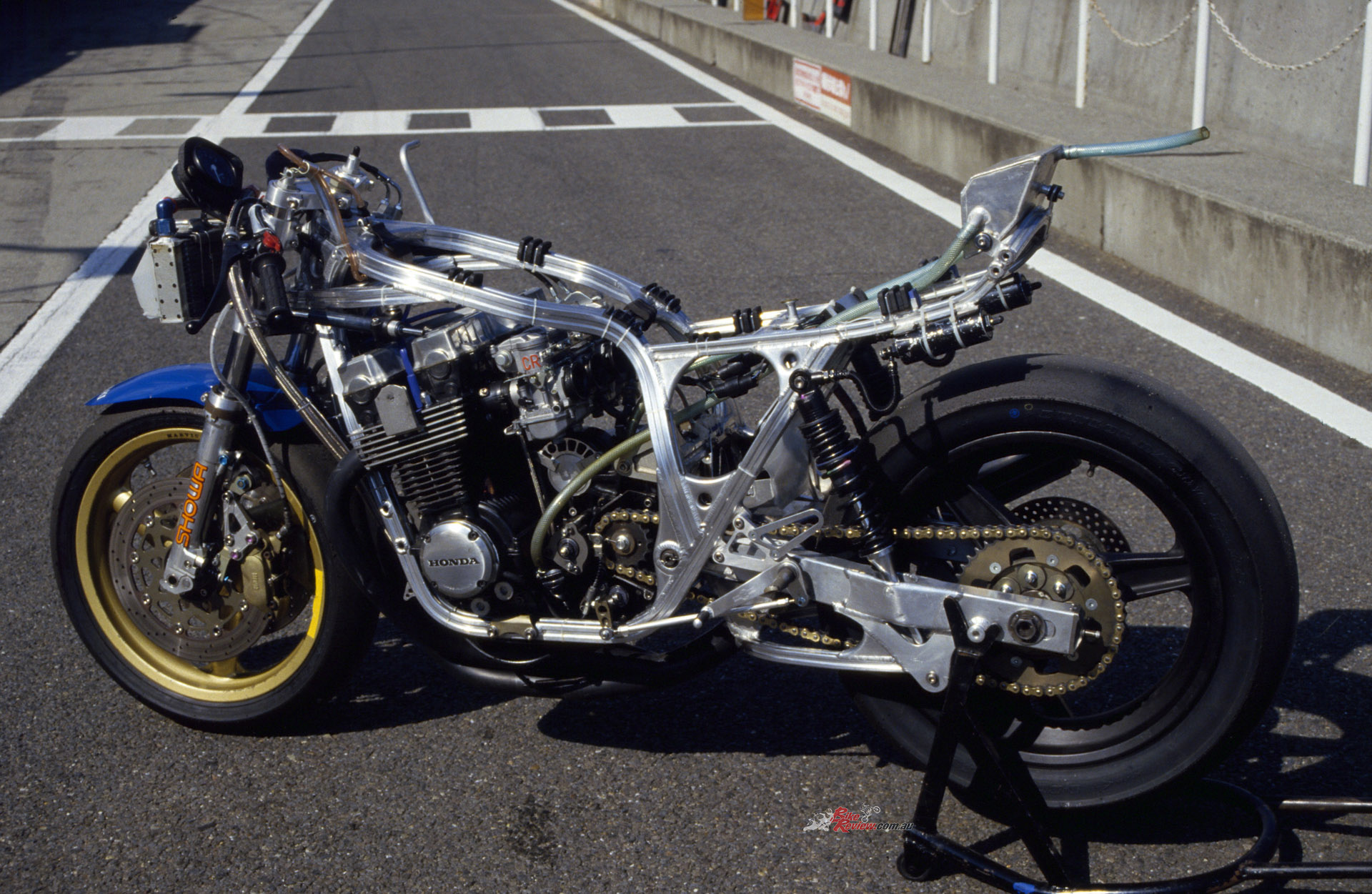
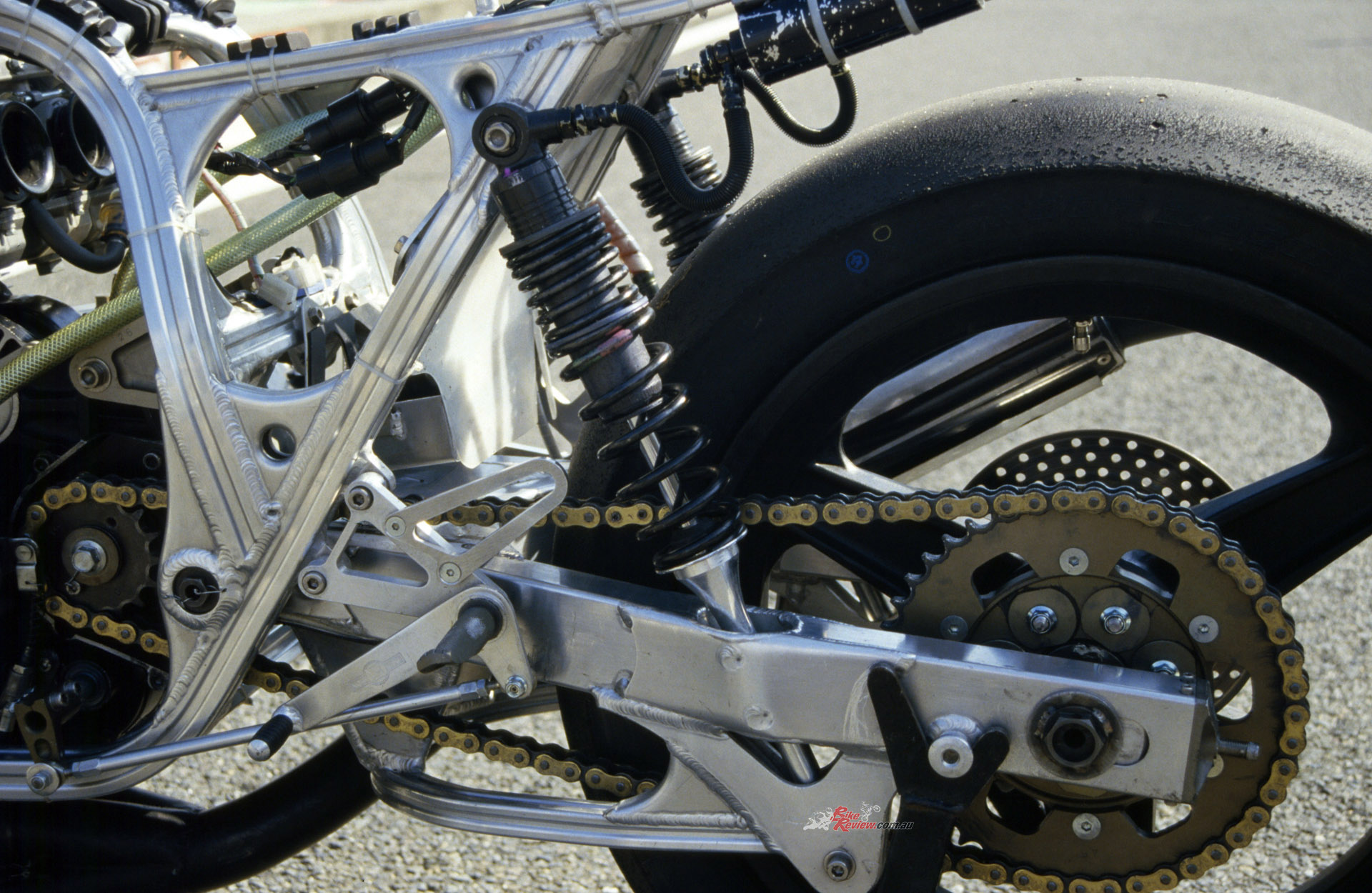
However, unlike on the Moriwaki NSR250, which featured a revised design of lower mounts, the Kayaba shocks on the CBX employed steel extensions which actually passed through the box section of the swingarm on each side of the wheel, and pivoted on brackets attached to the underside of each leg of the well-braced fabricated aluminium swingarm. This allowed that to be wide enough to accommodate the 3.85/6.50 x 18 rear tyre, yet gave the necessary lateral rigidity too, as well as permitting the long Kayabas to be mounted in the desired fashion.
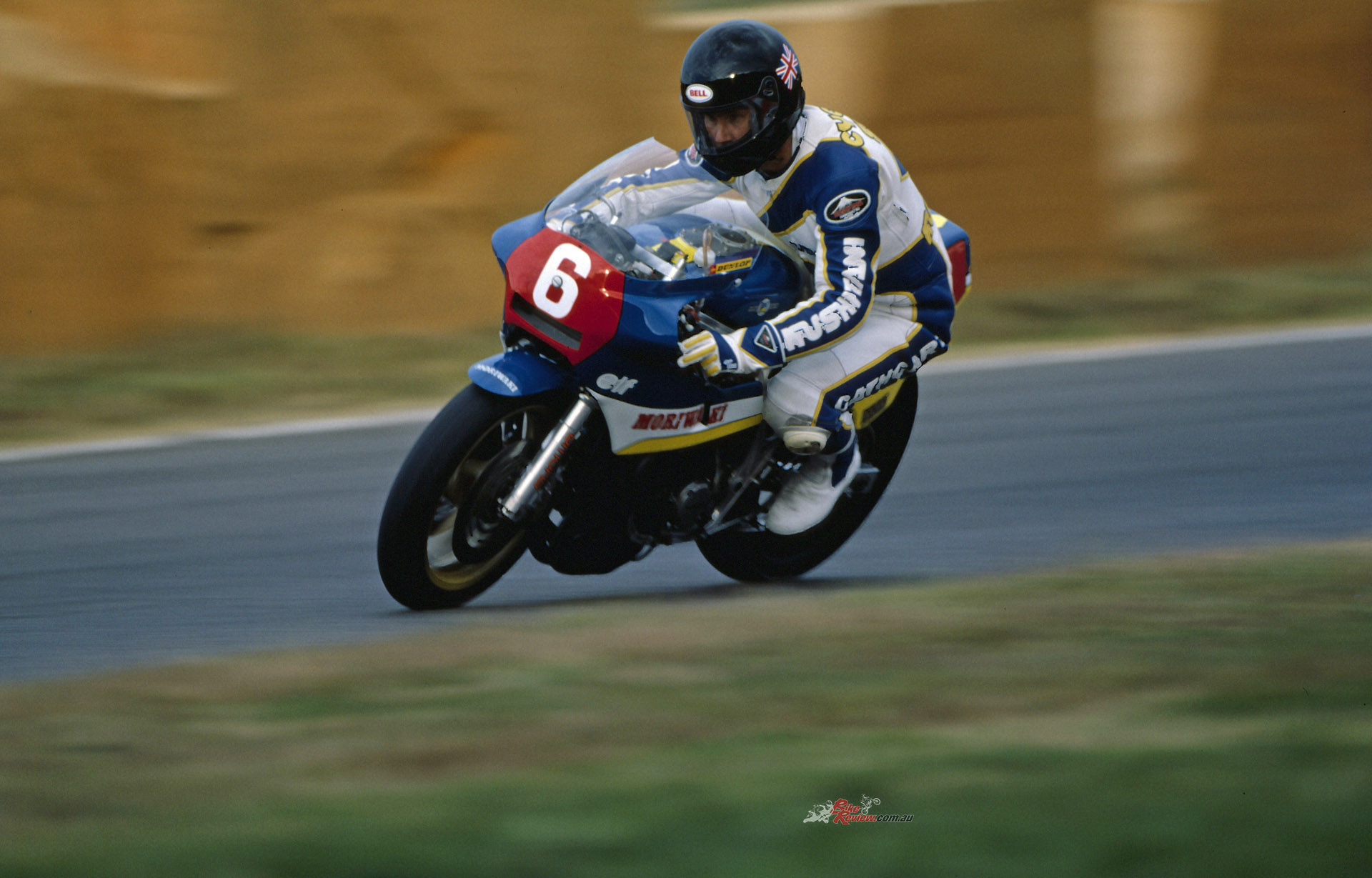
Alan found he had to get as much weight over the front as possible for grip, unless he used higher rpm and a gear lower.
The rear end was actually less stiffly sprung than almost any 250GP racer I’d ridden to that point, giving a compliant, reassuring ride that soaked up the ripples and bumps then prevalent on the Suzuka surface. Suspension response was good enough to be unremarkable, and in contrast to the NSR250 which had chattered over the bumps, the front-end of the CBX actually coped well with them.
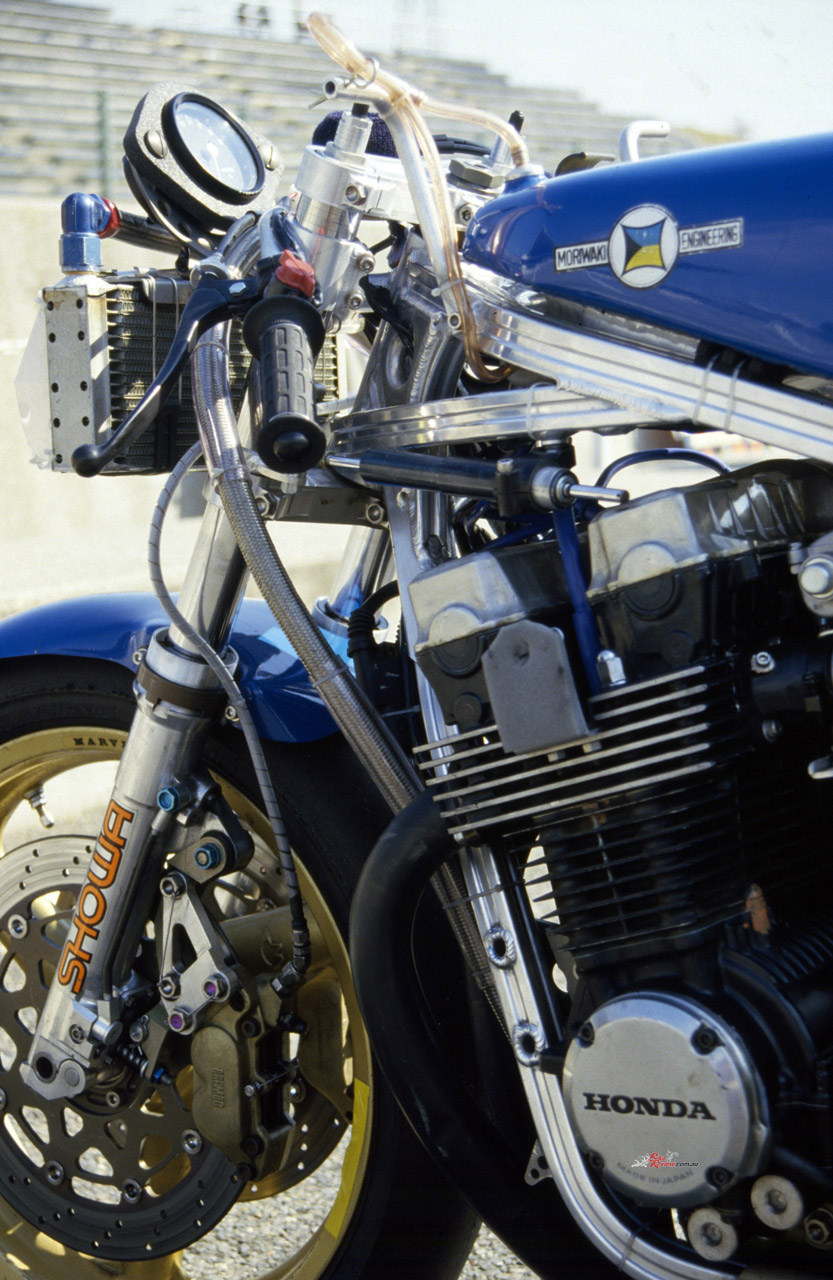
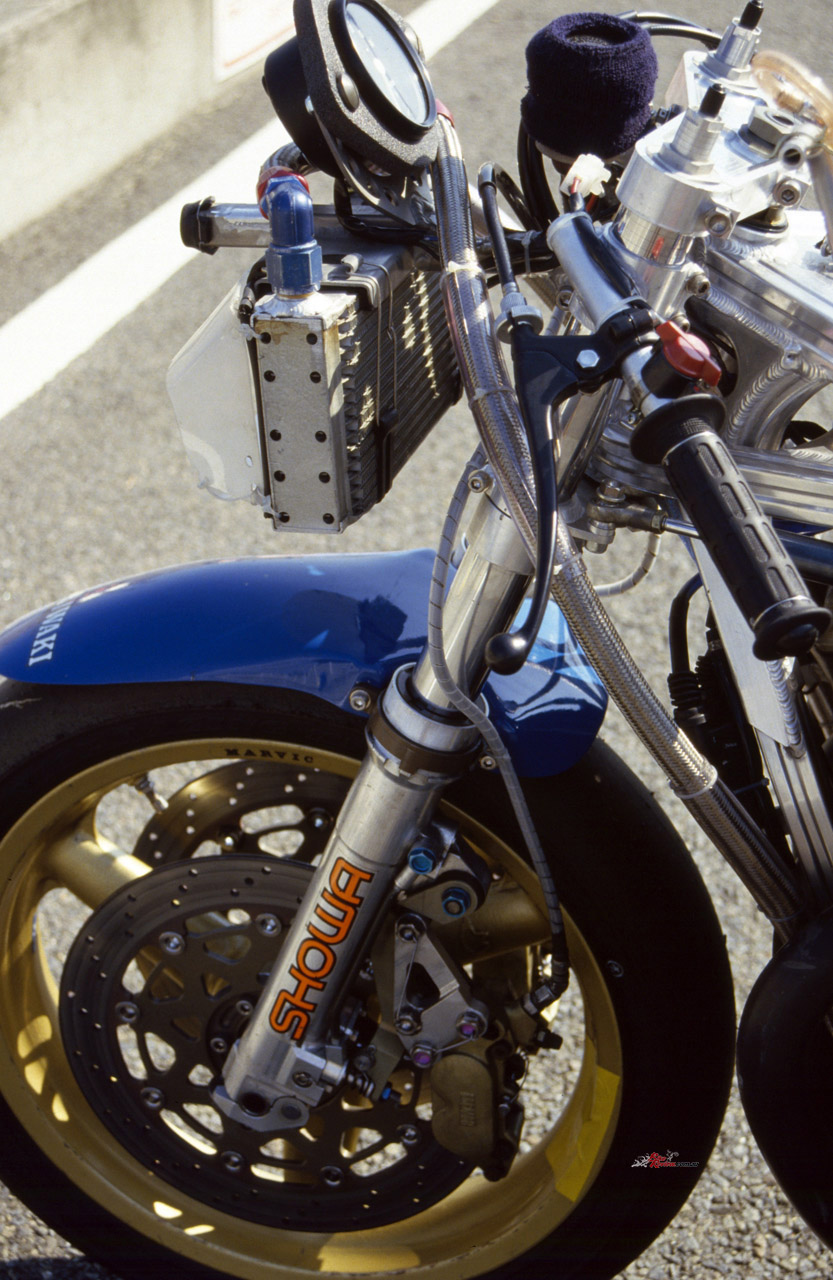
It was perhaps because Moriwaki had managed to acquire the outstanding 41.3mm Showa fork fitted to the works V4 Hondas, complete with TRAC brake-operated anti-dive. Although this, if connected, didn’t however stop the CBX’s front-end dipping quite a bit under hard braking, though not enough to cause a problem. The front suspension didn’t freeze, but kept on working as well as ever, just as in the Isle of Man and Ulster with ‘Yer Maun’ Joey Dunlop aboard.
The front suspension didn’t freeze, but kept on working as well as ever, just as in the Isle of Man and Ulster with ‘Yer Maun’ Joey Dunlop aboard.
Once you got used to its preference for being taken through corners with the power hard on, the Moriwaki chassis delivered total confidence. Moreover, not only did its alloy construction and various weight-saving touches result in a bike scaling 7kg less than the equivalent air-cooled steel-framed Kawasaki-powered Harris or P&M TT1 racers, but the overall effect was to make this 750cc four-stroke four seem like a 500GP two-stroke in terms of the speed of steering response, and the ease with which it changed direction.
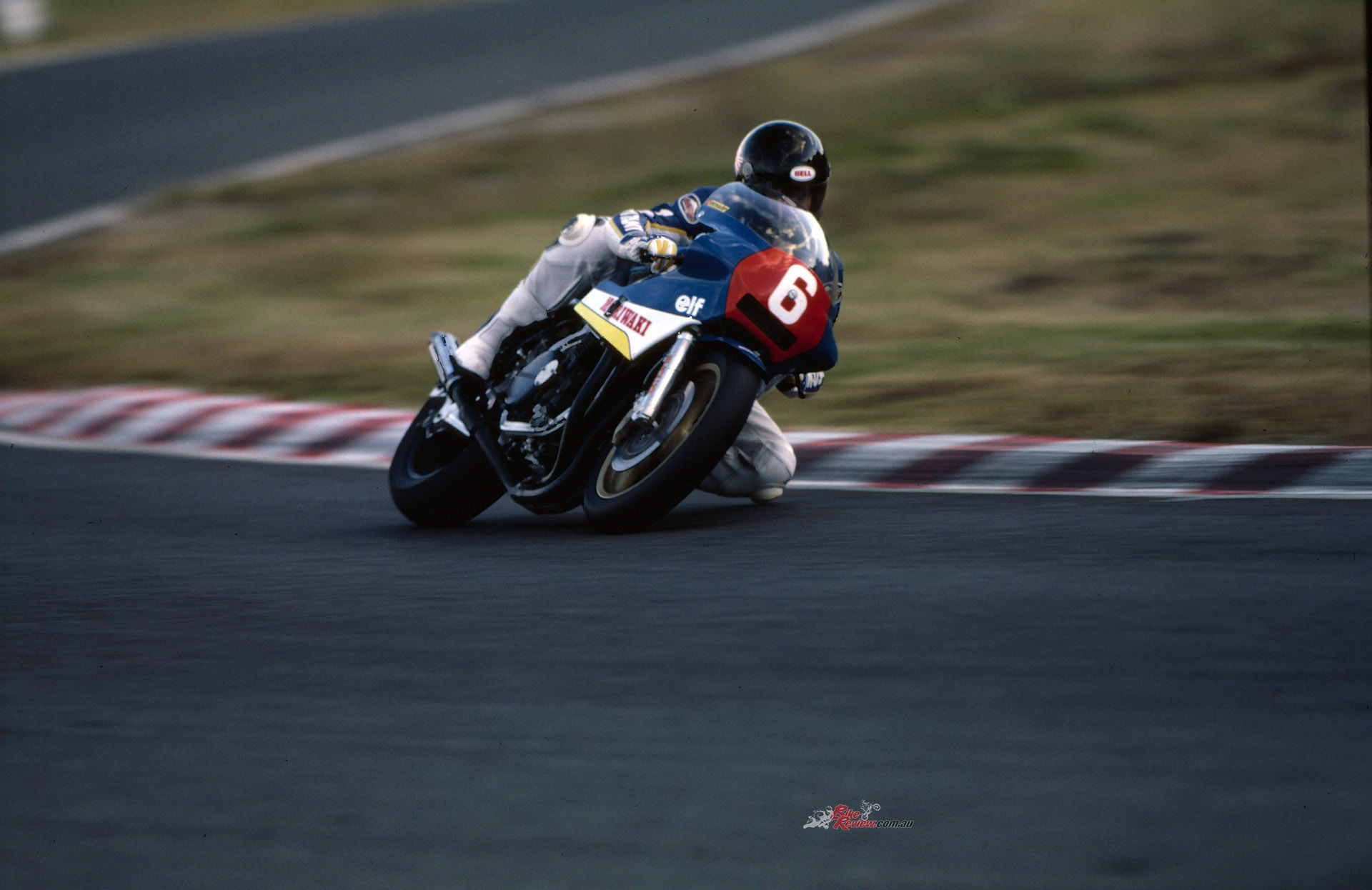
It felt like a lot lighter and smaller bike than it really was – delicate, almost, which is scarcely a term I’ve ever got used to applying to big in-line fours! But the CBX750 engine was so narrow (especially thanks to having the alternator placed behind the engine, here removed and blanked off in TT1 form) that it conveyed this impression, as well as reducing the frontal aspect considerably. It also started incredibly easily, a fact I tested for myself in pit lane, much to the amusement of the Moriwaki crew: Three steps, lean on the tank, fire it up and you’re away.
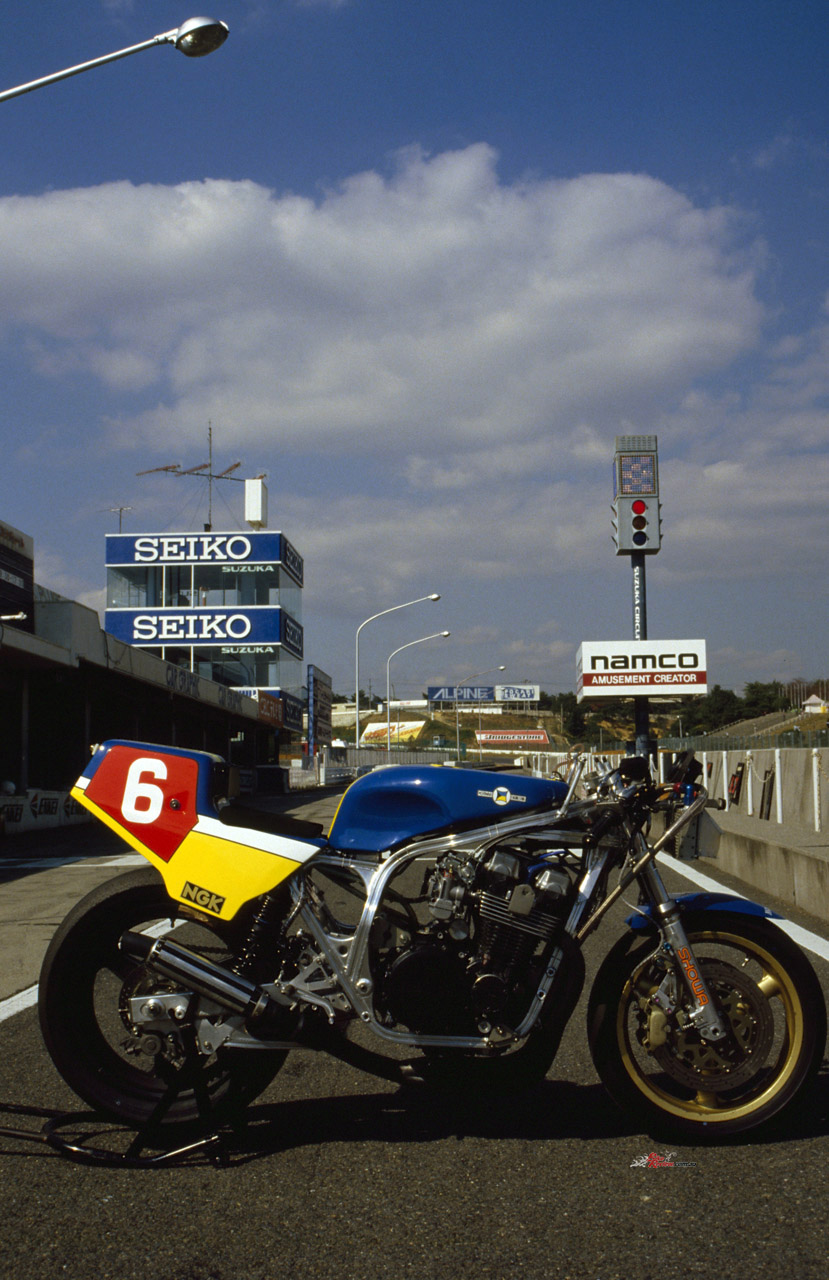
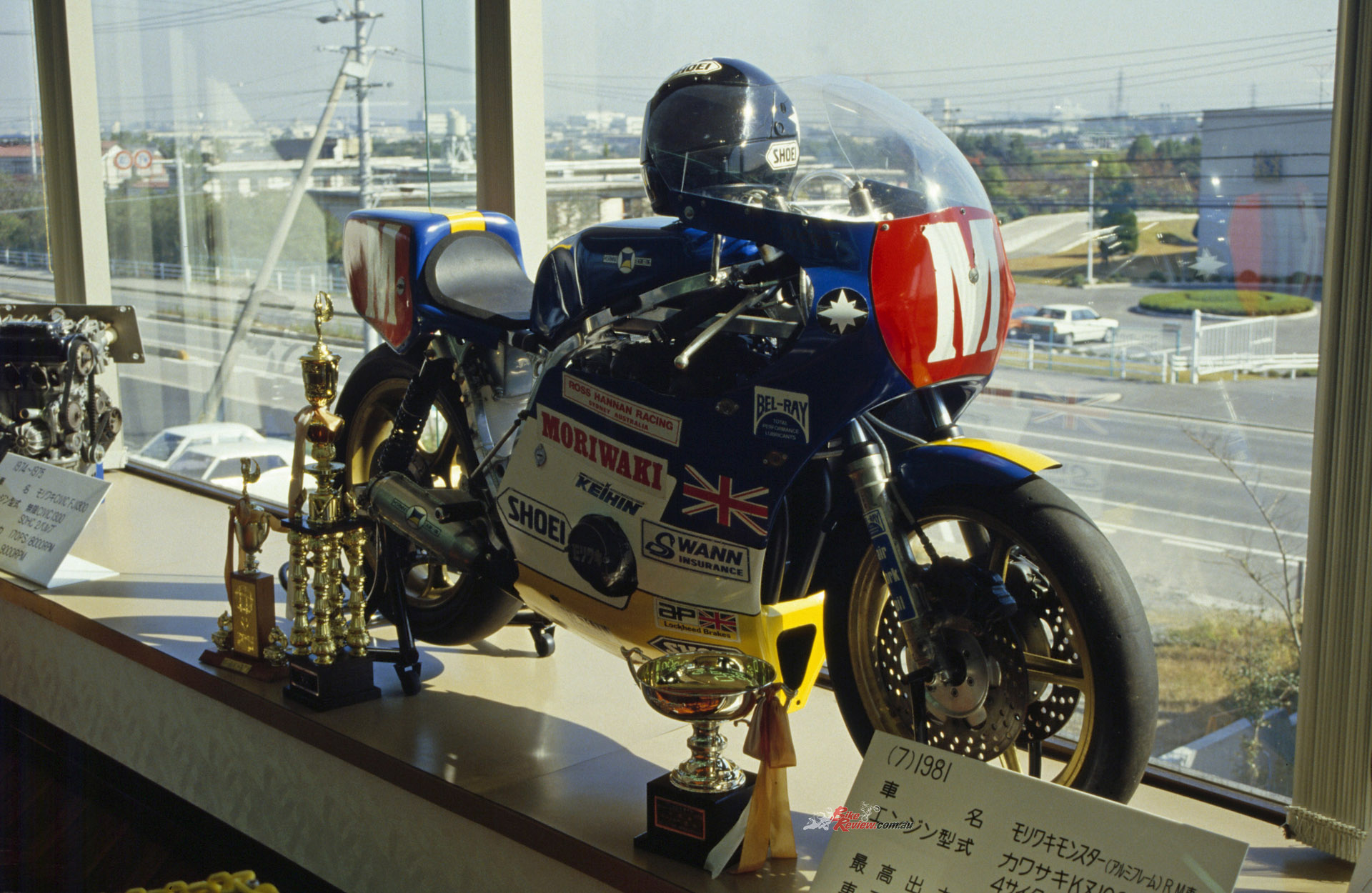
The CBX7S0 had so much going for it in TT1 form, that the obvious question remained to be asked: why did nobody else ever race one seriously outside Japan? Part of the reason was the herd instinct, for although they like to pretend otherwise, road racers are slaves to fashion, and by then air-cooled racebikes were strictly for the history books. But the main reason was Honda’s own lack of enthusiasm for what was very definitely a short-lived interim model, which in turn seemingly led to a reluctance by HRC to promote the fact it actually did have a racekit available for it.
The CBX7S0 had so much going for it in TT1 form, that the obvious question remained to be asked: why did nobody else ever race one seriously outside Japan?
I’m bound to say I reckon a kitted CBX750 would have been a much more practical proposition for a private team than the hard-to-work-on V4 Honda – as several teams found out the hard way during the next decade, especially with the RC45. It would have proved at least as good a bet as the Suzuki and Yamaha fours with the added benefits of reliability thanks to its greater accessibility, born of simplicity.
In fact, on the basis of my test I’d say a CBX750 equipped with HRC/Moriwaki tuning parts would have made a pretty competitive and cost-effective privateer bike for the debut World Superbike series which kicked off in 1988 – and was of course won by Fred Merkel on the semi-works Team Rumi Honda RC30. Too bad nobody ever tried to prove me right or wrong about that.
Moriwaki Honda CBX750 TT1 Specifications
Engine: Air-cooled DOHC 16-valve inline four-cylinder four-stroke, 67 x 53mm bore x stroke, 12.5:1 compression ratio, 747cc, 4 x 33mm Keihin CR carburettors, Kokkusan Denko CDI ignition, six-speed HRC close-ratio gearbox, multiplate oil-bath clutch, 118bhp at 10,500rpm.
Chassis: Twin-loop full-duplex cradle frame in extruded square-section aluminium tubing, 41.3mm Showa telescopic fork with TRAC brake-operated anti-dive system, fabricated aluminium swingarm with twin Kayaba gas shocks, 25° rake, 1420mm wheelbase, 156kg (with oil, no fuel), 55/45% static weight distribution, twin 320mm front discs with Brembo four-piston calipers, single 200mm rear disc with Lockheed twin-piston caliper, Marvic cast aluminium wheels (3.50 x 17in front, 5.50 x 18in rear), Dunlop 3.25/4.25-17 crossply front and 3.85/6.50-18 radial rear tyres.
Performance: 118bhp (88kW) at 10,500rpm, top speed 268km/h (Suzuka, 1984), year of manufacture 1984, manufacturer Moriwaki Engineering, Suzuka, Japan.
You Might Also Like