

Two-Stroke Tuesday | Classic Racer Test. Everything happens at double speed on a Honda RS125R GP bike, even a 25-year-old one… Words: Jeff Ware Photography: Heather Ware
When you climb aboard a Grand Prix RS125R, you immediately realise that time itself bends, particularly when you are exactly double the age of the bike. The GP bike reacts quicker, the revs rise faster, and even your mistakes happen at lightning speed.
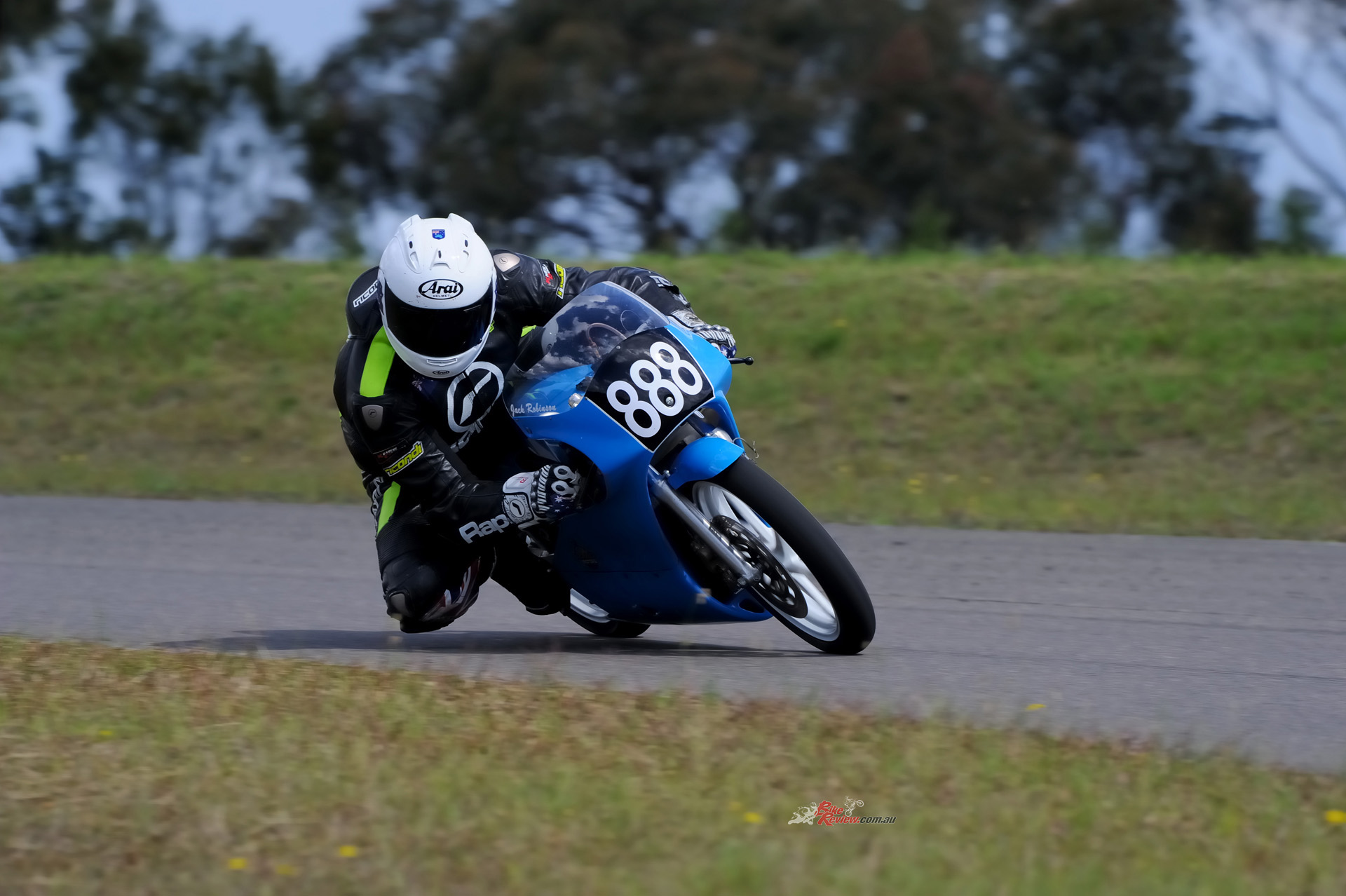
Turn One at The Farm, the 1989 RS125 takes it at full tilt, even with Jeff on board!
That was the case when I was handed the chance of a lifetime: an afternoon at The Farm on Post Classic Racing Association pointy end competitor at the time, young Jack Robinson’s 1989 ex-HARC-Pro Honda RS125R (with some 1990 bits). Jack is younger than most PCRA rider, but rides with speed and skill far beyond his age. He’s bloody fast, that’s for sure…
Read our other Two-Stroke Tuesday articles here…
Riding any GP bike is the kind of invitation you can’t refuse, even if you’re twice the size of the riders the machine was designed for. At 50kg dripping wet, most GP 125 pilots would barely dent the seat foam. So, the first question in my mind was simple, would the fragile-looking alloy frame even hold me?
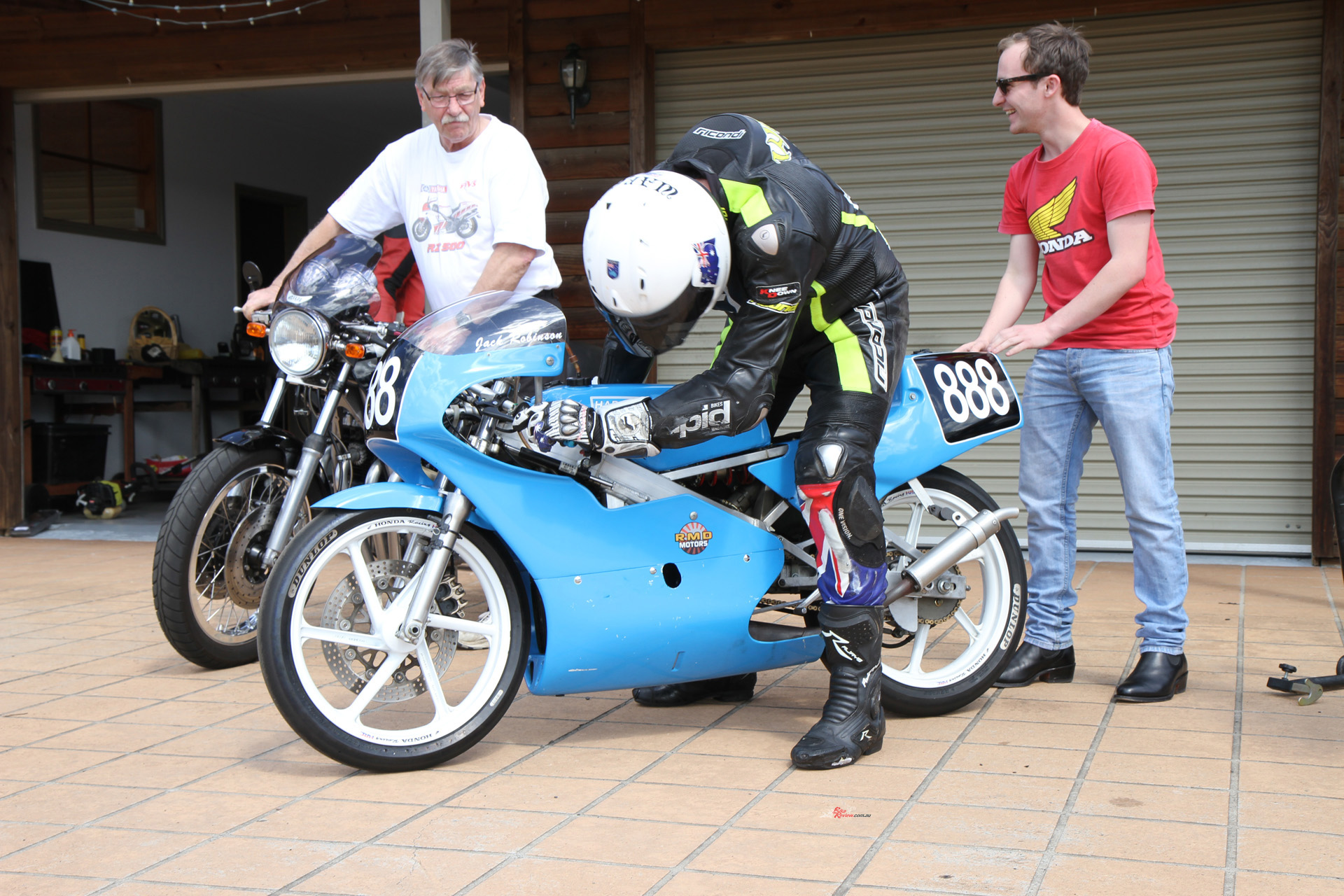
Dudley Lister (Left) watches Jack and Jeff start the bike. Dudley was Mick Doohan’s and Kevin Magee’s race engineer here among many other riders, and ran the Marlboro Yamaha Team here with Warren Willing, Glenn Willing and Jeff did part of his apprenticeship with Dudley in the 1990s at Willing Motorcycles.
Jack offered a little guidance before I set off, “Keep an eye on the temperature. The brakes are powerful too. And mate, try not to highside. Get plenty of heat in the tyres”… Sound advice. Though with a 125, generating tyre temperature is hardly a challenge for a 100kg in gear washed up racer, keeping up with the bike’s furious pace is the real test. My body doesn’t react to my brain as fast these days and I quit racing in 2015…
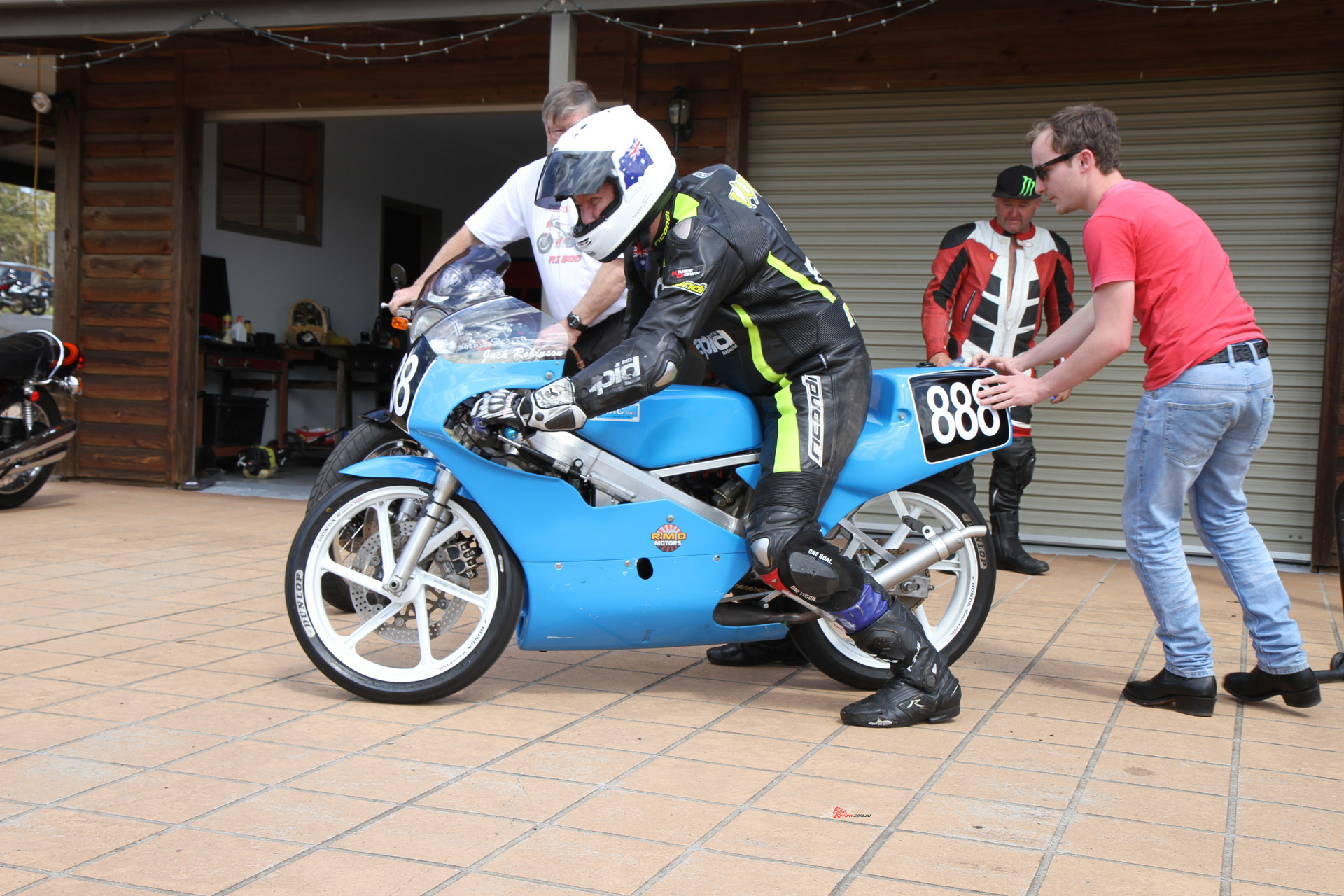
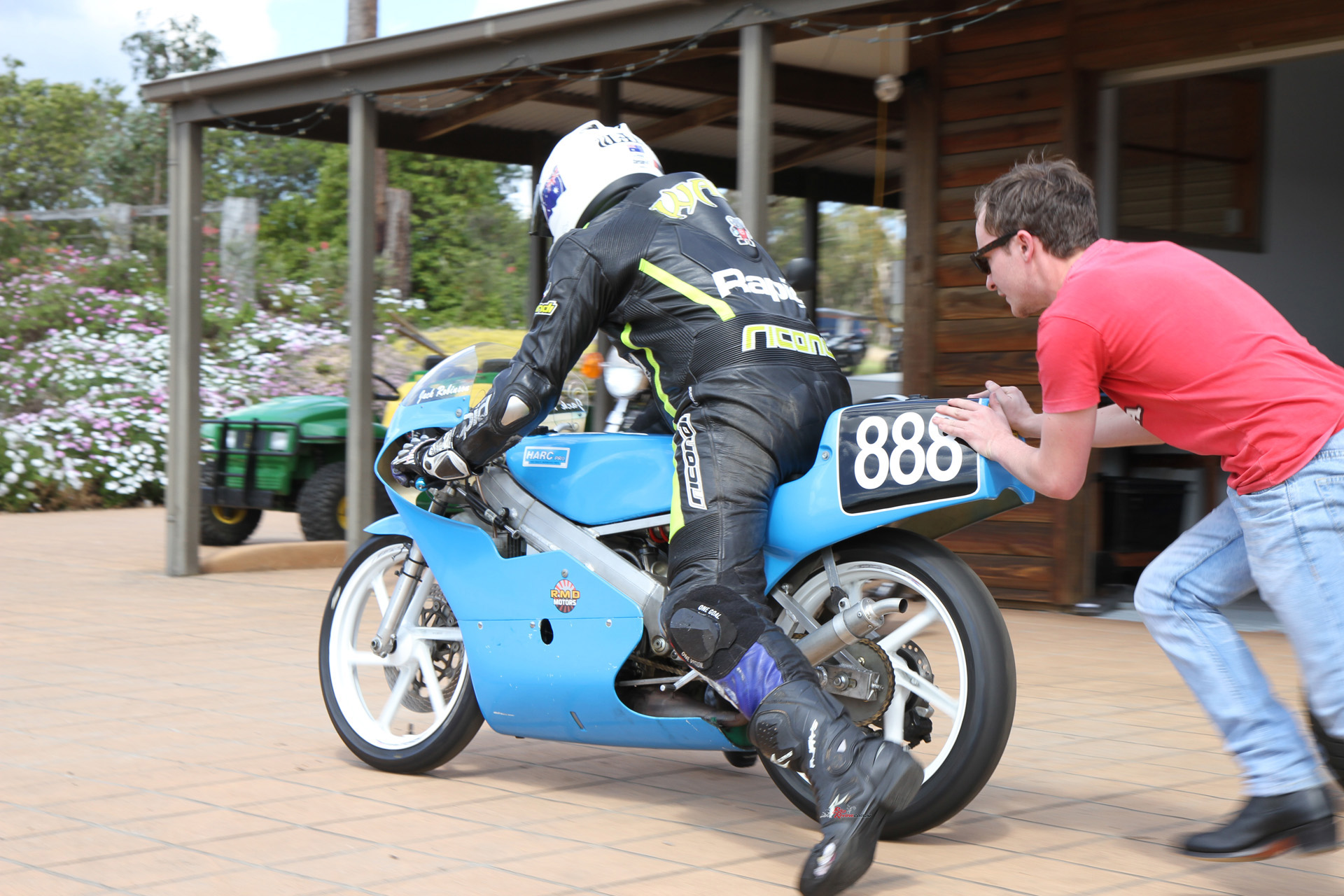
First released in 1980 and developed up until 2011, the RS125R became the weapon of choice for aspiring world champions throughout the 1980s, ’90s and 2000s. The 1989 model sat at the beginning of Honda’s true customer-racer era, when privateers could finally buy a machine not far removed from the works bikes of Ezio Gianola or Àlex Crivillé…
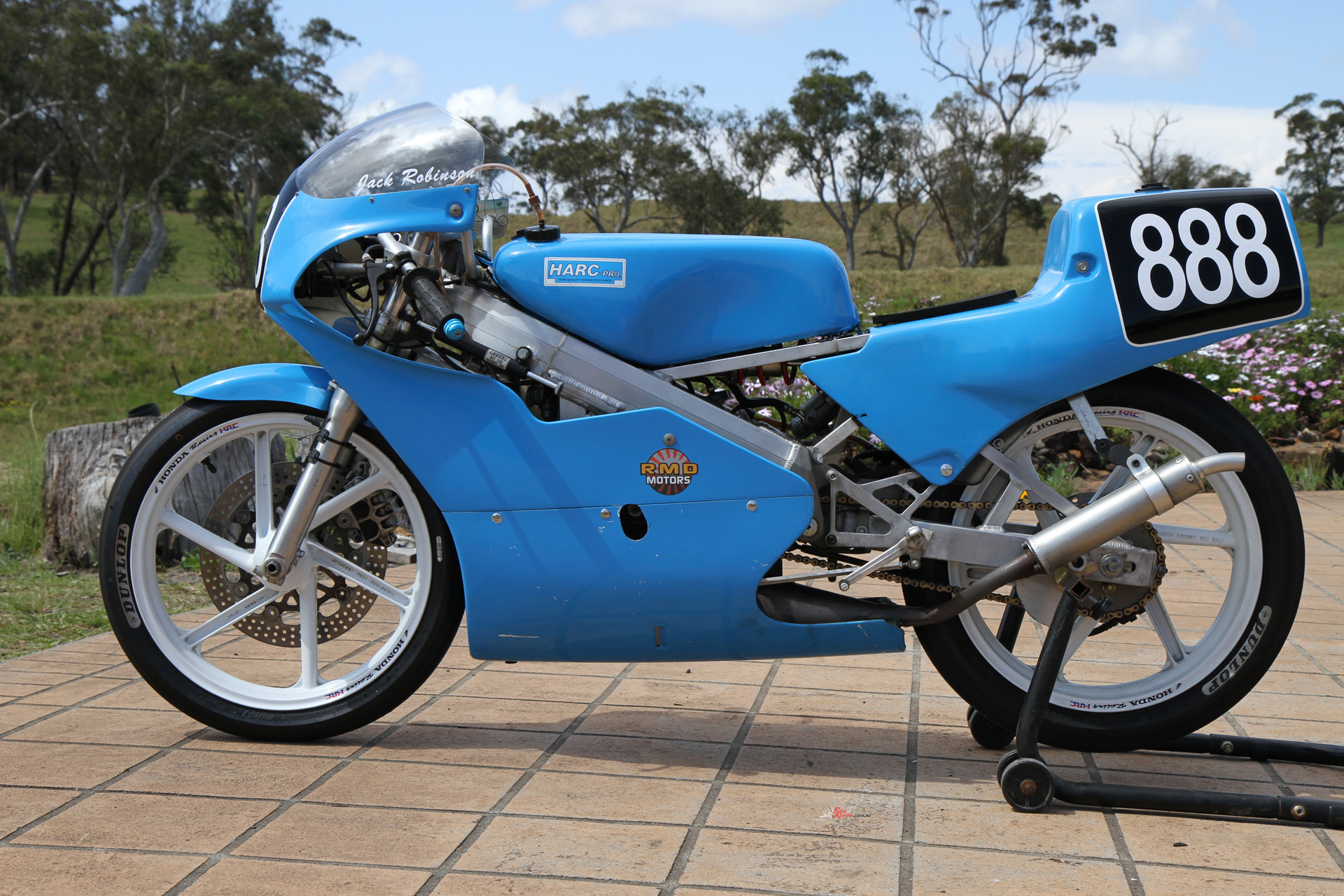
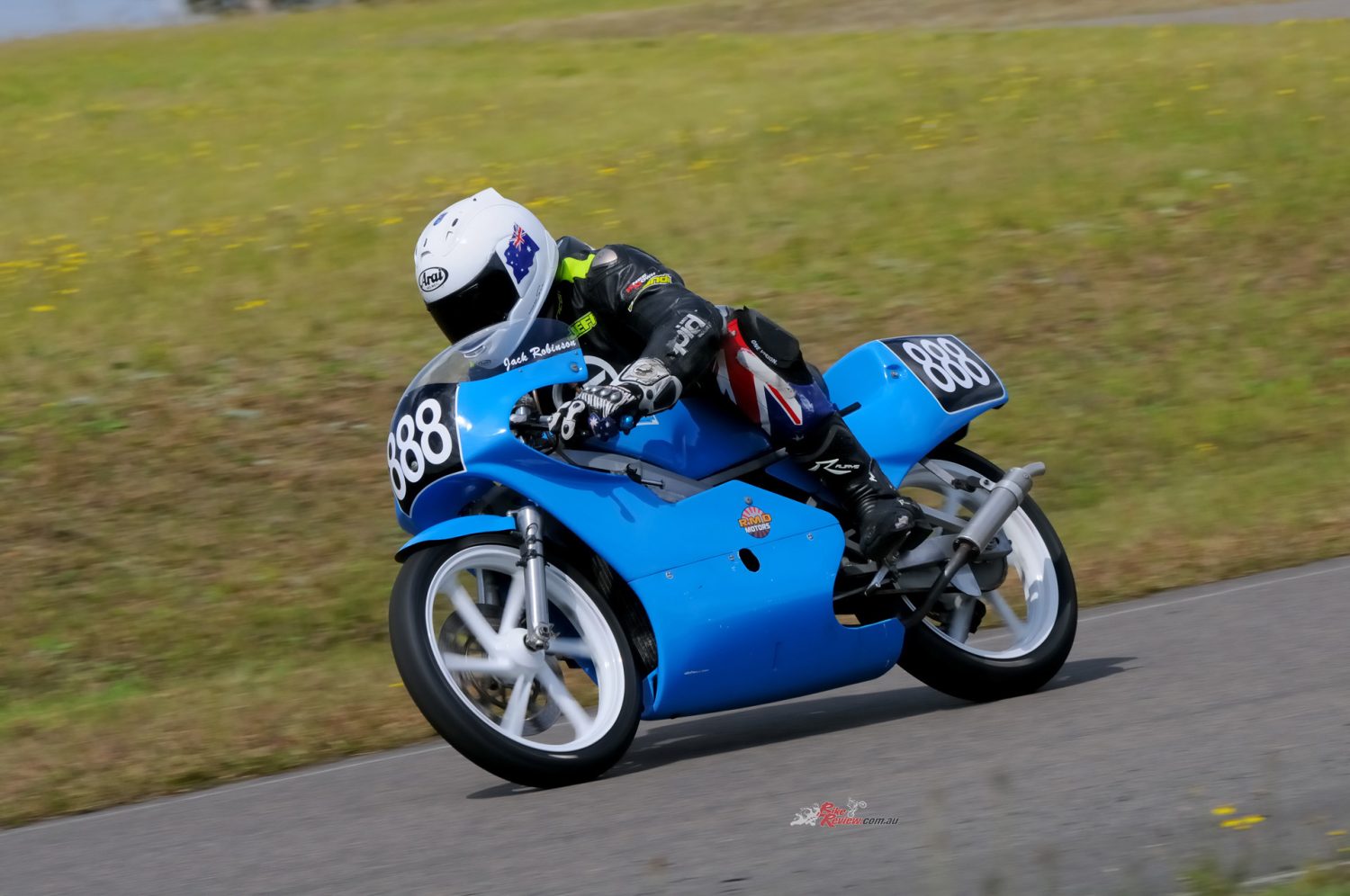
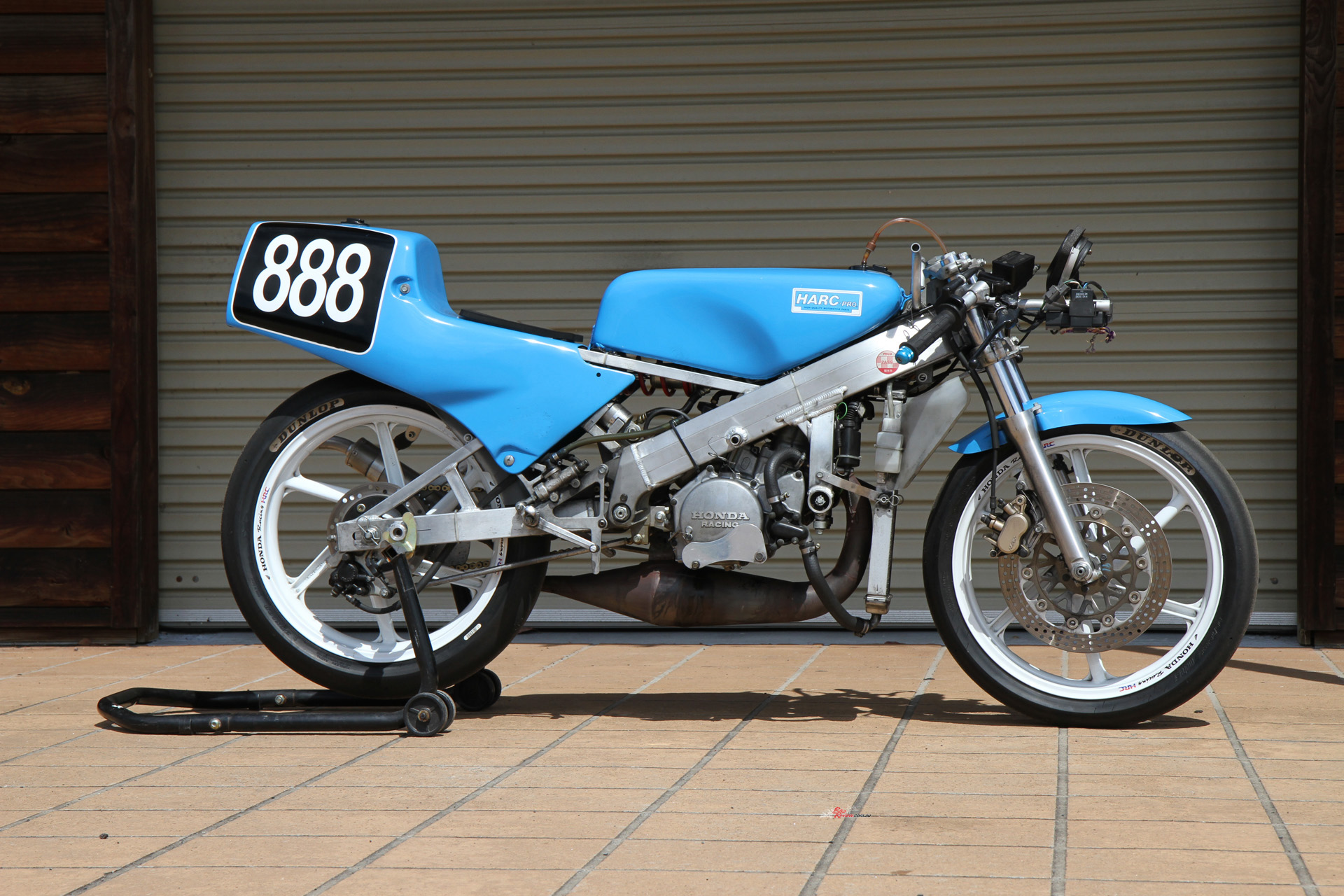
17in wheels front and rear on Jack’s RS, and his 888 race number. It’s quite a long reach to the tiny bars.
By then the RS125R was pumping out around 43hp from its liquid-cooled single, screaming to 14,000rpm and featuring a close-ratio a six-speed gearbox. The bike weighed just over 70kg ready to race. It was a scalpel, designed for one thing only, win, and survive the merciless grind of Grand Prix racing in the two-stroke era… Riders like Loris Capirossi, Dani Pedrosa and Andrea Dovizioso all learned their craft on RS125s before conquering the world stage. Peter Galvin won no fewer than 7 Australian Championships on the RS125R. I tested his 2007 RS125R, so will run that in the future.
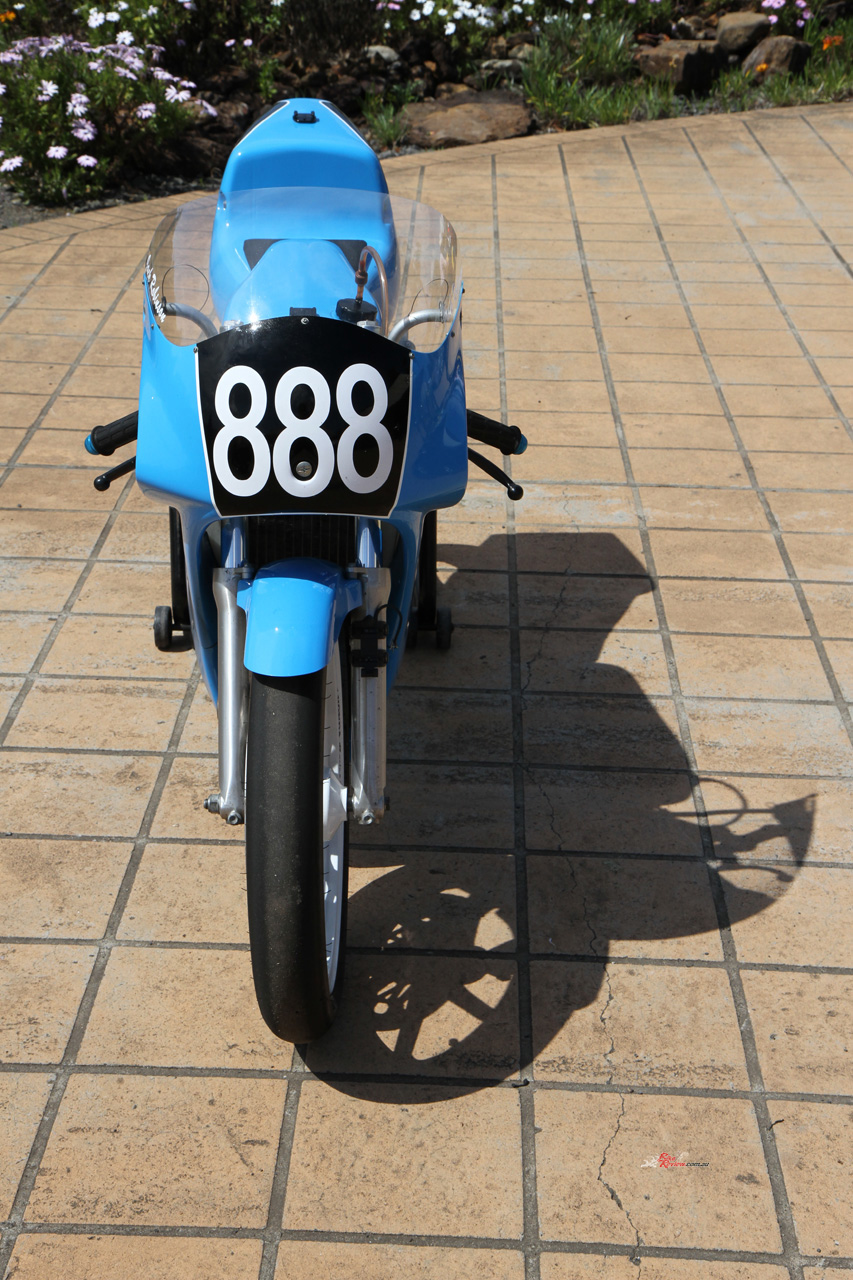
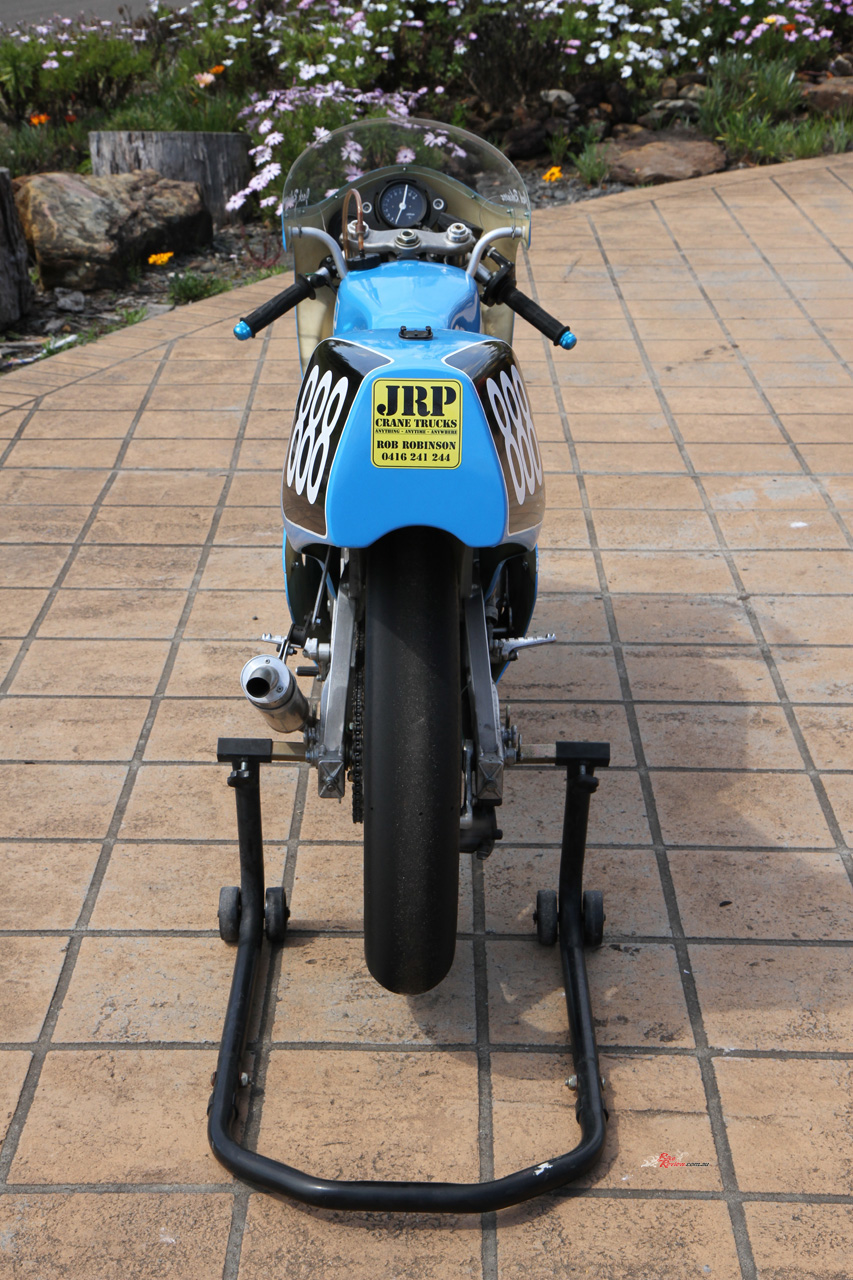
And then there’s HARC-Pro. A name revered in Japan, this team and tuning house became synonymous with Honda’s lightweight racing projects. Founded in the 1970s by Shigeki Honda, HARC-Pro has built a reputation for nurturing young riders and extracting every last ounce of performance from Honda machinery. They went on to prepare championship-winning bikes in All-Japan series, the Suzuka 8 Hours, and even Moto2, but their roots were deep in small-capacity racing. Seeing the HARC-Pro sticker on the blue fairing of Jack’s RS125 only reinforced the sense of authenticity; this was no backyard special, but a genuine piece of Honda racing heritage.
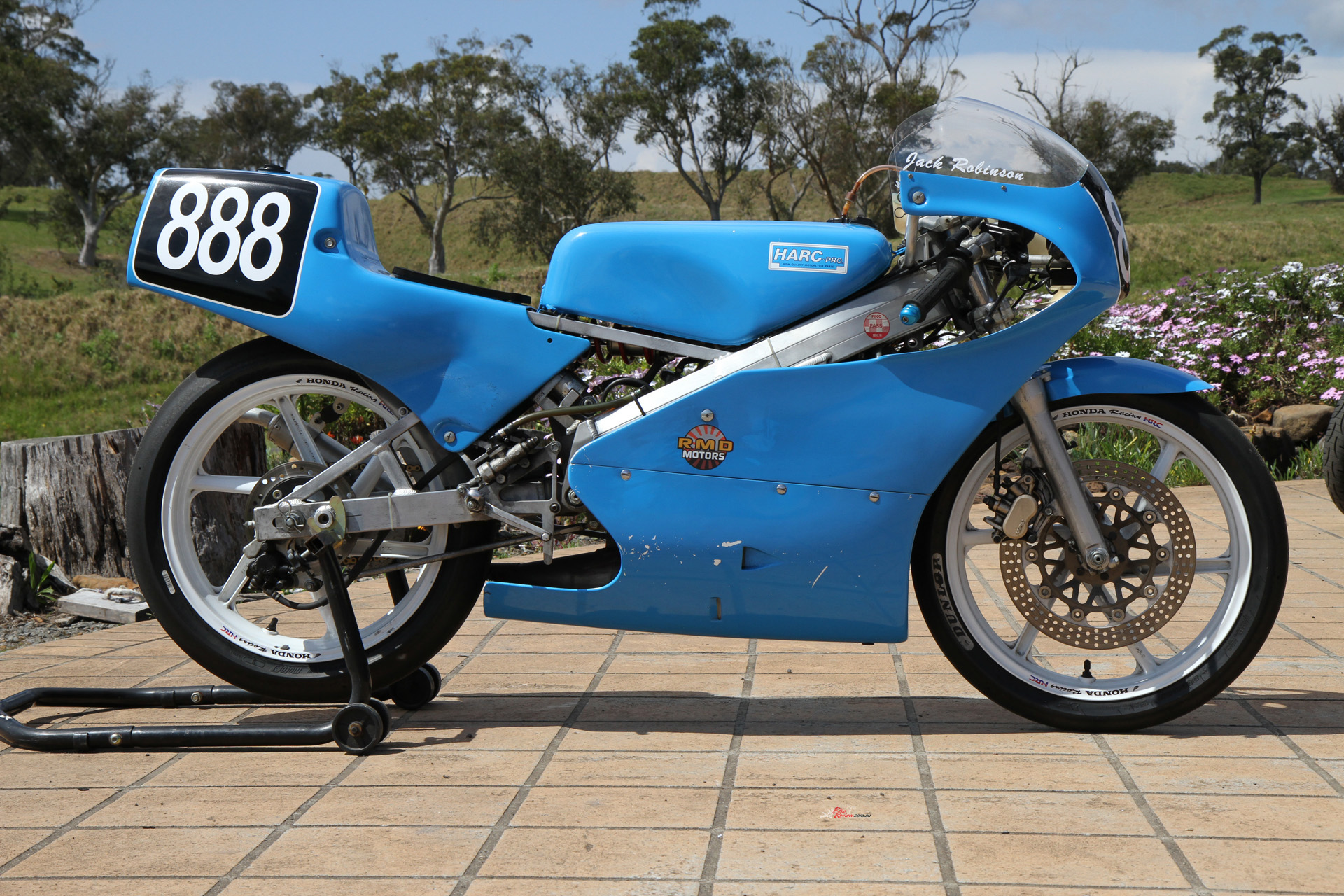
The RS has won more GP races, plus world and domestic titles than just about any bike in history.
Getting on the bike for the first time was an exercise in awkwardness. Jack rolled it off the stand, I swung a leg over and immediately realised I was perched on something that felt slightly, err, too small for me. How I wish I was that 60kg 250 racer from the 1990s I once was…
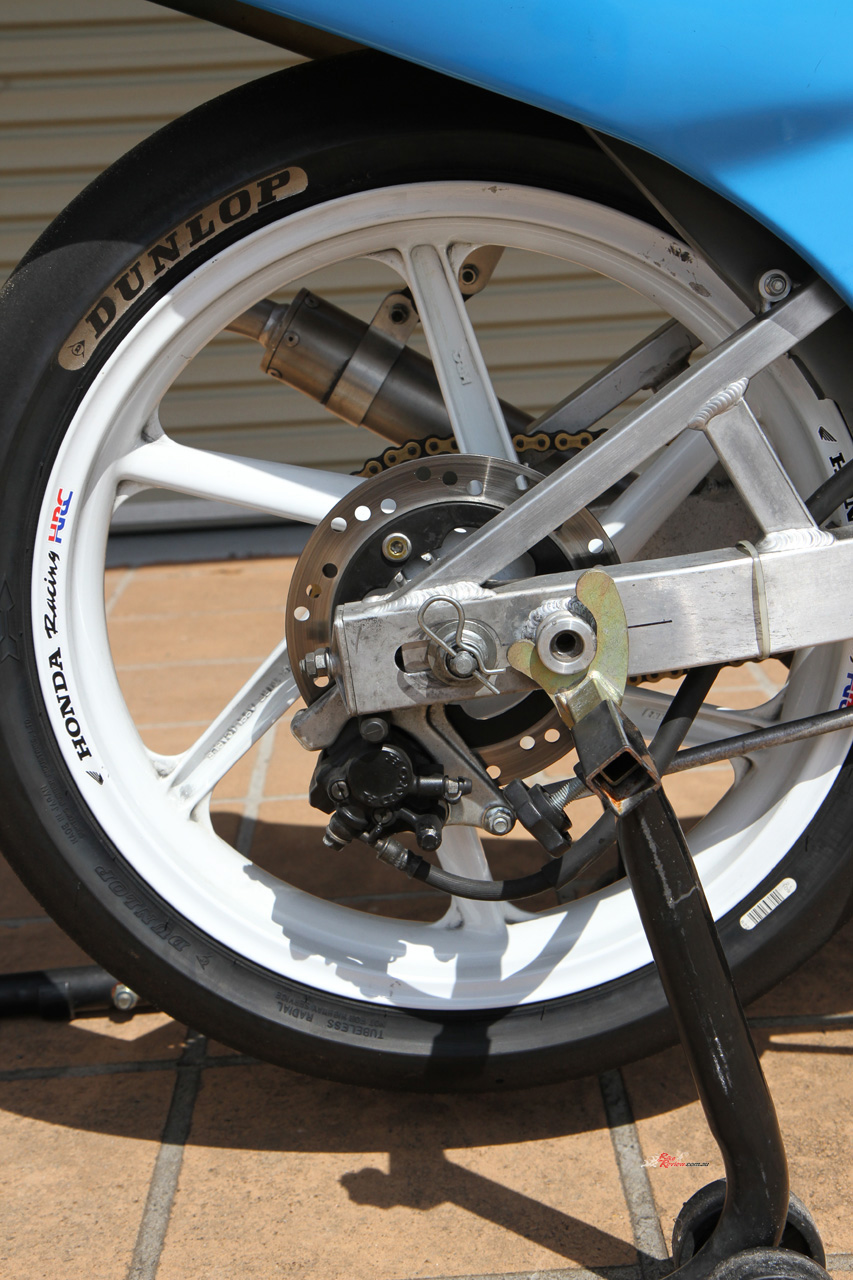
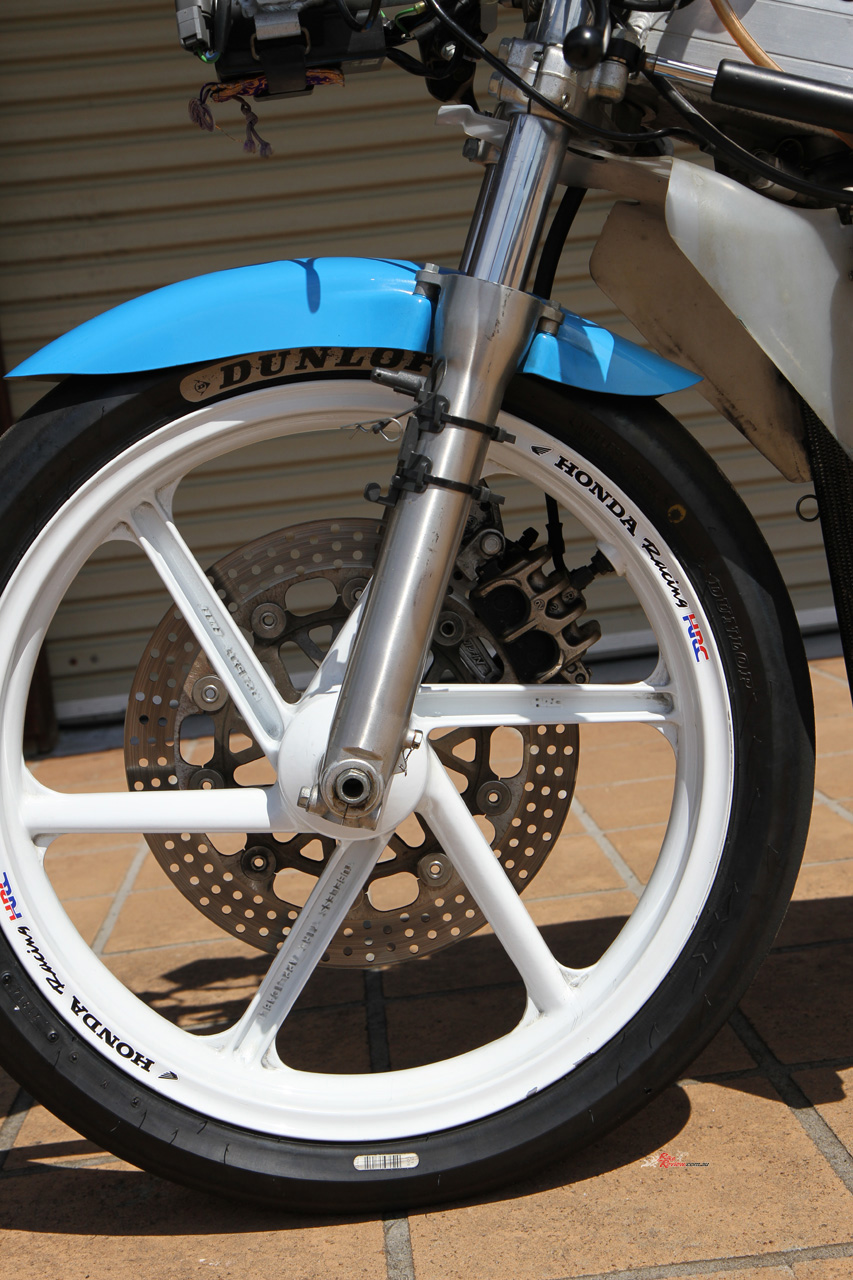
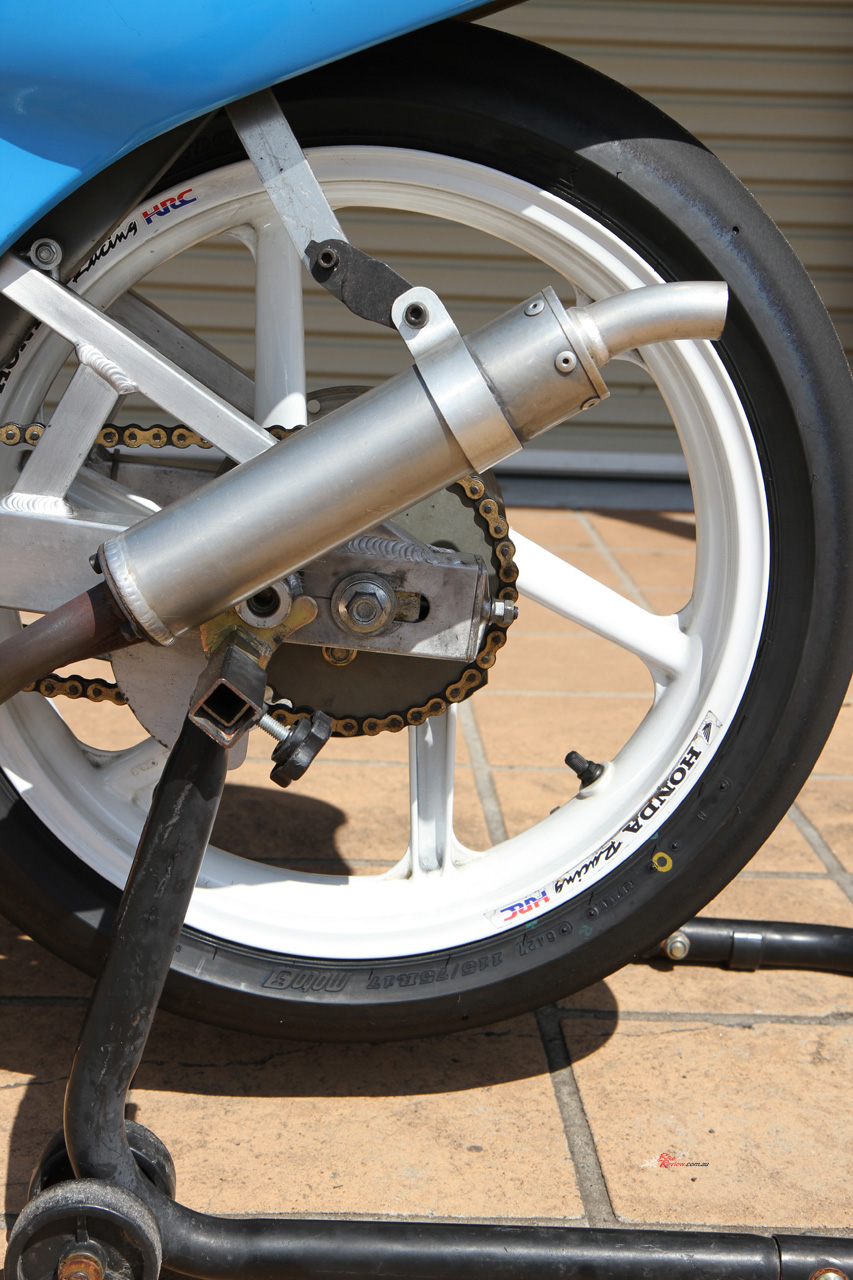
The RS125R is built for riders who are practically jockey-sized, and it demands total submission to its compact ergonomics. But somehow, even for my 187cm, it all felt OK and I managed to make myself fit into this stunning piece of history, thankfully!
Jack gave me a push start and the little two-stroke barked into life, fuelled by a Keihin carb belching Elf race juice. The clutch lever felt like it belonged on a BMX, the throttle snapped open with no resistance, and within seconds the RS125R was snarling down pit lane, eager to run.
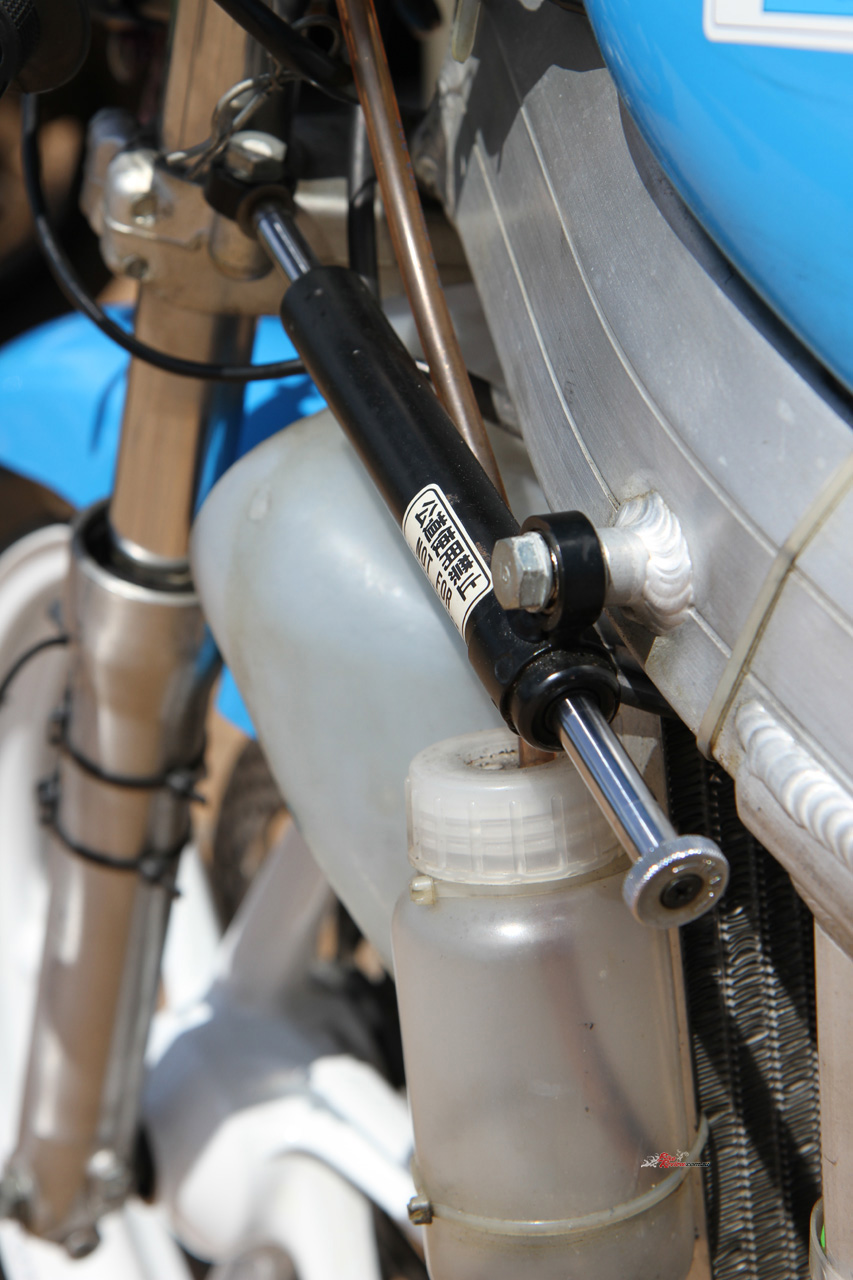
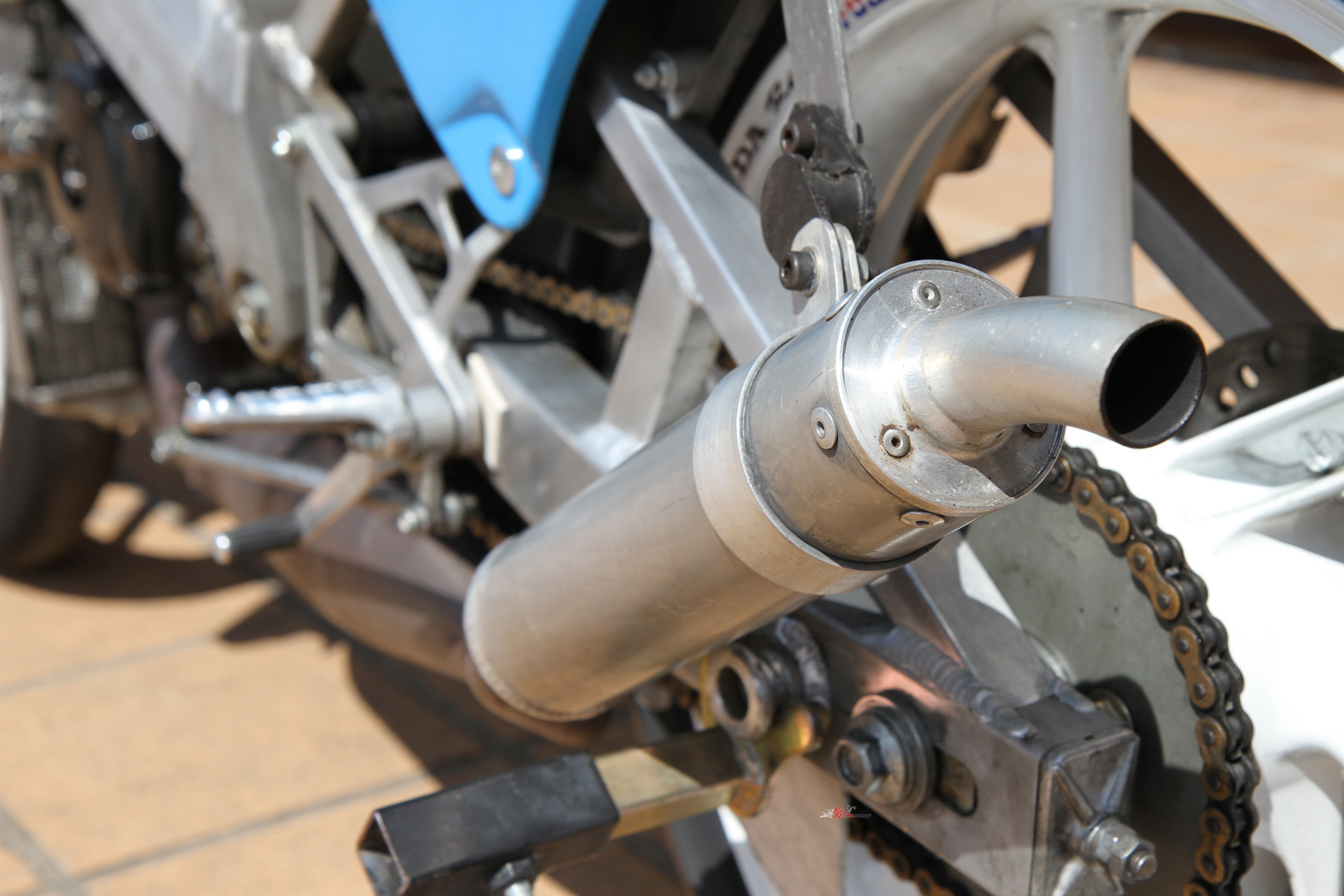
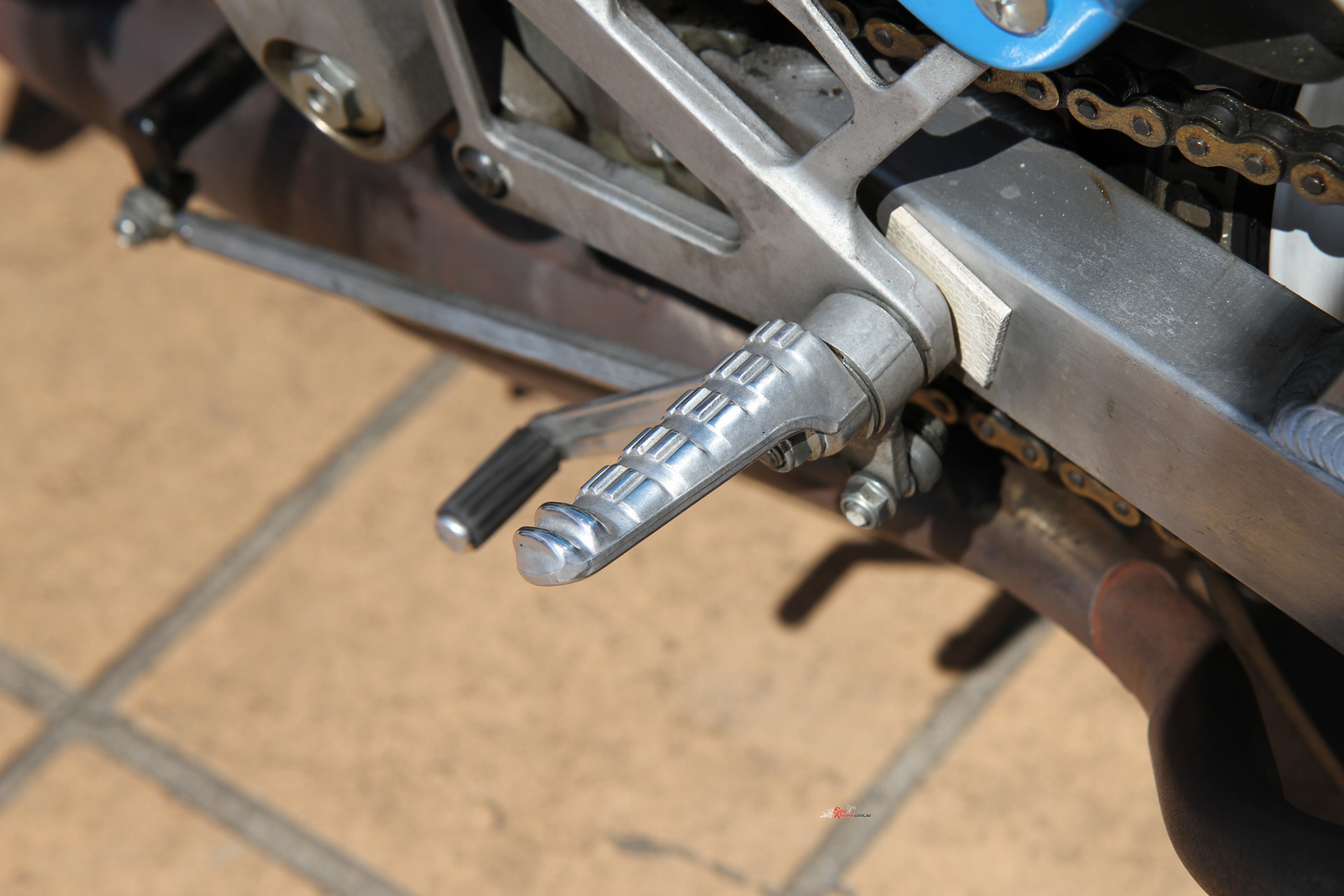
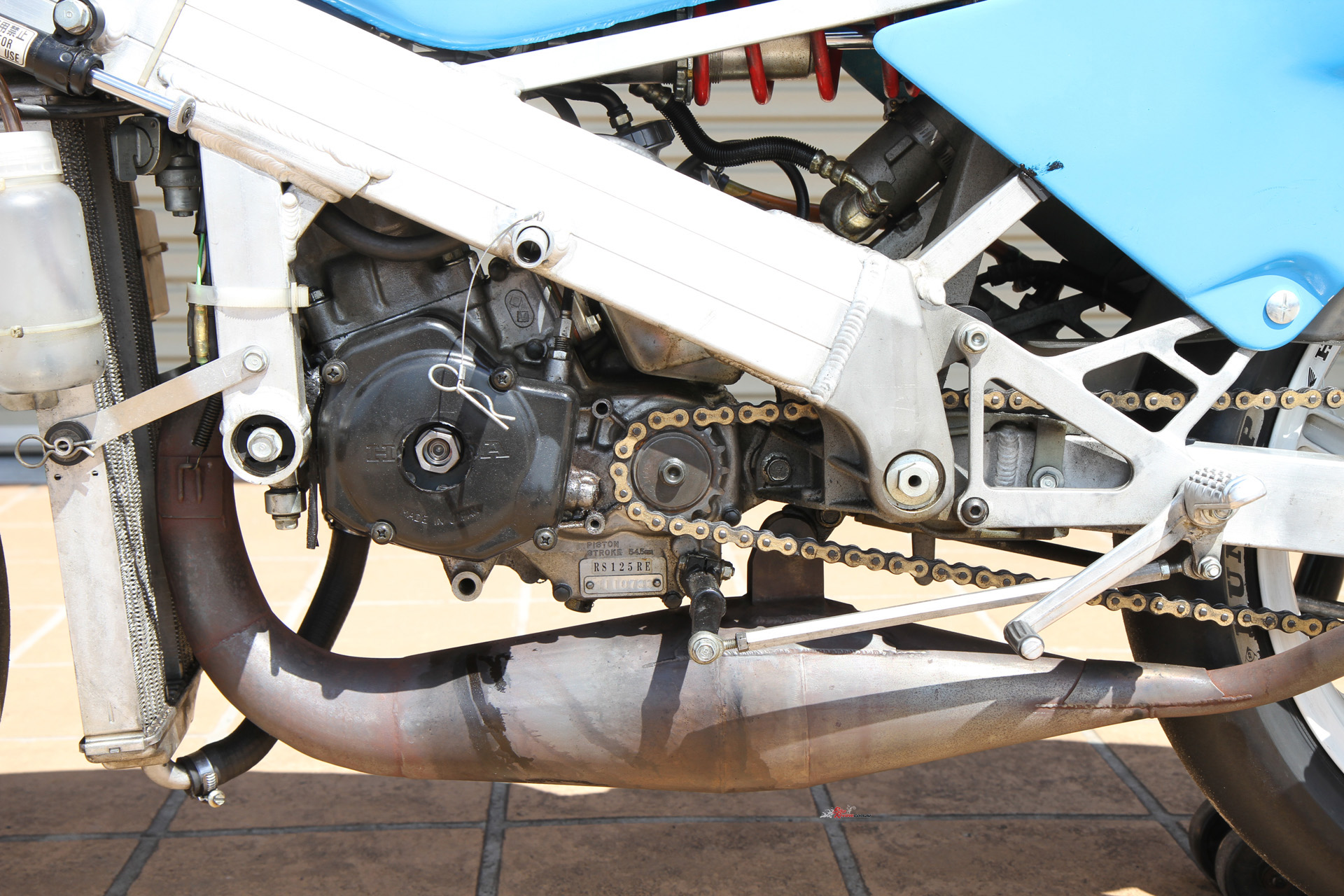
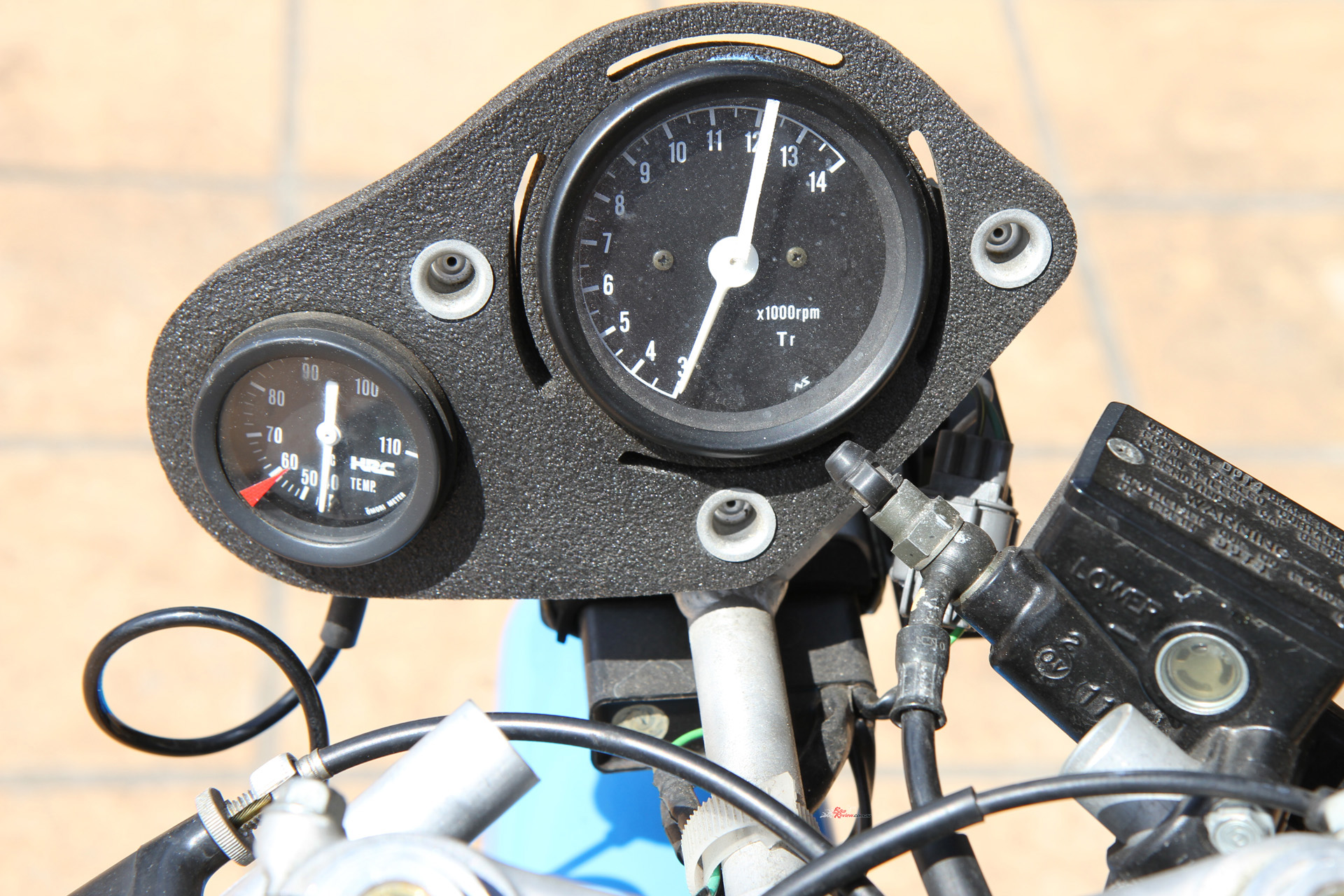
The first lap was reconnaissance. As mentioned I had tested a later RS125R back in 2007, but this was a different animal. Older, rawer, peakier. The engine pulled savagely once it came on the pipe, revving cleanly to 12,000pm. It would spin harder, but the thought of scattering a crank across the tarmac kept me shifting just before the white mark Jack had on the tacho. I can imagine parts are difficult to find, given my own issues finding spares for my old Yamaha TZ2505KE.
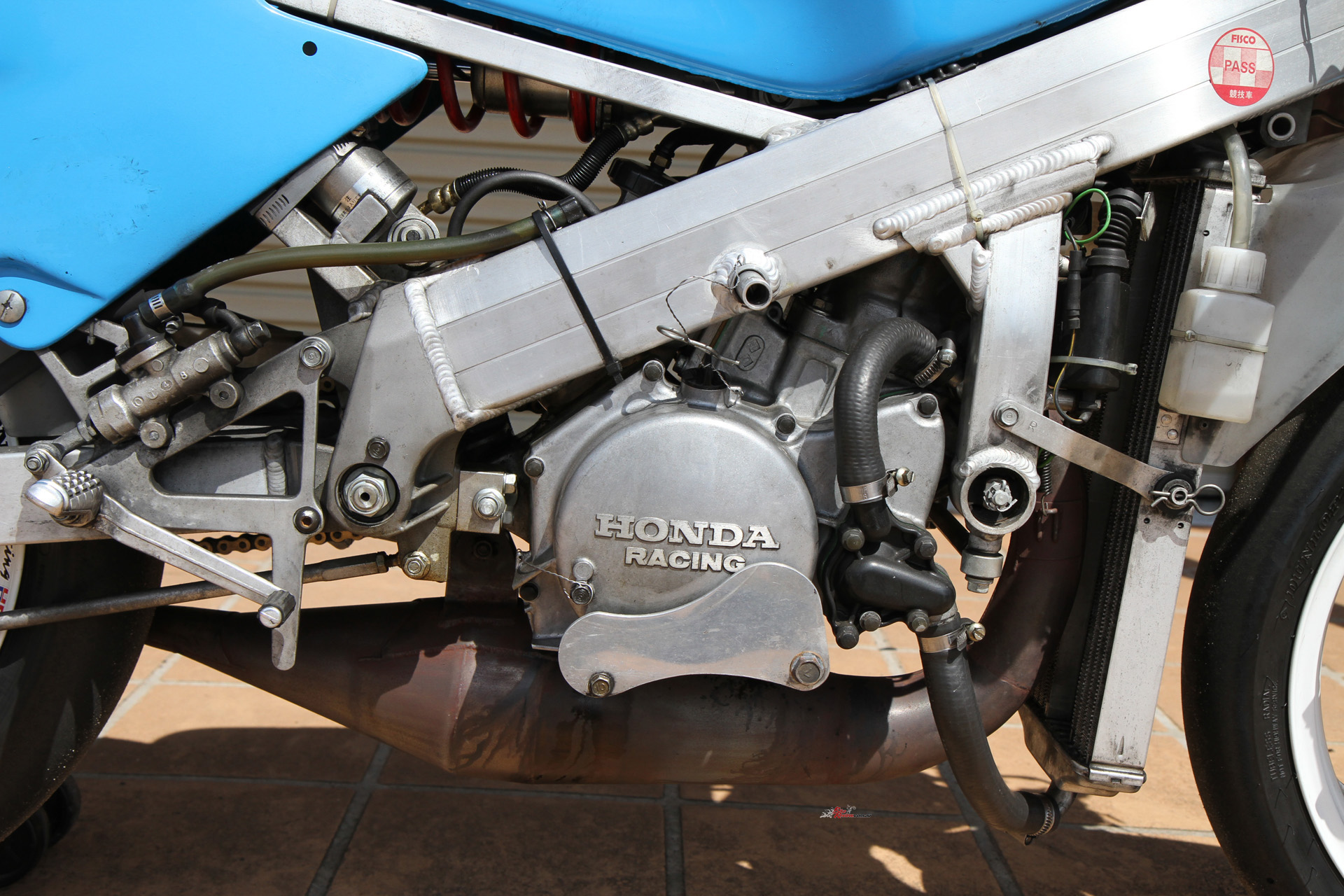
Jetted right and maintained by the book, the RS125 engines are pretty bullet-proof for a GP bike, which made them popular for privateers from 1988 onwards.
Tucked in as tightly as I could manage, the bike howled down The Farm’s chute. My visor vibrated against the screen, eyes glued to the tach and temp gauge, preparing for turn one. I tried holding it pinned in top but chickened out, rolling to fourth on entry.
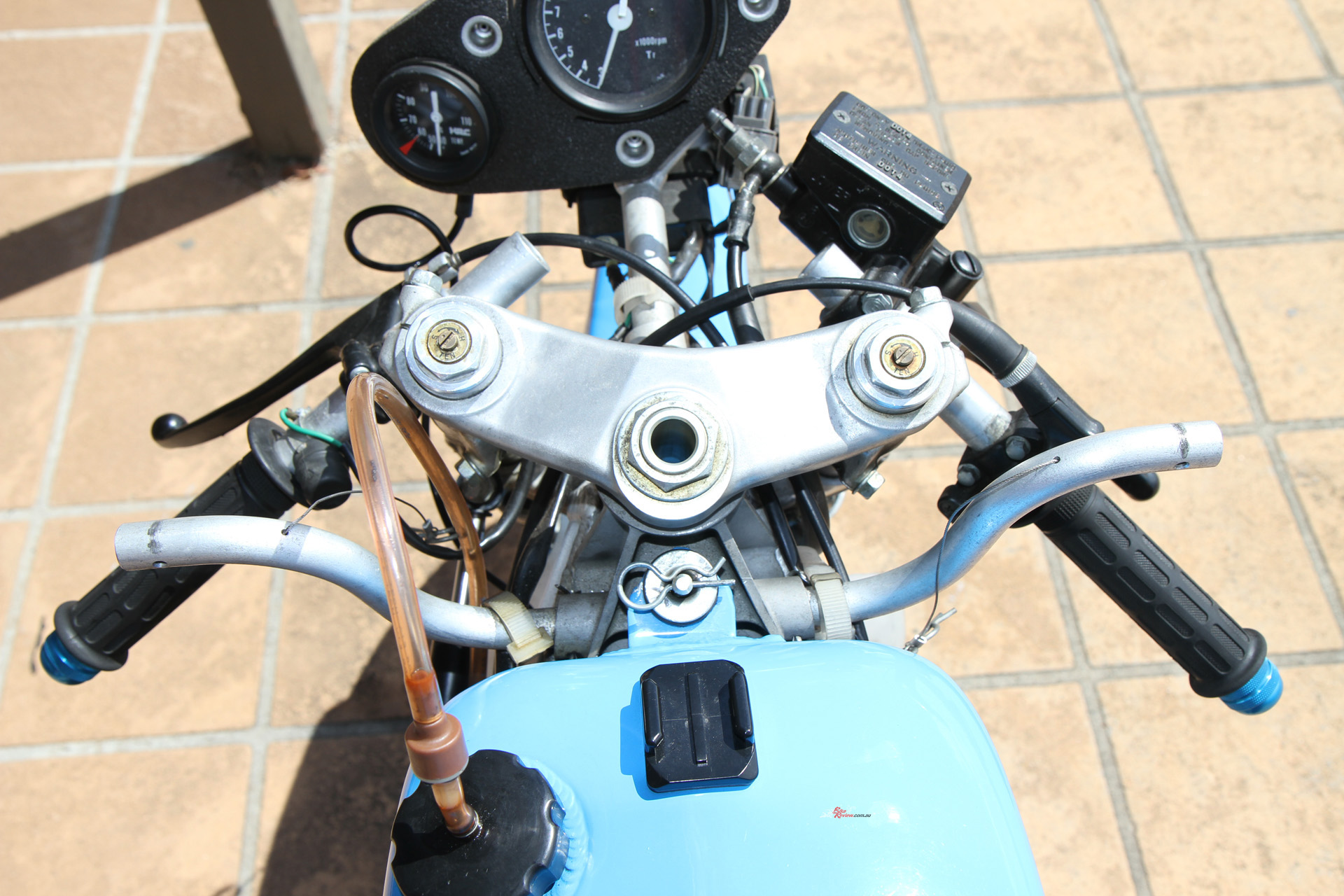
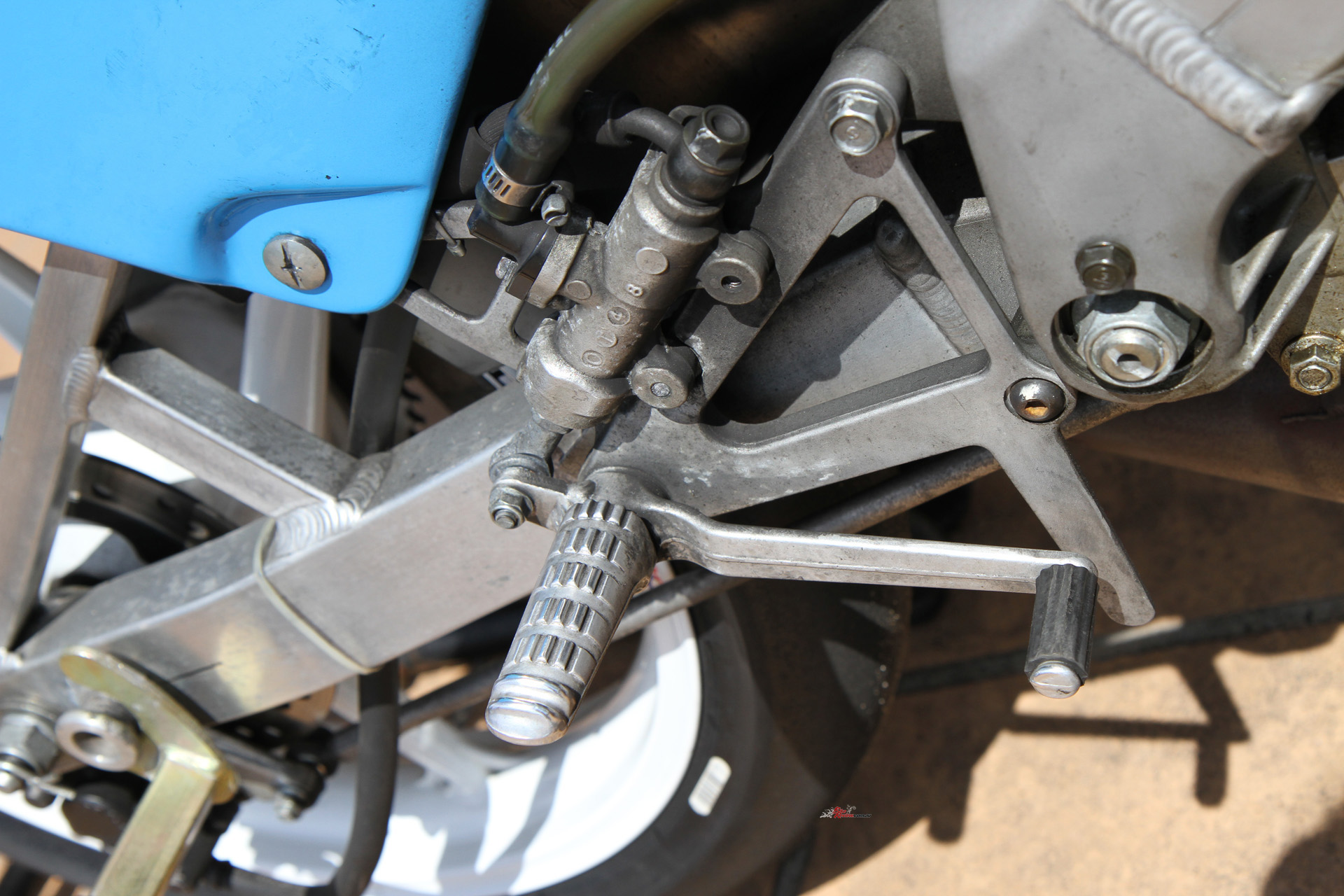
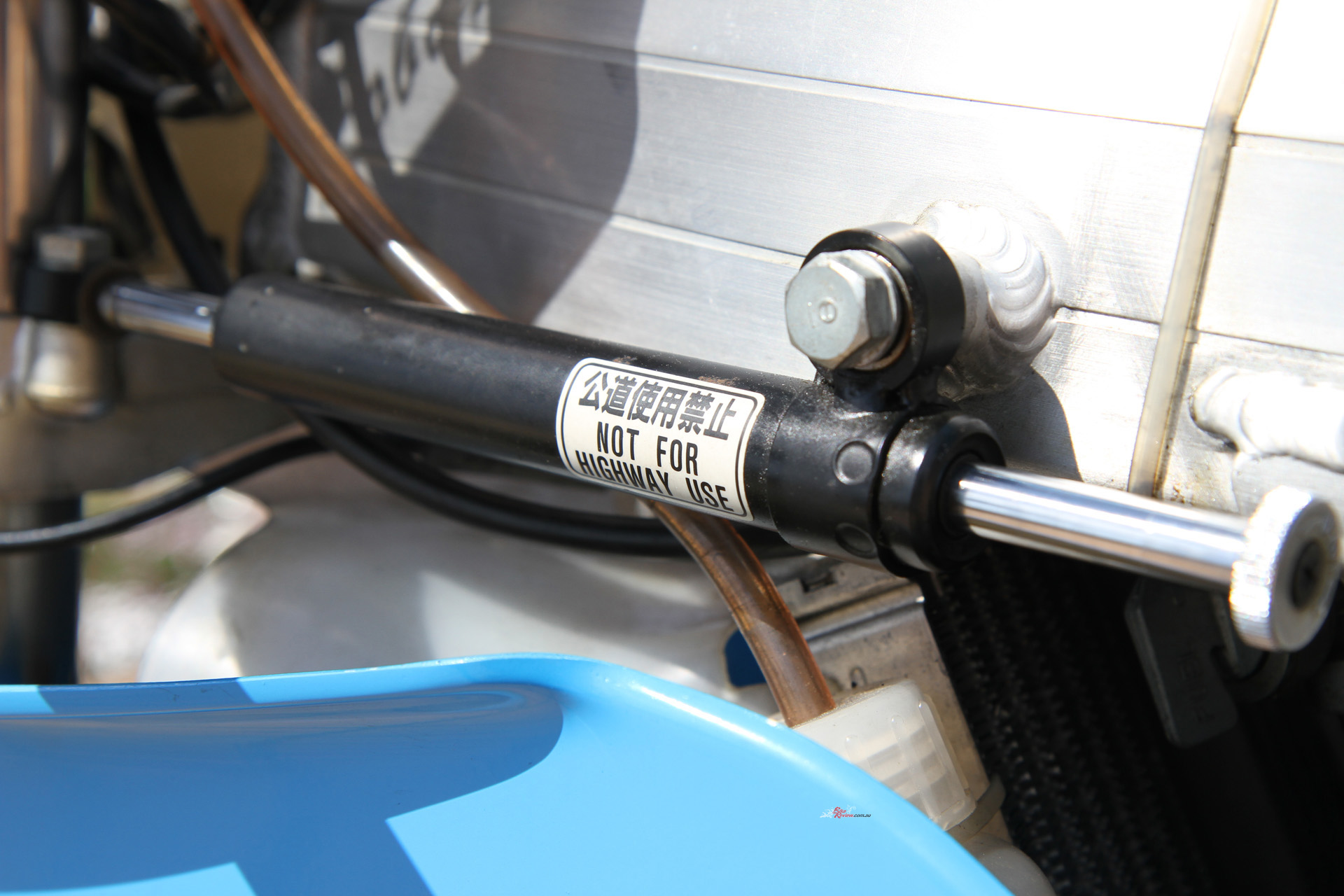
Even so, the RS carried mind-bending corner speed and pulled out of the turn with admirable speed given my weight, slight misjudgement of revs, and the incline. The steering was lightning quick, the little tyres clung on like suction cups, and braking for the following left-hand hairpin, soft at the lever, brutal in effect and nearly popped my eyeballs into the visor. On any other bike I’d have been picking gravel out of my ears. On this thing, I was perfectly in line and already thinking I could have gone faster.
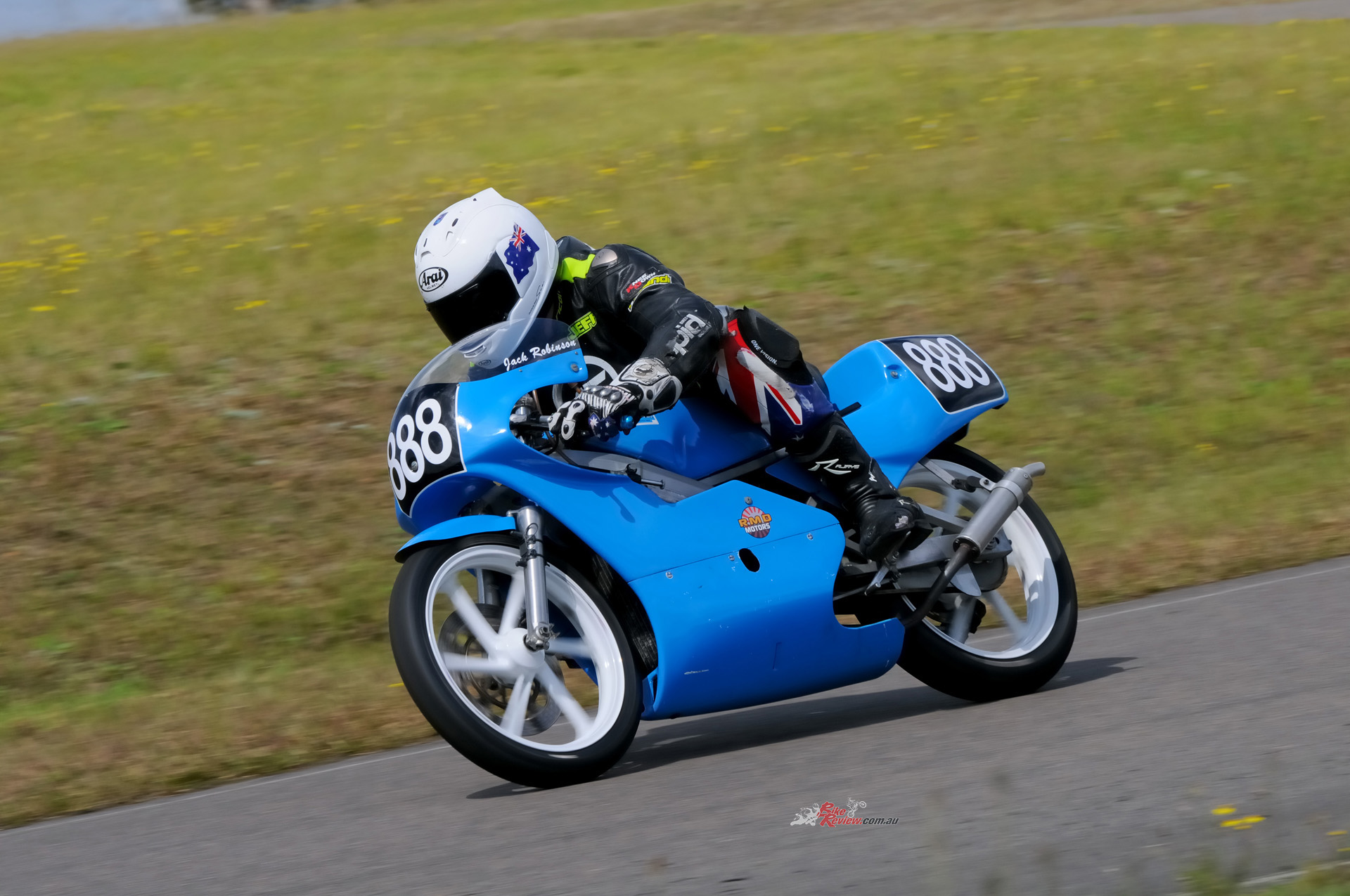
17in wheels front and rear on Jack’s RS, and his 888 race number. It’s quite a long reach to the tiny bars.
That’s the trap with a 125 GP bike. The more you commit, the more it gives. It laughs at your timidness, begs you to squeeze every last rpm. Forget to drop that one extra gear, or roll the throttle a fraction early, and it falls flat. Nail the rhythm and it becomes an extension of your nervous system.
“This wasn’t just a motorcycle test. It was a reunion with a slice of Honda’s Grand Prix history”.
I strung a few laps together and finally let it all hang out. Wide-open throttle everywhere, brushing the brakes, carrying absurd lean angles. I came over the hill into turn eight flat, downhill, off camber and the RS didn’t flinch. It was on rails, the suspension loaded and light all at once, the bike almost felt telepathic. Keep it boiling, keep it screaming… amazing for a bike a quarter of a century old but with 19-years of development in its DNA by 1989, and we know HRC do not do things in halves…
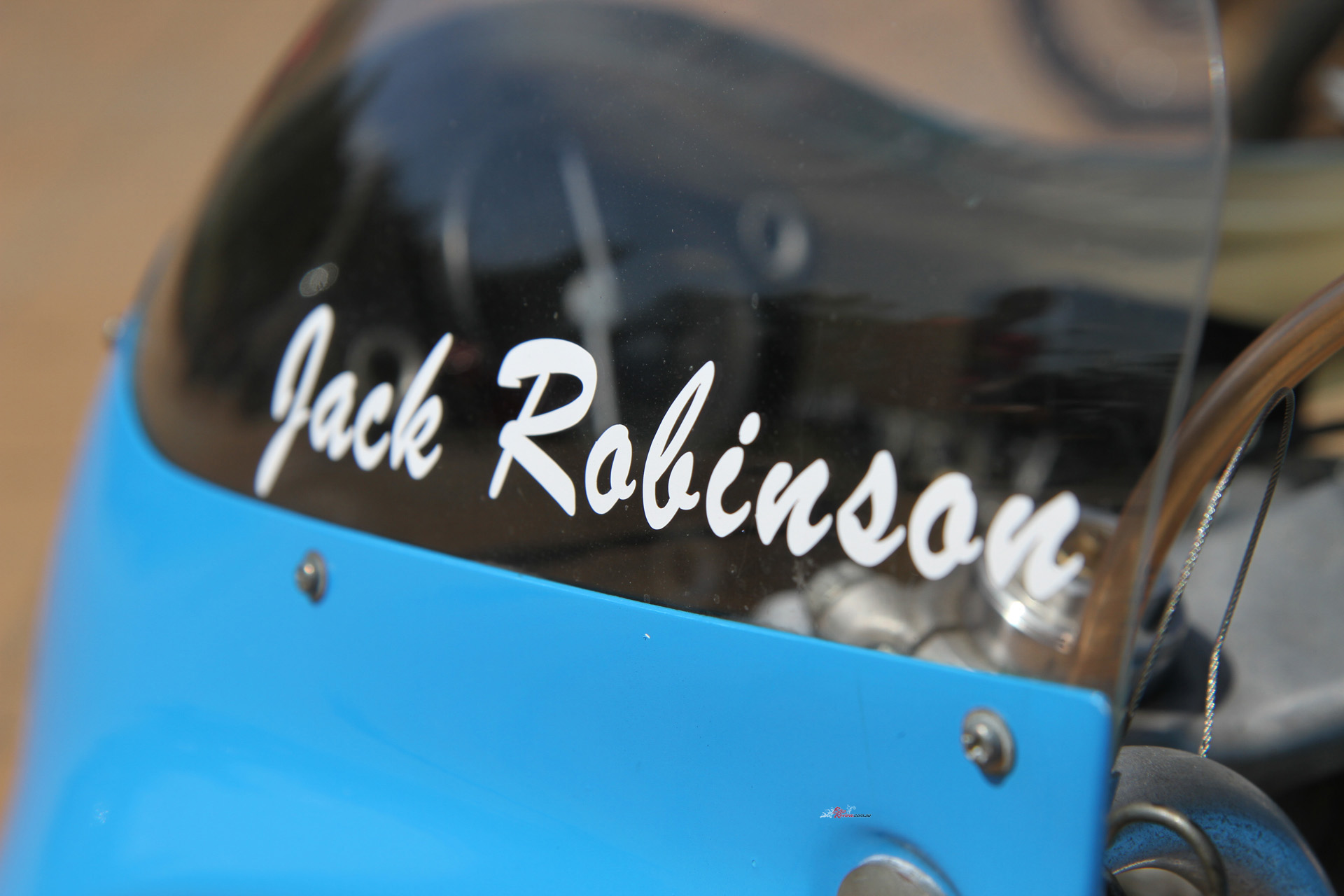
Jack Robinson raced this bike around a decade back with great success here in Australia
Top speed? Maybe 170km/h at The Farm. But at that pace, head down behind the bubble, the RS125R felt every bit as wild as a litre-bike doing 250km/h. Turn one, a fast kink followed by a fast right hander, became a vortex, sucking me in as the chassis carved a perfect line, the engine singing on song. The 1989 RS letting me get away with clumsy shifts, poor lines and, well, dealing with my size. I can only imagine how good the bike is with a lightweight rider such as Jack. Surprisingly, the RS is stable, on the brakes and on hard acceleration, and there is a huge amount of feel that comes through to those tiny clip-ons. It feels like you are holding the front axle directly, just stunning.
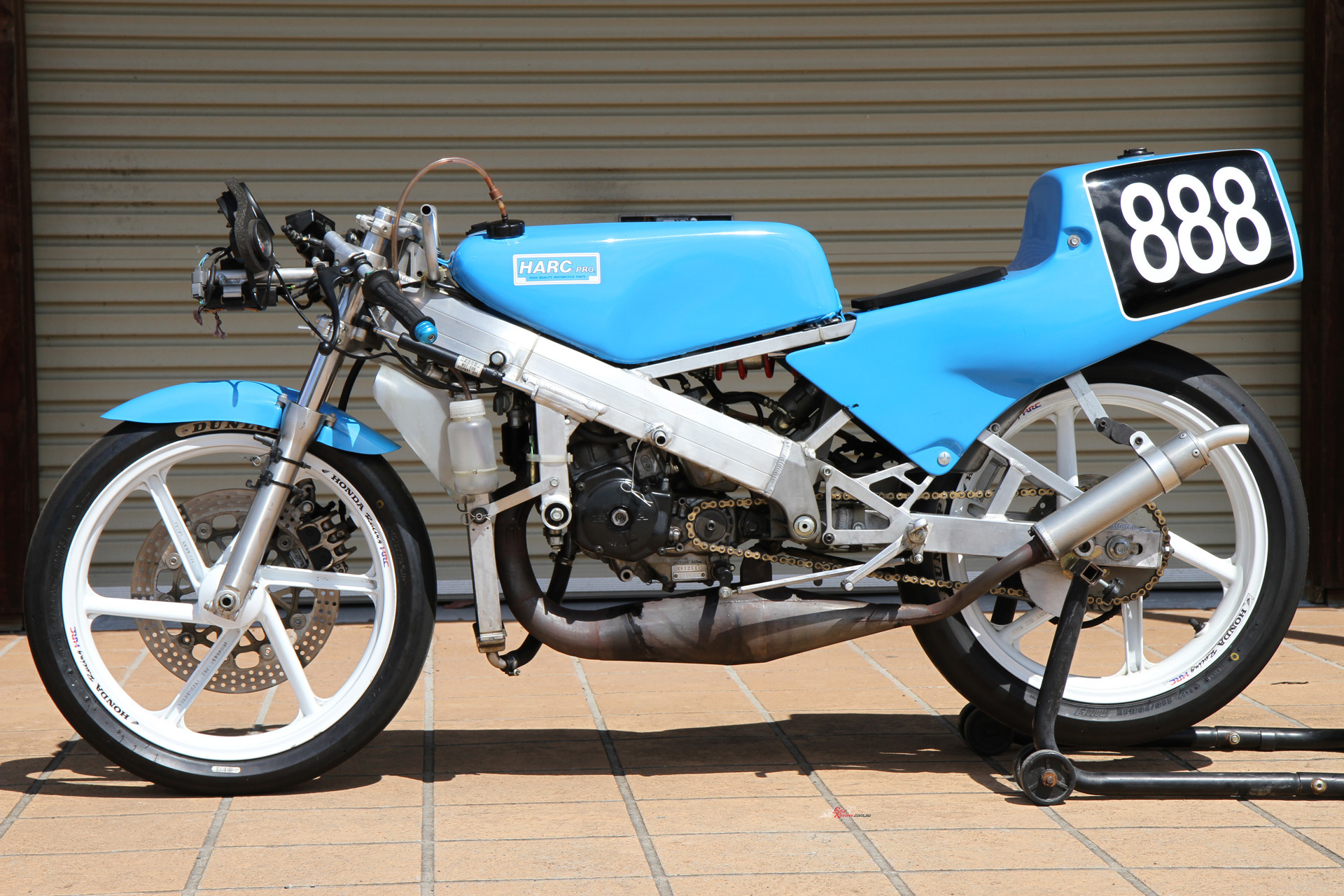
Large alloy fuel tank, Harc Pro expansion chamber.
Eight laps later, I rolled into pit lane, took my helmet off, and grinned. Back in 1999, I lived in Japan, doing some riding and working with Moto Bum HRC (who build B kits, and ran the Aoki brothers in GP among many other things), a team that worked closely with HARC-Pro. I saw countless RS125s being built and raced domestically over there as the GP classes were thriving then, each one a stepping stone for some young hopeful. Riding Jack’s 1989 HARC-Pro machine brought that all flooding back.
This wasn’t just a motorcycle test. It was a reunion with a slice of Honda’s Grand Prix history, a reminder of what it felt like to chase lap times when everything depended on momentum, precision, set-up and a little madness. It was a dream come true, a great experience…
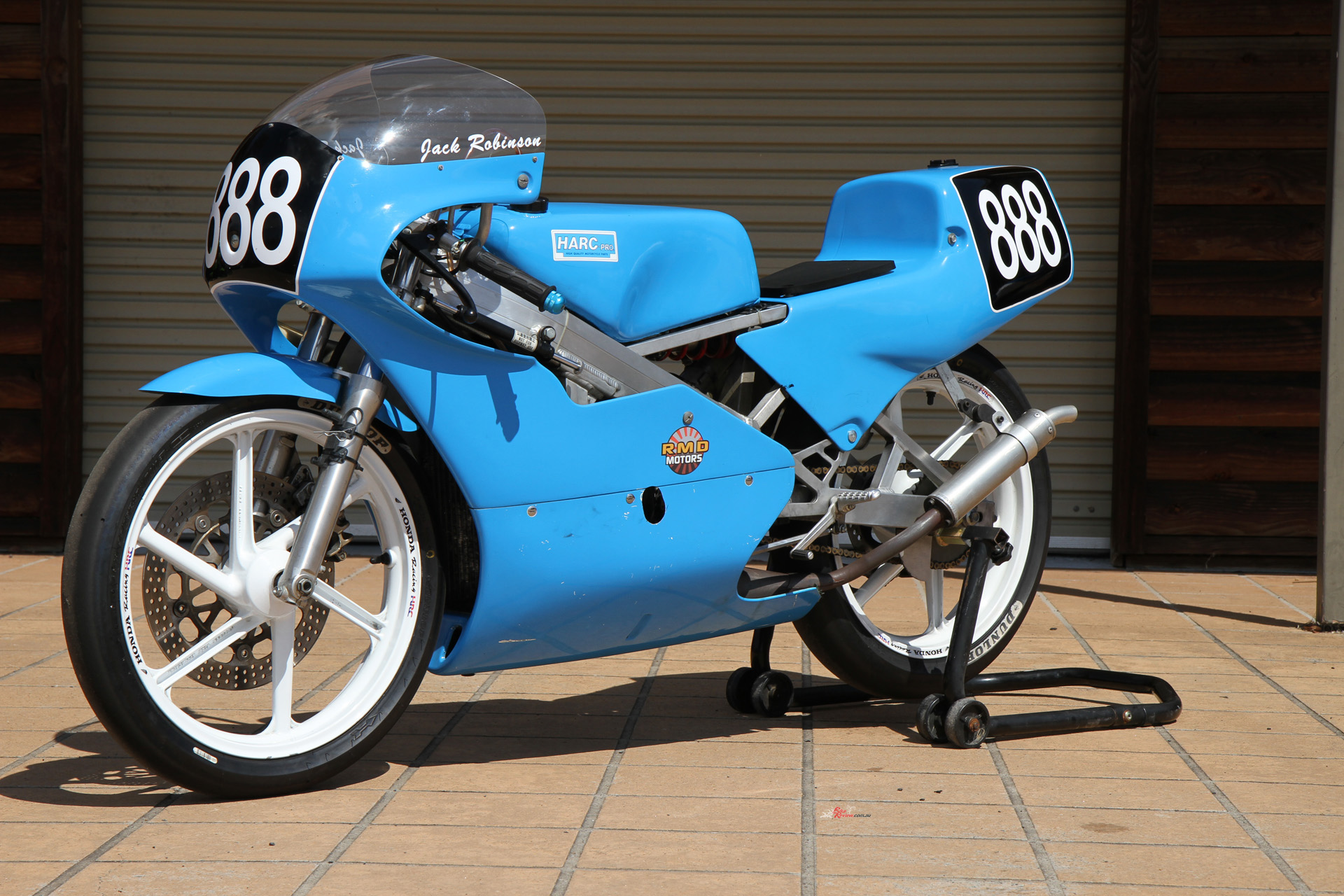
A fantastic looking GP racer.
1989 Honda RS125R NF4 Specifications
Engine: 124.8 cc liquid-cooled two-stroke single, 6-speed constant-mesh, dry clutch, Keihin carburettor, premix race fuel, HRC ECU
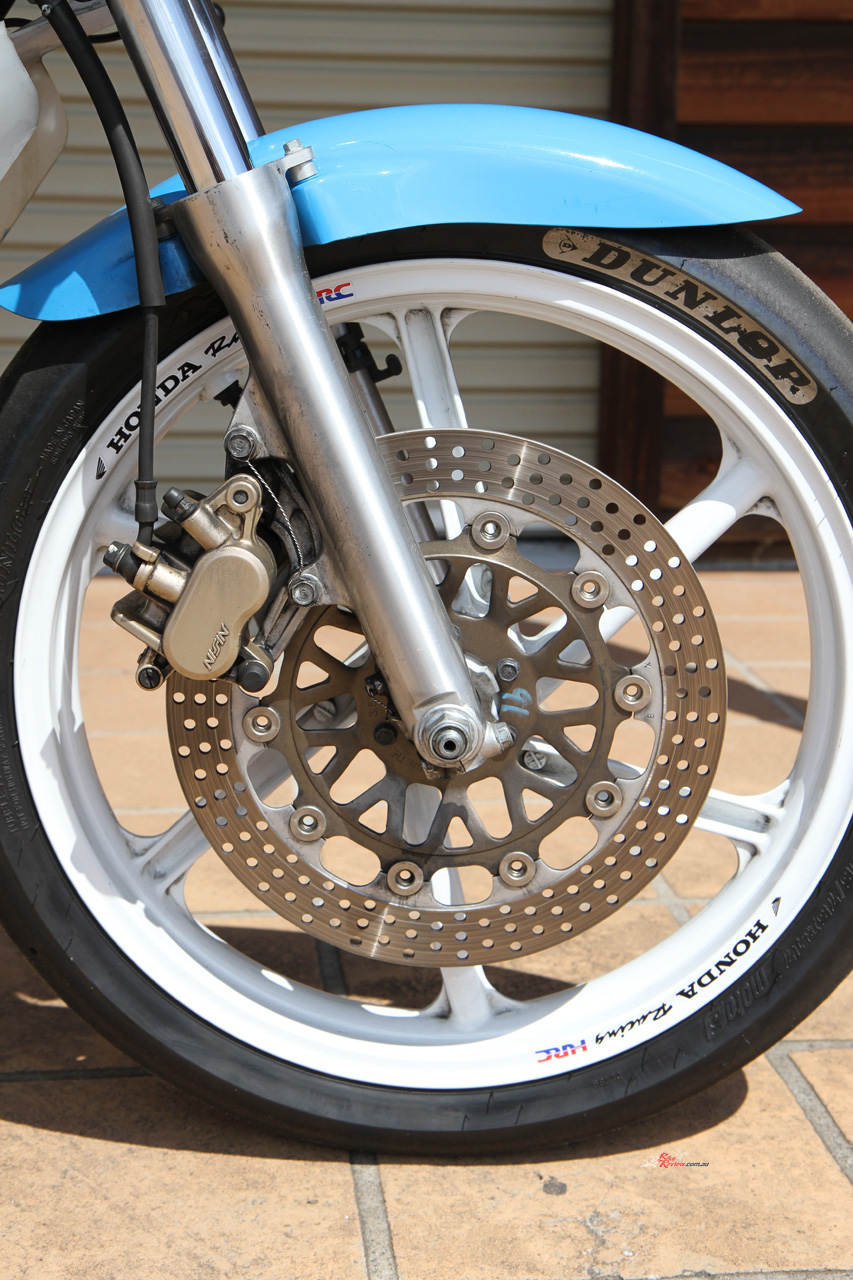
Chassis: Frame: Aluminium twin-tube, box-section swingarm, HRC steering damper, Nissin front and rear disc brakes, SHOWA forks and shock, 18-inch alloy wheels (1990) with Dunlop racing slicks, 1990/1992 model rear seat fairing.
Performance: Power: 43hp@12,250rpm, 72kg (dry), Top Speed: 180 to 190km/h
Owner: Jack Robinson, Australia
The Author

You Might Also Like